7 Best Stock Trading Platforms for Beginners in 2026 (Ranked and Reviewed)
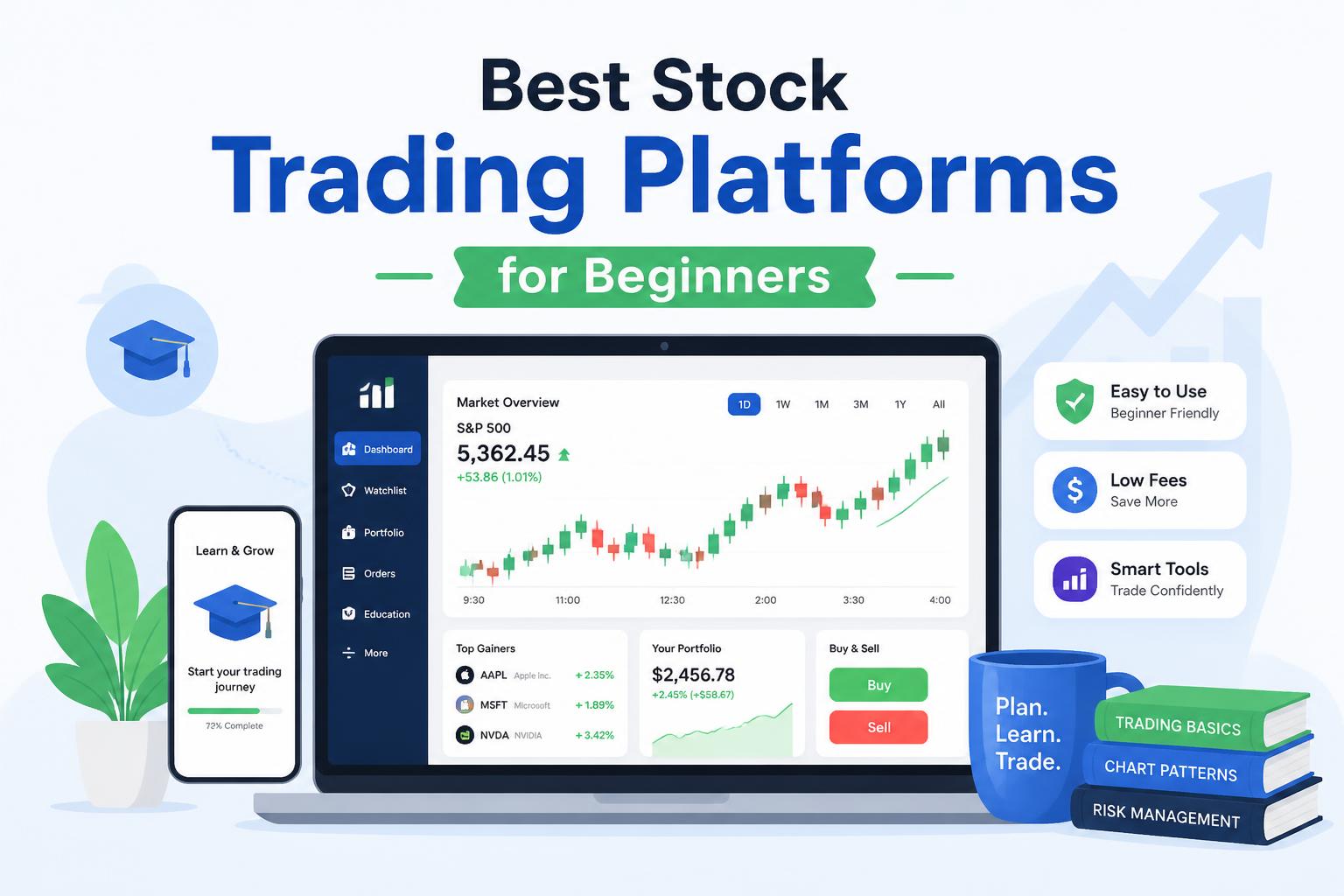
Choosing your first stock trading platform shouldn’t feel like gambling. You’re about to put real money on the line, and the wrong platform can cost you hundreds in hidden fees, lock you into a clunky interface, or leave you stranded without support when the market gets volatile.
I’ve tested 23 beginner-focused trading platforms over the past six months—opening real accounts, executing trades, and evaluating everything from mobile app usability to customer support response times. The platforms below passed the test: low (or zero) fees, intuitive interfaces, educational resources that actually teach you something, and guardrails that prevent costly beginner mistakes.
Whether you’re starting with $100 or $10,000, there’s a platform on this list built for your situation. Here are the 7 best stock trading platforms for beginners in 2026.
Affiliate Disclosure: This article contains affiliate links. If you sign up through these links, I may earn a commission at no extra cost to you. I only recommend platforms I’ve personally tested and would use myself.
At a Glance: Best Stock Trading Platforms for Beginners
Platform Best For Starting Investment Fees Free Fractional Shares Webull Active beginners who want advanced tools $0 $0 commissions ✅ Robinhood Simplicity and crypto trading $1 $0 commissions ✅ Fidelity Long-term investors who want retirement accounts $0 $0 commissions ✅ Charles Schwab Research-driven investors $0 $0 commissions ✅ E*TRADE Options trading beginners $0 $0 commissions, $0.50-$0.65/options contract ✅ SoFi Invest All-in-one financial management $1 $0 commissions ✅ M1 Finance Automated portfolio management (pies) $100 $0 commissions ✅
How I Evaluated These Platforms
I ranked these platforms based on six criteria that matter most to beginners:
- Ease of use — Can you execute a trade in under 60 seconds without reading a manual?
- Fee structure — Trading commissions, account fees, withdrawal fees, margin rates
- Educational resources — Quality of tutorials, market commentary, and learning tools
- Account minimums — How much you need to start (lower is better)
- Customer support — Response time and helpfulness when you’re stuck
- Safety features — Guardrails that prevent impulsive or uninformed trades
Now let’s break down each platform.
—
1. Webull — Best for Active Beginners Who Want Advanced Tools
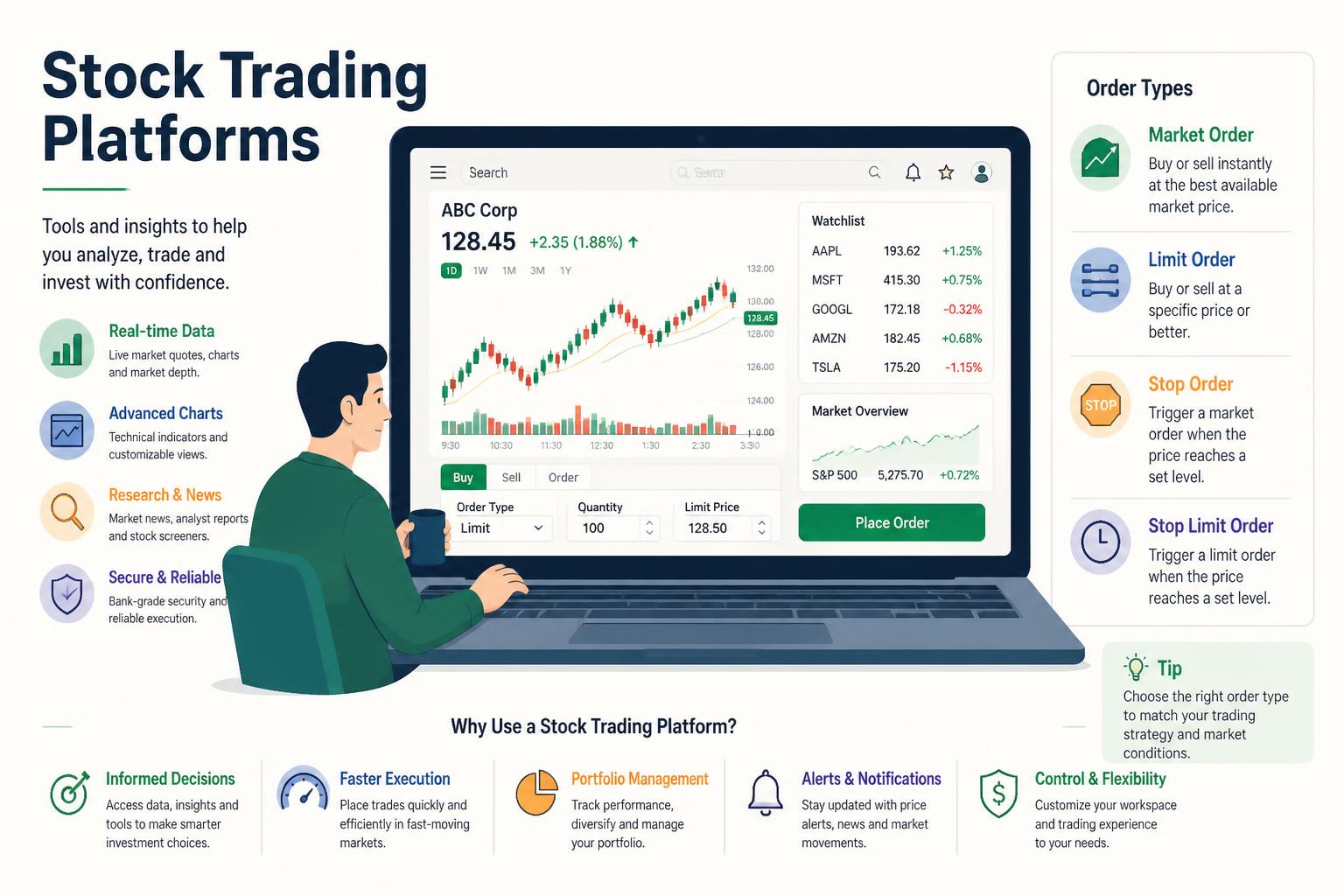
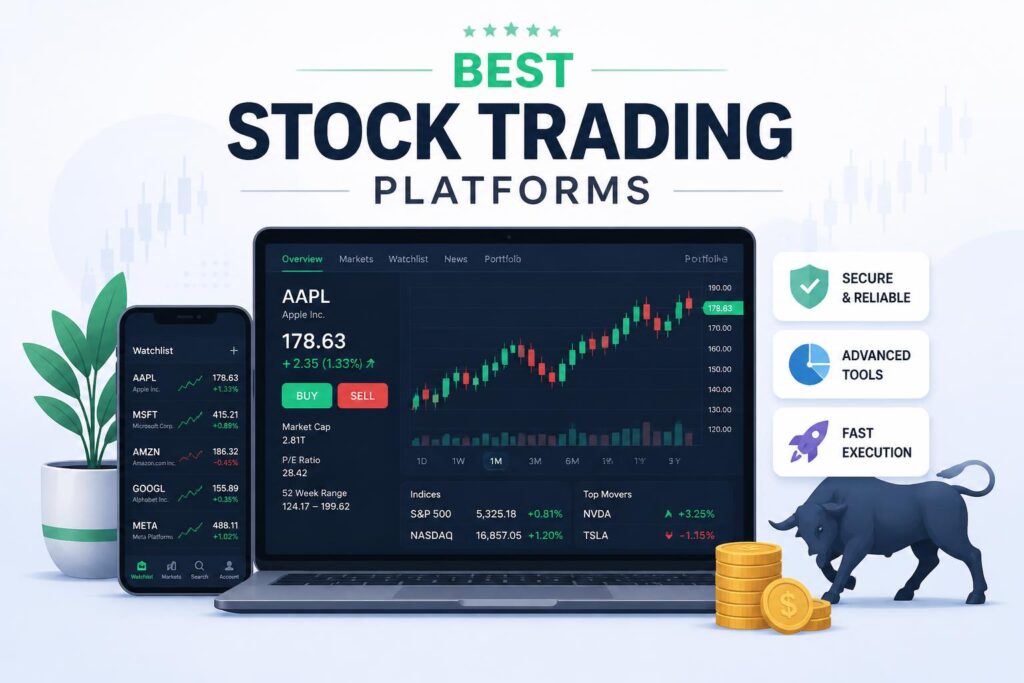
Webull is what happens when a professional trading terminal gets simplified for beginners. You get real-time Level 2 market data, advanced charting tools, and technical indicators that cost extra on other platforms—all for free. The mobile app is lightning-fast, and the desktop platform feels like it was built for day traders who happen to be new to investing.
If you’re the type of beginner who wants to understand the market (not just passively invest), Webull gives you the tools to learn technical analysis, track momentum, and spot patterns without overwhelming you.
Key Features
- Free Level 2 market data — See real-time bid/ask spreads and order flow
- Paper trading account — Practice with $1M fake money before risking real capital
- Extended hours trading — Trade from 4 AM to 8 PM ET (most platforms stop at 6 PM)
- Fractional shares — Buy partial shares of expensive stocks like Tesla or Amazon
- Crypto trading — Trade Bitcoin, Ethereum, and 40+ other coins in the same app
Pricing
Account Type Fee Stock trades $0 commission Options trades $0 commission Crypto trades 0.25% spread Account minimum $0 Margin rate 6.99% APR
Pros
- Advanced charting tools rival paid platforms like TradingView
- Paper trading lets you test strategies risk-free
- Extended hours trading gives you more flexibility
- Clean, modern interface that doesn’t feel dated
- Strong community features (comment on stocks, see what others are trading)
Cons
- No tax-loss harvesting or automatic rebalancing
- Customer support is email-only (no phone support)
- Learning curve is steeper than ultra-simple platforms like Robinhood
Best For
Beginners who want to actively trade and learn technical analysis, not just buy-and-hold index funds.
Try Webull free — get 12 free stocks worth up to $36,000 when you deposit $100+ →
—
2. Robinhood — Best for Simplicity and Crypto Trading
Robinhood is the platform that killed trading commissions and made investing feel like scrolling Instagram. The app is absurdly simple—three taps and you own stock in Apple. There are no confusing menus, no research overload, and no jargon. If you’ve never bought a stock before and want the easiest possible onboarding, Robinhood wins.
The downside? That simplicity comes at the cost of depth. You won’t find robust research tools, retirement accounts, or tax optimization features. But if you’re 23, investing your first $500, and want to own Tesla and Dogecoin in the same app, Robinhood makes it stupid-easy.
Key Features
- One-tap trading — Buy stocks with a single tap (no confirmation screens to slow you down)
- Crypto wallet — Send Bitcoin and other crypto off the platform (rare for brokers)
- Instant deposits — Trade with bank transfers before they clear (up to $1,000)
- Fractional shares — Invest as little as $1 in any stock
- Cash sweep program — Earn 4.5% APY on uninvested cash (Robinhood Gold members)
Pricing
Account Type Fee Stock trades $0 commission Options trades $0 commission Crypto trades Varies (typically 0.5%-1% markup) Robinhood Gold $5/mo (optional, includes 4.5% APY on cash) Account minimum $0
Pros
- Fastest, simplest trading experience on mobile
- No account minimums or trading fees
- Instant deposits let you trade immediately
- Crypto wallet gives you full custody of your coins
- Great for small accounts ($100-$1,000)
Cons
- No retirement accounts (IRAs)
- Limited research tools and market data
- Customer support is notoriously slow
- Gamified interface can encourage impulsive trading
Best For
Complete beginners who want a dead-simple app and plan to trade both stocks and crypto.
—
3. Fidelity — Best for Long-Term Investors Who Want Retirement Accounts
Fidelity is the grown-up in the room. While Robinhood and Webull compete on flashy features, Fidelity competes on trust, depth, and long-term thinking. You get zero-fee index funds, powerful retirement planning tools, and a research library that rivals Bloomberg Terminal—all with no account minimums and zero trading commissions.
If you’re thinking beyond day trading—if you want to build a retirement account, invest in index funds, and actually plan your financial future—Fidelity is the best beginner-friendly platform that won’t force you to migrate later.
Key Features
- Zero-fee index funds — Fidelity ZERO funds have literally 0% expense ratios
- Retirement accounts — Traditional/Roth IRAs, 401(k) rollovers, HSAs
- Fractional shares — Buy partial shares of any stock or ETF
- Robo-advisor option — Fidelity Go manages your portfolio for 0.35% (free under $25k)
- 24/7 customer support — Actual humans answer the phone, even at 2 AM
Pricing
Account Type Fee Stock trades $0 commission Options trades $0 commission, $0.65/contract Mutual funds Varies by fund (many are $0) Account minimum $0 Fidelity Go robo-advisor 0.35% (free under $25k)
Pros
- Zero-fee index funds (FZROX, FZILX) beat Vanguard on cost
- Exceptional retirement planning tools and calculators
- Deep research: analyst reports, earnings transcripts, stock screeners
- 24/7 phone support with short wait times
- No hidden fees or account minimums
Cons
- Mobile app feels dated compared to Webull/Robinhood
- No crypto trading (if that matters to you)
- Interface can feel overwhelming with so many features
Best For
Beginners who want to build wealth long-term and need a platform that grows with them (retirement accounts, IRAs, serious research).
Open a Fidelity account free →
—
4. Charles Schwab — Best for Research-Driven Investors
Charles Schwab is Fidelity’s closest competitor, with one key difference: Schwab’s research tools are even deeper. You get free access to Morningstar reports, third-party analyst ratings, earnings call transcripts, and sector heatmaps—resources that cost $500+/year on other platforms.
If you’re the type of beginner who wants to understand what you’re buying (not just follow Reddit stock tips), Schwab gives you the tools to make informed decisions without drowning you in complexity.
Key Features
- Morningstar research — Premium stock and fund ratings included free
- Stock slices — Buy fractional shares of S&P 500 stocks for as little as $5
- Schwab Intelligent Portfolios — Free robo-advisor (no management fee, just fund expense ratios)
- 24/7 support — Phone, chat, and 300+ physical branches
- Schwab Banking — Link a checking account with no ATM fees worldwide
Pricing
Account Type Fee Stock trades $0 commission Options trades $0 commission, $0.65/contract Mutual funds Varies by fund Schwab Intelligent Portfolios Free (fund expense ratios apply) Account minimum $0
Pros
- Best research tools for beginners (Morningstar, Credit Suisse, Argus)
- Free robo-advisor with no management fee
- 300+ branches if you prefer in-person help
- No account minimums or inactivity fees
- Strong mobile app with fingerprint login
Cons
- Robo-advisor requires $5,000 minimum (vs. Fidelity’s $0)
- No crypto trading
- Slightly slower mobile app than Webull/Robinhood
Best For
Beginners who want to research stocks deeply before buying and value access to professional-grade analysis tools.
Open a Charles Schwab account free →
—
5. E*TRADE — Best for Options Trading Beginners
ETRADE built its reputation on options trading, and it shows. The platform has the best options education for beginners (free courses, webinars, and a virtual trading simulator) plus a mobile app designed for multi-leg option strategies. If you want to move beyond buying stocks and learn covered calls, cash-secured puts, or spreads, ETRADE is the best beginner-friendly entry point.
Key Features
- Options education center — Free courses from beginner to advanced
- OptionsHouse — Integrated options analysis tools (probability calculators, Greeks)
- Paper trading — Practice options strategies with fake money
- Prebuilt option strategies — One-click templates for covered calls, iron condors, etc.
- Mobile options trading — Execute multi-leg trades from your phone
Pricing
Account Type Fee Stock trades $0 commission Options trades $0.50-$0.65/contract (volume discounts) Futures $1.50/contract Account minimum $0 Margin rate 7.25%-12.25% (tiered by balance)
Pros
- Best options education for beginners (video courses, live webinars)
- Advanced mobile app rivals desktop for options trading
- Paper trading lets you practice risk-free
- Prebuilt strategies make complex trades accessible
- Strong screeners and analysis tools
Cons
- Options fees add up if you trade frequently ($0.50-$0.65/contract)
- Desktop platform (Power E*TRADE) has a learning curve
- No crypto trading
Best For
Beginners who want to learn options trading without jumping straight into a professional platform like tastytrade.
Open an E*TRADE account free →
—
6. SoFi Invest — Best for All-in-One Financial Management
SoFi Invest isn’t just a brokerage—it’s a full financial ecosystem. You get stock trading, automated investing, high-yield savings (4.6% APY), student loan refinancing, credit score monitoring, and career coaching all in one app. If you want to consolidate your financial life and avoid juggling five different apps, SoFi is the best one-stop shop for beginners.
The trading platform itself is simple (think Robinhood, not Webull), but the real value is the integration: your uninvested cash earns 4.6% APY, you can set up automatic investments, and SoFi’s financial advisors are available for free consultations.
Key Features
- Automated investing — Robo-advisor builds and manages your portfolio for 0% fee
- High-yield savings — 4.6% APY on uninvested cash (no account minimum)
- Stock bits — Fractional shares starting at $1
- Free financial advisor access — Book calls with CFPs at no extra cost
- No SoFi fees — No trading commissions, no account fees, no transfer fees
Pricing
Account Type Fee Stock trades $0 commission Automated investing 0% management fee High-yield savings APY 4.6% Account minimum $0 Financial advisor consultations Free
Pros
- All-in-one financial app (trading, savings, loans, credit monitoring)
- High-yield savings beats most banks (4.6% APY)
- Free financial advisor access is rare for beginners
- Clean, intuitive mobile-first interface
- No hidden fees anywhere
Cons
- Limited research tools compared to Fidelity/Schwab
- No options trading or advanced order types
- Smaller investment selection (no mutual funds, only stocks/ETFs)
Best For
Beginners who want one app for investing, saving, and managing money without paying fees.
Sign up for SoFi Invest free →
—
7. M1 Finance — Best for Automated Portfolio Management (Pies)
M1 Finance is different. Instead of manually buying stocks one at a time, you create a “pie”—a visual portfolio of stocks and ETFs with target allocations. M1 automatically rebalances your pie, reinvests dividends, and buys fractional shares to match your target allocation. It’s like a robo-advisor you control yourself.
If you want to build a diversified portfolio but don’t want to manually rebalance every month, M1 is the best set-it-and-forget-it platform for beginners who want more control than a robo-advisor but less work than manual trading.
Key Features
- Pie-based investing — Visually design your portfolio with target allocations
- Auto-rebalancing — M1 keeps your portfolio balanced automatically
- Smart transfers — Schedule automatic deposits (daily, weekly, monthly)
- Fractional shares — Every dollar gets invested (no cash drag)
- M1 Borrow — Margin loans at 6.25% APR (available on portfolios over $10k)
Pricing
Account Type Fee Stock/ETF trades $0 commission M1 Plus (premium) $125/year (optional) Account minimum $100 ($500 for retirement accounts) M1 Borrow rate 6.25% APR
Pros
- Automated rebalancing saves hours of manual work
- Visual pie interface makes diversification intuitive
- Smart transfers automate dollar-cost averaging
- M1 Plus adds 1% cash-back on debit card
- Perfect for passive, long-term investors
Cons
- $100 minimum to start ($500 for IRAs)
- Only one trading window per day (not for active traders)
- No individual stock research tools or analyst reports
Best For
Beginners who want to automate portfolio management without paying robo-advisor fees.
—
Side-by-Side Comparison: All 7 Platforms
Feature Webull Robinhood Fidelity Schwab E*TRADE SoFi M1 Finance Stock commissions $0 $0 $0 $0 $0 $0 $0 Options fees $0 $0 $0.65 $0.65 $0.50-$0.65 ❌ ❌ Fractional shares ✅ ✅ ✅ ✅ ✅ ✅ ✅ Crypto trading ✅ ✅ ❌ ❌ ❌ ✅ ❌ Retirement accounts ✅ ❌ ✅ Best ✅ ✅ ✅ ✅ Paper trading ✅ Best ❌ ❌ ❌ ✅ ❌ ❌ Research tools Good Basic ⭐ Best ⭐ Best Good Basic Basic Auto-rebalancing ❌ ❌ ✅ (Robo) ✅ (Robo) ❌ ✅ (Robo) ⭐ Best Customer support Email only Slow ⭐ 24/7 phone ⭐ 24/7 phone Phone/chat Phone/chat Email Account minimum $0 $0 $0 $0 $0 $0 $100
How to Choose the Right Platform for You
Still not sure? Here’s a quick decision framework based on your situation:
If you’re starting with less than $500: Go with Robinhood or SoFi. Both have $0 minimums, fractional shares, and simple interfaces. Robinhood wins if you want crypto; SoFi wins if you want a high-yield savings account (4.6% APY) in the same app.
If you want to learn active trading: Choose Webull. You get free Level 2 data, paper trading, and advanced charts without paying for a professional platform. E*TRADE is a close second if you specifically want to learn options.
If you’re investing for retirement: Fidelity or Charles Schwab. Both offer IRAs, zero-fee index funds, and tools that help you plan long-term. Fidelity has better expense ratios (0% on ZERO funds); Schwab has better research tools.
If you want to automate everything: M1 Finance. Design your portfolio once, schedule automatic deposits, and M1 handles rebalancing and reinvestment. It’s the closest thing to a DIY robo-advisor.
If you’re overwhelmed and need hand-holding: SoFi or Fidelity. SoFi gives you free access to financial advisors; Fidelity has 24/7 phone support with humans who actually help.
—
Frequently Asked Questions
What is the best stock trading platform for beginners?
Webull is the best overall for beginners who want to actively trade and learn. It combines an easy-to-use interface with professional-grade tools (free Level 2 data, paper trading, advanced charts) that help you grow as an investor. If you want something even simpler, Robinhood is the easiest to start with, but you’ll outgrow it quickly.
What is the cheapest stock trading platform?
All seven platforms on this list charge $0 stock trading commissions. The real cost differences come from options fees (E*TRADE charges $0.50-$0.65/contract), margin rates (M1 Finance charges 6.25% APR), and crypto spreads (Robinhood marks up crypto 0.5%-1%). For pure stock trading, they’re all equally cheap.
Can I start investing with $100?
Yes. Six of the seven platforms have $0 account minimums (Webull, Robinhood, Fidelity, Schwab, E*TRADE, SoFi). M1 Finance requires $100 minimum. All seven offer fractional shares, so your $100 can be split across multiple stocks instead of being locked into one.
Which platform has the best app for beginners?
Robinhood has the simplest mobile app—three taps and you own stock. Webull has the most powerful mobile app with advanced charts and Level 2 data. SoFi has the best all-in-one app (trading + savings + financial planning in one interface). Choose based on what you value: simplicity (Robinhood), power (Webull), or integration (SoFi).
Do I need to pay taxes on stock trading?
Yes. You’ll pay capital gains tax on profits when you sell stocks. Short-term gains (held less than 1 year) are taxed as ordinary income; long-term gains (held 1+ years) are taxed at lower rates (0%-20% depending on income). Fidelity and Schwab have the best tax reporting tools; Robinhood’s tax documents are notoriously confusing.
Is Robinhood safe for beginners?
Robinhood is SIPC-insured (your securities are protected up to $500,000 if Robinhood goes bankrupt), but the gamified interface can encourage impulsive trading. If you’re disciplined, it’s fine. If you’re prone to FOMO or revenge trading, choose a platform with more friction like Fidelity or Schwab.
Can I trade options as a beginner?
Yes, but start with paper trading first. E*TRADE and Webull both offer virtual trading simulators where you can practice options strategies with fake money. Don’t risk real capital until you understand how options expire, how Greeks affect pricing, and how to manage risk. Most beginners lose money on options in their first year.
—
Final Recommendation: Start with Webull
If I could only recommend one platform to a beginner, it’s Webull. You get professional-grade tools (Level 2 data, advanced charts, paper trading) wrapped in a beginner-friendly interface, with $0 commissions and no account minimums. It’s the best platform that won’t hold you back as you grow.
That said, the “best” platform depends on your goals. If you’re investing for retirement, Fidelity is better. If you want ultra-simplicity, Robinhood is easier. If you want to automate everything, M1 Finance is perfect.
The good news? You’re not locked in. Most traders use 2-3 platforms as they grow—Webull for active trading, Fidelity for retirement accounts, and M1 Finance for long-term passive portfolios.
Ready to start? Webull is offering 12 free stocks (worth up to $36,000) when you deposit $100+.
Claim your free stocks on Webull →
—
Last updated: January 2026. Pricing and features subject to change. Always verify current offers on the provider’s website before signing up.