
Best Brokerage Accounts: Your Complete Guide to Smart Investing in 2024
Choosing the right brokerage account can feel overwhelming. With dozens of platforms competing for your business, each promising low fees and powerful tools, how do you know which one actually deserves your hard-earned money? The wrong choice could cost you thousands in unnecessary fees, limit your investment options, or leave you stranded without proper support when you need it most.
This guide cuts through the noise to help you find the best brokerage accounts for your specific needs—whether you’re a beginner taking your first steps into investing, an active trader looking for advanced tools, or someone building long-term wealth through retirement accounts.
What Makes a Brokerage Account “Best”?
Before diving into specific recommendations, let’s establish what separates exceptional brokerage accounts from mediocre ones.
Core Features That Matter
Commission Structure: The best brokerage accounts offer commission-free trading on stocks and ETFs. While this has become standard, watch for hidden costs in options contracts, mutual funds, and other securities.
Account Minimums: Top brokers have eliminated or significantly reduced minimum deposit requirements, making investing accessible to everyone regardless of starting capital.
Investment Selection: Quality platforms provide access to stocks, ETFs, mutual funds, bonds, options, and sometimes cryptocurrencies—all from a single account.
Platform Usability: Whether you prefer desktop, mobile, or web-based trading, the interface should be intuitive and reliable, not a frustrating obstacle between you and your investments.
Research and Education: The best brokerage accounts empower you with quality research tools, market analysis, and educational resources to make informed decisions.
Top Brokerage Accounts for Different Investor Types
Best Overall: Fidelity Investments
Fidelity consistently ranks among the best brokerage accounts because it excels across nearly every category. With $0 commissions on stocks, ETFs, and options (plus $0.65 per contract), no account minimums, and access to over 3,300 no-transaction-fee mutual funds, Fidelity delivers exceptional value.
Why Fidelity Stands Out:
– Comprehensive research tools with independent equity ratings
– Excellent customer service with 24/7 phone support
– Robust mobile app with full trading capabilities
– Outstanding retirement account options
– Fractional share trading for expensive stocks
Best For: Investors seeking a full-service broker with excellent all-around capabilities and long-term account relationships.
Best for Beginners: Charles Schwab
Charles Schwab built its reputation on investor education and transparent pricing, making it one of the best brokerage accounts for those just starting out. The platform balances simplicity with sophistication—easy enough for novices yet powerful enough to grow with you.
Why Beginners Choose Schwab:
– Intuitive interface with guided investing options
– Extensive library of educational content and webinars
– Schwab Intelligent Portfolios (robo-advisor) with $0 advisory fee
– No account minimums for most accounts
– Excellent branch network for in-person support
Best For: New investors who value education and want a platform they won’t outgrow.
Best for Active Traders: TD Ameritrade (thinkorswim)
Active traders need sophisticated tools, real-time data, and lightning-fast execution. TD Ameritrade’s thinkorswim platform delivers all three, making it one of the best brokerage accounts for serious traders.
Why Active Traders Prefer TD Ameritrade:
– Professional-grade thinkorswim platform with advanced charting
– Paper trading environment to test strategies risk-free
– Extensive technical indicators and drawing tools
– Real-time news and market scanning capabilities
– Options analysis tools that simplify complex strategies
Best For: Active traders and options enthusiasts who need institutional-quality tools.
Best for Low Costs: Interactive Brokers
When rock-bottom costs are your priority, Interactive Brokers stands out among the best brokerage accounts. IBKR Pro charges minimal commissions ($0.0035 per share with a $0.35 minimum for stocks), but the real savings come from superior pricing on options, futures, forex, and international securities.
Why Cost-Conscious Investors Choose IBKR:
– Lowest margin rates in the industry
– Access to 150 markets in 33 countries
– Best execution for international investors
– Advanced order types for precise control
– Transparent pricing structure
Best For: High-volume traders, international investors, and those with larger portfolios seeking maximum cost efficiency.
Best for Retirement Investing: Vanguard
Vanguard pioneered low-cost index investing, and its brokerage platform remains one of the best brokerage accounts for long-term retirement savers. While the platform lacks bells and whistles, it excels at what matters most: low-cost funds and straightforward account management.
Why Retirement Savers Trust Vanguard:
– Industry-lowest expense ratios on mutual funds and ETFs
– Strong selection of target-date retirement funds
– No commission trades on Vanguard funds and most ETFs
– Excellent IRA and 401(k) rollover support
– Customer-owned structure aligns incentives with investors
Best For: Buy-and-hold investors focused on low-cost index funds for retirement.
Best Robo-Advisor Integration: Betterment
While technically a robo-advisor, Betterment functions as one of the best brokerage accounts for hands-off investors. The platform automatically builds, manages, and rebalances diversified portfolios based on your goals and risk tolerance.
Why Passive Investors Choose Betterment:
– Fully automated portfolio management
– Tax-loss harvesting to improve after-tax returns
– Goal-based planning tools
– Low 0.25% annual fee (or 0.40% for premium)
– No minimum balance requirement
Best For: Investors who want professional management without the cost of traditional advisors.
Key Factors to Compare When Choosing
Trading Costs and Fees
Even among the best brokerage accounts, fee structures vary. Most major brokers now offer $0 stock and ETF trades, but costs differ significantly for:
- Options contracts: Typically $0.50-$0.65 per contract
- Mutual fund transaction fees: Some charge $49.95+ for non-proprietary funds
- Margin interest rates: Range from under 7% to over 12% annually
- Account maintenance fees: Most eliminated, but some remain for small accounts
- Wire transfer and paper statement fees: Often overlooked but can add up
Investment Options and Access
The best brokerage accounts provide comprehensive investment access. Consider whether you need:
- Stocks and ETFs: Universal among reputable brokers
- Mutual funds: Varies widely; some offer thousands with no transaction fee
- Fixed income: Corporate and municipal bonds, CDs, Treasuries
- Options trading: Check for level approval restrictions
- International securities: Critical if you want global diversification
- Cryptocurrencies: Still limited at traditional brokers
- IPO access: Rare at discount brokers
Account Types Available
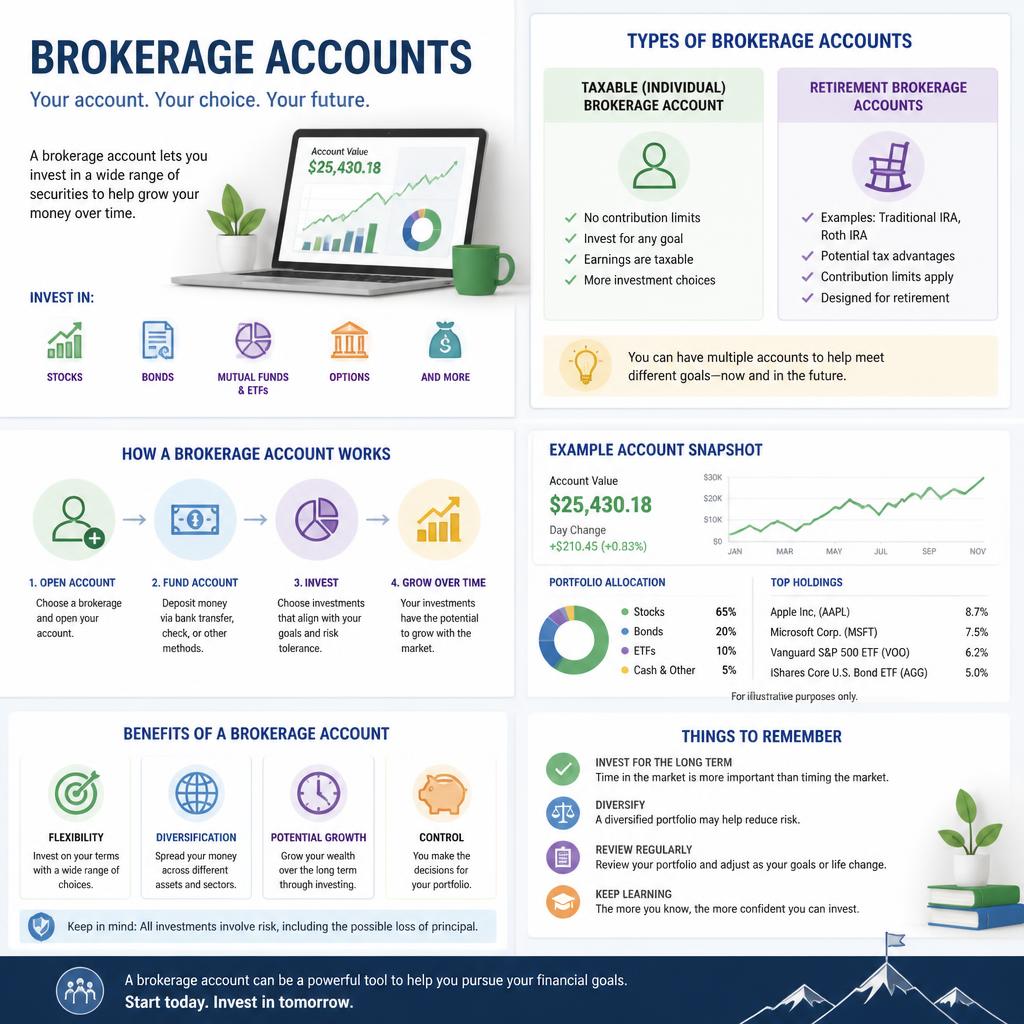
Different financial goals require different account structures. The best brokerage accounts support:
- Individual and joint taxable accounts
- Traditional and Roth IRAs
- SEP and SIMPLE IRAs for self-employed individuals
- 401(k) rollovers
- Custodial accounts (UGMA/UTMA)
- Trust accounts
- Business and entity accounts
Platform Technology
Your experience with even the best brokerage accounts depends heavily on platform quality:
Mobile Apps: Test whether you can execute all necessary functions on mobile, not just monitor accounts.
Desktop Platforms: Advanced traders need downloadable software with sophisticated charting and analysis tools.
Web Interface: Should be fast, stable, and offer most functionality without downloading software.
Order Types: Market, limit, stop, stop-limit, trailing stop, and conditional orders give you precise control.
Real-Time Data: Essential for active traders; some brokers charge extra.
Common Mistakes to Avoid
Choosing Based on Promotions Alone
Brokers frequently offer cash bonuses for new accounts. While tempting, these promotions shouldn’t be your primary decision factor. A $100 bonus doesn’t compensate for years of higher fees or inferior tools.
Ignoring Account Transfer Fees
If you already have investments elsewhere, factor in transfer costs. Many top brokers reimburse transfer fees from other institutions—sometimes up to several thousand dollars.
Overlooking Tax Implications
The best brokerage accounts provide robust tax reporting, but platforms differ in tax-loss harvesting capabilities, wash sale tracking, and Form 1099 clarity. Poor tax tools can cost you significantly at tax time.
Underestimating Research Needs
Beginners often overestimate how much research they’ll do, while intermediate investors sometimes underestimate their need for quality analysis tools. Honestly assess your research habits before choosing.
How to Open Your Brokerage Account
Once you’ve identified the best brokerage accounts for your needs, opening one takes 10-20 minutes:
- Gather Required Information: Social Security number, employment details, bank account information for funding, and financial information for options approval.
- Complete the Application: Provide personal details, investment experience, and financial situation. This helps the broker understand your needs and regulatory requirements.
- Choose Account Type: Select individual, joint, IRA, or other account structure based on your goals.
- Fund Your Account: Link a bank account for electronic transfer, wire funds, or request an account transfer from another broker.
- Configure Settings: Set up two-factor authentication, establish trading permissions, and configure account alerts.
Maximizing Your Brokerage Account
Start with a Plan
Even the best brokerage accounts won’t generate returns without a solid investment strategy. Define your goals, timeline, and risk tolerance before placing your first trade.
Take Advantage of Education
Most top brokers offer free education—webinars, articles, courses, and even in-person workshops. These resources help you become a more confident, capable investor.
Use Dollar-Cost Averaging
Rather than timing the market, invest consistently over time. Set up automatic transfers to build wealth systematically, regardless of market conditions.
Monitor Costs, Not Just Returns
Investment returns are unpredictable; costs are controllable. Minimizing fees and expenses has a direct, permanent impact on your wealth accumulation.
Review Regularly, Rebalance Occasionally
Check your portfolio quarterly to ensure it aligns with your goals, but resist the urge to constantly tinker. The best investors make intentional, strategic adjustments—not reactive, emotional ones.
The Bottom Line
The best brokerage accounts aren’t determined by features alone—they’re the ones that match your specific investing style, goals, and experience level. Fidelity and Charles Schwab offer outstanding all-around value for most investors. Active traders should explore TD Ameritrade’s thinkorswim platform, while cost-minimizers benefit from Interactive Brokers’ low fees. Retirement savers find unbeatable value at Vanguard, and hands-off investors appreciate Betterment’s automated approach.
Start by identifying your primary need: Are you a beginner seeking education? An active trader requiring advanced tools? A retirement saver prioritizing low costs? Your answer points you toward the right platform.
Remember, you’re not locked into your first choice forever. Many successful investors maintain accounts at multiple brokers, using each for its strengths. The important thing is to start—because the best brokerage account is the one you actually open and use to build your financial future.
Open your account today, start with what you can afford, and let compound growth work its magic over time. Your future self will thank you for taking action now rather than waiting for the “perfect” moment that never arrives.
Affiliate Disclosure: We may earn a commission from some of the products mentioned in this article.