Cheapest Crypto Exchanges in 2026 (Fee Comparison and Review)
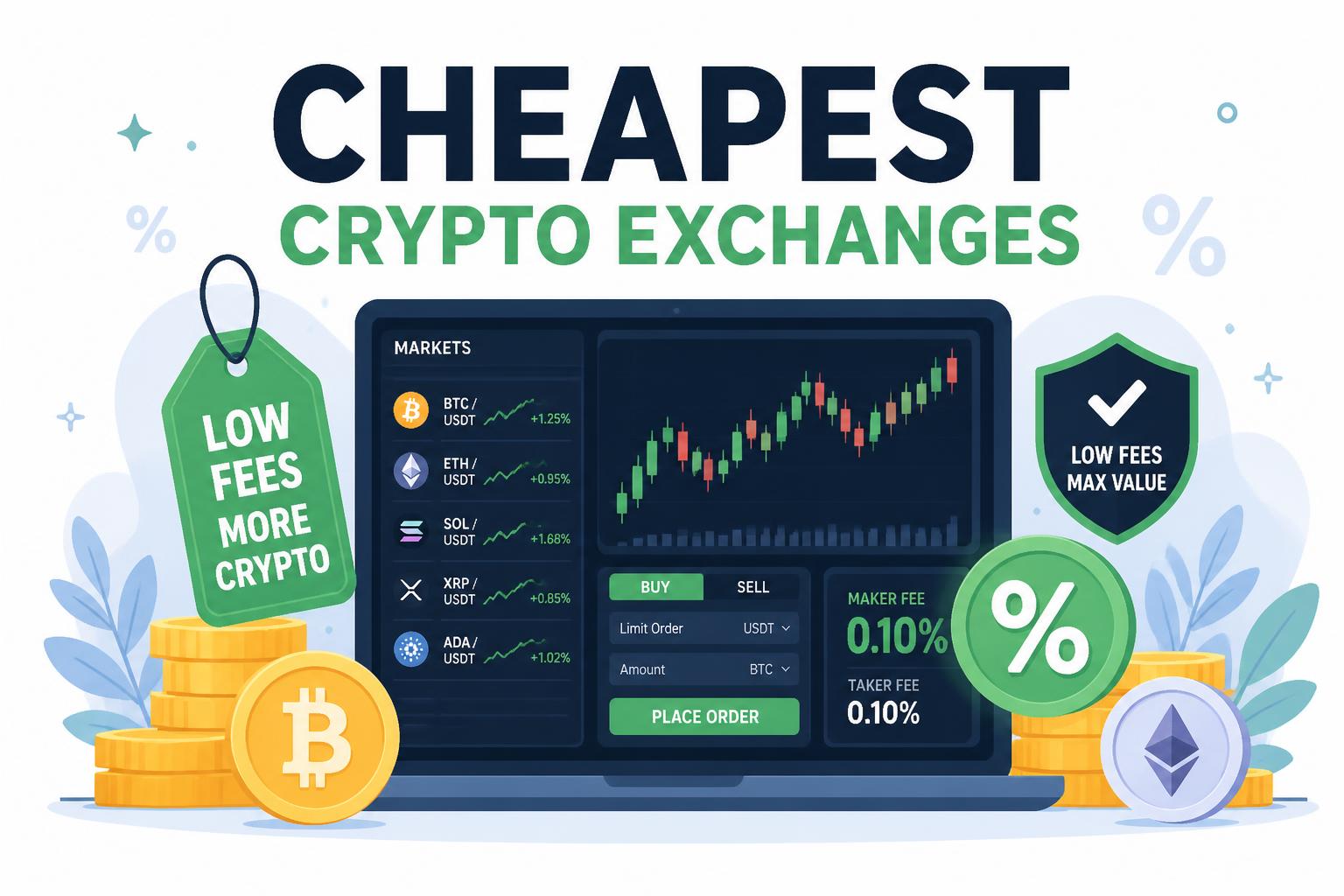
Trading fees rarely feel important at first. They’re small per trade, so it’s easy to ignore them. But over time, especially if you trade often, they quietly take a noticeable bite out of returns.
This guide looks at major crypto exchanges in 2026 and compares their real trading costs, including spot and futures fees, withdrawal charges, spreads, and common hidden costs. Platforms included here are Binance, Bybit, OKX, Kraken, KuCoin, Bitstamp, and Crypto.com.
—
At a glance: lowest-fee crypto exchanges (2026)
Exchange Best suited for Starting fees Free plan Binance Low-cost active trading ~0.1% or lower Yes Bybit Futures and frequent trading ~0.1% Yes OKX Low fees with extra features ~0.08–0.1% Yes KuCoin Altcoins ~0.1% Yes Kraken Security and fiat use ~0.16% Yes Bitstamp Simple spot trading ~0.3% (lower with volume) Yes Crypto.com Mobile app and tiered discounts ~0.075–0.4% Yes
How these exchanges were compared
The ranking is based on actual trading costs rather than advertised fees alone.
Main factors:
- Spot trading fees (maker and taker rates)
- Futures and derivatives pricing
- Withdrawal costs for crypto and fiat
- Real execution cost, including spreads
- Volume or token-based discounts
- Liquidity and slippage
- Transparency of fee structure
—
1. Binance — lowest overall trading costs
Binance still has some of the lowest trading fees in the market, especially when using fee discounts tied to its native token or higher trading volume. Liquidity is deep across most major pairs, which helps reduce slippage.
Key points
- Spot fees around 0.1% or lower
- Very deep order books
- Strong futures and margin trading support
- Fee reductions through tier system
Fees
| Type | Fee |
|---|---|
| Spot | ~0.1% |
| Futures | ~0.02% maker / ~0.04% taker |
| Withdrawals | Network-based |
Strengths
- Low fees across most markets
- High liquidity
- Wide range of assets
- Advanced trading tools
Limitations
- Interface can feel overwhelming
- Availability depends on region
Best fit: frequent traders focused on minimizing execution costs
—
2. Bybit — strong for derivatives trading
Bybit is often used by traders who focus on futures. Fees are close to Binance, and the platform is generally simple to navigate.
Key points
- Spot and futures fees around 0.1%
- Competitive derivatives pricing
- Clean interface
- Copy trading features
Fees
| Type | Fee |
|---|---|
| Spot | ~0.1% |
| Futures | ~0.02% / ~0.055% |
| Withdrawals | Network fee only |
Strengths
- Strong futures market
- Easy to use
- Good liquidity on major pairs
Limitations
- Fewer fiat options
- Not available in all regions
Best fit: derivatives traders and active short-term traders
—
3. OKX — low fees with broader ecosystem
OKX sits between a trading platform and a broader crypto ecosystem. Fees are slightly lower than many competitors, and it also offers Web3 features.
Key points
- Spot fees around 0.08–0.1%
- Futures and options trading
- Web3 wallet integration
- Strong liquidity on major assets
Fees
| Type | Fee |
|---|---|
| Spot | ~0.08–0.1% |
| Futures | ~0.02–0.05% |
| Withdrawals | Network-based |
Strengths
- Slightly lower base fees
- Wide feature set beyond trading
- Good liquidity
Limitations
- Can feel complex at first
- Some features require higher verification levels
Best fit: users who want low fees plus extra crypto tools
—
4. KuCoin — large altcoin selection at low cost
KuCoin is often used for accessing smaller or newer tokens while keeping fees relatively low.
Key points
- Spot trading around 0.1%
- Large selection of altcoins
- Futures trading available
- Earn and lending features
Fees
| Type | Fee |
|---|---|
| Spot | ~0.1% |
| Futures | ~0.02–0.06% |
| Withdrawals | Network fee |
Strengths
- Wide altcoin access
- Competitive trading fees
- Frequent new listings
Limitations
- Regulation varies by region
- Interface less refined than top competitors
Best fit: altcoin traders and early token investors
—
5. Kraken — security-focused and transparent pricing
Kraken is known for reliability and clear pricing. Fees are slightly higher than ultra-low-cost exchanges, but structure is straightforward.
Key points
- Spot fees start around 0.16%
- Strong fiat support
- High regulatory compliance
- Emphasis on security
Fees
| Type | Fee |
|---|---|
| Spot | ~0.16% |
| Futures | ~0.02–0.05% |
| Withdrawals | Varies |
Strengths
- Strong security reputation
- Transparent pricing
- Reliable fiat on/off ramps
Limitations
- Higher fees than Binance or OKX
- Smaller selection of speculative assets
Best fit: users who prioritize safety and fiat access
—
6. Bitstamp — simple and predictable
Bitstamp is one of the oldest exchanges and focuses on simplicity rather than feature depth.
Key points
- Spot fees around 0.3% (lower with volume)
- Strong fiat support (USD/EUR)
- Simple interface
- Reliable execution
Fees
| Type | Fee |
|---|---|
| Spot | ~0.3% |
| Withdrawals | Low or flat |
Strengths
- Easy to use
- Long operating history
- Stable fiat support
Limitations
- Higher base fees
- Limited advanced tools
Best fit: beginners who want simplicity
—
7. Crypto.com — tiered mobile trading system
Crypto.com uses a tiered model where fees drop based on staking and trading volume. The mobile app is its main focus.
Key points
- Spot fees vary widely (~0.075–0.4%)
- Fee discounts through staking
- Mobile-first design
- Broader ecosystem (card and app services)
Fees
| Type | Fee |
|---|---|
| Spot | ~0.075–0.4% |
| Withdrawals | Network-based |
Strengths
- Strong mobile experience
- Ecosystem beyond trading
- Lower fees at higher tiers
Limitations
- Fee system can be confusing
- Best rates require staking
Best fit: mobile users and ecosystem-focused holders
—
Comparison overview
Category Leader Lowest spot fees Binance / OKX Derivatives Binance / Bybit / OKX Altcoin selection KuCoin Security Kraken Beginner experience Bitstamp Mobile ecosystem Crypto.com
Choosing the right exchange
Which exchange makes sense depends less on rankings and more on how you trade.
- Frequent trading → Binance or OKX
- Futures trading → Bybit or Binance
- Altcoin focus → KuCoin
- Security-first approach → Kraken
- Simple onboarding → Bitstamp or Crypto.com
Fees matter, but they’re not the only cost. Liquidity, spreads, and withdrawal charges often have just as much impact on what you actually pay.
—
FAQ
What exchange has the lowest fees in 2026?
Binance usually comes out lowest for most active traders.Are any exchanges completely free?
Some run promotions with zero fees, but standard trading almost always includes small maker/taker costs.Is the cheapest exchange always the best?
Not necessarily. Low fees don’t help much if liquidity is poor or withdrawals are expensive.What’s easiest for beginners?
Bitstamp and Crypto.com are generally simpler to get started with.Are decentralized exchanges cheaper?
Not always. Network gas fees can make them more expensive during busy periods.—
Final takeaway
For most traders, Binance remains the lowest-cost option overall thanks to its liquidity and fee structure.
Kraken is a solid alternative if you care more about simplicity, regulation, and transparency than the absolute lowest fee.
In practice, Binance tends to strike the best balance between cost, depth of market, and available tools.
—
Notes
- Fee structures change frequently, so it helps to review them every few months
- Withdrawal costs and spreads can matter as much as listed trading fees
- Liquidity differences can affect real-world trading cost more than percentages alone