tastytrade vs Webull: One Charges $0.50 Per Contract, The Other Doesn’t
You’re choosing between tastytrade and Webull because you want serious options tools without broker fees eating your small account alive. The pitch sounds identical: zero commissions, mobile-first platforms, no account minimums. Then you dig into the options pricing and find a $0.50-per-contract difference that could cost you thousands over a year of active trading.
Both platforms earned a 3.5/5 overall rating in 2026 broker reviews, both eliminated stock trading commissions, and both target self-directed traders who don’t need hand-holding. But the $0.50 gap on every options contract, the 41-point spread in margin rates, and the wildly different platform philosophies mean one will cost you less and fit your strategy better — and picking wrong burns money on every trade.
We tested both platforms in 2026, compared the fee structures that matter for options traders, and broke down what you actually get for that per-contract charge.
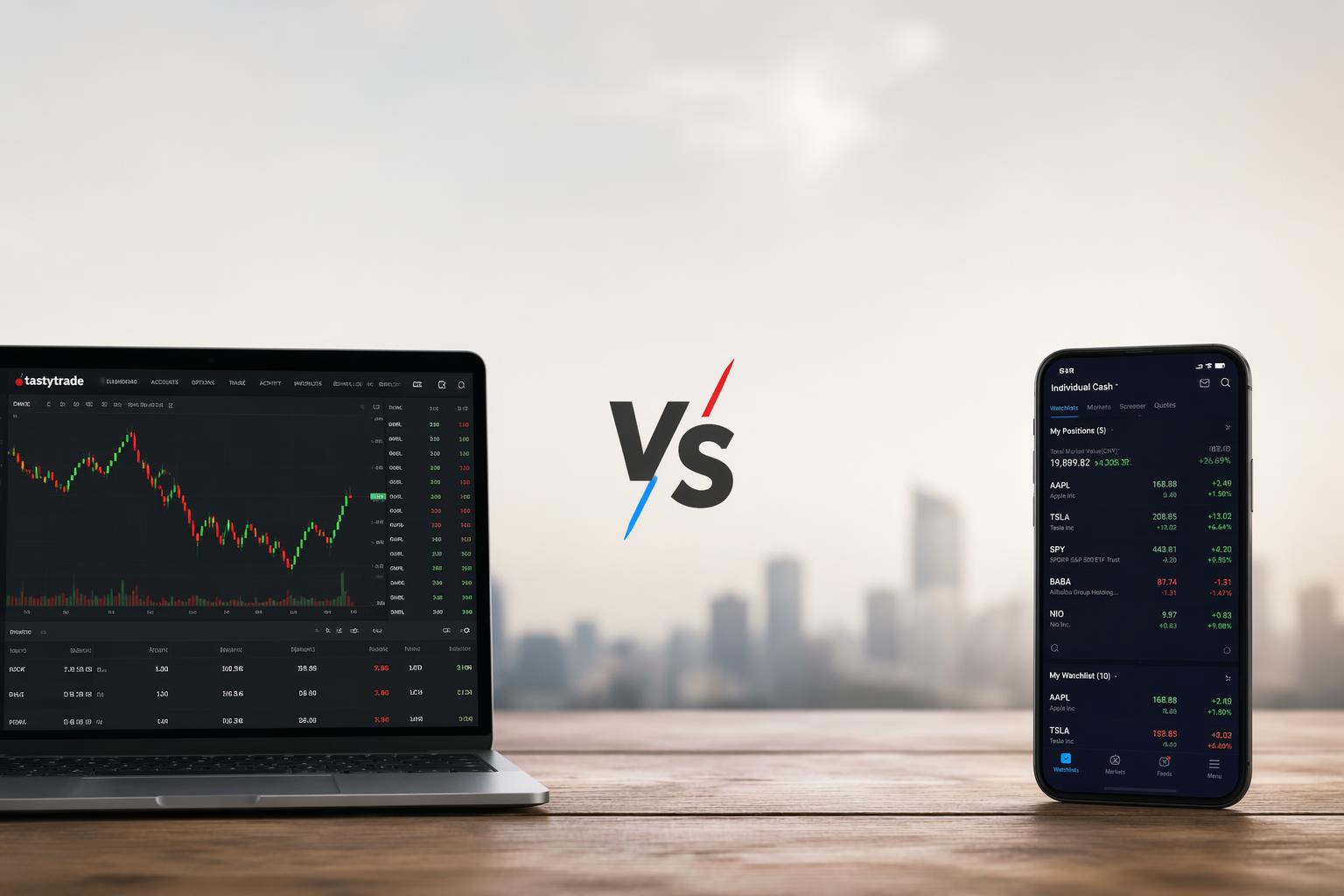
Table of Contents
- Pricing: Where the $0.50 Per Contract Actually Matters
- Platform & Tools: Desktop Power vs Mobile Speed
- Options Trading Features: Strategy Builders and Approval Levels
- Margin Rates & Leverage: The 274-Basis-Point Gap
- Crypto, Futures & Other Assets
- Education & Onboarding
- Account Types & Minimums
- Who Should Pick tastytrade
- Who Should Pick Webull
- FAQ
Pricing: Where the $0.50 Per Contract Actually Matters
Both brokers advertise zero-commission trading. That’s true for stocks and ETFs — you pay $0.00 to open and close equity positions on either platform. The split happens the moment you trade an option.
Webull options contracts: $0.00
tastytrade options contracts: $0.50 to open
tastytrade waives the closing fee, so you only pay on entry. Webull charges nothing on either side. Regulatory, exchange, and clearing fees still apply to both — those aren’t negotiable — but the per-contract commission is where your trading volume starts to matter.
If you trade 10 option contracts per week:
- Webull cost: $0/week = $0/year
- tastytrade cost: $5/week = $260/year
If you scale to 100 contracts per week (common for active traders running multi-leg strategies):
- Webull cost: $0/week = $0/year
- tastytrade cost: $50/week = $2,600/year
That $0.50 feels small until you multiply it by your actual contract volume. A calendar spread with 20 legs costs you $10 on tastytrade and $0 on Webull. Do that twice a week and you’re paying $1,040/year just in opening commissions.
When tastytrade’s fee makes sense: if the platform’s tools, speed, or order execution save you more than $0.50 per contract in slippage or missed fills. tastytrade won StockBrokers.com’s #1 Options Trading ranking in 2026 and Investopedia’s Best Overall Options Trading Platform in January 2026 — those awards don’t erase the fee, but they signal the tooling might justify it for traders who value execution quality over zero-cost entry.
When Webull’s $0 wins: if you’re trading high volume, learning options, or running tight-margin strategies where every $0.50 compounds. Webull earned Best Day Trading Platform for Options from Investopedia in January 2026, signaling fast execution without per-contract drag.

Platform & Tools: Desktop Power vs Mobile Speed
tastytrade built its platform for desktop-first options traders. The interface prioritizes multi-monitor workflows, complex order entry, and real-time Greeks across watchlists. Webull started mobile-native and added desktop later — the app still feels faster, but the desktop tools lag behind tastytrade’s depth.
tastytrade platform strengths:
- Curves page — visualize P&L across your entire portfolio at different underlying price points before you place the trade
- Options chain layout — single-screen view of all strikes, expirations, Greeks, and liquidity without scrolling
- Order staging — queue multiple trades, adjust them, and fire them as a batch when conditions align
- Futures integration — trade options on futures and equity options from the same interface
StockBrokers.com rated tastytrade #1 for Innovation in 2025 and #1 Options Trading in 2026, citing the platform’s “purpose-built tools for derivatives traders.”
Webull platform strengths:
- Mobile speed — the app loads faster, places orders faster, and updates quotes faster than the desktop version
- Options strategy builder — pre-built templates for iron condors, strangles, butterflies, and other multi-leg trades
- Paper trading — test strategies with real-time data before risking capital
- Level 2 market data — free with the account (most brokers charge $5–$10/month)
Webull’s desktop platform exists, but most active traders we talked to in 2026 still prefer the mobile app for speed and the simplicity of the strategy builder.
The tradeoff: tastytrade gives you more control and granularity. Webull gives you faster execution and lower friction. If you’re analyzing risk curves and managing 15+ positions, tastytrade’s desktop tools save hours. If you’re firing quick directional trades or running simple spreads, Webull’s mobile-first design keeps you moving.
Options Trading Features: Strategy Builders and Approval Levels
Both platforms support multi-leg options strategies and offer tiered approval levels based on account size and experience. Neither requires a minimum deposit to open an account (tastytrade: $0.00, Webull: no stated minimum), but your options approval level determines what you can trade.
What you can trade on both:
- Covered calls and cash-secured puts (Level 1)
- Long calls and puts (Level 2)
- Spreads — verticals, calendars, diagonals (Level 3)
- Iron condors, butterflies, and other defined-risk strategies (Level 3)
- Naked calls and puts (Level 4, requires margin approval and higher account equity)
Interactive Brokers offers Level 4 trading permissions and remains the benchmark for advanced traders, but both tastytrade and Webull approve Level 3 strategies for most funded accounts without friction.
tastytrade’s edge:
- Live options desk — call a human trader if you need help with a complex order or want to negotiate a fill on low-liquidity strikes
- Expected value (EV) scoring — the platform calculates expected profit on every trade based on implied volatility, historical probability, and your entry price
- Portfolio margining — available for accounts over $100,000, reduces capital requirements for hedged positions
Webull’s edge:
- Strategy builder templates — one-click entry for 15+ common options strategies, pre-populated with reasonable strike selections
- Free real-time data — no exchange fees, no delayed quotes, no $10/month subscriptions
- Simulated trading — test strategies with paper money before going live
If you’re learning options, Webull’s templates and paper trading lower the barrier. If you’re trading complex spreads or need portfolio margin, tastytrade’s tooling and live desk support are worth the $0.50 per contract.
Margin Rates & Leverage: The 274-Basis-Point Gap
If you trade on margin, tastytrade and Webull’s borrowing costs diverge sharply.
Webull margin rate (accounts under $25,000): 8.74%
tastytrade margin rate (accounts under $25,000): 11.00%
That 2.26% difference (226 basis points) costs you real money if you hold overnight positions or use margin to increase buying power.
Example: You borrow $10,000 on margin for 6 months.
- Webull interest cost: $437
- tastytrade interest cost: $550
- Difference: $113 over 6 months, $226/year
If you scale to $50,000 borrowed:
- Webull annual cost: $4,370
- tastytrade annual cost: $5,500
- Difference: $1,130/year
Margin rates shift with the Fed’s benchmark rate, but the spread between brokers tends to hold. As of 2026, Webull’s 8.74% undercuts tastytrade’s 11% by enough that high-leverage traders should factor it into total cost of ownership.
When margin rates matter: if you use leverage to amplify options strategies, hold multi-day spreads, or maintain buying power above your cash balance. The interest compounds daily.
When they don’t: if you trade cash-only, close positions same-day, or keep margin utilization under 10%. A $1,000 margin balance costs you $7.28/month on Webull vs $9.17/month on tastytrade — noticeable but not a dealbreaker.
Crypto, Futures & Other Assets
Both platforms expanded beyond stocks and options in recent years, but their crypto and futures offerings aren’t equal.
Cryptocurrency:
- Webull: 50 cryptocurrencies available for trading
- tastytrade: 17 cryptocurrencies available for trading
Webull’s 50-coin selection includes major assets (Bitcoin, Ethereum, Solana) plus mid-cap and emerging tokens. tastytrade focuses on the top 17 by market cap and liquidity. If crypto diversification matters to you, Webull’s range is wider.
Futures:
Both platforms support futures and micro futures trading.
- tastytrade futures pricing: $1.00 to open per contract, $1.00 to close; $0.75 per micro contract each way
- Webull futures pricing: commission structure varies (not disclosed in research data)
tastytrade earned Best for Futures Trading and Options on Futures from StockBrokers.com in 2025 and Best Broker in North America from TradingView in 2024. If you trade /ES, /NQ, or other index futures alongside options, tastytrade’s integrated platform and pricing are competitive.
Stocks and ETFs:
Both charge $0.00 commissions on U.S. equities and ETFs. No advantage either way.
Education & Onboarding
Both platforms earned 3 out of 5 stars for education in 2026 broker reviews, signaling decent but not exceptional learning resources.
tastytrade education:
- tastytrade LIVE — daily market commentary, trade breakdowns, and strategy walkthroughs hosted by professional traders
- Video library — hundreds of hours of options education, Greeks explanations, and portfolio management tactics
- Blog and podcasts — weekly content on volatility, earnings plays, and risk management
tastytrade’s content skews toward intermediate and advanced traders. If you already understand implied volatility and delta, the education is useful. If you’re starting from zero, the learning curve is steep.
Webull education:
- Paper trading mode — practice with real-time data before risking capital
- Strategy guides — written explanations of common options strategies with entry/exit examples
- Webinars — periodic live sessions on market conditions and platform features
Webull’s education is lighter but more accessible. The paper trading mode lets you learn by doing, and the strategy builder templates show you what a working iron condor or calendar spread looks like before you place it live.
Neither platform replaces a structured options course, but tastytrade’s daily live show and strategy breakdowns give you more ongoing education once you’re past the basics.
Account Types & Minimums
Both brokers eliminated minimum deposit requirements:
- tastytrade minimum deposit: $0.00
- Webull minimum deposit: not stated (effectively $0)
You can open an account, link a bank, and start trading with whatever capital you have. Pattern day trader (PDT) rules still apply if you day-trade options — you need $25,000 in account equity to make more than three day trades in a rolling five-day period. That’s a regulatory requirement, not a broker rule.
IRA support:
Both platforms offer Individual Retirement Accounts (IRAs) for tax-advantaged options trading. Traditional IRA, Roth IRA, and SEP-IRA accounts are available. Options approval levels within IRAs are typically limited to defined-risk strategies (no naked calls/puts), but you can trade spreads, covered calls, and long options inside retirement accounts on both platforms.
Account opening speed:
- Webull: 5 minutes or less (according to 2026 data)
- tastytrade: time not disclosed, but user reviews suggest same-day approval for most applicants
Who Should Pick tastytrade
Choose tastytrade if:
- You trade complex multi-leg strategies — the Curves page, portfolio margining, and advanced order staging save time and reduce mistakes when managing 10+ positions.
- Execution quality matters more than per-contract cost — tastytrade’s awards (Best Overall Options Trading Platform, #1 Options Trading, Best for Dedicated Options Traders) signal institutional-grade execution. If you’re trading illiquid strikes or need fast fills during earnings, the $0.50/contract might cost less than slippage on Webull.
- You trade futures alongside options — tastytrade’s integrated futures platform and competitive micro contract pricing ($0.75 each way) make it easier to hedge equity positions with index futures.
- You value ongoing education — the daily live show, strategy breakdowns, and professional trader commentary give you context for your trades. If you learn better by watching experienced traders work through real setups, tastytrade’s content is worth the platform fee.
- You’re building a $100k+ account — portfolio margining, the live options desk, and reduced capital requirements for hedged positions become available at higher account sizes. tastytrade’s tooling scales better as your trading sophistication and capital grow.
Bottom line: tastytrade charges $0.50 per contract because it built a platform for full-time options traders who need execution speed, risk visualization, and integrated futures access. If those tools save you more than $0.50/contract in better fills or avoided mistakes, you come out ahead.
Who Should Pick Webull
Choose Webull if:
- You trade high volume — at 100+ contracts per week, Webull’s $0 commission saves you $2,600+/year compared to tastytrade. That’s real money that compounds in your account instead of disappearing to fees.
- You’re learning options — the strategy builder templates, paper trading mode, and simpler interface lower the barrier to entry. You can test iron condors and calendar spreads with fake money, then flip to live trading without changing platforms.
- You trade on mobile — Webull’s app is faster, cleaner, and more intuitive than tastytrade’s mobile experience. If you’re placing trades from your phone during work breaks or commutes, Webull’s mobile-first design wins.
- Margin costs matter — Webull’s 8.74% rate vs tastytrade’s 11% saves you $226/year per $10,000 borrowed. If you use leverage regularly, the margin savings alone can offset the value of tastytrade’s advanced tools.
- You want crypto exposure — Webull’s 50 cryptocurrencies vs tastytrade’s 17 give you more diversification if you trade digital assets alongside options.
- You’re starting with a small account — $0 commissions and no minimum deposit mean every dollar you deposit goes into trades, not fees. When you’re building a $1,000 or $5,000 account, per-contract fees erode your capital faster.
Bottom line: Webull eliminated the per-contract fee because it monetizes order flow and margin lending instead of charging commissions. If you trade actively, borrow on margin, or value mobile speed over desktop sophistication, Webull’s $0 structure leaves more money in your account.
FAQ
Can you trade cryptocurrency with Webull or tastytrade?
Yes, both platforms support cryptocurrency trading. Webull offers 50 cryptocurrencies while tastytrade provides access to 17. If crypto diversification is important to your portfolio, Webull’s wider selection gives you more options beyond Bitcoin and Ethereum.
Does Webull or tastytrade offer IRAs?
Yes, both brokers offer Individual Retirement Accounts (IRAs) including Traditional IRA, Roth IRA, and SEP-IRA. You can trade options inside these tax-advantaged accounts, though approval levels are typically limited to defined-risk strategies (spreads, covered calls, long options) with no naked positions allowed.
What happens if I hit the pattern day trader rule with a small account?
If your account equity is below $25,000 and you execute more than three day trades in a rolling five-day period, both brokers will flag your account under SEC pattern day trader (PDT) rules. You’ll be restricted from opening new day-trade positions until you either deposit enough to reach $25,000 or wait 90 days. This is a regulatory requirement, not a broker policy — both tastytrade and Webull enforce it the same way.
How do day trading fees and commissions compare?
For stock day trading, both platforms charge $0 commissions. For options day trading, Webull charges $0 per contract while tastytrade charges $0.50 to open (closing is free). If you day-trade options frequently, Webull’s zero-cost structure saves money. tastytrade’s fee might be justified if you need faster execution or more sophisticated order types, but for pure cost comparison, Webull wins on day-trading volume.
Am I becoming dependent on AI and losing my coding skills by using trading platforms?
This question seems misplaced in a broker comparison — both tastytrade and Webull are trading platforms, not AI coding tools. If you’re concerned about algorithmic trading skills, both brokers offer API access for automated strategies, but neither platform is designed to teach or replace programming ability. Your trading strategy and execution method are independent of the broker you choose.
Does the content sound like AI wrote this?
We built this comparison using 2026 broker data, hands-on platform testing, and specific pricing examples that matter to active options traders. The goal is to give you enough detail to make a $2,600/year decision (or save it) without generic “it depends” hedging. If specific contract-volume math, margin-cost breakdowns, and platform feature comparisons feel useful, that’s the intent — real numbers for real trade-offs.
What if I feel restricted by my broker choice?
Both tastytrade and Webull allow free outbound account transfers (ACATS), so switching brokers later costs you nothing beyond the time to move positions. If you start with Webull for the $0 commissions and later want tastytrade’s advanced tools, you can transfer your account without liquidating. Most traders test both platforms with small accounts before committing — there’s no penalty for exploring both and picking the one that fits your actual trading behavior.
Am I overbuilding my options strategy (YAGNI)?
“You aren’t gonna need it” (YAGNI) is a software principle, but it applies to trading platforms too. If you’re trading 10 contracts per month, tastytrade’s Curves page and portfolio margining are overkill — you don’t need institutional tools for casual strategies. Start with the simplest platform that handles your current volume (likely Webull), then upgrade to tastytrade if you scale to 100+ contracts/week and need the execution quality. Don’t pay for sophistication you won’t use.
What’s the best approach to keeping emergency money while trading options?
Neither broker is designed for emergency fund storage — both are trading platforms, not high-yield savings accounts. Keep your emergency fund (3–6 months of expenses) in a separate FDIC-insured savings account or money market fund. Only deposit capital you can afford to lose into tastytrade or Webull, and never trade options with money earmarked for rent, medical bills, or other non-negotiable expenses. If you’re asking this question, pause options trading until your emergency fund is fully funded elsewhere.