How to Compare High-Yield Savings Accounts in 2026
FTC Disclosure: This article contains affiliate links. If you sign up through our links, we may earn a commission at no extra cost to you. We only recommend products we’d use ourselves.
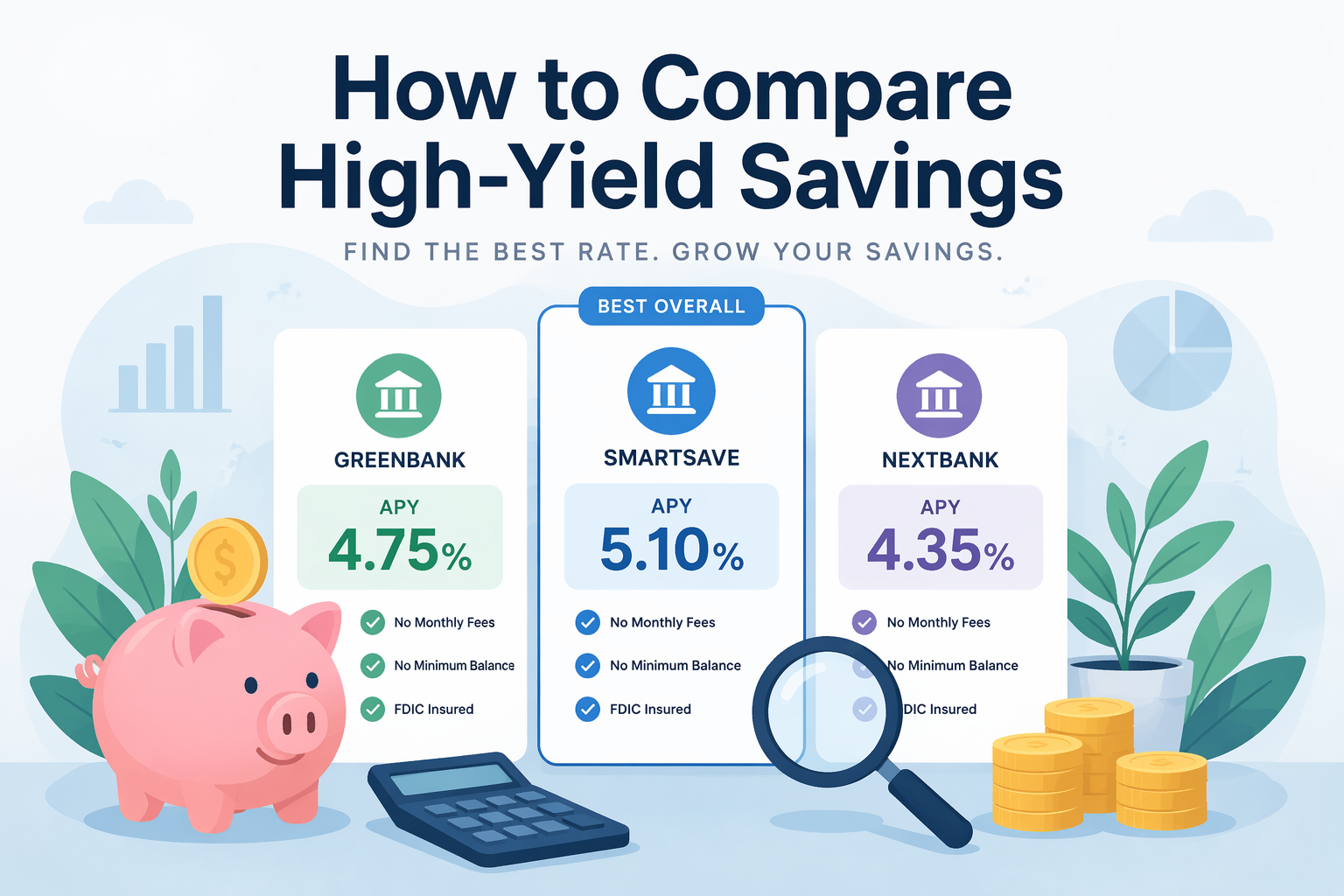
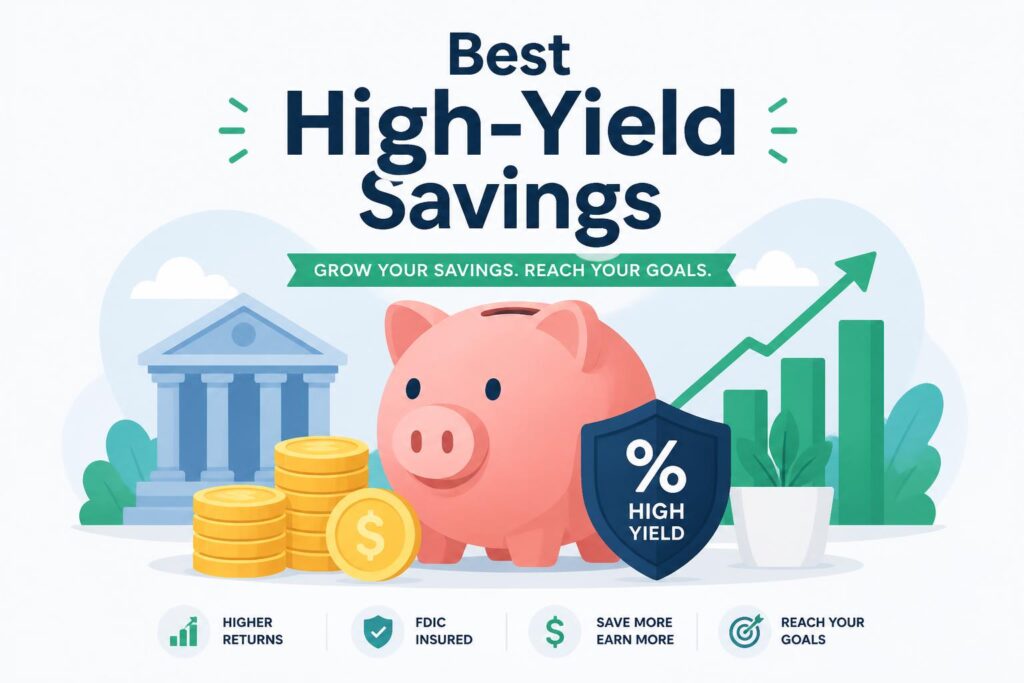
High-yield savings accounts pay way more interest than regular banks. The problem is figuring out which one to pick when you’re staring at a dozen options that all claim to have the “best rate.”
Some advertise 4.15% APY but bury a $5,000 minimum in the fine print. Others have no minimums but cut rates every other month. A few have great rates and terrible customer service, which you discover at 9pm on a Saturday when you need to move money and nobody picks up the phone.
Here’s how to compare them without getting lost in the weeds. You’ll check APY, minimums, fees, and FDIC insurance. Then you’ll open an account and start earning 10x more interest than you’re getting now.
What you need:
- Rough idea how much you’ll deposit at first
- Whether you need to pull money out often
- 15-20 minutes
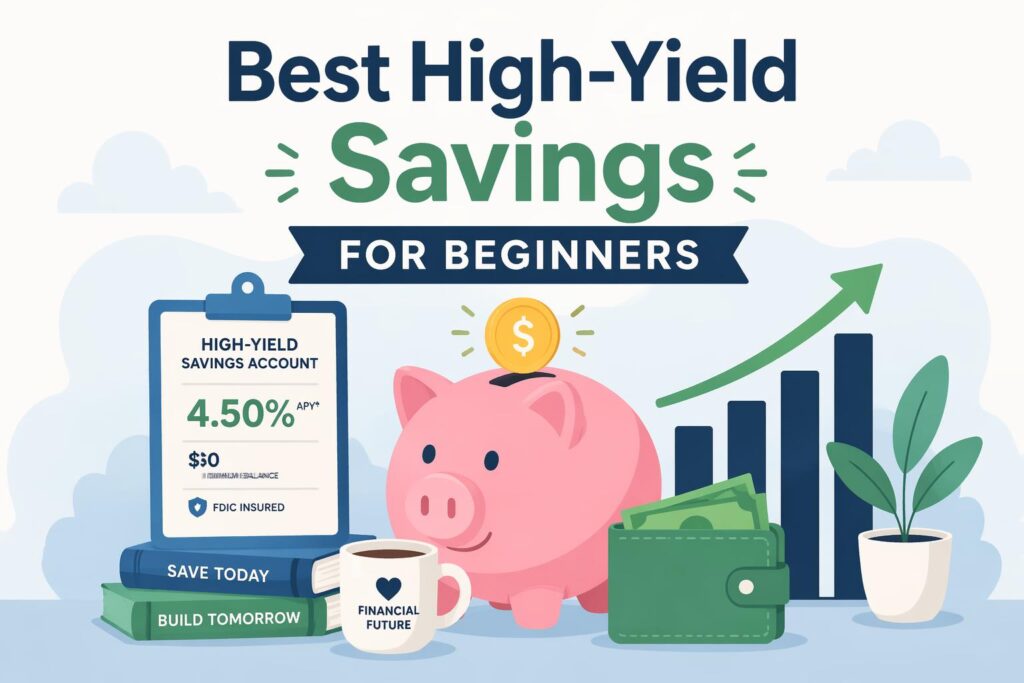
As of July 2026, top high-yield savings accounts pay around 4.15% APY. The national average is 0.38%. On a $25,000 emergency fund, that’s the difference between earning $1,037 per year and earning $95.
But the highest rate isn’t always the right move. Here’s what actually matters.
—
What APY Means
APY is Annual Percentage Yield. It’s the real rate you earn after compound interest.
If you see “4.15% APY” and you park $10,000 in the account for a year, you’ll earn about $415 in interest.
Banks advertise APY instead of the base interest rate because it sounds better. A 4.00% interest rate that compounds daily becomes 4.08% APY. Always compare APY to APY.
If a bank only shows “interest rate” and not APY, either calculate it yourself or skip them. They’re probably hiding something.
One thing to know: APY isn’t locked in. Banks change rates all the time based on what the Fed does. The rates you see today reflect where things stand in mid-2026. They’ll shift.
—
Current Top Rates (July 2026)
Start by finding the highest APYs available right now. According to surveys covering 850+ banks, here’s what the top accounts pay as of early July 2026:
- Forbright Bank — 4.15% APY, no minimum deposit
- CIT Bank — 4.10% APY, $100 minimum to open (but you need $5,000 to get the full rate)
- Vio Bank — 4.01% APY, $100 minimum
- Peak Bank — 4.01% APY, $100 minimum
- Happen Bank — 4.00% APY, $250 minimum to earn the APY
Compare that to the 0.38% national average. Even the fifth place account pays more than 10x what most people are getting.
If you see “up to X%” or a rate buried under asterisks, read the fine print before you get excited.
Rates change constantly. These numbers were current July 1-2, 2026. Check the bank’s site before you open anything.
—
Minimum Deposits
High-yield savings accounts fall into three groups:
- No minimum — Open with $1 if you want
- Low minimum ($100-$250) — Standard for most online banks
- High minimum ($5,000+) — Required to earn the advertised top rate
If you’re depositing under $100, go with Forbright (4.15%, no minimum) or Zynlo (3.85%, no minimum).
If you’re depositing $100 to $5,000, most top accounts are open to you.
If you’re depositing over $5,000, you unlock accounts like CIT that reward higher balances.
Watch for the difference between minimum opening deposit and minimum balance to earn APY. They’re often different numbers. Happen Bank requires $250 to earn the APY, but you can open the account with less. You just won’t earn 4.00% until you hit $250.
—
What the Rate Difference Actually Costs You
A 0.10% APY difference sounds tiny. On a $25,000 emergency fund, here’s what it means:
- 4.15% APY (Forbright): $1,037.50/year
- 4.00% APY (Happen): $1,000/year
- 0.38% APY (National average): $95/year
The gap between first place and tenth place is maybe $37.50 per year on $25,000.
The gap between first place and a regular bank savings account is $942.50 per year on the same balance.
Formula: Annual Interest = Balance × (APY ÷ 100) The higher your balance, the more that extra 0.10% matters. If you’re saving $100,000+, optimize every 0.05%. If you’re starting with $2,000, worry more about minimums and fees.
—
Fees
The best high-yield savings accounts charge nothing. Zero monthly maintenance fees. But check anyway:
- Monthly maintenance fee (should be $0)
- Excess withdrawal fees (some banks still charge after 6 withdrawals per month even though the federal limit was suspended)
- Wire transfer fees
- Paper statement fees ($2-5/month if you don’t go paperless)
- Minimum balance fees
If an account charges a monthly fee unless you meet a bunch of conditions — direct deposit, minimum balance, linked checking — skip it. High-yield savings shouldn’t work like that.
The fee schedule should be easy to find on the bank’s website, usually in account disclosures or terms. If you have to hunt for it, that’s a warning sign.
Most competitive accounts (Vio, Peak, Happen, Bread Savings, EverBank, Limelight, Popular Direct, Zynlo) charge no monthly fees. That’s standard in 2026.
—
FDIC Insurance
Your money is safe in a high-yield savings account if it’s FDIC insured.
FDIC covers up to $250,000 per depositor, per bank, per account type. If the bank fails, you get your money back — principal plus interest.
How to check:
- Look for “Member FDIC” in the website footer
- Verify on the FDIC’s BankFind tool: https://banks.data.fdic.gov/bankfind-suite/bankfind
- Search the bank name — it should show “Active” status
Every page of the bank’s site should mention FDIC membership. If they’re not insured, your money is at risk if they go under.
Online-only banks like Forbright, CIT, and Vio are FDIC insured just like Chase or Bank of America. “Online only” doesn’t mean “less safe.”
—
Access and Withdrawals
High-yield savings accounts are for money you don’t need to touch often. But you still need reasonable access.
Check:
- ACH transfers — Free, 1-3 business days to move money in or out
- Wire transfers — Faster, usually cost $15-30
- ATM card — Some accounts include one, most don’t
- Mobile app — You need this to check balances and initiate transfers
- Customer service hours — Online banks may have limited phone support
If you need instant cash access, keep some money in checking and use high-yield savings for your emergency fund.
Federal withdrawal limits (6 per month) were suspended during the pandemic and haven’t come back as of 2026. Some banks still enforce their own limits. Check the fine print.
—
Opening an Account
Some banks let you open an account online in five minutes. Others make you wait and ask for extra documents.
You’ll need:
- Social Security number or Tax ID
- Government ID (driver’s license, passport)
- Proof of address (sometimes)
- Initial deposit (often $0 — you can add funds later)
Red flags:
- Banks that require you to open checking first
- Promotional rates that expire in 3-6 months
- “Invitation only” accounts with vague rules
The application should take under 10 minutes. If it feels complicated, their customer service will probably match.
—
APY Tiers
Some banks advertise a high APY, then bury the fact that you only earn it on balances over $25,000.
Common structures:
- Flat rate — Same APY on every dollar (best for most people)
- Tiered rate — Higher APY above a certain balance
- Blended rate — Different APY on different chunks of your balance
CIT Bank’s 4.10% APY requires $5,000. Below that, you earn less. If you’re depositing $2,000, CIT might not be your best pick even though it ranks second overall.
Look for clear language: “4.15% APY on all balances” or “4.10% APY on balances of $5,000+.”
Accounts like Forbright (4.15%, no minimum), Vio (4.01%, $100 minimum), and Peak (4.01%, $100 minimum) use flat rates. You earn the advertised rate from dollar one.
—
Test Customer Service First
Before you move your emergency fund to a new bank, test their support:
- Check their hours
- Send a test email — how fast do they respond?
- Call their support line — how long do you wait?
- Read recent reviews — search “[Bank Name] reviews 2026”
If you have an urgent problem — failed transfer, locked account, disputed charge — you need a bank that picks up the phone.
Look for phone support during business hours, email support with 24-48 hour responses, and a mobile app rated 4.0+ stars.
—
Rate Stability
APY rates move around. But some banks cut rates more aggressively than others.
How to check:
- Look for historical rates on the bank’s site (some publish a rate history chart)
- Search “[Bank Name] rate history”
- Compare to competitors — do they stay in the top five, or do they spike rates to attract deposits then cut hard?
Red flag: A bank suddenly offering 0.50% more than everyone else. That’s usually a short-term promo, and the rate will drop fast.
Rates should track Fed policy. When the Fed cuts, high-yield savings rates drop across the board. Banks that keep competitive rates during Fed cuts are better long-term bets.
As of 2026, the Fed finished a rate-cutting cycle that started in 2024-2025. High-yield rates have settled around 3.85%-4.15%. If the Fed cuts more, expect these to drop.
—
Make Your Decision
If you’re starting with… Best option Under $100 Forbright (4.15%, no minimum) or Zynlo (3.85%, no minimum) $100-$5,000 Vio or Peak (4.01%, $100 minimum) Over $5,000 CIT (4.10%, $5,000 minimum for top rate) Need frequent access Keep some in checking, use high-yield for emergency fund Want the highest rate Forbright (4.15% as of July 2026)
- Go to the bank’s website
- Click “Open Account”
- Enter your info (SSN, address, ID)
- Link your checking account
- Make your first deposit (or schedule it)
- Verify your email and activate
Most online banks approve within 1-2 business days.
Set up automatic transfers from checking to savings. Even $50/week adds up, and at 4.15% APY you’re earning interest on every dollar.
—
What to Do Next
Open your account. Rates can change anytime.
Set up automatic transfers.
Review your rate every few months. If your bank drops way below competitors, switch.
The difference between 0.38% and 4.15% is $942.50 per year on $25,000.
—
Troubleshooting
The APY changed overnight Banks adjust rates constantly. Check the current rate before opening. If it drops right after you apply, call them — they often honor the rate you applied under.
My application was denied High-yield accounts use ChexSystems to check your banking history. Past overdrafts, unpaid fees, or fraud can get you denied. Try a second-chance account or work on your ChexSystems report.
I can’t link my checking account Some banks send two tiny deposits (under $1) to verify your account. Takes 2-3 days. Check your checking account for the deposits, then enter the amounts to finish verification.
The APY dropped after I opened APY is variable, not fixed. When the Fed cuts rates, banks lower savings rates. Normal. If your bank drops way more than competitors, move your money.
I need cash NOW but transfers take 3 days High-yield savings aren’t built for instant access. Keep 1-2 weeks of expenses in checking. Use high-yield for your 3-6 month emergency fund, not daily spending.
—
FAQ
Do I need to pay for anything? No. All these accounts are free to open and free to maintain.
How long does this take? 15-20 minutes if you follow the steps. Comparing rates takes under five minutes.
Can I compare without opening an account? Yes. Walk through everything, pick a winner, open it when you’re ready.
Is my money safe in an online-only bank? Yes, if it’s FDIC insured. Online banks like Forbright, CIT, and Vio are regulated the same as traditional banks. Your deposits are insured up to $250,000 per depositor per bank. They just don’t have branches, which is how they pay higher rates.
What if rates drop? Check competitors every few months. If your bank falls 0.25%+ below the top options, consider switching. Moving accounts is straightforward — open the new one, link the old one, transfer, close.
Should I get a CD instead? Depends. CDs lock in a fixed rate for a set term but penalize early withdrawal. High-yield savings have variable rates but full access. Use CDs for money you won’t touch. Use high-yield savings for emergency funds.
—
—
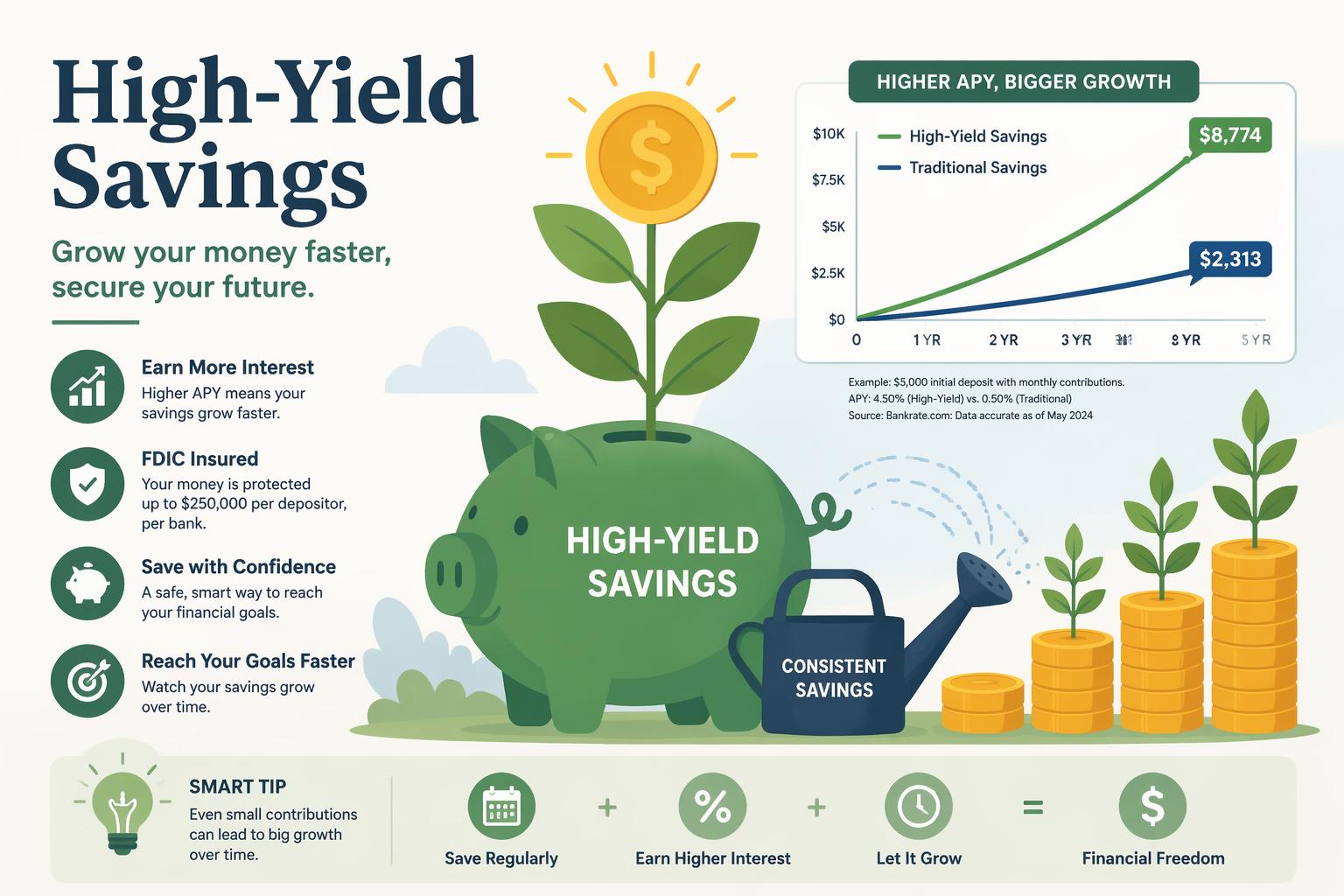
The national average savings rate is 0.38%. Top high-yield accounts pay 4.15% — nearly 11x more on the same balance.