
Clearscope Review: Is This $170/Month SEO Tool Actually Worth It?
I spent $170 on Clearscope because SEO people keep recommending it like it is the gold standard for content optimization.
After a month of using it almost every day, my take is simple: Clearscope is good. Very good, actually. But most small teams are probably paying too much for something they will not use often enough.
This review covers what Clearscope does well, where it feels limited, and how it compares with other AI SEO tools that cost a lot less.
What Clearscope does
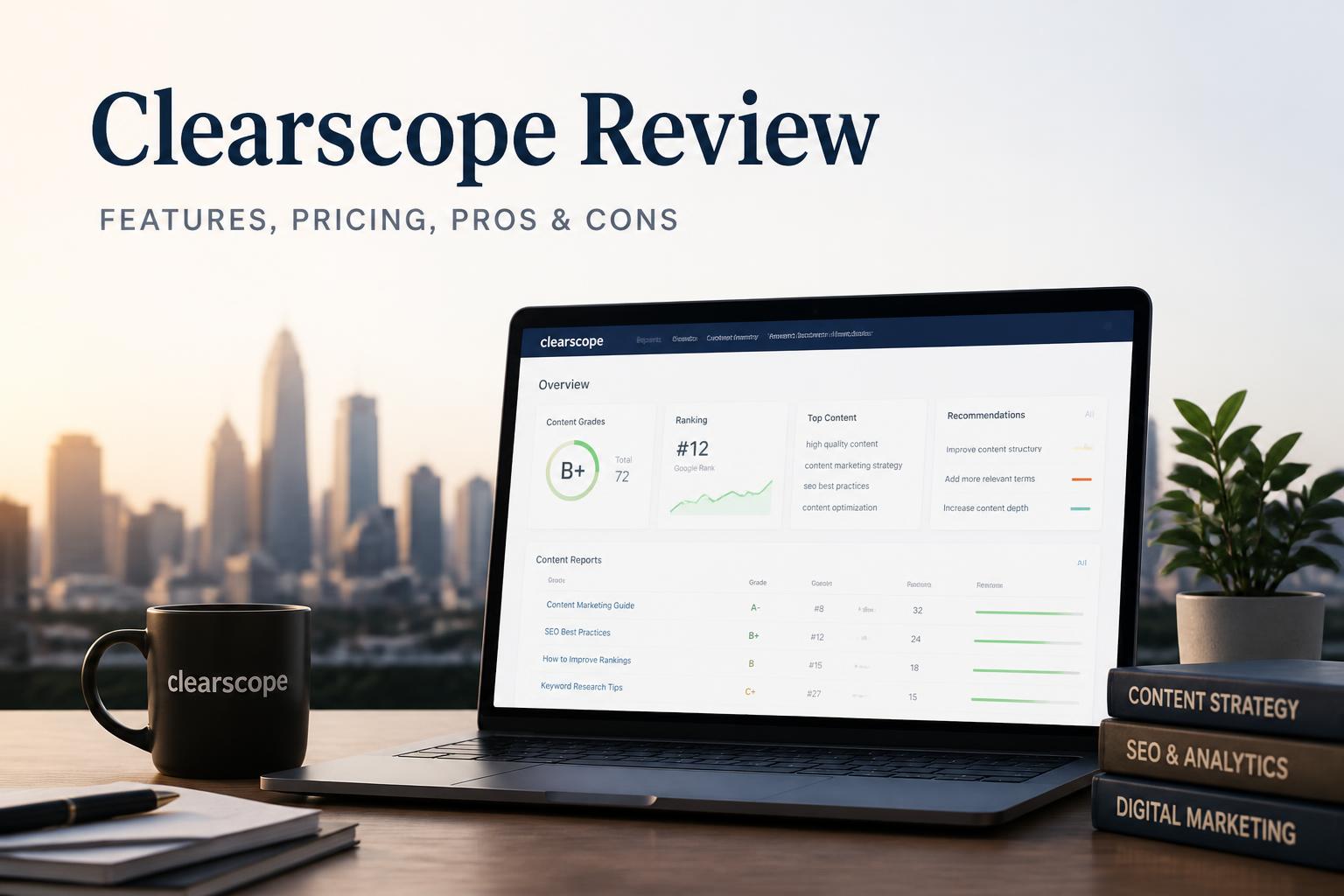
Clearscope analyzes the pages already ranking for your target keyword and shows you which topics and terms appear most often.
The workflow is straightforward. You enter a keyword, Clearscope reviews the top results, then gives you a content report. That report includes recommended terms, topic ideas, and a content grade. As you write, Clearscope scores the draft based on how well it covers the topic.
It does not write the article for you. It does not replace Ahrefs or Semrush. It does not track rankings. It is mainly a content optimization tool.
That narrow focus is both the best and worst thing about Clearscope.
My 30-day test
I used Clearscope on 15 posts across SaaS reviews, finance guides, and local service pages. Some were new articles. Others were older posts that were stuck outside the top 10.
The best result came from a post targeting “best CRM for small business.” Before optimization, it ranked around position 18 and brought in about 120 visits per month. After updating it with Clearscope, it moved to position 7 within three weeks and reached around 890 monthly visits.
Clearscope helped me spot missing sections on contact management, sales pipelines, and customer data. Those were not just keywords to sprinkle in. They were topics the article should have covered better.
Another strong result was a retirement guide for people in their 30s. I used Clearscope from the first draft, built the structure around the questions showing up in search results, and the post reached position 4 within two months.
But it did not work everywhere.
A local “plumber near me” page earned a decent Clearscope grade but barely moved. That SERP was dominated by map results, reviews, and proximity. Clearscope could not fix that.
A “Slack vs. Microsoft Teams” comparison reached an A grade and still got stuck around position 9. The top results came from huge brands like Slack, Microsoft, PCMag, TechRadar, and Forbes. My page matched the topic coverage, but it did not have their authority.
That pattern showed up again and again. Clearscope works best for informational content where depth matters. It is less useful for local pages, product pages, and SERPs where brand authority does most of the heavy lifting.
Clearscope pricing
Clearscope starts at $170 per month when billed annually.
The Essentials plan includes 20 content reports per month, unlimited optimizations on those reports, Google Docs integration, WordPress support, and one user seat.
That sounds fine until you realize each report is tied to a keyword. If you like testing multiple angles for one article, those credits disappear quickly. Extra reports cost more, and the annual billing push is hard to miss.
The Business plan jumps to around $1,200 per month. It adds unlimited reports, unlimited users, API access, inventory management, and plagiarism checks. That only makes sense for agencies or larger teams producing a serious amount of content.
Enterprise pricing is custom and usually starts much higher. Unless you manage hundreds of posts each month, it is probably more than you need.
The annoying part is the lack of flexibility. There is no real free trial, and once you pay, you should not expect a generous refund policy.
Where Clearscope is strong
Clearscope’s content reports are genuinely useful. The term suggestions feel more thoughtful than what I have seen in many cheaper tools. It does not just throw a giant keyword list at you. It helps you understand what subtopics belong in the article.
For example, for “email marketing software,” it suggested terms like “automation workflows,” “list segmentation,” and “A/B testing.” More importantly, it showed that top-ranking pages often treated those as full sections, not random phrases.
The Google Docs integration is also excellent. I write most drafts in Google Docs, so being able to see Clearscope suggestions in the sidebar made the tool much easier to use.
I also like that Clearscope does not try to become an AI writer. Plenty of SEO tools now generate bland drafts that all sound the same. Clearscope stays focused on guidance. You still have to write the article yourself.
Where Clearscope falls short
The biggest problem is price.
For $170 per month, Clearscope only handles content optimization. You still need another tool for keyword research, rankings, backlinks, and technical SEO. That means your actual SEO stack can get expensive fast.
Surfer SEO and Frase are not as polished, but they include more features for less money. Surfer starts around $89 per month. Frase is cheaper again. For many users, those tools will be good enough.
Clearscope also lacks a proper competitor breakdown. I wanted quick answers to questions like:
Which headings appear across the top results? What format is ranking? How long are the competing pages? How many images or internal links do they use?
Clearscope gives you terms. It does not give you the full SERP picture.
The readability score is another weak spot. It uses a formula that can push you toward oversimplifying content. One of my B2B SaaS posts was flagged as too complex, even though the audience expected technical detail.
The grading system can also become a trap. An A grade feels nice, but it is not a ranking guarantee. I had B-grade posts rank better than A-grade posts. Use the grade as a guide, not a target to chase at all costs.
Clearscope vs. alternatives
Feature Clearscope Surfer SEO Frase MarketMuse Price $170/mo $89/mo $45/mo $149/mo Content reports 20/mo Unlimited Unlimited 100/mo Keyword research No Yes Yes Yes SERP analysis Basic Advanced Advanced Advanced AI writing No Yes Yes Yes Google Docs integration Yes No No No Rank tracking No No No Yes Best for Quality-focused teams Solo creators Budget marketers Larger content teams
That is the real decision. Do you want the cleanest optimization tool, or do you want a cheaper tool that also handles keyword research, outlines, and SERP analysis?
Most people should choose the second option.
Who should buy Clearscope?
Clearscope makes sense if you run a content agency, manage a serious editorial calendar, or publish articles where a few ranking positions can mean thousands of dollars in revenue.
It also makes sense if your team already uses Google Docs and you care more about content quality than publishing volume.
Skip it if you are a solo blogger, a small business owner, or someone publishing only a few posts per month. Surfer or Frase will likely give you enough guidance for much less money.
Also skip it for local service pages and ecommerce product pages. Clearscope is built for informational content, not every SEO use case.
FAQ
Is Clearscope worth it for beginners?
No. Beginners should start with a cheaper tool like Frase or Surfer. Clearscope is better for people who already understand SEO and want to improve content that has a real chance of ranking.
Can Clearscope replace Ahrefs or Semrush?
No. Clearscope does not do keyword research, backlink analysis, rank tracking, or technical audits. You still need a broader SEO tool for those jobs.
Does Clearscope work with WordPress?
Yes, but the workflow is not ideal. The smoother option is writing in Google Docs with the Clearscope add-on, then moving the finished draft into WordPress.
How long does Clearscope take to work?
In my test, some posts improved within two to four weeks. But results depend on your site authority, the keyword, the competition, and whether your content actually satisfies the search intent.
Does Clearscope offer a free trial?
No. Clearscope offers demos, but not a proper free trial. You need a paid plan to use the product.
What is the best Clearscope alternative?
Surfer SEO is the closest alternative if you want content optimization plus SERP analysis and AI writing. Frase is the better budget pick. MarketMuse is closer to Clearscope for larger content teams, but it is also expensive.
Final verdict
Clearscope is one of the best content optimization tools I have used. It is also overpriced for most users.
If you publish high-value informational content and already have the rest of your SEO stack covered, Clearscope can be worth the $170 per month. The reports are useful, the Google Docs integration is smooth, and the suggestions are better than average.
But if you are a solo creator or small team, start with Surfer or Frase. You will get most of the value for much less money, plus extra features Clearscope does not include.
My recommendation: try Surfer first. Move to Clearscope only when you know exactly why you need it.
For a wider comparison, read our full guide to the best AI SEO platforms.