How to Choose Options Trading Strategies: A Step-by-Step Guide (2026)
Affiliate Disclosure: This article contains affiliate links. If you sign up for a service through these links, we may earn a commission at no additional cost to you. We only recommend products we’ve researched and believe will help you succeed.
You’re staring at your brokerage account, ready to explore options trading. Where do you start?
4.6 billion options contracts traded in 2025. Daily volumes now clear 40 million. Options moved from institutional trading desks to retail portfolios, but most beginners have no idea how to pick the right strategy for their goals.
The problem isn’t complexity. It’s that most traders jump in without matching their strategy to their risk tolerance, capital, and market view. Buying calls because someone on Twitter did isn’t a strategy. It’s gambling.
This guide shows you how to evaluate your objectives, match them to the right options strategy, and execute your first trade with confidence. Whether you’re protecting a portfolio or trying to generate income, you’ll learn the decision process that keeps traders from blowing up their accounts.
What you need:
- A brokerage account with options trading approval (most brokers offer tiered levels—start with Level 1 or 2)
- $2,000–$25,000 in trading capital (you can start smaller, but this range gives you flexibility)
- Basic stock trading experience (if you’ve never bought a stock, start there first)
- 2–3 hours to read this guide and practice on paper trading
You don’t need to quit your job or stare at charts all day. You need clarity on what you’re trying to accomplish and which strategy gets you there.
Understand What Options Actually Are
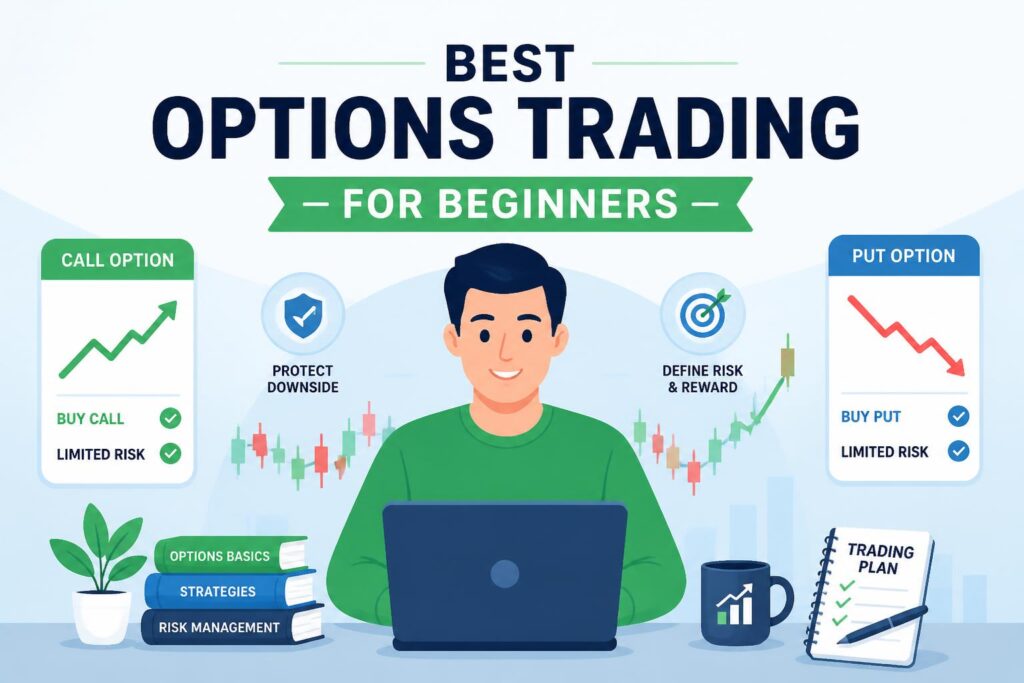
Options are contracts that give you the right, but not the obligation, to buy or sell a stock at a specific price (the strike price) before a specific date (expiration). Think of them as insurance contracts for stocks.
Two types:
- Call options: Right to buy a stock at the strike price
- Put options: Right to sell a stock at the strike price
When you buy an option, you pay a premium for that right. The seller collects that premium and takes on the obligation to deliver if you exercise.
Options aren’t a niche strategy anymore. In 2026, daily volumes regularly exceed 40 million contracts. They’re reshaping how stocks move, not just how traders speculate.
> Note: Many beginners confuse “I bought a call option” with “I bought the stock.” You didn’t. You bought the right to buy the stock at a certain price. The stock can go up 50% and your call can still expire worthless if it doesn’t cross your strike.
Define Your Trading Objective
Most traders skip this and wonder why they keep losing money. Your strategy choice flows directly from what you’re trying to accomplish.
Ask yourself:
What’s my market outlook?
- Bullish (stock going up) → Call options or bull spreads
- Bearish (stock going down) → Put options or bear spreads
- Neutral (stock staying flat) → Income strategies like covered calls or iron condors
- Volatile (big move coming, direction uncertain) → Straddles or strangles
What’s my risk tolerance?
- Low risk → Option selling strategies (covered calls, cash-secured puts)
- Moderate risk → Defined-risk spreads (vertical spreads, iron condors)
- High risk → Buying options outright (long calls, long puts)
What’s my goal?
- Generate income from stocks I already own → Covered calls
- Protect my portfolio from a crash → Protective puts
- Speculate on a big move → Long calls or puts
- Get paid while waiting to buy a stock cheaper → Cash-secured puts
Write down your answers. If you said “I want to make money fast with low risk,” you’re lying to yourself. Every options strategy involves tradeoffs. The best strategy is the one that matches your real objective and risk profile.
Learn Four Beginner-Friendly Strategies
Don’t try to master everything at once. These four cover 80% of what retail traders need.
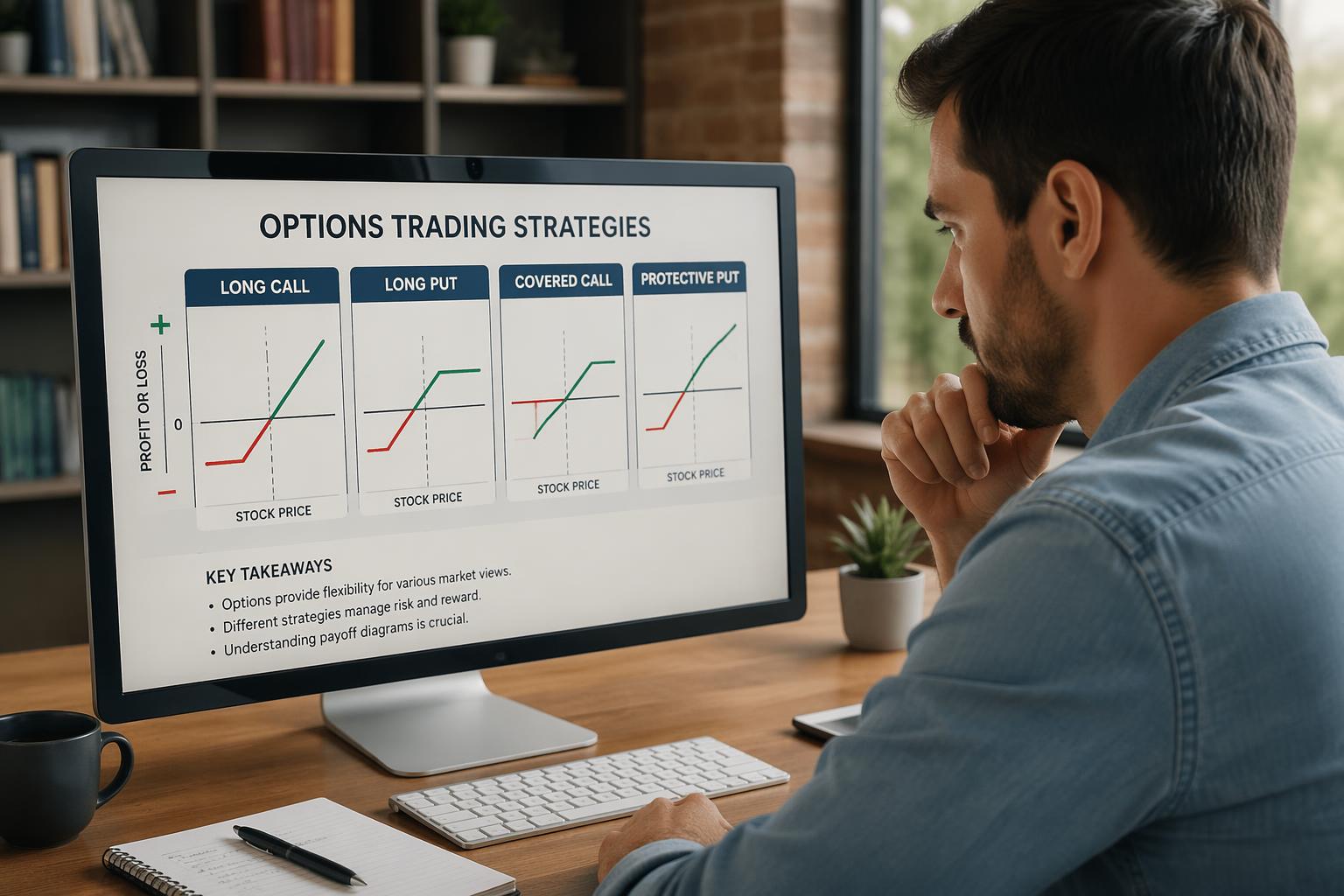
Buying Call Options (Bullish Bet)
You pay a premium to control 100 shares without buying them outright. Use this when you believe a stock will rise significantly before expiration.
Example: Tesla is trading at $250. You think it’ll hit $280 in two months. Instead of buying 100 shares for $25,000, you buy one call option with a $260 strike for $800. If Tesla hits $280, your option could be worth $2,000 (150% gain). If it stays below $260, you lose the $800.
Risk: You can lose 100% of your premium if the stock doesn’t move enough.
Buying Put Options (Bearish Bet or Protection)
You pay a premium for the right to sell shares at a set price, profiting when stocks fall. Use this when you believe a stock will drop, or you own shares and want protection.
Example: You own 100 shares of Apple at $180. You’re worried about a crash. You buy a put with a $175 strike for $400. If Apple drops to $150, your put is worth $2,500, offsetting most of your stock losses. If Apple stays above $175, you lose the $400 but keep your gains.
Risk: You can lose 100% of the premium.
Covered Calls (Income Generation)
You sell call options against stocks you already own, collecting premium income. Use this when you own a stock you expect to stay flat or rise modestly, and you want extra income.
Example: You own 100 shares of Microsoft at $420. You sell a call with a $440 strike expiring in one month, collecting $300. If Microsoft stays below $440, you keep the premium and your shares. If it goes above $440, your shares get called away at $440 (you still profit, just capped).
Risk: Limited upside. If the stock rockets higher, you miss gains above the strike.
Cash-Secured Puts (Getting Paid to Wait)
You sell put options on a stock you’d like to own at a lower price, collecting premium while you wait. Use this when you want to buy a stock but think it’s overpriced. You’d happily buy at a lower price and get paid to wait.
Example: Nvidia is at $140, but you’d only buy at $130. You sell a put with a $130 strike for $400. If Nvidia drops below $130, you’re obligated to buy 100 shares at $130 (which you wanted anyway). If it stays above $130, you keep the $400.
Risk: You must have cash set aside to buy the shares if assigned. Don’t sell puts on stocks you don’t actually want to own.
> Note: All four strategies are available at most brokerages under Level 1 or Level 2 options approval.
Choose Your Strike Price and Expiration Date
Once you’ve picked a strategy, you need strike price and expiration date.
Strike Price
Three categories:
- In-the-money (ITM): Strike is already favorable (calls below current price, puts above). More expensive, higher probability of profit.
- At-the-money (ATM): Strike equals current stock price. Moderate cost, moderate probability.
- Out-of-the-money (OTM): Strike is not yet favorable (calls above current price, puts below). Cheapest, lowest probability.
Beginners usually buy cheap OTM options because they seem like a better deal. They’re not. They’re lottery tickets. If you want a real chance of profit, start with ATM or slightly OTM.
Expiration Date
As of 2026, options expirations happen every week for popular stocks, but monthly expirations have the most liquidity. Key dates from the 2026 options calendar:
- March 20, June 18, September 18, December 18: “Triple Witching” days with the highest trading volumes
Time is both friend and enemy:
- Buy options: You need enough time for your thesis to play out, but time decay (Theta) works against you. Aim for 30–60 days.
- Sell options: Time decay works in your favor. Selling 30–45 day options captures the fastest decay period.
Don’t buy options expiring in less than 3 weeks unless you’re experienced.
Understand the Greeks
You don’t need a PhD, but you need to understand four factors that determine option price. These are the Greeks.
Delta: How much your option price changes when the stock moves $1.
- Calls have positive delta (0 to 1.0). A delta of 0.50 means your option gains $50 if the stock rises $1.
- Puts have negative delta (0 to -1.0).
- Use delta to estimate probability: a 0.30 delta option has roughly a 30% chance of expiring in-the-money.
Theta: How much value your option loses each day due to time decay.
- A theta of -0.05 means you lose $5 per day just from time passing.
- Theta accelerates as expiration approaches. The last two weeks are brutal for option buyers.
Vega: How much your option price changes when volatility changes.
- Higher volatility = higher option prices.
- If you buy options before earnings and volatility drops after (IV crush), you can lose money even if you were right about direction.
Gamma: How fast your delta changes. Advanced concept—ignore this until you’ve mastered the first three.
> Note: Your broker’s options chain will display all Greeks. If you don’t see them, look for a “Greeks” or “Analytics” toggle.
Execute Your First Trade on Paper
Don’t skip this. Even if you’re confident, start with paper trading.
Most brokers offer paper trading (virtual or simulated trading) where you practice with fake money in real market conditions.
Paper trading workflow:
- Open your broker’s paper trading platform
- Find the stock you want to trade options on
- Pull up the options chain
- Select your strategy, strike, and expiration
- Enter the trade like you would with real money
- Track it for at least two weeks
Watch what happens to the option price as the stock moves, time passes, and volatility changes.
When to go live:
- You’ve paper traded at least 5 options trades
- You understand why your winners won and losers lost
- You’ve set a clear risk limit (e.g., “I will not risk more than 5% of my account on any single trade”)
- You can explain your trade thesis in one sentence
Manage Your Trade
Placing the trade is easy. Managing it is where most traders fail.
Set profit targets and stop losses before you enter:
- Profit target: “I’ll close this trade if it gains 50%.” Many traders target 25–50% gains.
- Stop loss: “I’ll close this trade if it loses 50% of its value.” Better to take a small loss than watch it go to zero.
Monitor key risk points:
- Earnings announcements: Volatility spikes before earnings, then crashes after. If you’re holding through earnings, know your risk.
- Options expiration dates: In 2026, Cboe expanded trading hours with pre-market sessions from 7:30 a.m. ET to 9:25 a.m. ET and post-market sessions from 4:00 p.m. ET to 4:15 p.m. ET for high-volume options. Prices can move when you’re not watching.
- Gamma risk: As expiration approaches, at-the-money options become increasingly volatile.
When to close early:
- You’ve hit your profit target
- You’ve hit your stop loss
- Your thesis has changed
- Expiration is in 5 days or less and the option is OTM (it’s probably going to zero—cut your losses)
Don’t marry your trades. The goal is to make money, not to be right.
Track Your Results
After every trade—win or lose—fill out a simple trade journal.
What to track:
- Date and stock
- Strategy used
- Strike price and expiration
- Entry price and exit price
- Profit/loss (both $ and %)
- What you expected to happen
- What actually happened
- What you learned
After 10 trades, patterns will emerge. You’ll notice which strategies work for your personality and which don’t. Maybe you’re great at selling covered calls but terrible at timing directional bets. That’s valuable information.
Common Mistakes
“I bought a cheap out-of-the-money option because it was only $50”
Cheap options are cheap for a reason—low probability of profit. They expire worthless 70–90% of the time.
“I’m going to hold this option until expiration to maximize gains”
Time decay accelerates rapidly in the last 2 weeks. Most profitable traders close winning trades at 25–50% gains rather than holding for 100%.
“I don’t need to set a stop loss because I’m confident in this trade”
Confidence doesn’t protect you from market surprises. Every trade should have a predefined max loss.
“I’ll trade options on earnings announcements because the stock will make a big move”
Even if you’re right about direction, IV crush can make you lose money. Avoid earnings trades until you’re experienced.
Troubleshooting
The option I want has a huge bid-ask spread (like $2.00 bid, $2.50 ask). Should I still trade it?
No. Wide spreads mean low liquidity. You’ll pay too much to enter and get screwed when you exit. Stick to options with average daily volume above 150,000 contracts.
I bought a call and the stock went up, but my option lost value. What happened?
You got hit by IV crush (volatility dropped) or Theta decay (time passed faster than the stock moved). Check your Vega and Theta values next time.
My broker denied my options application. Now what?
Start with Level 1 approval (covered calls and cash-secured puts only). After 3–6 months, apply for Level 2.
I can’t afford 100 shares of expensive stocks like Tesla or Nvidia. Can I still trade options?
Yes. Buying options requires much less capital than buying shares. A Tesla call might cost $800 instead of $25,000 for 100 shares. But limited capital means limited risk tolerance—start small.
Next Steps
Focus on one strategy for your first 20 trades
Don’t jump between covered calls, long puts, and iron condors. Master one strategy first. Most beginners start with covered calls or cash-secured puts because they have defined risk and you collect premium instead of paying it.
Use a broker with strong options tools
Not all brokerages are equal for options traders. Look for:
- Real-time options chains with Greeks displayed
- Paper trading functionality
- Low options commissions (most charge $0.50–$0.65 per contract)
- Mobile app with options trading capability
Continue your education
Options trading has a learning curve. In 2026, retail participation hit record levels, and educational content exploded to meet demand.
Join a community (but stay skeptical)
Options trading communities can provide support and trade ideas, but be wary of “gurus” selling courses or promising guaranteed returns. If someone’s making so much money trading, why are they selling a $997 course?
The best options traders got there by studying, paper trading, starting small with real money, tracking every trade, and slowly building skill over months and years.
FAQ
Do I need a lot of money to start trading options?
Most traders start with $2,000–$25,000, but you can begin paper trading with $0. For real money trades, you need enough to avoid taking excessive risk on any single trade. If you only have $1,000, a single $200 options trade is 20% of your account—too risky.
Is options trading riskier than stock trading?
It depends on the strategy. Buying options outright is riskier than buying stocks (you can lose 100% of your investment). But selling covered calls against stocks you own is arguably less risky than holding stocks alone—you’re generating extra income and reducing your cost basis.
Can I trade options in my IRA or retirement account?
Yes, most brokers allow options trading in IRAs, but you’re typically limited to Level 1 and Level 2 strategies (no naked options). Covered calls and cash-secured puts are allowed.
How much time do I need to dedicate to options trading?
If you’re trading longer-dated options (30–60 days to expiration) and using conservative strategies, you can manage trades with 30–60 minutes per week. Day trading options requires significantly more time and experience.
What happens if I can’t sell my option before expiration?
If your option is in-the-money at expiration, your broker will typically auto-exercise it (for calls, you’ll buy the shares; for puts, you’ll sell them). If it’s out-of-the-money, it expires worthless. Always try to close positions before expiration to maintain control.
Should I sell options or buy options as a beginner?
Starting as a seller (covered calls, cash-secured puts) means time decay works in your favor and you have higher probability of profit. Buying options is tempting because of the leverage, but most options expire worthless—you’re fighting time decay from day one.
—
Every successful options trader started exactly where you are—confused, cautious, wondering if they’d blow up their account. The difference between traders who succeed and those who quit: they started small, tracked every trade, and learned from their losses. Your first trade won’t be perfect. Your tenth probably won’t be either. But by trade twenty, you’ll have developed intuition that no article can teach.