How to Compare Day Trading Platforms and Strategies: A Complete 2026 Guide
Affiliate Disclosure: This article contains affiliate links. If you sign up through our links, we may earn a commission at no extra cost to you. We only recommend tools we’ve researched and believe will help you succeed.
Choosing the right day trading platform and strategy in 2026 isn’t just about picking the cheapest broker or following the latest trend. With only 1-4% of day traders achieving consistent long-term profitability and 72% experiencing net losses, the decisions you make before you start trading can determine whether you join the tiny percentage of winners or the vast majority who lose money.
By the end of this guide, you’ll know exactly how to evaluate trading platforms, compare strategy success rates, and make informed decisions that align with your goals and risk tolerance. Whether you’re comparing brokers, strategies, or market types, this step-by-step framework will help you avoid the most expensive mistakes beginners make.
Estimated time: 20-25 minutes to complete this evaluation process
The Hard Truth About Day Trading Comparisons
Before we dive into how to compare options, you need to understand what you’re comparing against. The data from 2026 is sobering: according to research tracking over 450,000 traders on the Taiwan Stock Exchange, only 0.88% were consistently profitable. When traders use margin (borrowed money to amplify trades), average returns drop to -4.53%.
This doesn’t mean day trading is impossible—it means your comparison process must be ruthlessly honest about success rates, costs, and requirements. You’re not comparing which platform makes trading easiest—you’re comparing which gives you the best shot at joining that 1-4% who succeed long-term.
What You Need Before Starting
Before you begin comparing platforms and strategies:
- 30-45 minutes of focused time to evaluate options
- A clear understanding of your starting capital (note: pattern day traders must maintain $25,000 minimum equity in the U.S.)
- A realistic assessment of time commitment (successful day trading requires full-time dedication)
- A spreadsheet or notes app to track your comparison criteria
- No account required yet—we’ll compare first, then recommend where to practice
Step 1: Define What You’re Actually Comparing
Day trading comparison isn’t one decision—it’s four interconnected decisions:
- Market type: Stocks, forex, crypto, or futures?
- Trading platform: Which broker offers the tools you need?
- Strategy approach: Momentum, breakout, scalping, or mean reversion?
- Risk framework: How much capital and time you’ll commit?
Start by writing down your specific comparison goal. Instead of “find the best day trading platform,” write:
- “Compare stock trading platforms for someone starting with $30,000”
- “Compare crypto vs. forex markets for part-time trading”
- “Compare momentum trading vs. breakout strategies for volatile tech stocks”
You should see: A clear, specific comparison question that narrows your research scope.
> Note: If you’re not sure which market to trade yet, start with Step 2 to compare markets first, then return to compare platforms within your chosen market.
Step 2: Compare Market Types by Realistic Success Rates
Each market has different characteristics that affect your odds. Here’s how to evaluate them:
Stocks:
- Trading hours: 9:30 AM – 4:00 PM ET (limited window)
- Pattern Day Trader (PDT) rule: Requires $25,000 minimum equity
- Volatility: Moderate to high in tech and small-cap stocks
- Success insight: Retail investors account for 20-25% of daily equity volume in the U.S., creating opportunities but also noise
Forex:
- Trading hours: 24 hours, 5 days per week
- Minimum capital: Often lower than stocks (some brokers allow $100 starts)
- Volatility: Over $6.60 trillion in daily trades creates constant liquidity
- Success insight: High leverage (50:1 or more) amplifies both gains and losses dramatically
Crypto:
- Trading hours: 24/7 year-round
- Minimum capital: Can start with as little as $5-10
- Volatility: Extremely high—daily swings of 5-10% common
- Success insight: Less regulated, higher fraud risk, but no PDT restrictions
Futures:
- Trading hours: Near 24-hour trading for major contracts
- Minimum capital: Typically $1,000-5,000 for day trading futures
- Volatility: High leverage (10:1 to 20:1 typical)
- Success insight: Margin requirements and contract specifications can be complex
Create a simple comparison matrix:
Factor Stocks Forex Crypto Futures Min. capital $25,000 (PDT) $100-1,000 $5-100 $1,000-5,000 Trading hours 9:30-4 ET 24/5 24/7 ~24/5 Leverage risk Moderate Very high High High Learning curve Moderate Steep Moderate Steep
> Note: Lower minimum capital doesn’t mean lower risk. Crypto and forex allow small starts but have higher volatility and leverage risks.
Step 3: Compare Trading Platforms by Essential Features
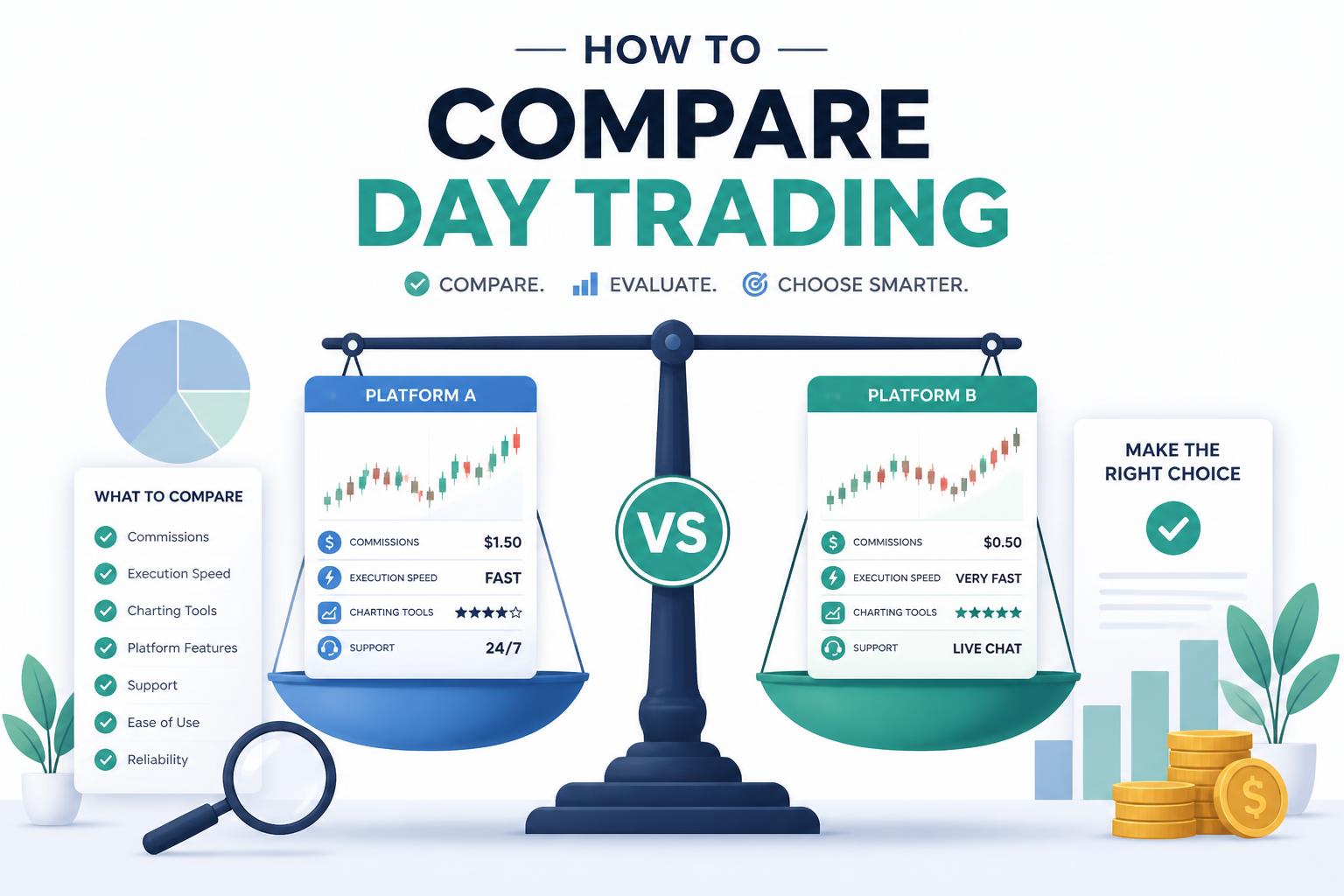
Once you know which market you’re trading, compare platforms within that market using these criteria:
1. Commission and fee structure:
- Per-trade commissions (many stock platforms now offer $0 commissions)
- Spread costs (the difference between buy and sell prices—critical for forex/crypto)
- Inactivity fees
- Withdrawal fees
- Data feed costs
2. Paper trading (simulation) capability: This is non-negotiable. According to expert traders in 2026, you must “trade with a simulator before trading with real money.” Look for platforms offering:
- Real-time market data in simulation mode
- Unlimited practice time
- Full feature access (not a stripped-down demo)
3. Order execution quality:
- Order fill speed (critical for day trading)
- Slippage rates (how often your order fills at a worse price than expected)
- Access to direct market access (DMA) or smart order routing
4. Charting and technical analysis tools: Day traders rely heavily on technical analysis. Essential tools include:
- Multiple chart types (candlestick, bar, line)
- Technical indicators (moving averages, RSI, MACD, Bollinger Bands)
- Drawing tools (trendlines, support/resistance levels)
- Customizable layouts
Recommended platforms for comparison in 2026:
E*TRADE:
- Commission-free stock and ETF trading
- Paper trading simulation tools
- Strong educational resources
- Best for: Stock traders wanting free practice accounts
Charles Schwab:
- Extensive learning resources
- Preset layouts designed for new traders
- Robust research tools
- Best for: Beginners who value education and support
Interactive Brokers:
- Sophisticated tools for advanced traders
- Competitive margin rates
- Access to global markets
- Best for: Experienced traders or those planning to trade multiple markets
ProRealTime:
- Free advanced charting platform
- Extensive technical indicators
- Multiple timeframe analysis
- Best for: Traders prioritizing chart analysis over execution
Create a scoring matrix with your top 3-5 platforms:
Platform Fees Paper Trading Tools Ease of Use Total Score Platform A 4/5 5/5 4/5 3/5 16/20 Platform B 5/5 3/5 4/5 5/5 17/20
You should see: One or two platforms emerging as clear leaders for your specific needs.
Step 4: Compare Day Trading Strategies by Real Success Rates
Not all strategies are created equal. Here’s how different approaches perform based on 2026 data:
Breakout Trading:
- Success rate: ~30% among studied traders
- How it works: Buy when price breaks above resistance or sell when it breaks below support
- Best for: Markets with clear technical patterns and moderate volatility
- Risk: False breakouts are common—price breaks through then reverses
Momentum Trading:
- Success rate: Traders using structured momentum models achieved win rates of 55-70%
- How it works: Trade in the direction of strong price movements, entering when momentum is confirmed
- Best for: Volatile markets with strong trends
- Risk: Momentum can reverse suddenly, especially near market close
Scalping:
- Success rate: Highly variable—requires exceptional execution
- How it works: Make dozens to hundreds of trades per day for tiny profits each
- Best for: Traders with very fast execution and low commission costs
- Risk: High stress, commission costs can eat profits, requires full-time focus
Mean Reversion:
- Success rate: Context-dependent—works best in range-bound markets
- How it works: Bet that prices will return to their average after extreme moves
- Best for: Stable markets with defined trading ranges
- Risk: “The trend is your friend”—fighting strong trends loses money quickly
To compare strategies:
- Match the strategy to current market conditions (trending vs. range-bound)
- Assess your available time (scalping requires constant attention; swing trading can be part-time)
- Consider your emotional temperament (momentum trading requires quick decisions; mean reversion requires patience)
- Calculate your win rate requirement: If your average winner is $3,500 and your average loser is $2,000, you need a 36% win rate to break even
Professional trader Craig verified these principles with $20 million in trading profits, maintaining a 71% accuracy rate. His approach combines momentum trading with strict risk management—proving that structured, disciplined strategies can work.
You should see: One strategy type that matches your personality, schedule, and market choice.
> Warning: Don’t strategy-hop. Pick one, master it in simulation for at least 3 months before trading real money, then stick with it long enough to gather meaningful performance data.
Step 5: Compare Risk Management Frameworks
This is where most comparisons fail. Traders spend weeks comparing platforms but minutes thinking about risk management. Yet risk management is what separates the 1-4% who succeed from the 72% who lose money.
Compare these risk frameworks:
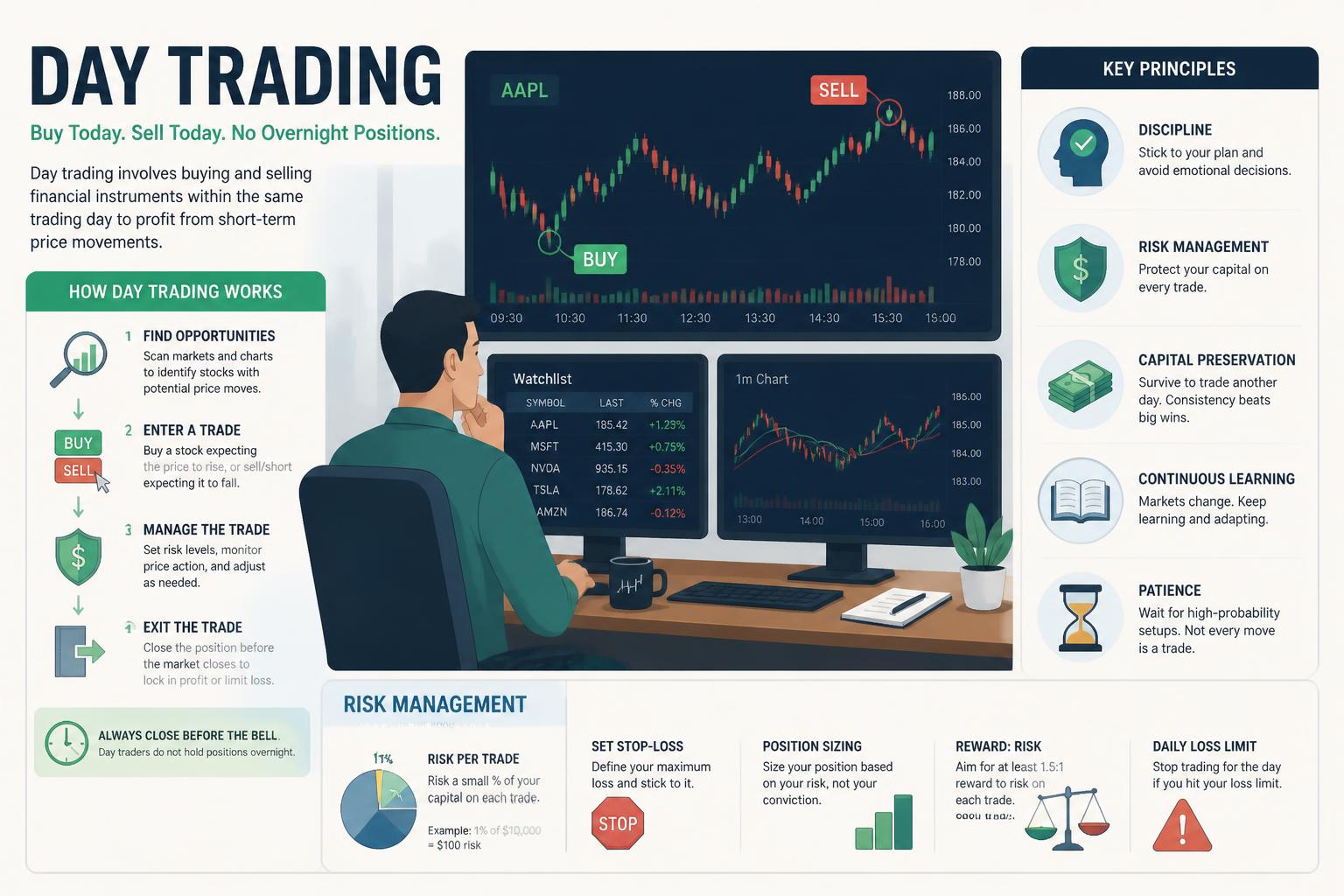
Position Sizing Rules:
- Risk 1% of capital per trade (conservative)
- Risk 2% of capital per trade (moderate)
- Risk 3%+ per trade (aggressive—higher risk of ruin)
Example: With $30,000 capital:
- 1% risk = $300 maximum loss per trade
- 2% risk = $600 maximum loss per trade
- 3% risk = $900 maximum loss per trade
Stop-Loss Placement Methods:
- ATR-based stops: Set stop-loss at 0.5-1.0 ATR (Average True Range) from entry—adjusts to market volatility
- Percentage stops: Fixed percentage below entry (e.g., 2%)
- Technical stops: Below support levels or above resistance
Daily Loss Limits:
- Stop trading after losing 3% of capital in one day (conservative)
- Stop after losing 5% (moderate)
- No daily limit (dangerous—one bad day can destroy weeks of gains)
Leverage Comparison:
- No leverage (cash only): Lowest risk, slowest growth
- 2:1 to 4:1 leverage (typical for stocks): Moderate risk amplification
- 10:1+ leverage (forex/futures): High risk—remember that investors using margin averaged returns of -4.53%
Create your risk framework before comparing execution tactics:
My Risk Framework:
- Maximum risk per trade: [1-3%]
- Stop-loss method: [ATR/percentage/technical]
- Daily loss limit: [3-5% of capital]
- Maximum leverage: [1:1 to 4:1]
- Required win rate to break even: [calculated based on average winner/loser]
You should see: A complete risk framework that will protect your capital during the inevitable losing streaks.
Step 6: Compare Costs Over Time, Not Per Trade
The cheapest per-trade cost isn’t always the cheapest overall. Compare total costs over realistic trading volume:
Example comparison for active day trader (20 trades per day, 20 trading days per month = 400 trades/month):
Platform A: $0 commissions, but 2-pip spread on forex pairs
- Cost per trade: $20 (on standard lot)
- Monthly cost: $8,000
Platform B: $5 commission per trade, 0.5-pip spread
- Commission cost: $5 × 400 = $2,000
- Spread cost: $5 × 400 = $2,000
- Monthly cost: $4,000
Platform A advertises “$0 commissions” but costs twice as much for active traders.
Other hidden costs to compare:
- Data feed fees ($50-200/month for real-time data)
- Platform fees for advanced tools
- Interest on margin (if holding overnight by mistake)
- Withdrawal fees (especially common in crypto)
Calculate your estimated annual trading costs:
Annual Trading Cost Calculation:
- Trades per day: ___
- Trading days per year: 252 (standard for U.S. markets)
- Total annual trades: ___
- Cost per trade (commission + spread): $___
- Annual trading costs: $___
- Break-even profit needed just to cover costs: $___
You should see: A realistic annual cost figure that factors into your profit expectations.
> Reality check: If you need to make $10,000 just to cover trading costs, you need to clear that hurdle before you’re actually profitable.
Step 7: Test Your Top Choice with Paper Trading
Never trust your comparison until you’ve tested in simulation. Here’s the systematic testing process:
Week 1-2: Learn the platform
- Execute 20-30 practice trades just to understand order types
- Practice setting stop-losses and take-profits
- Test the charting tools and technical indicators
- Goal: Platform familiarity, not profit
Week 3-6: Test your chosen strategy
- Trade your selected strategy exclusively
- Track every trade in a detailed log
- Calculate win rate, average winner, average loser
- Goal: Gather data to refine your approach
Week 7-12: Trade your complete risk framework
- Implement position sizing rules
- Honor stop-losses without exception
- Track daily loss limits
- Goal: Prove you can follow your plan under simulated pressure
Success criteria before considering real money:
- At least 100 completed trades
- Win rate sufficient to be profitable with your risk/reward ratio
- Consistent adherence to risk rules (never violated stop-loss or daily limit)
- Emotional control (no revenge trading after losses)
Educational resources like Warrior Trading offer 2-week trials with live classes and paper trading access—allowing you to test both the platform and your strategy under expert guidance.
You should see: At least 3 months of consistent paper trading results before risking real capital.
Step 8: Make Your Final Decision
Now consolidate your comparison into a final decision matrix:
Decision Factor Your Choice Confidence (1-5) Market type [Stock/Forex/Crypto/Futures] _/5 Trading platform [Platform name] _/5 Primary strategy [Strategy type] _/5 Risk framework [Described in Step 5] _/5 Paper trading performance [Win rate and P&L] _/5
Final reality check questions:
- Can I commit full-time to this? (Part-time day trading has much lower success rates)
- Do I have the minimum capital required? ($25,000 for stock day trading under PDT rules)
- Have I tested this for at least 3 months in simulation?
- Do I understand that 72% of day traders lose money?
- Am I prepared to stop if I’m consistently losing after 6-12 months?
If you answered “no” to any of these, reconsider whether day trading is right for you at this time.
What to Do Next
Now that you’ve compared your options and made informed decisions:
- Open your paper trading account on your chosen platform and commit to 3-6 months of simulated trading
- Join a trading education community like Warrior Trading to learn from experienced traders
- Track every trade in a detailed log—winners, losers, emotional state, market conditions
- Review weekly performance to identify patterns in what works and what doesn’t
- Only fund a live account after proving consistent profitability in simulation
Remember: The real comparison isn’t between platforms or strategies—it’s between your disciplined, well-tested approach and your emotional reactions under pressure. According to expert traders, “successful traders view day trading as a serious business requiring discipline and education,” not as a get-rich-quick scheme.
The markets will still be there in 6 months. Use that time to compare, test, and refine your approach until you’re truly ready.
Troubleshooting Common Comparison Mistakes
“I compared platforms but still don’t know which to choose” You’re comparing too many variables at once. Pick your market type first (Step 2), then compare only platforms that serve that market. Limit your comparison to 3 platforms maximum.
“The strategy with the highest success rate isn’t working for me in simulation” Success rates are averages across many traders. A strategy’s “success rate” depends on market conditions, your execution skill, and your psychological fit. If a strategy doesn’t match your temperament after 50+ practice trades, try a different approach.
“Platform A has lower costs but Platform B has better tools” Calculate the dollar value of those better tools. If Platform A saves you $100/month in fees but Platform B’s tools help you make one additional profitable trade worth $500/month, Platform B is cheaper in net terms.
“I’m ready to trade real money after 2 weeks of paper trading” You’re not. The minimum testing period is 3 months or 100 trades, whichever comes last. Your brain needs time to build pattern recognition and emotional discipline that only comes with repetition.
Frequently Asked Questions
Do I need $25,000 to start day trading? Only if you’re day trading stocks in the U.S. under the Pattern Day Trader rule. Forex, crypto, and futures markets don’t have this requirement, though you’ll still need sufficient capital to manage risk properly. Starting with less than $5,000 in any market makes profitable trading extremely difficult due to position sizing limitations.
Can I day trade and work full-time at the same time? Realistically, no. Successful day trading requires full-time commitment and constant attention during market hours. The traders achieving that 1-4% long-term success rate are treating it as a full-time profession, not a side activity. If you can’t commit full-time, consider swing trading or longer-term investing instead.
Which market is best for day trading beginners? There’s no universal “best” market. Stock trading offers the most educational resources and regulatory protection but requires the most capital ($25,000). Crypto has the lowest barriers to entry but the highest volatility and fraud risk. Your best market depends on your capital, schedule, and risk tolerance—use Step 2 to compare based on your specific situation.
How long does it take to become consistently profitable? Most traders who achieve consistency report 1-3 years of dedicated learning and practice. Only 15% of day traders remain active after three years, suggesting the learning curve eliminates most participants. Plan for at least 6-12 months of paper trading before risking real money, then another 6-12 months of small-size live trading before scaling up.
What’s a realistic profit goal for day traders? This varies enormously based on capital, strategy, and market conditions. Professional traders often target 1-2% return per month on their capital as a sustainable goal. With $30,000 capital, that’s $300-600/month—or $3,600-7,200/year. Anyone promising “double your account in 30 days” is selling a fantasy that contradicts the data showing 72% of day traders lose money.
Should I use leverage to maximize returns? Leverage amplifies both gains and losses. Research shows that investors using margin averaged returns of -4.53%—negative returns. If you’re not consistently profitable without leverage, adding leverage will only make you lose money faster. Consider leverage only after proving profitability with cash-only trading for at least 6-12 months.
Key Takeaways
Comparing day trading options isn’t about finding the “best” platform or the “secret” strategy—it’s about honest self-assessment and systematic testing:
- Only 1-4% of day traders achieve long-term profitability, so your comparison must be brutally realistic about success rates
- Compare markets first (stocks, forex, crypto, futures) based on your capital and schedule, then compare platforms within that market
- Success rates vary by strategy: structured momentum models achieved 55-70% win rates, while breakout strategies averaged ~30%
- The Pattern Day Trader rule requires $25,000 minimum equity for stock day trading in the U.S.—factor this into your market comparison
- Paper trade for at least 3 months and 100+ trades before risking real money
- Compare total costs over time, not per-trade costs—hidden fees in spreads, data feeds, and margin interest add up quickly
The comparison process itself is a filter. If you can’t commit to 3-6 months of systematic comparison and testing, you’re not ready for day trading. The markets reward preparation and discipline—not impulse and hope.
Start with paper trading on a platform that matches your chosen market, test your strategy until you have real data, and only then consider whether day trading aligns with your financial goals and risk tolerance.