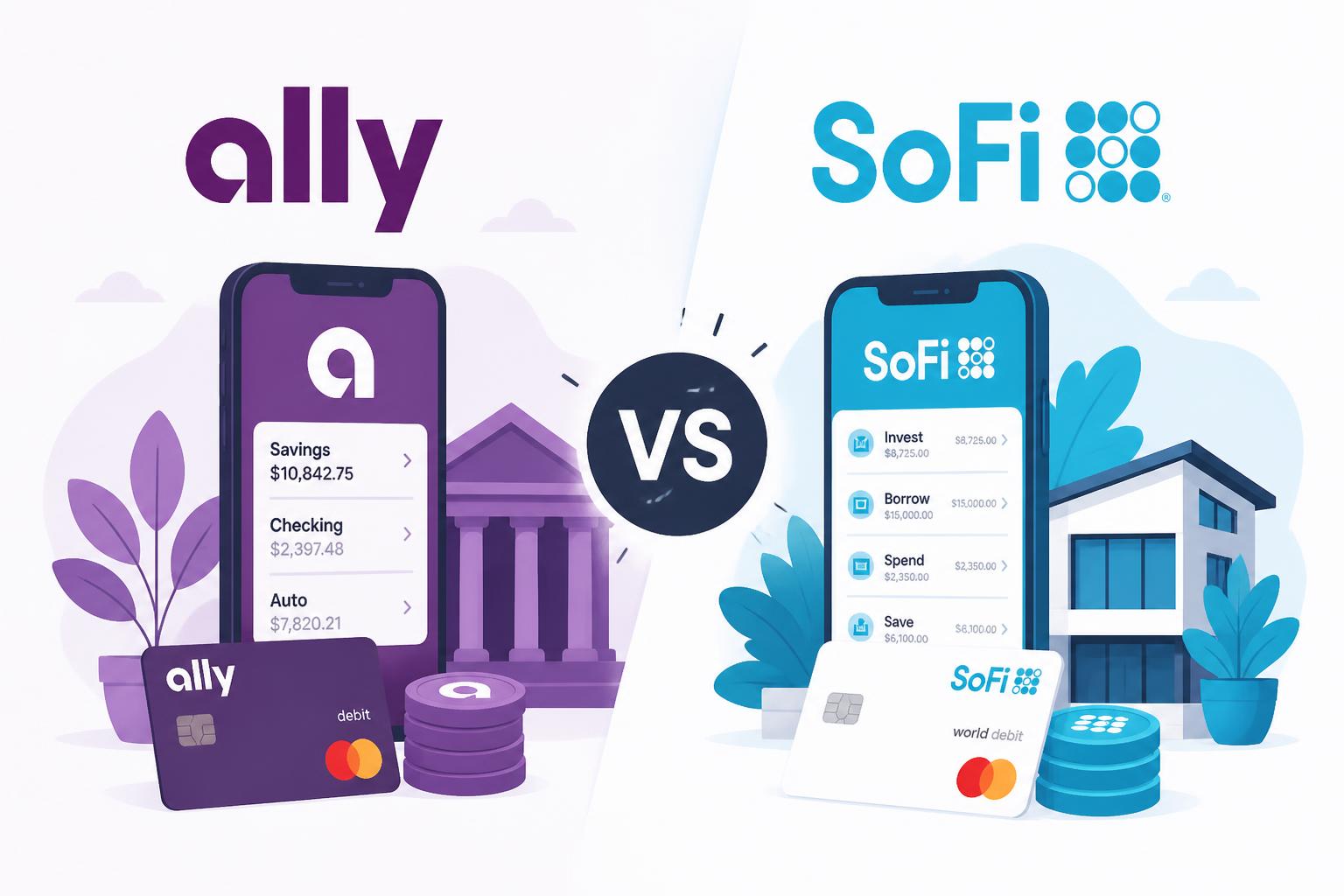
Ally vs SoFi (2026): Which High-Yield Savings Actually Pays More?
You’ve narrowed it down to two names that keep popping up: Ally and SoFi. Both promise high-yield savings, no monthly fees, and mobile-first banking. But one requires you to jump through hoops to get the rate they advertise, and the other just… pays it.
If you’ve spent the last hour toggling between comparison charts and still can’t decide, this guide will settle it. We’ll break down the 2026 APYs, the fine print behind SoFi’s “up to 4%” claim, and which bank makes sense depending on whether you’re willing to move your paycheck or just want to park cash and forget it.
Table of Contents
- APY Breakdown: The Real Numbers in 2026
- The Direct Deposit Trap (and Why It Matters)
- Account Features: What You Actually Get
- Fees, Minimums, and the Fine Print
- Who Should Pick SoFi (and Who Shouldn’t)
- Who Should Pick Ally (and Who Shouldn’t)
- The Verdict: Which One Wins in 2026?
- FAQ
APY Breakdown: The Real Numbers in 2026
Let’s start with what you came here for: the interest rates.
As of mid-2026, here’s what each bank actually pays on savings accounts:
- SoFi: Up to 4.20% APY — but only if you set up direct deposit. Without it, you’re looking at a significantly lower rate.
- Ally: 4.20% APY — no strings attached. No direct deposit requirement, no minimum balance, no monthly activity threshold.
On paper, they’re tied. In practice, Ally’s rate is unconditional, while SoFi’s headline number comes with a behavioral requirement.

For checking accounts, the gap widens:
- SoFi Checking: 0.50% APY on your checking balance when bundled with their savings account.
- Ally Checking: 0.10% APY for balances under $15,000, 0.25% APY for balances $15,000 and up.
If you keep a meaningful checking balance (say, $10,000+ for monthly expenses and buffer), SoFi’s 0.50% is objectively better. That’s an extra $40–50 per year on a $10,000 balance compared to Ally’s 0.10%. Not life-changing, but it’s free money for doing nothing.
Source: Yahoo Finance, Clear Value Lending
One thing to note: some SoFi promotions in early 2026 advertised savings APYs “up to 4.0%” or even “3.8% for new customers.” Those numbers have since been updated. As of June 2026, the standard rate with direct deposit is 4.20%, matching Ally’s unconditional rate.
The Direct Deposit Trap (and Why It Matters)
Here’s the part most comparison articles gloss over: SoFi’s top savings APY is gated behind direct deposit.
What does that mean in practice?
You need to route your paycheck (or at least $1,000/month in qualifying deposits) into your SoFi account to unlock the full 4.20% APY. If you don’t, your rate drops — in some cases, as low as 1.00% APY.
That’s not a rounding error. That’s a 76% rate cut.
Ally, meanwhile, pays 4.20% APY whether you direct deposit, whether you log in once a month, or whether you just opened the account and forgot about it.
Who this matters for:
- If you’re already planning to move your primary banking to SoFi (paycheck, bill pay, daily spending), the direct deposit requirement is a non-issue. You were going to do it anyway.
- If you just want a high-yield savings account to complement your existing bank, SoFi’s requirement is friction. You either need to split your paycheck between two banks, or you’re stuck with a mediocre rate.
Ally’s approach is simpler: open the account, transfer money, earn 4.20%. No ongoing maintenance, no behavioral monitoring.
Source: Clear Value Lending, YouTube: SoFi vs Ally comparison
Account Features: What You Actually Get
Beyond APY, here’s what each bank offers (and where they differ).
SoFi Checking & Savings
SoFi bundles checking and savings into a single “Checking & Savings” account. You can’t open a standalone savings account — it’s an all-or-nothing package.
What you get:
- 0.50% APY on checking balances (better than most competitors)
- 4.20% APY on savings (with direct deposit)
- No monthly maintenance fees
- No minimum balance requirement
- Up to $2 million in FDIC insurance via SoFi’s sweep network (they partner with multiple banks to extend coverage beyond the standard $250k limit)
- Unlimited ATM fee rebates at 55,000+ Allpoint ATMs
- Mobile-first experience — the app is the product; there are no physical branches
What you don’t get:
- Standalone savings — you can’t open just a savings account without the checking component.
- Cash deposit options without fees — depositing cash costs up to $4.95 per transaction, which is absurd if you occasionally deal in cash.
- Sub-accounts or savings buckets — no way to organize savings into goals (vacation, emergency fund, car fund, etc.) within the same account.
Source: Yahoo Finance, YouTube: Best High Yield Savings 2026
Ally Bank Online Savings
Ally offers a full suite of deposit accounts: checking, savings, money market, and CDs. You can open any of them independently.
What you get:
- 4.20% APY on savings (no direct deposit required)
- 0.10% to 0.25% APY on checking (depending on balance tier)
- No monthly fees, no minimum balance
- Sub-savings buckets — you can create multiple “goals” within a single savings account (e.g., emergency fund, vacation, down payment). Each bucket earns the same APY, but they’re organized separately in the app.
- Up to 10 free withdrawals per month from savings (federal regulation; exceeding this may trigger fees or account conversion)
- Up to $10 in ATM fee rebates per month (not unlimited like SoFi, but enough to cover 2–3 out-of-network ATM trips)
- CDs with competitive rates — as of mid-2026, Ally’s 12-month CD pays 3.7% APY, which is higher than their savings rate in some tiers.
What you don’t get:
- Unlimited ATM rebates — you’re capped at $10/month, which is fine for most people but less generous than SoFi.
- High checking APY — if you keep a large checking balance, Ally’s 0.10%–0.25% is noticeably worse than SoFi’s 0.50%.
Source: Yahoo Finance, Clear Value Lending
Fees, Minimums, and the Fine Print
Both banks advertise “no monthly fees” and “no minimum balance.” That’s true — with caveats.
SoFi
- Monthly maintenance fee: $0
- Minimum balance: $0
- Overdraft fees: $0 (SoFi doesn’t charge overdraft fees, but they also don’t offer traditional overdraft protection; transactions that would overdraw your account are simply declined)
- Cash deposit fee: Up to $4.95 per deposit (via Green Dot retail locations)
- ATM fees: $0 at 55,000+ Allpoint ATMs; out-of-network fees are fully reimbursed with no monthly cap
- Wire transfer fees: Outgoing domestic wires typically cost $0–$25 depending on the transfer method
Ally
- Monthly maintenance fee: $0
- Minimum balance: $0
- Overdraft fees: $0 (Ally also doesn’t charge overdraft fees; they offer overdraft transfer protection from savings if you opt in)
- Cash deposit fee: $0 (no direct cash deposit option; you’d need to deposit cash at another bank and transfer electronically, or use a money order)
- ATM fees: $0 at 43,000+ Allpoint ATMs; out-of-network fees reimbursed up to $10/month
- Wire transfer fees: Outgoing domestic wires cost $20
The takeaway: If you need to deposit cash regularly, both banks are bad choices (SoFi charges a fee; Ally doesn’t offer the option at all). If you’re fully digital, both are zero-fee in practice.
Source: Yahoo Finance, Clear Value Lending
Who Should Pick SoFi (and Who Shouldn’t)
SoFi makes sense if:
- You’re moving your entire banking relationship. If you’re ready to direct deposit your paycheck, pay bills, and use SoFi as your primary bank, you get the full 4.20% savings APY plus 0.50% on checking. That’s a strong combined rate.
- You want everything in one app. SoFi’s app handles checking, savings, investing, loans, and credit score monitoring. If you like a single dashboard for all your money, SoFi delivers.
- You’re chasing a new account bonus. SoFi occasionally runs promotions offering up to $300–$400 in bonuses for new customers who meet deposit thresholds (typically $5,000+ in the first 30–60 days). If you’re opening an account anyway and you have the cash to qualify, the bonus is free money.
- You never deal in cash. If 100% of your income hits your account electronically and you never need to deposit physical bills, SoFi’s lack of cash-deposit infrastructure won’t hurt you.
SoFi is a bad fit if:
- You just want a high-yield savings account to complement your existing bank, and you don’t want to move your paycheck.
- You occasionally deposit cash (the $4.95 fee per deposit adds up fast).
- You want sub-accounts or savings buckets to organize your money by goal.
Source: YouTube: SoFi vs Ally comparison, Clear Value Lending
Who Should Pick Ally (and Who Shouldn’t)
Ally makes sense if:
- You want a set-it-and-forget-it savings account. No direct deposit requirement. No monthly activity threshold. No rate games. Open it, transfer money, earn 4.20%. Done.
- You want to keep your existing bank and just add a high-yield savings account. Ally plays well with others. You don’t need to move your entire financial life — just link your current checking account and transfer money when you’re ready.
- You like organizing savings by goal. Ally’s sub-savings buckets let you earmark money for specific purposes (emergency fund, vacation, car down payment) without opening multiple accounts. Each bucket earns the same APY.
- You want access to CDs and money market accounts. Ally offers a full product lineup. If rates shift and you want to lock in a 12-month CD at 3.7% APY, you can do it under the same login.
Ally is a bad fit if:
- You want to maximize interest on a large checking balance (SoFi’s 0.50% checking APY beats Ally’s 0.10%–0.25%).
- You need unlimited ATM fee rebates (Ally caps rebates at $10/month; SoFi is unlimited).
- You want a flashy mobile app experience with investing and loans bundled in (Ally’s app is solid but less ambitious than SoFi’s).
Source: Clear Value Lending, Yahoo Finance
The Verdict: Which One Wins in 2026?
There’s no universal winner. It depends on what you’re optimizing for.
Pick SoFi if:
- You’re ready to direct deposit and make SoFi your primary bank.
- You keep a large checking balance (the 0.50% APY pays better than Ally).
- You want a single app for banking, investing, loans, and credit monitoring.
- You’re eligible for a new account bonus and you have the cash to unlock it.
Pick Ally if:
- You just want a high-yield savings account without moving your paycheck.
- You like organizing savings into separate buckets for different goals.
- You value simplicity and predictability (no hoops, no rate drops, no surprises).
- You might want to open a CD or money market account down the road.
Pick neither if:
- You regularly deposit cash (both banks either charge fees or don’t support it at all).
- You need in-person branch access (both are online-only).
In practice, the APY difference is negligible if you meet SoFi’s direct deposit requirement — both pay 4.20% on savings as of June 2026. The real decision comes down to whether you want a full-service neobank (SoFi) or a dedicated high-yield savings account that doesn’t ask for anything in return (Ally).
For most people who aren’t ready to uproot their entire banking relationship, Ally is the easier choice. For people who want to consolidate everything and are comfortable with mobile-first banking, SoFi is the better deal.
FAQ
Does SoFi require direct deposit to get the highest savings APY?
Yes. SoFi’s 4.20% APY on savings requires you to set up direct deposit (typically your paycheck or at least $1,000/month in qualifying deposits). Without it, your rate drops significantly — in some cases to as low as 1.00% APY.
Are SoFi and Ally savings accounts FDIC-insured?
Yes. Both are FDIC-insured up to $250,000 per depositor, per institution. SoFi extends coverage up to $2 million through its sweep network, which spreads your deposits across multiple partner banks.
Which pays a higher APY — SoFi or Ally savings?
As of June 2026, both pay 4.20% APY on savings accounts. SoFi’s rate requires direct deposit; Ally’s rate has no conditions.
Can I keep my existing bank and just open SoFi or Ally savings?
Yes for Ally — it’s designed to work alongside your existing bank. You can open a standalone savings account and link it to your current checking account.
For SoFi, it’s more complicated. SoFi bundles checking and savings into a single account, so you can’t open just savings. And to get the top savings APY, you need to direct deposit into SoFi, which means moving at least part of your banking relationship over.
Is there a minimum balance required to open SoFi or Ally savings?
No. Both accounts have $0 minimum balance to open and maintain.
How quickly can you withdraw money from SoFi or Ally savings?
SoFi offers unlimited withdrawals from savings (though transfers to external banks typically take 1–3 business days).
Ally allows up to 10 free withdrawals per month from savings (federal regulation). Exceeding that limit may result in fees or account conversion.
Does SoFi compound interest daily or monthly on savings?
SoFi compounds interest daily and pays it monthly. Ally does the same.
Does Ally savings offer sub-accounts or savings goals?
Yes. Ally lets you create multiple savings buckets within a single account, each earning the same 4.20% APY. You can label them (e.g., “Emergency Fund,” “Vacation,” “Car Down Payment”) and track progress toward each goal.
Is SoFi a direct bank, or does it hold deposits at a partner institution?
SoFi is not a bank itself. It partners with SoFi Bank, N.A. (a chartered bank) and other FDIC-insured institutions to hold customer deposits. Your money is FDIC-insured through those partner banks.
How does overdraft protection work at SoFi vs Ally?
Neither bank charges overdraft fees.
SoFi simply declines transactions that would overdraw your account. There’s no traditional overdraft protection, but there’s also no fee.
Ally offers overdraft transfer protection — if you opt in, Ally will automatically transfer money from your linked savings account to cover an overdraft in checking. There’s no fee for the transfer, but it counts toward your 10 monthly savings withdrawals.