How to Get Started with High-Yield Savings: Step-by-Step Guide (2026)
> Affiliate Disclosure: This article contains affiliate links. If you sign up for a product through our links, we may earn a commission at no extra cost to you. This helps us continue creating content.
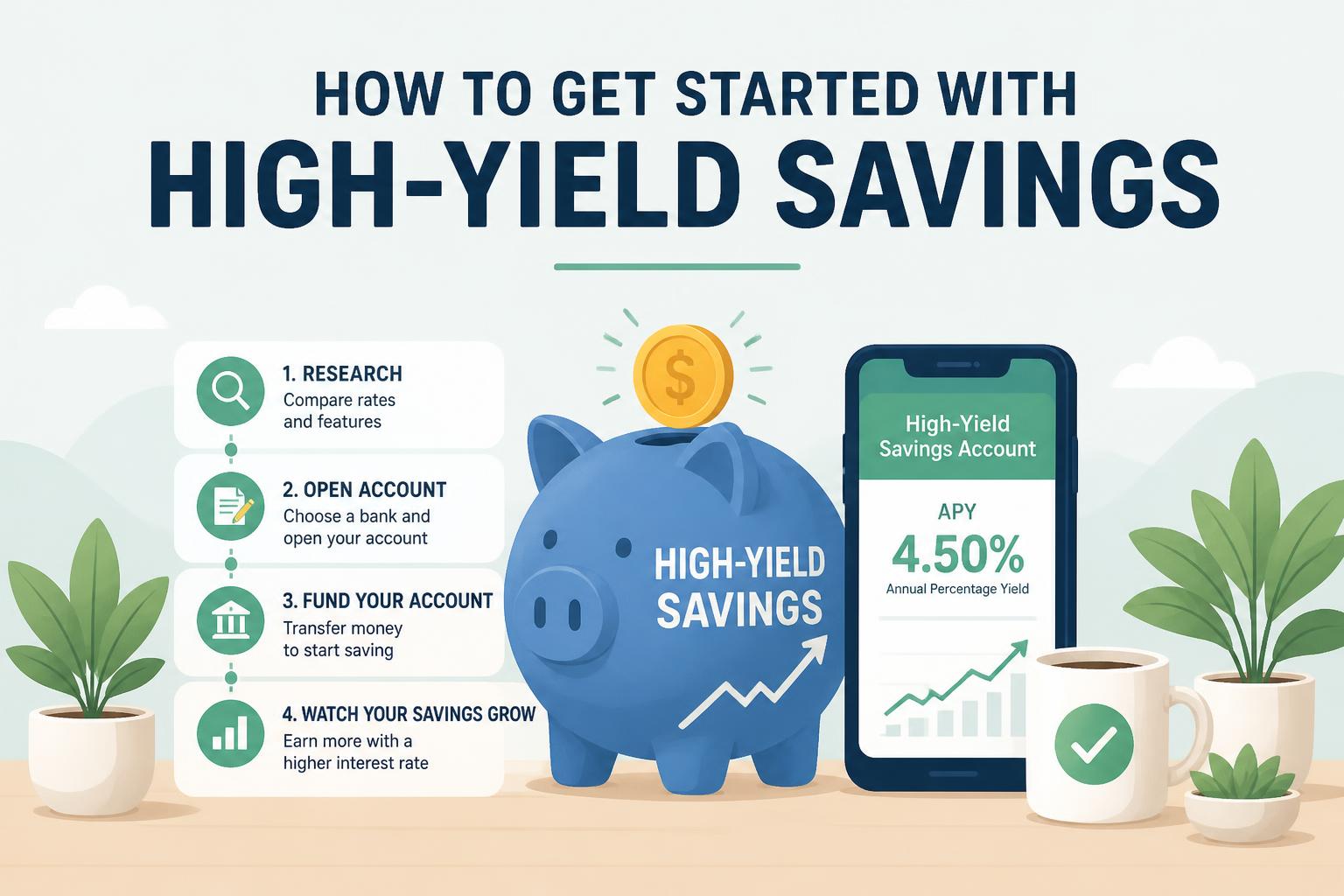
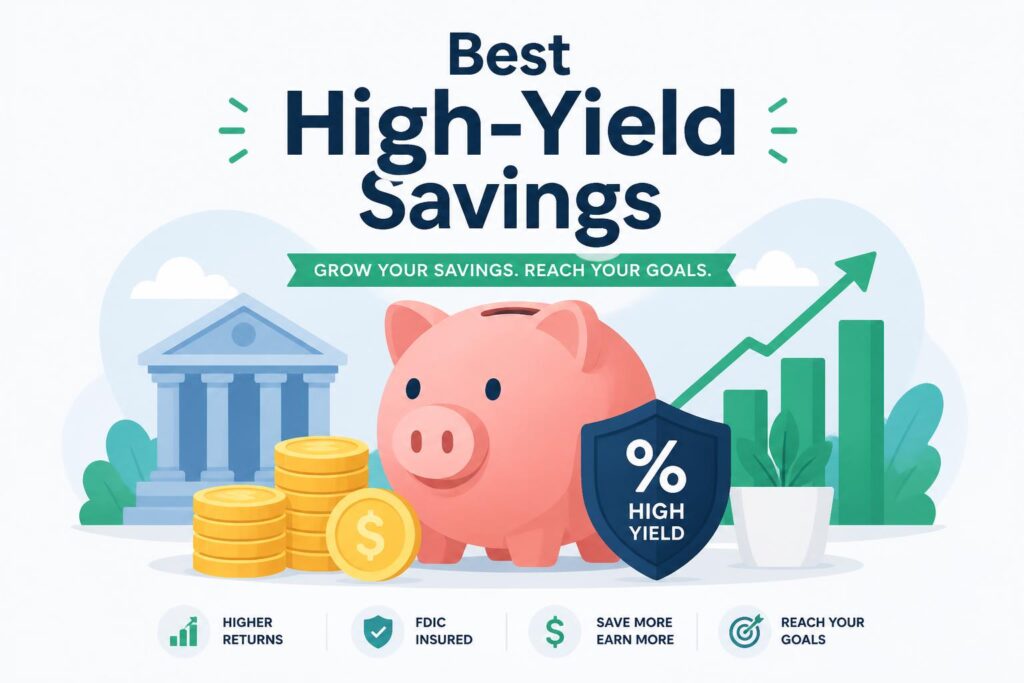
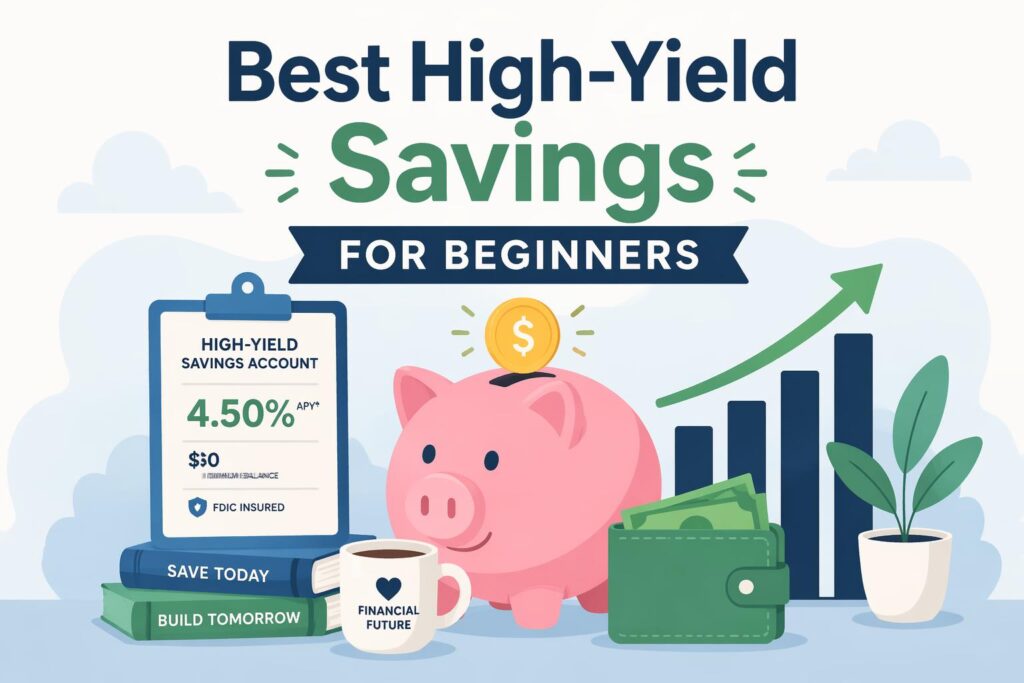
You’ve been leaving money on the table. The national average savings rate sits at 0.38% APY as of July 2026. That’s $3.80 per year on $1,000. Meanwhile, high-yield savings accounts are paying up to 4.15% APY—$41.50 on that same $1,000.
Same FDIC insurance. Same federal protection. Just better interest.
This guide walks you through opening a high-yield savings account, funding it, and setting up automatic transfers so your emergency fund grows without you thinking about it.
What you need:
- Government-issued ID (driver’s license or passport)
- Social Security number
- A checking account with $100-$250 available to fund the new account
- 15-20 minutes
Setup takes 20 minutes. Account verification takes 2-3 business days.
Why This Matters Right Now
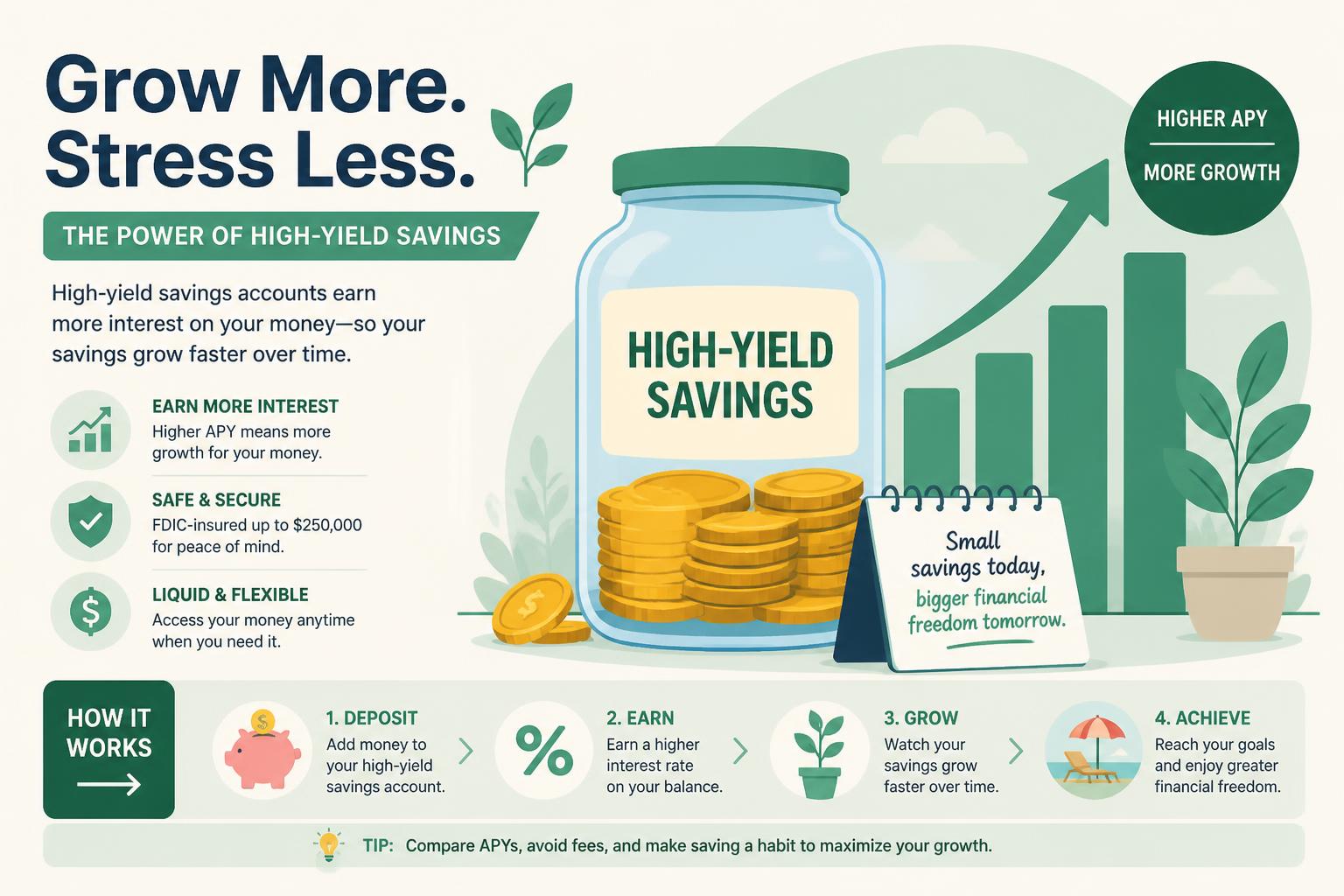
Money in a traditional savings account loses value over time. Inflation eats it quietly. Online banks can pay higher interest because they don’t maintain expensive branch networks. Your money stays FDIC-insured up to $250,000 per depositor, but earns 10-12 times more interest.
As of July 2026, the gap between traditional and high-yield accounts is wider than it’s been in years. The FDIC national average is 0.38% APY. Top online banks are offering above 4% APY.
Step 1: Understand What You’re Getting Into
High-yield savings accounts work like regular savings accounts. You deposit money, it earns interest, you can withdraw when needed. The difference is the interest rate.
Key characteristics:
- FDIC insured up to $250,000 per depositor, per institution
- Variable interest rates that adjust with Federal Reserve policy
- Limited to 6 withdrawal transactions per month (though enforcement varies by bank as of 2026)
- No physical branches—everything is online or mobile
- Interest compounds daily or monthly, pays out monthly
High-yield savings accounts are not investment accounts. Your principal is safe. Rates fluctuate. They’re designed for short-to-medium term savings like emergency funds, down payment savings, or cash you’ll need within 1-5 years.
If you need to access your money multiple times per week, keep it in checking. High-yield savings accounts are for money you don’t touch regularly.
Step 2: Compare Current High-Yield Savings Rates
Not all high-yield accounts pay the same rate. As of July 2026, rates range from 3.85% to 4.15% APY among competitive banks.
Current top rates (July 2026):
- Forbright Bank: 4.15% APY, no minimum deposit
- CIT Bank: 4.10% APY, $100 minimum deposit (requires $5,000 balance for highest yield)
- Vio Bank: 4.01% APY, $100 minimum deposit
- Peak Bank: 4.01% APY, $100 minimum deposit
- Happen Bank: 4.00% APY, $250 minimum to earn APY
On a $10,000 emergency fund, the difference between 0.38% and 4.15% is $377 per year versus $38. That’s an extra $339 for choosing where to park your money.
What to look for:
- APY: Higher is better, but check if there are balance requirements to earn that rate
- Minimum deposit: Some banks require $0, others need $100-$250 to open
- Monthly fees: Should be $0
- Balance requirements: Some accounts only pay top APY on balances above $5,000 or $25,000
- Account access: Mobile app and web interface matter
Pick 3-5 banks you’re considering based on their APY, minimum deposit, and whether you can meet any balance requirements.
APY changes regularly based on Federal Reserve policy. The rates listed here are accurate as of July 2026 but will fluctuate. Focus on banks that offer competitive rates consistently, not just whoever is 0.05% higher today.
Step 3: Choose Your Bank Based on Your Situation
Pick the account that matches your starting balance.
If you’re starting with less than $100:
Choose Forbright Bank (4.15% APY, $0 minimum) or Zynlo Bank (3.85% APY, $0 minimum). You can open the account with any amount and start earning immediately.
If you have $100-$5,000 to deposit:
Vio Bank, Peak Bank, or Bread Savings (3.95-4.01% APY) are solid. $100 minimums, no balance requirements to earn the advertised rate.
If you have $5,000 or more:
CIT Bank (4.10% APY) pays its highest rate on balances of $5,000+, making it good for larger emergency funds.
If you want the best mobile app:
Research which banks have top-rated apps. Most online banks have strong mobile platforms. Read recent reviews on the App Store or Google Play.
You should have one specific bank selected based on how much you’re depositing.
Step 4: Gather Your Required Documents
Before starting the application, get these ready:
- Government-issued photo ID (driver’s license, passport, or state ID)
- Social Security number
- Existing checking account information:
– Bank name
– Routing number (9 digits)
– Account number
– Available balance to confirm you can fund the new account
- Contact information: Current address, phone number, email address
- Employment information: Some banks ask for employer name and income range (not all require this)
Have all documents within reach and your checking account details written down before you begin. This prevents you from abandoning the application mid-process.
Step 5: Open Your Account Online
Go to the bank’s website or download their mobile app. Look for “Open Account,” “Get Started,” or “Apply Now”—usually on the homepage.
The application process includes:
- Account type selection: Choose “Savings Account” or “High-Yield Savings Account”
- Personal information: Name, date of birth, Social Security number, address, phone, email
- Identity verification: Some banks use knowledge-based questions (previous addresses, loan history) or may ask you to upload a photo of your ID
- Funding source: Link your external checking account using routing and account numbers
- Initial deposit amount: Enter how much you’re transferring to open the account (must meet minimum deposit requirement)
- Review and submit: Read terms and conditions, confirm everything is accurate, submit
You’ll see a confirmation screen stating your application is submitted and under review. Most banks provide instant approval. Some take 1-2 business days to verify identity and process the application.
Approval time is instant to 24 hours for most people. If you’re flagged for additional verification (rare), it may take up to 3 business days.
Keep the confirmation email. It contains your temporary account number and instructions for next steps.
Step 6: Fund Your New Account
Once approved, you’ll receive instructions to complete your initial deposit. Most banks allow several funding methods:
Option A: ACH transfer from your checking account (most common)
- Log into your new high-yield savings account
- Go to “Transfer” or “Move Money”
- Select “External Account” as the source
- Verify the micro-deposits (two small deposits under $1.00) that the bank sends to your checking account within 1-2 business days
- Once verified, initiate your initial deposit transfer
Option B: Instant verification (if available)
- Some banks use Plaid or similar services to instantly verify your checking account
- Log into your checking account through the HYSA’s interface
- No need to wait for micro-deposits
- Transfer can happen immediately
Option C: Wire transfer (for large deposits)
- Contact your current bank to initiate a wire transfer
- Use the routing and account number provided by your new HYSA
- Wire transfers cost $15-30 but arrive same-day or next-day
Your initial deposit will show as “pending” in your new HYSA within 1 business day (for ACH transfers) or immediately (for instant verification). Full funds availability takes 3-5 business days for ACH transfers.
Don’t close your old savings account yet. Wait until you confirm your new HYSA is working and you’ve completed at least one deposit and one withdrawal.
Step 7: Set Up Automatic Transfers
The difference between people who build emergency funds and people who don’t is automation. Set up recurring transfers so you save without thinking about it.
How to set it up:
- Log into your high-yield savings account
- Go to “Transfers,” “Automatic Transfers,” or “Recurring Transfers”
- Select your linked checking account as the source
- Choose transfer frequency:
– Weekly: Best if you’re paid weekly
– Bi-weekly: Aligns with most paychecks
– Monthly: Simplest if you’re paid monthly or have variable income
- Set the transfer amount (start with whatever’s realistic—even $25/week adds up)
- Choose the transfer date (ideally 1-2 days after your paycheck hits)
- Review and activate
You’ll see a confirmation that your automatic transfer is scheduled. Check your calendar for the first scheduled transfer date.
Recommended starting amounts:
- If you earn under $40,000/year: Start with $25-50 per paycheck
- If you earn $40,000-$80,000/year: Start with $100-200 per paycheck
- If you earn over $80,000/year: Start with $250-500 per paycheck
The goal is to build a 3-6 month emergency fund over time. With a 4% APY, your savings grow from both your contributions and compound interest.
Step 8: Enable Mobile App and Notifications
Download your bank’s mobile app and set up alerts so you know what’s happening with your account.
Notifications to enable:
- Large deposit alerts: Get notified when deposits over a certain threshold clear
- Withdrawal alerts: Know immediately when money leaves your account (fraud protection)
- Low balance alerts: Set a threshold so you’re warned if your balance drops unexpectedly
- Monthly statements: Receive notification when your statement is ready
- Interest payment alerts: See when your monthly interest is paid out
You’ll get push notifications or emails confirming these alerts are active. Test one by making a small transfer.
Enable biometric login (Face ID or fingerprint) for faster, more secure mobile access. Never save your password in an insecure location.
Step 9: Understand How Interest Compounds
High-yield savings accounts compound interest daily and pay it out monthly.
How compounding works:
- Your bank calculates interest on your balance every day
- That daily interest is added to your principal
- The next day, you earn interest on the original principal plus yesterday’s interest
- At the end of the month, all accumulated interest posts to your account
Real example with 4.15% APY:
- Starting balance: $5,000
- Daily interest rate: 4.15% ÷ 365 = 0.0114% per day
- Day 1 interest: $5,000 × 0.000114 = $0.57
- Day 2 interest: $5,000.57 × 0.000114 = $0.57
- Month 1 total interest (30 days): ~$17.19
- After 12 months (with no additional deposits): $5,211.87
Your first interest payment will appear in your account 30-35 days after opening, labeled as “Interest Paid” or similar. This confirms everything is working.
Step 10: Build Your Emergency Fund to 3-6 Months of Expenses
Now that your account is open and automated, focus on reaching your target emergency fund balance.
How to calculate your target:
- List your monthly essential expenses:
– Rent/mortgage
– Utilities
– Groceries
– Insurance
– Minimum debt payments
– Transportation
- Add them up to get your monthly survival number
- Multiply by 3 (minimum) or 6 (ideal) depending on job stability
Example:
- Monthly essential expenses: $2,500
- Minimum emergency fund (3 months): $7,500
- Ideal emergency fund (6 months): $15,000
You should have a clear target number and a timeline for when you’ll reach it based on your automatic transfer amount.
Timeline example:
- Target: $10,000 emergency fund
- Current balance: $1,000
- Need to save: $9,000
- Automatic transfer: $200/paycheck (bi-weekly) = $400/month
- Time to reach goal: ~22.5 months
- Plus interest earned along the way: ~$400 over that period (reduces time to ~21 months)
It’s okay if reaching your goal takes 1-2 years. The important part is that it’s happening automatically. You can always increase your transfer amount when you get a raise or pay off a debt.
You Now Have a High-Yield Savings Account Earning 10x the National Average
You’ve set up a financial foundation that will grow your emergency fund while you focus on everything else. Your money is FDIC-insured, easily accessible when needed, and earning competitive interest that compounds daily.
What you accomplished:
- Opened a high-yield savings account with one of the top-rated online banks
- Funded it with an initial deposit
- Set up automatic transfers so savings happens without willpower
- Enabled mobile access and alerts for easy account monitoring
- Started earning up to 4.15% APY—more than 10 times the national average
Next steps:
- Review your rate quarterly. Banks adjust APYs based on Federal Reserve policy. If your rate drops significantly below competitors, consider switching (it takes 20 minutes).
- Increase your automatic transfer when you can. Every raise, bonus, or paid-off debt is an opportunity to accelerate your emergency fund growth.
- Keep 1 month of expenses in checking. Your checking account should cover immediate bills. Everything else above that can move to your HYSA to earn interest.
- Don’t withdraw for non-emergencies. The power of compound interest grows over time. Let your emergency fund grow undisturbed until you actually need it.
—
Troubleshooting common issues
My application was denied
This means identity verification failed or there’s a freeze on your credit report. Contact the bank’s customer service—they can often resolve this by requesting additional documentation. Also check if you have a security freeze with ChexSystems or the credit bureaus that needs to be temporarily lifted.
The micro-deposits never arrived
Check your checking account 2-3 business days after linking accounts. If nothing appears, verify you entered the correct routing and account numbers. Contact your HYSA’s support team—they can resend the deposits or use an alternative verification method.
I can’t find the option to set up automatic transfers
Some banks call this “Recurring Transfers,” “Scheduled Transfers,” or “AutoSave.” Look under the “Transfers” or “Move Money” section. If you still can’t find it, contact customer service—every major HYSA offers this feature.
My rate dropped after I opened the account
High-yield savings rates are variable and change with Federal Reserve policy. If rates drop across the board (all banks), there’s nothing to do—it’s the market. If your bank’s rate drops significantly below competitors, you can open a new account and transfer your funds. Your money is never locked in.
I accidentally made more than 6 withdrawals in a month
Federal Regulation D historically limited savings account withdrawals to 6 per month, though enforcement was suspended in 2020 and varies by bank as of 2026. If your bank charges an excess withdrawal fee, call customer service—they often waive it for first-time occurrences. Going forward, keep 1 month of expenses in checking to avoid frequent HYSA withdrawals.
—
Frequently asked questions
Do I need a paid account to follow this tutorial?
No. All high-yield savings accounts mentioned here are free to open and maintain. No monthly fees, no minimum balance fees, no hidden charges. You only need to meet the initial minimum deposit requirement ($0-$250 depending on the bank).
Is my money safe in a high-yield savings account?
Yes. High-yield savings accounts from reputable online banks are FDIC-insured up to $250,000 per depositor, per institution. This is the same federal protection that traditional banks offer.
How long does it take to set up a high-yield savings account?
The application takes 15-20 minutes. Account approval is instant in most cases, but funding and full verification can take 3-5 business days depending on your bank’s ACH processing time.
Can I have multiple high-yield savings accounts?
Yes. Many people use multiple HYSAs to organize savings by goal (emergency fund, vacation fund, down payment fund). Each account at a different bank gets separate FDIC insurance up to $250,000.
What should I do if I can’t open a high-yield savings account?
If your application is denied, contact the bank to understand why. Common reasons include identity verification issues, ChexSystems flags from past bank problems, or credit freezes. You can often resolve these by providing additional documentation or lifting temporary freezes.
Should I get a CD instead of a high-yield savings account?
It depends on your goal. CDs offer guaranteed rates but lock your money for a fixed term (6 months, 1 year, 5 years). High-yield savings accounts offer flexibility—you can withdraw anytime without penalty. For emergency funds, HYSAs are better. For money you definitely won’t need for 1+ years, CDs might offer slightly higher rates.
—
Final thoughts
The national average savings rate of 0.38% APY is essentially zero after accounting for inflation. By moving your emergency fund to a high-yield savings account earning 4%+, you’ve made a single decision that will compound in your favor for years.
Over 5 years, a $10,000 emergency fund at 4% APY grows to $12,166 with no additional contributions. That same $10,000 at 0.38% becomes $10,191. The difference—$1,975—is money you earned by choosing where to park your savings.
Your money is safe, accessible, and growing.