How to Save Money on Charting & Analysis: A Complete Guide (2026)
Affiliate Disclosure: This article contains affiliate links. If you purchase through these links, we may earn a commission at no extra cost to you.
If you’re serious about trading or investing, you already know that charting and analysis tools are essential. But here’s the problem: the pricing landscape is confusing, features overlap across platforms, and it’s easy to overpay for capabilities you’ll never use.
By the end of this guide, you’ll know exactly how to choose the right charting platform for your needs, avoid expensive upgrades you don’t need, and save hundreds—or even thousands—of dollars per year without sacrificing the quality of your technical analysis.
What you’ll learn:
- How to identify which features you actually need (and which are just marketing)
- The smartest free and low-cost alternatives to expensive platforms
- Pricing traps that cause traders to overpay
- A step-by-step process to evaluate platforms based on your trading style
- How to maximize free trials and freemium plans
Estimated reading time: 12 minutes
—
Why Most Traders Overpay for Charting Software
The charting software market in 2026 has never been more competitive—or more confusing. Platforms like TradingView, StockCharts, NinjaTrader, and newer AI-powered tools like TrendSpider all promise to give you an edge. But the reality is that most traders use less than 30% of the features they’re paying for.
The problem starts with how these platforms are marketed. Professional-tier plans with advanced backtesting, custom indicators, and real-time data feeds sound essential. But if you’re swing trading stocks twice a week, you don’t need the same tools as a day trader executing 50 futures contracts daily.
Common pricing traps:
- Real-time data feeds you don’t need: Many platforms charge $30-100/month extra for real-time data. If you’re not day trading, 15-minute delayed data is often sufficient.
- Premium indicator packages: Custom indicators and Pine Script libraries sound powerful, but 90% of successful traders rely on basic candlestick patterns, support/resistance, and volume.
- Multi-monitor workspace features: Great for professional traders, unnecessary if you trade part-time from a laptop.
According to research from World Business Outlook (May 2026), the top charting platforms range from completely free (MetaTrader 5, TradingView Basic) to over $200/month (eSignal, TradeStation premium tiers). The difference isn’t always quality—it’s features you may not need.
—
Step 1: Identify Your Actual Charting Needs
Before comparing platforms, you need to define what you’ll actually use. This is where most people go wrong—they choose based on what sounds impressive, not what matches their trading style.
Answer these questions:
- What do you trade? Stocks, futures, Forex, crypto, or multiple asset classes?
- How often do you trade? Daily, weekly, or monthly?
- What’s your analysis style? Pure price action, indicator-heavy, or fundamental + technical?
- Do you backtest strategies? If yes, how often and how complex are your rules?
- Do you need mobile access? Will you monitor charts away from your desk?
Example scenario 1: Swing trader, stocks only, weekly trades
- Needs: Basic candlestick charts, volume, moving averages, support/resistance drawing tools
- Real-time data: Not critical (15-minute delay is fine)
- Best fit: TradingView Free or StockCharts Basic (~$0-15/month)
Example scenario 2: Day trader, futures, 20+ trades/day
- Needs: Real-time tick data, order flow/footprint charts, custom indicators, fast execution
- Backtesting: Essential for strategy validation
- Best fit: NinjaTrader or ATAS ($50-150/month depending on data feeds)
Example scenario 3: Part-time crypto trader, technical + sentiment analysis
- Needs: Multi-exchange support, on-chain data, community scripts
- Mobile access: Important for alerts
- Best fit: TradingView Pro ($12.95/month with community scripts)
> You should see: A clear list of must-have features vs nice-to-haves. This becomes your filtering criteria.
—
Step 2: Start with Free Platforms (You’d Be Surprised What’s Available)
One of the biggest myths in trading is that you need to pay for professional-grade charting. In 2026, that’s simply not true.
Free platforms that rival paid tools:
TradingView (Free Plan)
TradingView’s free plan is shockingly capable. You get:
- 3 indicators per chart (enough for most strategies)
- All basic drawing tools (trendlines, support/resistance, Fibonacci)
- Access to community scripts (thousands of free custom indicators)
- Multi-device sync
- Real-time data for crypto, 15-minute delay for stocks
Who this works for: Beginner to intermediate traders who don’t need advanced backtesting or ultra-fast data.
Limitation to watch: Only 1 saved chart layout on the free plan. If you trade multiple setups, you’ll need to recreate your workspace each time.
MetaTrader 5 (Completely Free)
MetaTrader 5 is free at most brokers and includes:
- Full technical analysis suite with 80+ built-in indicators
- Algorithmic trading support (Expert Advisors)
- Economic calendar and market news
- Mobile apps for iOS and Android
Who this works for: Forex and CFD traders, anyone interested in automated trading.
Limitation to watch: Primarily designed for Forex/CFD markets. Stock data coverage is limited unless your broker provides it.
According to World Business Outlook’s 2026 charting software review, MetaTrader 5 has “wide broker support” and is the go-to platform for traders who want zero software costs.
Thinkorswim by TD Ameritrade (Free with Funded Account)
If you have a TD Ameritrade account (no minimum balance required in 2026), you get:
- Professional-grade charting with 400+ indicators
- Strong options analysis tools (probability calculator, risk graphs)
- PaperMoney simulator for practice trading
- Market replay feature
Who this works for: U.S. stock and options traders who want institutional-quality tools without monthly fees.
Limitation to watch: Only available to TD Ameritrade customers. Data is U.S. markets only.

—
Step 3: Evaluate Paid Platforms Only After Exhausting Free Options
If free platforms don’t meet your needs, you’re likely a more active trader who needs specific advanced features. Here’s how to evaluate paid platforms without wasting money.
Run This Comparison Test
Create a spreadsheet with these columns:
- Platform name
- Monthly cost (including data fees)
- Must-have features present (Y/N)
- Nice-to-have features present (Y/N)
- Trial period available
- Cancellation policy
Platforms to compare based on 2026 market research:
Platform Cost/Month Best For Key Strength TradingView Pro $12.95 Multi-asset traders Huge community, cloud sync StockCharts.com $14.95-$39.95 Stock-focused traders Trusted price history, easy scans NinjaTrader $50+ (plus data) Futures day traders Strong backtest engine, C# custom code ATAS $69-$199 Order flow traders 400+ cluster chart setups, footprint tools TrendSpider $39.95-$99.95 Pattern traders AI-based pattern recognition, no-code strategy lab
The Free Trial Strategy
Most platforms offer 7-30 day free trials. Here’s how to maximize them:
- Sign up for trials in sequence, not simultaneously. Test one platform thoroughly before moving to the next.
- Set up your actual trading workspace. Don’t just browse—configure it as if you’re paying.
- Test your most common workflows. If you scan for breakouts daily, run that scan 10 times during the trial.
- Track friction points. Note every time you get frustrated or can’t find something.
- Export your trial data. Most platforms let you save watchlists and notes—keep these for comparison.
> Note: Set a calendar reminder 2 days before the trial ends. Many platforms auto-convert to paid subscriptions if you don’t cancel.
—
Step 4: Avoid the “Premium Data” Trap
Real-time data feeds are one of the biggest recurring costs in trading platforms. But here’s what most traders don’t realize: you may not need them.
When Real-Time Data Matters
- You’re day trading with entries/exits within minutes
- You trade options and need accurate bid/ask spreads
- You’re scalping futures or Forex
When 15-Minute Delayed Data is Fine
- You’re swing trading (holding positions for days or weeks)
- You set limit orders based on daily/weekly charts
- You’re researching stocks, not actively trading during market hours
Cost difference: Real-time data typically costs $30-100/month extra depending on exchanges (NYSE, NASDAQ, futures exchanges). Over a year, that’s $360-1,200 saved if you don’t need it.
The Broker Data Workaround
Many brokers provide free real-time data when you hold an account with them:
- TD Ameritrade: Free real-time data for U.S. stocks, ETFs, options
- Interactive Brokers: Real-time data included with Trader Workstation (free software)
- Webull: Free real-time quotes for stocks and crypto
Strategy: Use your broker’s platform for real-time execution data, and a free charting platform like TradingView for analysis and alerts. This combination costs $0/month for most traders.
—
Step 5: Master Free Indicators Before Buying Premium Ones
The indicator marketplace is tempting. For $49, you can buy a “professional trading system” with custom signals. But here’s the truth: most successful traders use basic, free indicators.
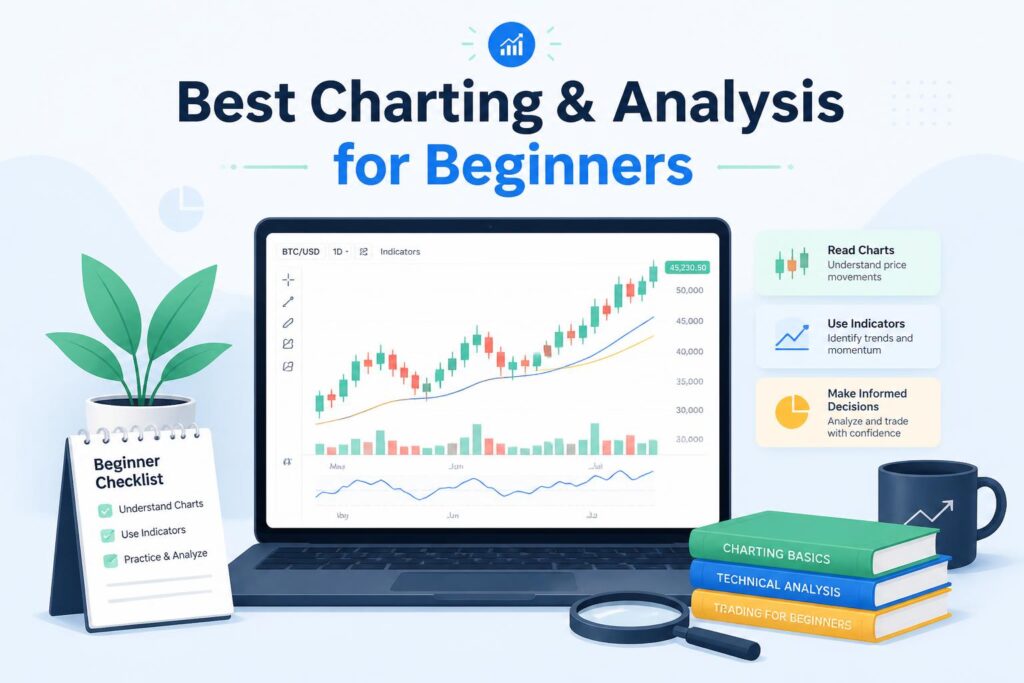
According to a 2026 beginner’s guide to stock charts, the most important elements of chart reading are:
- Price movement
- Trading volume
- Basic technical indicators (moving averages, RSI, MACD)
- Support and resistance levels
Start With These Free Essentials
1. Candlestick Patterns Available on every platform. Research from Forex Tester (August 2026) shows that basic patterns like Head and Shoulders (89% success rate in backtesting), Double Bottom (88%), and Bull Flag (85%) outperform many expensive custom indicators.
2. Moving Averages Free on all platforms. The 20/50/200 EMA combination is used by institutional traders and costs nothing.
3. Volume The most underrated indicator. Volume confirms price moves and is free everywhere.
4. VWAP (Volume Weighted Average Price) Highlighted in the 2026 stock chart guide as a “popular technical indicator” for day traders. Free on TradingView, Thinkorswim, and most platforms.
When to Consider Premium Indicators
Only buy premium indicators if:
- You’ve mastered the free versions and documented their limitations
- You’ve backtested the paid indicator with historical data (not just marketing claims)
- The cost is offset by measurable improvement in your win rate
Red flag: Any indicator marketed as “90% win rate” or “never lose again.” If it sounds like magic, it’s marketing.
—
Step 6: Choose Based on Your Trading Timeline
Your trading style determines which features matter most. Paying for the wrong feature set is the fastest way to waste money.
For Position Traders (Monthly timeframe)
What you need:
- Weekly/monthly chart clarity
- Basic indicators
- Fundamental data integration (earnings, P/E ratios)
- Long-term trendline tools
Recommended platform: StockCharts Basic ($14.95/month) or TradingView Free ($0) Annual cost: $0-179
For Swing Traders (Days to weeks)
What you need:
- Daily charts with clean price action
- Multi-timeframe analysis
- Reliable alerts
- Watchlist management
Recommended platform: TradingView Pro ($12.95/month) or StockCharts Extra ($24.95/month) Annual cost: $155-299
For Day Traders (Intraday)
What you need:
- Real-time tick data
- Fast execution integration
- Advanced order types
- High-frequency alerts
Recommended platform: NinjaTrader ($50+ with data) or ATAS ($69-199) Annual cost: $600-2,400
> You should see: A clear match between your trading frequency and platform costs. Position traders should never pay day-trader prices.
—
Step 7: Use Platform Bundles and Broker Deals
Many brokers bundle free or discounted charting software with funded accounts. This is one of the most overlooked ways to save money.
Current Broker Bundles (2026)
TD Ameritrade:
- Free Thinkorswim platform (valued at ~$99/month if sold separately)
- No account minimum
- Includes real-time U.S. market data
Interactive Brokers:
- Free Trader Workstation with professional-grade charting
- $0 minimum to open (market data subscriptions separate but cheap: $4.50/month for real-time U.S. stocks if you meet activity thresholds)
TradeStation:
- Free TradeStation platform with funded account
- Tight integration with EasyLanguage coding
- According to World Business Outlook, TradeStation has “strong lessons and sim” tools built-in
Strategy: Open a funded account (even with just $100) at a broker that offers free charting. Keep your main funds at your preferred broker, but use the free platform for analysis.
Annual savings: $500-1,200 compared to paying separately for professional charting software.
—
Step 8: Cut Costs on Backtesting and Automation
Backtesting and algorithmic trading tools are expensive. But there are smart workarounds.
Free Backtesting Options
TradingView Strategy Tester (Free/Pro)
- Available on free plan with limitations (only recent data)
- Full historical backtesting on Pro plan ($12.95/month)
- Visual strategy results with buy/sell markers on charts
MetaTrader 5 Strategy Tester (Free)
- Completely free with broker accounts
- Test Expert Advisors (automated strategies) across all timeframes
- Export results to Excel for analysis
NinjaTrader Free Version
- Free strategy backtesting with limited functionality
- Pay only if you need live trading automation ($50/month lease or $1,000 lifetime)
The Manual Backtest Method (Costs $0)
If you’re just starting with strategy development, you don’t need software at all:
- Use a free platform’s replay feature (TradingView has Bar Replay on Pro, Thinkorswim has Market Replay for free)
- Document trades in a spreadsheet with entry/exit/reason
- Calculate win rate and risk/reward manually
This method is slower but costs nothing and forces you to understand your strategy deeply.
—
Step 9: Negotiate Annual Plans and Discounts
Most charting platforms offer annual prepay discounts—but they rarely advertise them prominently.
Standard Annual Discounts (2026)
- TradingView Pro: $155.40/year (save ~$20 vs monthly)
- StockCharts Extra: $249/year (save ~$50 vs monthly)
- TrendSpider: Save 15-20% with annual prepay
How to Negotiate Further Discounts
1. Contact support before your trial ends: “I’m about to cancel, but I’d subscribe if you offered X% off.”
2. Ask about “seasonal” or “student” discounts: Many platforms offer 20-40% off for students or during Black Friday/New Year promotions.
3. Bundle purchases: If you refer a friend or buy multiple accounts (for teaching or business), ask for volume pricing.
4. Downgrade instead of canceling: Platforms often offer retention discounts if you threaten to switch to a free plan.
> Note: The worst they can say is no. Annual savings from a single 20% discount: $30-240 depending on platform.
—
Common Mistakes That Waste Money
Mistake 1: Buying the Platform Your Favorite YouTuber Uses
Influencers often use expensive platforms because they’re sponsored or because they need advanced features for content creation. Just because a trader with 100K subscribers uses TrendSpider doesn’t mean you need it.
Fix: Choose based on your needs, not social proof.
Mistake 2: Paying for Multiple Platforms Simultaneously
Traders often subscribe to TradingView for analysis, NinjaTrader for backtesting, and StockCharts for scans—paying $100+/month total.
Fix: Pick one primary platform. Use free alternatives for secondary tasks.
Mistake 3: Not Canceling Unused Subscriptions
Research shows that 42% of subscription users forget about at least one recurring charge. Set calendar reminders to review your trading software costs quarterly.
Fix: Audit your credit card statement every 3 months. Cancel anything you haven’t used in 30 days.
Mistake 4: Ignoring Free Educational Resources
Many platforms offer free courses that teach you to use their software effectively. Traders pay for premium indicators because they don’t know how to use free ones properly.
Fix: Complete your platform’s official tutorials before buying add-ons.
—
Troubleshooting: When Free Platforms Aren’t Enough
“Free platforms are slow on my computer” This usually means too many indicators or charts open at once. Close unused watchlists and reduce indicators to 3-5 per chart.
“I need features that only expensive platforms have” Make sure you’ve actually exhausted free options. For example, TradingView’s free community scripts include thousands of custom tools—search before buying.
“My strategy requires real-time data” Consider switching to a broker that includes free real-time data (TD Ameritrade, Interactive Brokers) rather than paying for data separately.
—
Your Action Plan: Start Saving Today
Here’s your step-by-step process:
Week 1:
- Write down your actual charting needs using the questions in Step 1
- Sign up for TradingView Free and MetaTrader 5 (both free, no credit card required)
- Test your normal trading workflow on both platforms
Week 2:
- If free platforms meet your needs, cancel any paid subscriptions
- If you need advanced features, start a free trial of ONE paid platform
- Document every feature you use during the trial
Week 3:
- Compare your documented needs against platform costs
- Choose the cheapest platform that meets 90% of your requirements (not 100%—perfection costs too much)
- If subscribing, ask for annual discount or student/referral pricing
Week 4:
- Set a 90-day calendar reminder to audit whether you’re still using all paid features
- Set a 12-month reminder to re-evaluate as your trading style evolves
—
Next Steps
Now that you know how to save money on charting tools, your next step is to actually use them effectively. Here are resources to maximize your platform:
- Learn price action: Most successful traders rely on candlestick patterns and support/resistance, not expensive indicators. A 2025 technical analysis video (15,599 views) walks through exactly how to read charts confidently.
- Master your chosen platform: Every platform has keyboard shortcuts, hidden features, and power-user tricks. Spend one week learning your platform’s official tutorials—it’s free education that prevents expensive mistakes.
- Track your trading costs holistically: Charting software is one cost, but commissions, data fees, and subscription add-ons add up. Calculate your total monthly trading overhead and aim to reduce it by 20% in the next quarter.
—
FAQ
Do I need real-time data for swing trading? No. Swing traders hold positions for days or weeks, so 15-minute delayed data is sufficient for analysis. Save the $30-100/month real-time data fee unless you’re day trading.
What’s the best free charting platform in 2026? TradingView Free for multi-asset traders, MetaTrader 5 for Forex/CFD traders, and Thinkorswim for U.S. stock traders with a TD Ameritrade account. All three are genuinely free with professional-grade features.
Can I backtest strategies without paying for expensive software? Yes. TradingView Pro ($12.95/month) includes backtesting, MetaTrader 5 offers free automated backtesting, and Thinkorswim has free Market Replay. You can also manually backtest using free chart replay tools.
Are premium indicators worth buying? Rarely. According to backtesting research from Forex Tester (August 2026), basic chart patterns like Head and Shoulders (89% success rate) and Double Bottom (88% success rate) outperform most paid systems. Master free indicators first.
How do I know if I’m overpaying for my current platform? Track which features you actually use for 30 days. If you’re using less than 50% of your paid plan’s capabilities, you’re overpaying. Downgrade to a cheaper tier or switch to a free alternative.
What’s the minimum I can spend on professional-grade charting? $0/month if you use TradingView Free, MetaTrader 5, or Thinkorswim with a funded TD Ameritrade account. These platforms offer 80% of what paid platforms provide. For advanced features, TradingView Pro at $12.95/month is the best value.