Interactive Brokers vs TradeStation: Which Platform Actually Saves You Money in 2026?
The difference between Interactive Brokers and TradeStation shows up in your brokerage statement as $0.25 or $0.80 per options contract, hundreds of times a year. If you trade actively, that gap is real money.
Both platforms dropped stock commissions to zero in 2026. That’s where the similarities end. Interactive Brokers has a 4.9/5 rating with 1.4 million users. TradeStation sits at 4.2/5 with 144,000. The pricing structures, platform capabilities, and costs you don’t see until month three tell you which one fits how you actually trade.
The data here comes from Investing.com, BrokerChooser, and StockBrokers.com as of June 2026.
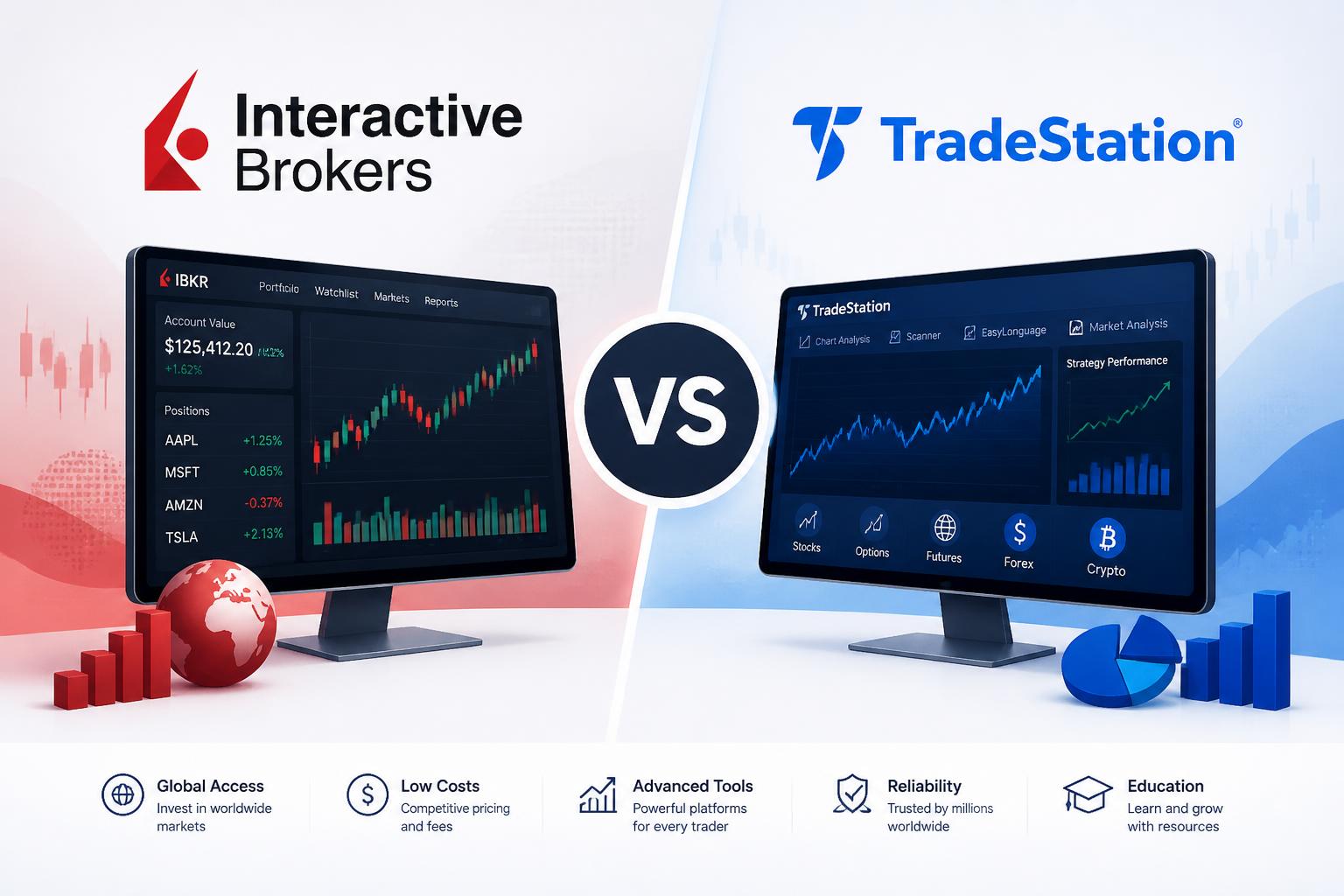
Table of Contents
- Fee Structures: Where the Real Cost Difference Lives
- Platform Capabilities: TWS vs TS10
- Account Types and Minimums
- Market Access and Asset Coverage
- Security and Regulation
- Customer Support Experience
- Which Platform Wins for Your Trading Style
- FAQ
Fee Structures: Where the Real Cost Difference Lives
Commission-free stock trading looks identical until you start trading options or using margin.
Interactive Brokers has two pricing models:
- IBKR Lite: $0 stock commissions, $0.65 per options contract, no minimum deposit
- IBKR Pro: $0.0035 per share (tiered) or $0.005 per share (fixed), options contracts from $0.15 to $0.65, $1,000 minimum deposit
TradeStation charges $0 on stocks with standard routing and $0.80 per options contract. No account tiers. No deposit minimum.
If you trade 100 options contracts a month, Interactive Brokers Pro at $0.25 per contract costs you $25. TradeStation at $0.80 costs $80. Over a year that’s $660 versus $960—a $300 difference for the same volume.
Stock traders who rarely touch options pay effectively nothing on both platforms. Options heavy traders pay less with Interactive Brokers Pro, but you need $1,000 to open the account and the learning curve is steeper.

Platform Capabilities: TWS vs TS10
TradeStation built its reputation on charting and technical analysis. TS10, TS Mobile, and TS Webtrade give you deep customization for indicators, scanning, and automated strategy execution. The platform is designed for traders who live in chart patterns and need millisecond level order routing control.
Interactive Brokers’ Trader Workstation (TWS) handles complexity differently. You get 150 global markets, multi asset portfolio margining, and algorithmic order types most retail platforms don’t have. The interface looks like engineers built it for other engineers. Powerful, not intuitive.
Both platforms support automated trading. TradeStation’s EasyLanguage lets you code strategies without learning Python. TWS uses API access for algo traders who already know how to code.
The practical difference: TradeStation is better if your edge comes from technical setups and you want the cleanest charting experience. Interactive Brokers is better if you trade multiple asset classes across global markets and need institutional grade execution.
Account Types and Minimums
Interactive Brokers has two paths:
- IBKR Lite: $0 minimum, simplified pricing, US stocks and ETFs only
- IBKR Pro: $1,000 minimum, tiered pricing, access to global markets and the full product suite
TradeStation requires $0 to open an account and gives you full platform access immediately. No tiers. No feature gates based on deposit size.
Both brokers support margin accounts, IRAs, and entity accounts. Interactive Brokers lets you fund in 24 currencies. TradeStation sticks to USD for US accounts.
If you’re starting with under $1,000, TradeStation gives you full functionality from day one. If you’re depositing $10,000+ and want the lowest per trade costs, IBKR Pro pays for itself quickly.
Market Access and Asset Coverage
Interactive Brokers covers 150 markets across 33 countries. You can trade US equities, European stocks, Asian futures, forex pairs, and fractional shares in a single account. This is the biggest differentiator—true global access without opening multiple brokerage accounts.
TradeStation focuses on US equities, options, and futures. You get access to OTC stocks and mutual funds, but international markets require a separate TradeStation Global account (which routes through Interactive Brokers UK).
For US only traders, both platforms cover the same core products. For anyone trading international equities or forex, Interactive Brokers is the only real option.
Security and Regulation
Interactive Brokers earned a 90.6% safety score in 2026 reviews. The firm is regulated by the SEC, FINRA, and multiple international regulators. Client accounts have SIPC protection up to $500,000, with additional coverage through Lloyd’s of London.
TradeStation scored 68.4% on safety ratings. It’s regulated by the SEC and FINRA with standard SIPC protection. The lower score reflects fewer regulatory jurisdictions and less published financial data compared to Interactive Brokers’ multi decade public track record.
Both platforms use two factor authentication and encrypted connections. Neither has had a major security breach in the past five years.
The gap matters if you’re holding six figure accounts or trading internationally. Interactive Brokers has a significantly larger regulatory presence.
Customer Support Experience
Both brokers run 24/7 customer service in 2026. Interactive Brokers has phone, chat, and email support, but response times vary. Expect faster service if you’re an IBKR Pro user with a larger account balance.
TradeStation’s support is geared toward active traders, with faster response on platform specific technical issues. You’ll get quicker help troubleshooting a custom indicator than navigating tax forms.
BrokerChooser’s June 2026 comparison noted that Interactive Brokers’ service is “slightly better” overall, but that advantage shrinks for US only accounts where TradeStation’s focused support model shines.
Neither platform holds your hand through account setup. If you’re coming from Robinhood or Webull, expect a steeper onboarding process with both.
Which Platform Wins for Your Trading Style
Choose Interactive Brokers if:
- You trade options frequently and want the lowest per contract cost (IBKR Pro at $0.25 beats TradeStation’s $0.80)
- You need access to international markets without opening multiple accounts
- You’re comfortable with a complex interface in exchange for institutional grade tools
- You’re depositing $1,000+ and want tiered pricing that rewards volume
Choose TradeStation if:
- Technical analysis drives your strategy and you need top tier charting tools
- You’re starting with under $1,000 and want full platform access immediately
- You trade primarily US stocks and options, not international markets
- You value intuitive platform design over raw feature count
Interactive Brokers is the stronger all around platform for active traders according to multiple 2026 reviews. TradeStation is built for serious technical traders who rely heavily on charting and strategy customization.
The question is whether you’re paying $300 a year extra for a better charting experience (TradeStation) or saving that money for lower execution costs (Interactive Brokers Pro).
FAQ
What are the minimum deposits for Interactive Brokers and TradeStation?
Interactive Brokers requires $0 for IBKR Lite accounts and $1,000 for IBKR Pro. TradeStation has a $0 minimum for all account types. TradeStation gives you full platform access immediately. IBKR Lite restricts you to US markets.
How do the commission structures compare between the two brokers?
Both charge $0 on stock commissions. Interactive Brokers charges $0.65 per options contract (IBKR Lite) or $0.25 (IBKR Pro mid tier). TradeStation charges $0.80 per options contract. For 100 contracts a month, that’s a $55 monthly difference favoring IBKR Pro.
Can you trade cryptocurrency with Interactive Brokers or TradeStation?
Interactive Brokers has crypto trading through its platform. TradeStation added crypto capabilities but availability depends on account type and state regulations. Neither platform is crypto native—both treat it as an additional asset class rather than a core feature.
Does Interactive Brokers or TradeStation offer IRAs?
Yes. Both support traditional and Roth IRAs. Interactive Brokers allows IRA accounts for both IBKR Lite and Pro tiers. TradeStation gives IRA accounts the same platform access as taxable accounts.
Which platform is better for active traders?
Interactive Brokers scores higher overall (4.9/5 vs 4.2/5) and costs less for high volume options trading. TradeStation wins on charting tools and technical analysis features. If you trade 50+ times a month across multiple asset classes, Interactive Brokers Pro has better economics. If you day trade US stocks with heavy technical analysis, TradeStation’s platform is built for exactly that.