YNAB vs Rocket Money: Which Budgeting App Works in 2026?
You’re looking at two budgeting apps. YNAB costs $109 a year and makes you assign every dollar a job. Rocket Money is cheaper at $6-$14/month and automates most of the work. One requires discipline. The other requires trusting algorithms. Which one helps you stop living paycheck to paycheck?
Short version: YNAB if you want control and you’ll do the planning. Rocket Money if you want automation and hate spreadsheets. But which app is “better” misses the point—it’s about which one matches how you handle money.
I’ll compare them on cost, features, learning curve, and who each app is built for.
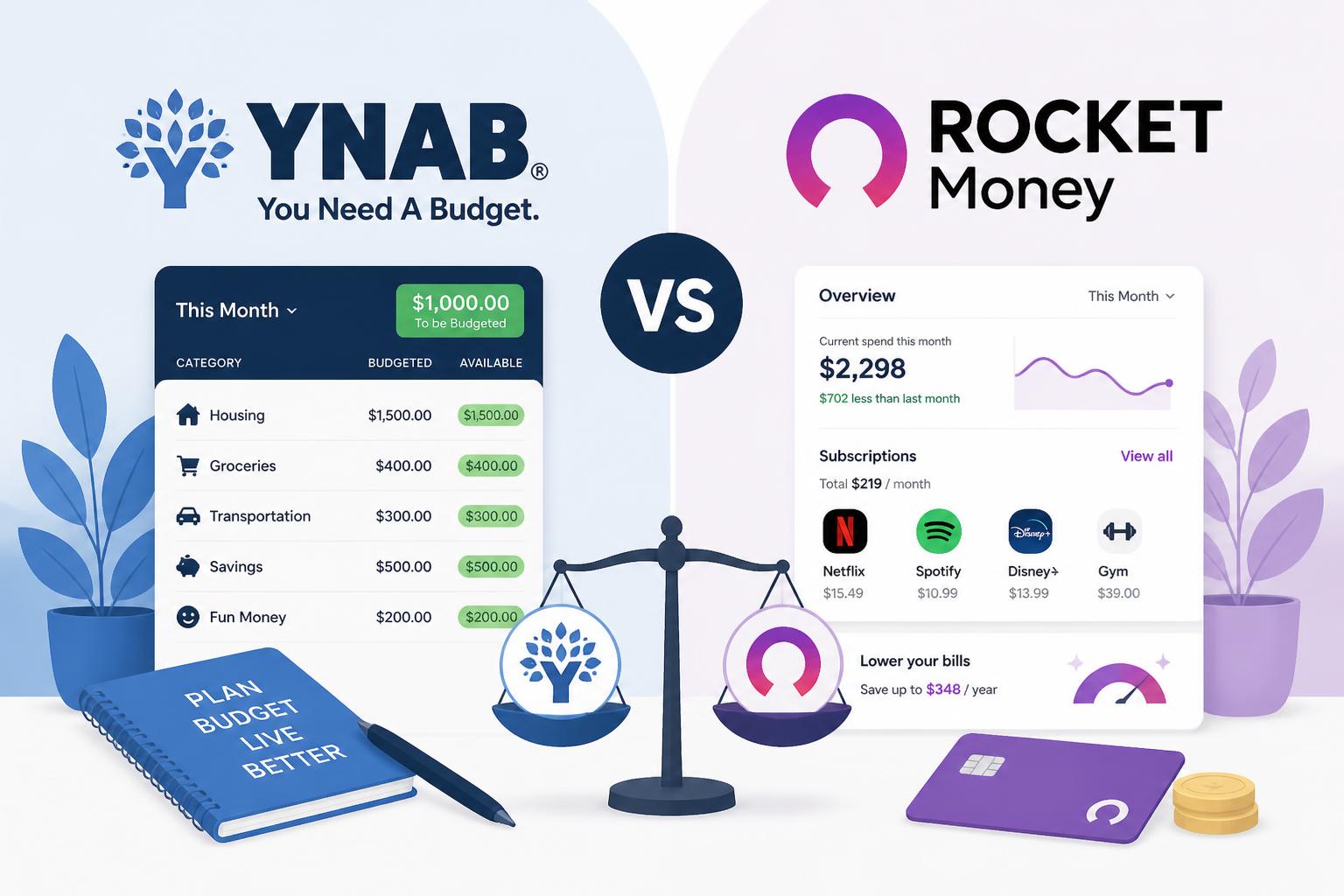
Table of Contents
- What YNAB and Rocket Money Do
- Pricing: What You Pay For
- Feature Comparison
- YNAB: For Proactive Budgeters
- Rocket Money: For Passive Savers
- The Learning Curve
- Which App for Debt Payoff?
- Common Dealbreakers
- FAQ
- Verdict
What YNAB and Rocket Money Do
YNAB (You Need a Budget) is zero based budgeting. Every dollar you earn gets assigned to a category before you spend it. You plan where money goes, track spending against those plans, and adjust when life changes. You decide, the app holds you accountable.
Rocket Money is an automated financial tracker. Connects to your bank, categorizes transactions automatically, monitors subscriptions, and can negotiate bills for you. You watch what happens. The app tells you where money went and flags problems.
YNAB assumes you want to control money before you spend it. Rocket Money assumes you want visibility after so you can adjust.
Both work. Just for different people.
Pricing: What You Pay For
YNAB: $14.99/month or $109/year. There’s a 34 day free trial (longer for college students). No free tier. You get zero based budgeting, a loan planner, and access to community forums.
Rocket Money: Free basic version with manual tracking and spending insights. Premium is $6-$14/month depending on what you negotiate during signup (the price is negotiable, which is weird). Premium adds automated subscription cancellation, bill negotiation, and smart savings. There’s a 7 day free trial for Premium.
YNAB yearly comes to $9.08/month. Rocket Money Premium averages $10/month if you negotiate. YNAB is slightly cheaper per month if you pay yearly, but Rocket Money has a free tier that works.
Time is the other cost. YNAB needs 15-30 minutes a week. Rocket Money needs 5 minutes to review what it found.
Feature Comparison
Feature YNAB Rocket Money Zero based budgeting Core feature—assign every dollar Not available Automated transaction import Yes, with bank sync Yes, fully automated Subscription tracking Manual categorization Automatic detection + cancellation Bill negotiation Not available Included in Premium Debt payoff planner Loan planner tool included Basic tracking only Spending insights Manual review required Automated alerts and summaries Goal tracking Category based goals Savings goals with auto transfer Learning curve Steep—requires understanding the method Shallow—works out of the box Community support Active forums and workshops Limited support resources Manual transaction entry Fully supported (some prefer this) Available but not emphasized
YNAB: For Proactive Budgeters
YNAB is for zero based budgeting. If you’ve said “I don’t know where my money goes,” YNAB forces you to know.
What it does well:
- Every dollar gets a job. You assign money to categories the moment it arrives. Rent, groceries, emergency fund, vacation—every dollar has a purpose before you spend.
- You plan instead of reacting. Decide priorities, then spend according to plan. Fewer surprises.
- Loan planner tool. Built in debt calculator showing when you’ll be debt free based on your payment plan. Works for credit cards, student loans, car loans.
- Active community. Forums, free workshops, and a method people stick with for years.
Where it falls short:
- Requires commitment. If you don’t update regularly, the budget breaks. You reconcile accounts, adjust categories, engage with the system.
- Learning curve. The four rules, rolling with the punches, aging your money—takes a few weeks to internalize. Some people bounce off.
- No bill negotiation or automation. YNAB won’t cancel subscriptions or call your cable company. It’s purely budgeting.
YNAB works well for debt reduction. If you’re paying off $20k in credit card debt and need a system to stay on track month after month, YNAB’s structure keeps you honest.
Who it’s for: People who want control, don’t mind weekly maintenance, and have a big financial goal like debt payoff or saving for a house.
Rocket Money: For Passive Savers
Rocket Money is beginner friendly with automated features. Designed for people who want clarity without manual work.
What it does well:
- Automated spending tracking. Connects to your bank, categorizes transactions, shows spending patterns without you doing anything.
- Subscription monitoring. Most people underestimate subscription spending by more than $200 a month. Rocket Money finds recurring charges and lets you cancel from the app. Premium cancels for you.
- Bill negotiation service. Rocket Money calls your cable, internet, or phone company and negotiates a lower rate. You keep 60% of savings, they keep 40%. People report saving $20-$100/month.
- Smart savings. Analyzes spending and auto transfers small amounts to savings when you can afford it.
- Low friction. Set it up once, check weekly. Works even if you forget about it.
Where it falls short:
- No zero based budgeting. Rocket Money tracks and categorizes, but doesn’t force you to assign every dollar before spending. You react to data instead of planning.
- Automated categorization isn’t perfect. Sometimes miscategorizes transactions. You correct it occasionally.
- Less suited for aggressive debt payoff. Tracks debt but doesn’t guide you through a structured payoff plan like YNAB.
Rocket Money is an accessible starting point for people who’ve never budgeted. Shows you the patterns. Once you see where money goes, you decide if you want more control (YNAB) or if passive monitoring is enough.
Who it’s for: People who want visibility without work, hate manual tracking, and want help with subscription cancellations and bill negotiation.
The Learning Curve
YNAB takes 2-4 weeks to feel natural. You watch tutorials, read the four rules, probably mess up your first budget. By week three it clicks. By month two you’re assigning dollars without thinking. The payoff is understanding your cash flow.
Rocket Money takes 10 minutes to set up. Connect your bank, review auto assigned categories, done. The downside is you never build the muscle memory of intentional planning.
If you’ve never budgeted, Rocket Money is easier. If you tried budgeting and it didn’t stick because you weren’t engaged, YNAB’s structure might be what you need.
Which App for Debt Payoff?
YNAB. The loan planner shows when each debt disappears based on your payment plan. You can model scenarios—what if I add $50 extra to this card? What if I pause vacation savings and throw everything at student loans for six months?
Zero based budgeting forces prioritization. Every dollar has a job, so if debt payoff is priority, you see what you’re sacrificing to make bigger payments. That clarity keeps people on track.
Rocket Money tracks debt balances and minimum payments but doesn’t guide you through a structured payoff strategy. You see your debt but you’re on your own to build a plan.
For debt payoff: YNAB by a wide margin. If you’re serious about crushing $15k in credit card debt or paying off a car loan early, YNAB’s structure and loan planner are worth $109/year.
Common Dealbreakers
YNAB dealbreakers:
- Price. $109/year feels steep when living paycheck to paycheck. (Though if it helps you save $200/month, it pays for itself in three weeks.)
- Time commitment. If you won’t spend 15 minutes a week updating, it won’t work.
- Manual reconciliation. Some people hate checking that transactions match their budget. If that’s you, Rocket Money’s automation is better.
Rocket Money dealbreakers:
- No proactive planning. If you need to assign every dollar before spending, Rocket Money won’t satisfy.
- Premium pricing variability. Some pay $6/month, others $14/month for the same features. The negotiation thing annoys people.
- Less depth. If you’re a spreadsheet person who wants granular control, Rocket Money feels too simple.
FAQ
Is YNAB worth $109 a year?
Yes, if you’ll use it. YNAB pays for itself if it helps you avoid one overdraft fee, find one forgotten subscription, or stick to debt payoff for a few extra months. Not worth it if you won’t commit to weekly updates.
Can Rocket Money negotiate my bills?
Yes. Bill negotiation is real and works for cable, internet, phone, and some insurance. You submit the bill, Rocket Money negotiates, you keep 60% of annual savings. People report $20-$100/month savings, though results vary.
Which app for beginners?
Rocket Money. Minimal learning curve and works even if you don’t understand budgeting yet. YNAB is better once you want serious control, but it’s not where most people should start.
Do I need both?
No. They solve the same problem in opposite ways. Some people use Rocket Money to track and YNAB to plan, but that’s overkill. Pick one based on whether you want automation (Rocket Money) or control (YNAB).
Best free alternative?
Empower Personal Dashboard is free for tracking in 2026, and EveryDollar has a free manual entry version. Rocket Money’s free tier works if you don’t need Premium features. YNAB has no free version.
Can budgeting apps hurt credit score?
No. Connecting a budgeting app to your bank is read only. Doesn’t affect credit. Bill negotiation through Rocket Money doesn’t hurt credit either—they negotiate on your behalf, not opening new accounts.
How long to see results?
Most people notice behavior changes within the first month of consistent use. YNAB users report less financial stress after 60-90 days once the method clicks. Rocket Money users see immediate value from subscription cancellations—sometimes hundreds of dollars in the first week.
Verdict
YNAB if you want to plan every dollar, need structured debt payoff, and will invest 15-30 minutes a week. $109/year, steep learning curve, but strong for intentional budgeting.
Rocket Money if you want automation, hate manual tracking, and need help with subscriptions and bill negotiation. $6-$14/month for Premium (free basic tier), minimal learning curve, but won’t teach proactive planning.
Do you want to control money before you spend it, or track after and adjust? Answer that and the choice is clear.