How to Save Money with High-Yield Savings: A Step-by-Step Guide (2026)
Affiliate Disclosure: This article contains affiliate links. If you sign up through these links, we may earn a commission at no extra cost to you. We only recommend products we’ve researched and believe will help you reach your financial goals.
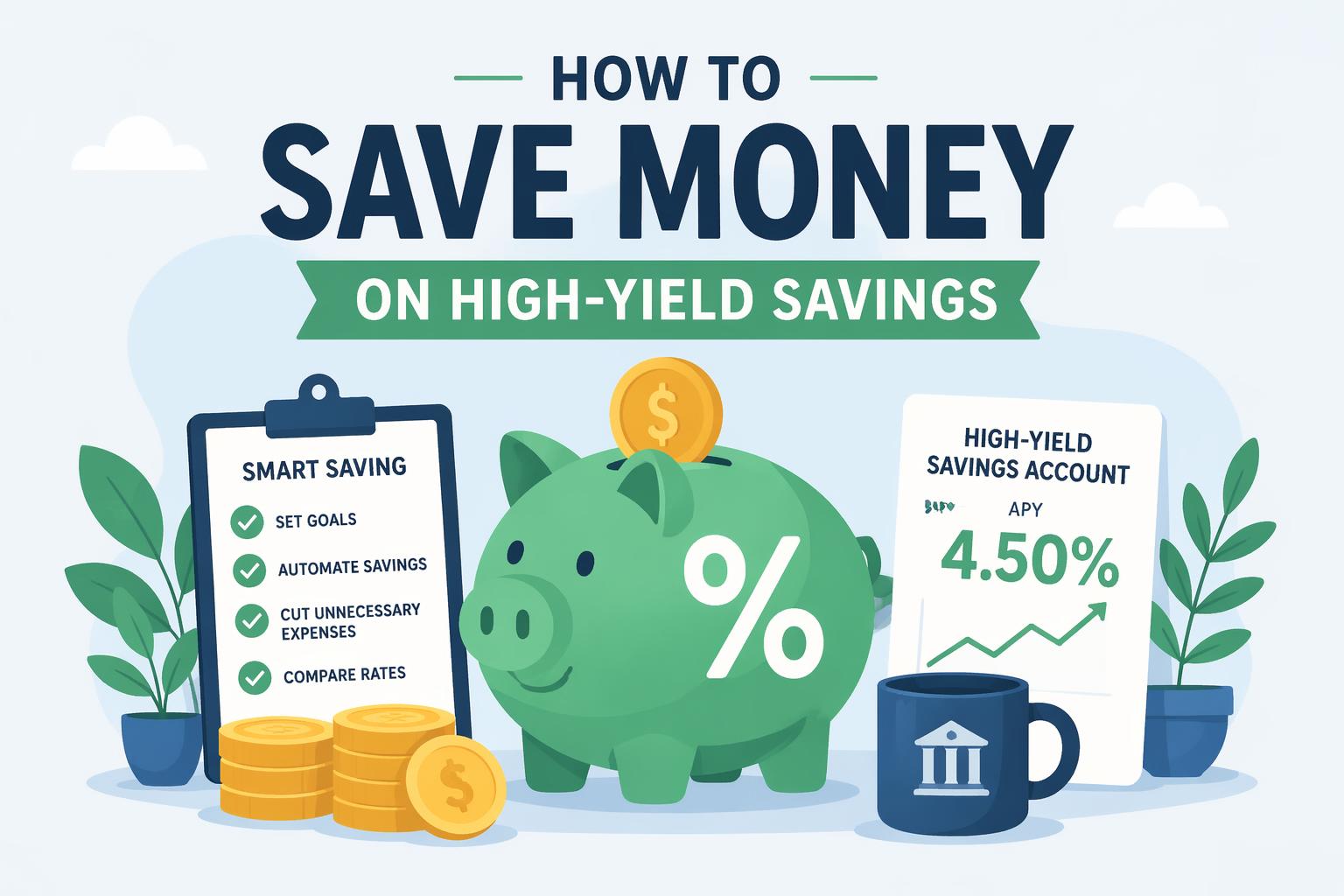
Your savings account is probably costing you money.
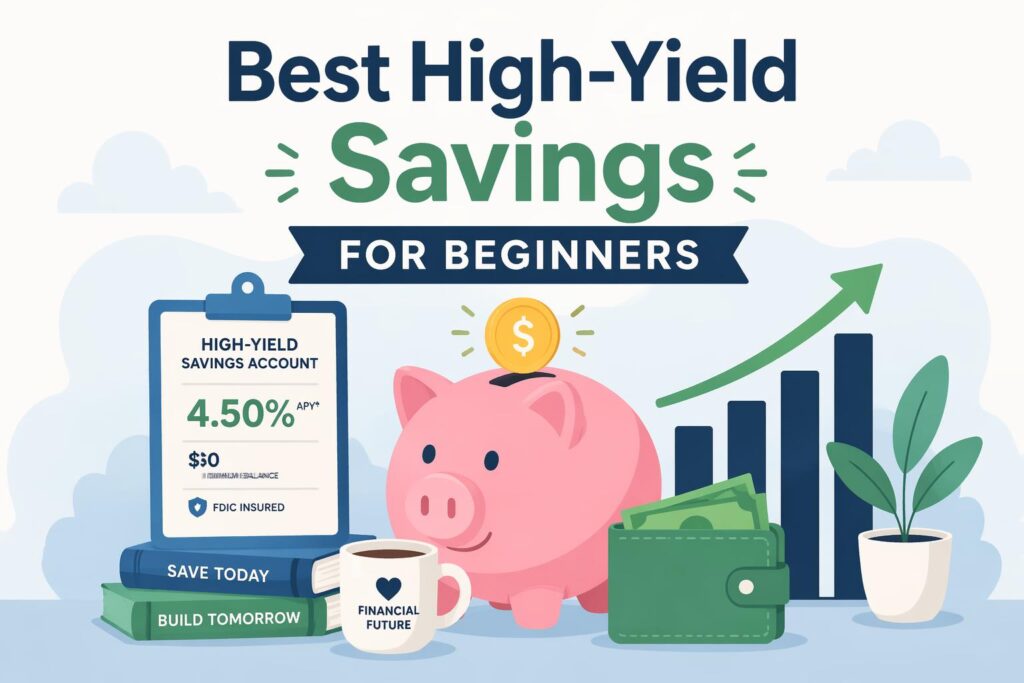
The national average savings rate is 0.38% APY as of July 2026. High-yield savings accounts pay up to 4.15% APY—nearly 11 times more interest on every dollar. On a $10,000 balance, that’s $38 per year versus $415.
High-yield savings accounts aren’t complicated. They’re federally insured savings accounts that pay competitive interest rates. The question is which account to pick and how to set it up so your money grows without you thinking about it.
What you need before starting:
- Government-issued ID (driver’s license or passport)
- Social Security number
- Basic personal information (address, employment, income)
- Initial deposit amount ($0-$250 depending on the bank)
- 15-20 minutes
Step 1: Understand what you’re getting
High-yield savings accounts work like traditional savings accounts, but pay better interest rates.
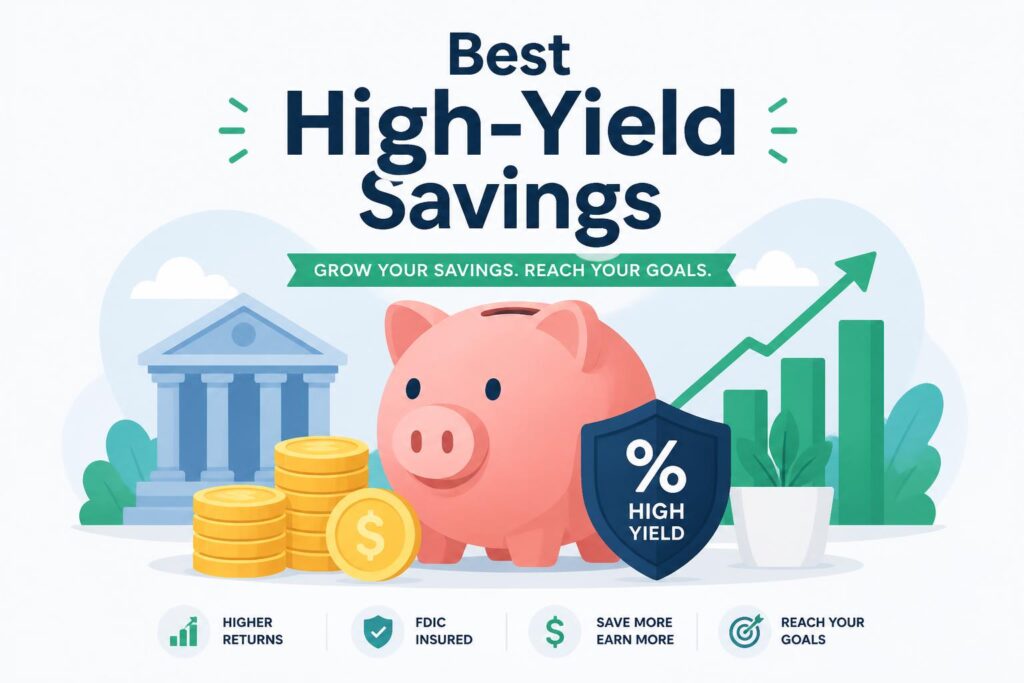
Top HYSAs in July 2026 offer 3.85% to 4.15% APY. The national average is 0.38%. Most come from online banks with lower overhead costs. Your money is federally insured up to $250,000 per depositor. You can transfer money in and out, though there may be limits on monthly withdrawals (typically six).
These accounts make sense for emergency funds, short-term savings goals, and money you need within 1-2 years. For longer goals, CDs or investment accounts are worth considering.
Step 2: Calculate how much more you’ll earn
Take your current savings balance and multiply by 0.0038 (the national average rate). That’s your annual earnings with a traditional account.
Now multiply by 0.0415 (the top rate as of July 2026).
Example:
- $10,000 × 0.0038 = $38/year (traditional account)
- $10,000 × 0.0415 = $415/year (high-yield account)
- Difference: $377 extra per year
Step 3: Compare account requirements and fees
Check minimum deposits first. Some accounts require $0 to open (Forbright Bank, EverBank, Zynlo Bank). Others need $100-$250. A few require $5,000 or more for the highest rates, like CIT Bank’s Platinum Savings.
The best high-yield accounts have no monthly maintenance fees. Avoid accounts that charge fees unless you maintain a minimum balance. Watch for transaction fees beyond standard withdrawal limits.
Some banks pay the same rate on any balance. Others have tiered rates where higher balances earn higher APY. Check if there’s a minimum balance to earn the stated APY.
Even if you can only start with $100, you’ll earn more than in a traditional savings account.
Step 4: Check current APY and rate history
Interest rates on high-yield savings accounts change based on Federal Reserve policy.
Top rates as of July 2026 (according to Bankrate and NerdWallet):
- Pibank: 4.40% APY
- Forbright Bank: 4.15% APY
- CIT Bank: 4.10% APY
- Vio Bank: 4.01% APY
- Peak Bank: 4.01% APY
- Happen Bank: 4.00% APY
- Bread Savings: 3.95% APY
Look at the bank’s rate history over the past 6-12 months. Check how quickly they raised rates during the Fed’s 11 rate hikes in 2022-2023, and whether they kept rates competitive during the rate cuts in 2024-2025. Banks that adjusted quickly in both directions tend to stay competitive.
Step 5: Verify FDIC insurance coverage
Every legitimate high-yield savings account should be FDIC insured. Verify before depositing.
Go to the FDIC’s BankFind Suite at fdic.gov/resources/bankers/bank-find-suite. Search for the bank name. Confirm “FDIC Insured” status and note the insurance certificate number.
FDIC insurance covers up to $250,000 per depositor, per insured bank. Both principal and accrued interest. All deposit account types at that institution combined.
If you have more than $250,000, split funds across multiple FDIC-insured banks or consider joint accounts (covered separately up to $250,000).

Step 6: Open your account online
Most high-yield savings accounts open entirely online in 15-20 minutes.
Visit the bank’s website and click “Open Account.” Enter personal information (name, address, date of birth, SSN). Provide employment and income details. Choose joint or individual account. Upload a photo of your government ID. Review and accept the account terms. Submit.
To fund your new account, link your existing checking account for an ACH transfer (takes 2-5 business days). Wire transfers are faster but may have fees. Mailing a check takes 7-10 days.
Most banks require you to fund the account within 30-60 days of approval.
You’ll get an email confirmation, then account approval within 1-2 business days, then instructions for your first deposit.
Some banks do a soft credit check during verification. This doesn’t affect your credit score.
Step 7: Set up automatic transfers
Once your account is funded, set up recurring transfers.
Log in to your account dashboard. Navigate to “Transfers” or “Move Money.” Select “Schedule Recurring Transfer.” Choose your linked checking account as the source. Enter the amount—start with whatever you can consistently afford. Set the frequency (every payday, monthly on the 1st, etc.). Choose a start date. Save.
If you’re paid biweekly, schedule transfers for the day after each paycheck clears. If monthly, transfer on the same day each month. Start small ($50-100) and increase gradually.
Step 8: Understand withdrawal limits
High-yield savings accounts are designed for saving, not frequent spending.
Federal regulations allow up to six “convenient” withdrawals per month (online transfers, automatic payments, phone transfers). In-person withdrawals at a branch or ATM are unlimited, though many online banks have no physical branches. Incoming transfers are unlimited.
If you exceed limits, most banks charge $5-10 per excess withdrawal. Repeated violations may result in account conversion to checking or closure. Some banks removed these restrictions but still encourage limiting withdrawals.
To access your money: ACH transfer to your linked checking account (1-3 business days), wire transfer for same-day access (usually has a fee), or ATM card if your bank offers one.
If you need frequent access, keep some money in checking and treat high-yield savings as actual savings.
Step 9: Monitor your interest earnings
Interest compounds and is typically paid monthly.
Log in to your account dashboard. Look for “Account Summary” or “Activity.” Find “Interest Paid” or “Interest Earned.” Check the APY displayed—it may change periodically.
Interest is calculated daily based on your average daily balance, then compounded monthly (added to your balance). Your annual percentage yield accounts for compounding.
Example for $10,000 at 4.15% APY:
- Month 1: ~$34.58 interest
- Month 12: ~$34.69 (slightly more due to compounding)
- Total year 1: ~$415
Step 10: Review rates quarterly
High-yield savings account rates change. Banks with top rates today may fall behind in six months.
Set a quarterly reminder. Check your current APY. Compare to top rates available (Bankrate, NerdWallet, Investopedia). Calculate if switching would earn you more.
Worth switching when your current rate is 0.25% or more below the top available rates, you have a large balance ($10,000+), or another bank offers a sign-up bonus.
To switch: open the new account, transfer most funds via ACH, leave the old account open with a small balance until transfers clear, then close the old account if desired.
You’re done
You now have a high-yield savings account paying up to 11 times the national average. Your money is FDIC insured and growing automatically through recurring transfers and compound interest.
With 4%+ APY rates in mid-2026, every $10,000 earns about $400 per year in interest versus $38 in a traditional savings account. That’s $362 more per year.
If you haven’t opened your account yet, these have the best combination of high rates and low minimums as of July 2026:
- Forbright Bank (4.15% APY, no minimum deposit)
- CIT Bank (4.10% APY, $100 minimum)
- Vio Bank (4.01% APY, $100 minimum)
Troubleshooting
My application was denied.
This can happen due to credit history issues or ChexSystems records (a banking history database). Try a second-chance bank like Chime or ask the bank for the specific denial reason. You can dispute incorrect information in ChexSystems.
The APY changed after I opened my account.
This is normal. High-yield savings account rates are variable. Rate changes apply to all account holders, not just new customers. If your rate drops a lot, review Step 10 and consider switching.
I can’t link my external checking account.
Some online banks have trouble verifying certain accounts. Try manual verification: the bank makes two small deposits (under $1) to your checking account. Check your balance, note the exact amounts, enter them in the verification form.
I exceeded the withdrawal limit.
You’ll see a fee ($5-10) for each excess withdrawal. To avoid this, plan your transfers more carefully or keep more money in checking for regular expenses.
I’m not earning as much interest as I expected.
Check your average daily balance for the month. You only earn interest on money actually in the account. If you deposited mid-month, you’ll earn proportionally less. Also verify you’re meeting any minimum balance requirements for the stated APY.
Frequently asked questions
Is my money safe in a high-yield savings account?
Yes. Money in a high-yield savings account is FDIC insured up to $250,000 per depositor, per insured bank. Same protection as traditional banks. If the bank fails, the FDIC guarantees you’ll get your money back.
What should I do if I can’t open a high-yield savings account?
If you’re denied due to banking history issues, try second-chance banks or credit unions with more lenient requirements. You can also work on resolving ChexSystems issues by requesting your report and disputing errors.
Should I get a CD instead of a high-yield savings account?
Depends on your goals. High-yield savings accounts offer flexibility—you can withdraw anytime. CDs lock in a rate for a fixed term (6 months to 5 years) and penalize early withdrawals. Use HYSAs for emergency funds and short-term goals. Use CDs only for money you won’t need during the term.
How can HYSAs help fight inflation?
A 4% APY doesn’t always fully match inflation rates, but it reduces the erosion of your purchasing power compared to low-interest accounts. The national average of 0.38% means you’re losing money to inflation. A high-yield account at least keeps pace partially.
Are high-yield savings accounts taxed?
Yes. Interest earned is taxable income. You’ll receive a 1099-INT form if you earn $10 or more in interest during the year. Report it on your tax return as interest income.
Does Chase have a high-yield savings account?
As of July 2026, Chase’s standard savings accounts don’t offer competitive rates. Traditional big banks typically pay closer to the national average (0.38%). For the best rates, look at online banks like those listed in this guide.
What to do next
Build your emergency fund first. Financial experts recommend 3-6 months of expenses in an easily accessible account.
Set specific savings goals beyond your emergency fund (down payment, vacation, car replacement). Track them mentally or with your bank’s goal-setting tools if available.
Consider a CD ladder for long-term savings. Once your emergency fund is funded, move some longer-term savings into CDs with higher rates for money you won’t need for 1-5 years.
Review other areas where you’re losing money to low rates. If you have savings in a traditional checking account, money market account, or old savings account, move it to your high-yield account.