How to Compare Cashback and Rewards Cards
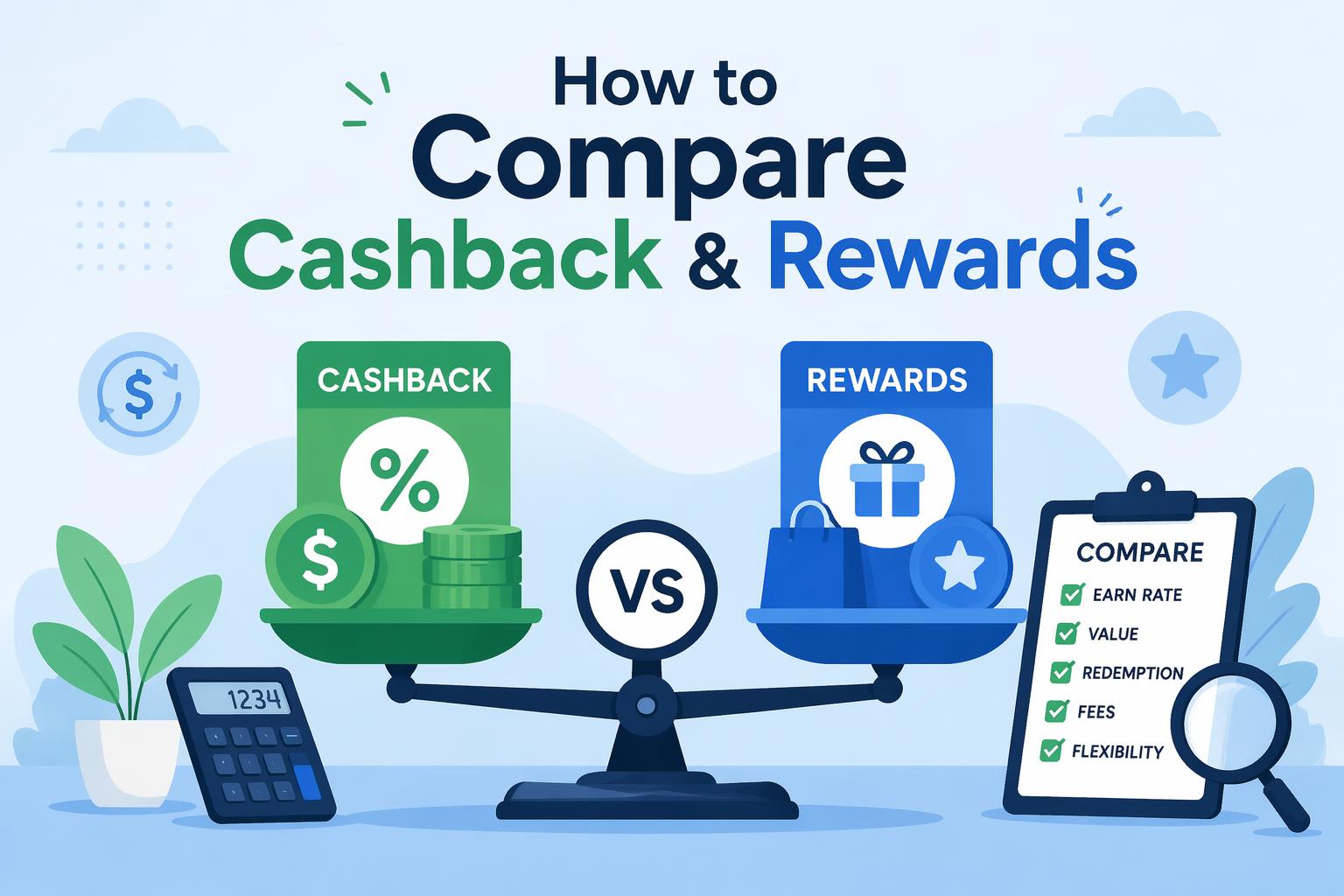
Picking a cashback credit card takes longer than it should. Hundreds of cards promise rewards, bonuses, and perks. Most people waste hours comparing offers or just grab whatever card their bank pushes.
I pulled recent data on rewards preferences: most cardholders prefer cash back over points or miles. With the right setup in 2026, you can earn up to 6% back on everyday purchases. But you need to know what actually matters.
This guide walks through how to evaluate cashback cards, match them to your spending, and build a strategy that maximizes rewards without juggling ten cards or paying fees that eat your earnings.
What you need:
- A clear picture of your monthly spending (grocery, dining, gas, general purchases)
- Your current credit score range
- About 15-20 minutes
—
What Makes Cashback Cards Different
Cash back means you get actual cash—a percentage of your spending returned as money. Not points that depreciate or expire. Not miles that force you to book through specific portals.
Three main types:
Flat rate cards give the same percentage on everything, usually 1.5-2%. The Wells Fargo Active Cash Card offers 2% on all purchases with no category restrictions. Simple. No tracking needed.
Rotating category cards offer higher rates (5%) on categories that change quarterly. The Discover it Cash Back rotates through gas stations, grocery stores, Amazon. You have to activate each quarter’s categories manually.
Fixed category cards give elevated rates on permanent categories. The Amex Blue Cash Preferred gives 6% cash back at U.S. supermarkets on up to $6,000 annually, then 1%. No quarterly activation.
In 2026 you can earn 5-6% back across almost all spending with the right combination. The trick is actually using the right combination.
—
Calculate Your Spending by Category
Before comparing cards, figure out where your money goes. Cards that look good on paper underperform if they don’t match how you spend.
Pull your last three months of statements. Break it down:
- Groceries: $____/month
- Dining and restaurants: $____/month
- Gas and transportation: $____/month
- General purchases (everything else): $____/month
Your distribution matters more than the total. If you spend $600/month on groceries but only $100 on dining, a grocery focused card beats a dining card—even if the dining card has a higher rate.
Don’t guess at these numbers. Actual spending is different from what you think you spend, and choosing the wrong card based on estimates costs real money.
—
Match Your Spending to a Card Type
If your spending is evenly distributed:
Get a flat rate card like Wells Fargo Active Cash (2% on everything) or Citi Double Cash Card (1% when you purchase, 1% when you pay).
If you have 1-2 dominant spending categories:
Get a fixed category card that matches. Heavy grocery spending? Amex Blue Cash Preferred gives 6% at supermarkets. Frequent restaurants? Capital One Savor.
If you’re willing to track and activate quarterly categories:
Get a rotating category card like Discover it Cash Back or Chase Freedom Flex. They require active management but offer 5% in bonus categories.
If you own a business or buy a lot of office supplies:
Consider Ink Business Cash Credit Card, which gives 5% on office supplies and internet services up to $25,000 spent annually.
Some financial advisors use specific cards for narrow categories—travel expenses on one card, for example. That works if you have concentrated spending in an unusual category.
—
Calculate Your Actual Annual Earnings
This is where most people mess up. They choose cards based on marketing instead of math.
For each card, run this:
(Category 1 spending × cashback %) + (Category 2 spending × cashback %) + (General spending × cashback %) = Annual cashback
Then subtract the annual fee.
Example:
Amex Blue Cash Preferred
- Groceries: $600/month × 12 × 6% = $432
- Gas: $200/month × 12 × 3% = $72
- Everything else: $400/month × 12 × 1% = $48
- Total: $552/year
- Annual fee: $95
- Net: $457/year
Wells Fargo Active Cash
- All spending: $1,200/month × 12 × 2% = $288
- Annual fee: $0
- Net: $288/year
Card A delivers $169 more annually despite the fee—but only if you actually spend $600/month on groceries. If your real grocery spending is $300/month, Card B wins.

—
Evaluate Sign-Up Bonuses
Sign up bonuses can shift first year math, but they shouldn’t be the main decision unless you’re choosing between two otherwise equal cards.
Common structures:
- Flat cash bonuses: Wells Fargo Active Cash offers a $200 bonus after spending $500 in the first 3 months. That’s a 40% return on your first $500.
- Matched cashback: Discover it Cash Back doubles all cashback earned in the first year for new cardmembers.
- Business card bonuses: Ink Business Cash offers a $1,000 bonus after qualifying purchases.
Run the bonus math:
- Check the minimum spending required
- Make sure you’ll hit that naturally (don’t overspend chasing a bonus)
- Add the bonus to your first year projection
- Recalculate without it for year two and beyond
Chase Freedom Unlimited offers 5% on Lyft purchases, 3% on dining and drugstores, 1.5% on everything else. If you don’t use Lyft, that 5% category is worthless.
Some cards offer 0% intro APR on purchases for 12-15 months. That matters if you’re making a large purchase and want to pay it off interest free, but it’s separate from cashback.
—
Check Category Caps and Restrictions
High percentages mean nothing if you hit spending caps three months in.
Annual spending caps: Amex Blue Cash Preferred offers 6% at supermarkets—but only on the first $6,000 annually. After that it drops to 1%. If you spend $800/month on groceries ($9,600/year), you only get 6% on the first $6,000, then 1% on the remaining $3,600.
Quarterly spending caps: Rotating category cards often cap 5% earnings at $1,500 per quarter. That’s $75 in cashback per quarter maximum.
Category definitions: “Dining” might exclude food delivery apps on some cards but include them on others. “Grocery” typically excludes Walmart and Target (they’re classified as general merchandise). “Gas” might exclude warehouse clubs.
Activation requirements: Rotating category cards require manual activation each quarter. Miss the deadline and you earn the base rate (usually 1%) instead of 5%.
Some advisors emphasize focusing on a few key spending categories rather than optimizing every dollar. The overhead of managing too many cards and restrictions often leads to mistakes that cost more than the extra percentage points earn.
—
Compare Annual Fees Against Benefits
$0 annual fee cards aren’t always the best value. If a card’s extra earnings exceed its fee, pay the fee.
When to pay an annual fee:
- Your earnings projection shows net positive after the fee
- The card offers additional perks you’ll use
- You have concentrated spending in the card’s bonus categories
When to avoid fees:
- The free card outperforms after the fee
- You’re building credit and want history without ongoing costs
- Your spending is too distributed to benefit from category bonuses
Common annual fees:
- $0: Wells Fargo Active Cash, Chase Freedom Unlimited, Discover it Cash Back, Citi Double Cash
- $39: Credit One Bank Platinum Rewards Visa Card
- $75-$99: Destiny Mastercard Cashback Rewards ($75 first year, $99 after)
- $95+: Premium cards with elevated category bonuses
Opensky Plus Secured Visa Credit Card charges $0 annually and offers 10% cash back in select categories with a $25 welcome bonus. It requires no credit check, making it accessible for building or rebuilding credit.
—
Build a Card Combination Strategy
Single card strategies are simple but rarely optimal. Most high earners use 2-3 cards for different spending categories.
A basic two card strategy:
Card 1: Category specialist for your top spending area
- Groceries → Amex Blue Cash Preferred (6%)
- Dining → Capital One Savor
- Rotating categories → Discover it Cash Back (5%)
Card 2: Flat rate backup for everything else
- Wells Fargo Active Cash (2%)
- Citi Double Cash Card (2%)
This gives you elevated earnings on concentrated spending and solid returns on general purchases without tracking which card to use for every transaction.
A three card strategy adds a rotating category card to capture seasonal bonuses. You can earn 5% back across almost all spending—matching the upper end of what’s possible in 2026.
If you need a spreadsheet to remember which card to use where, you have too many cards. Keep it simple enough to execute consistently.
—
Check Credit Score Requirements
The best cards require good to excellent credit. Applying for cards you don’t qualify for wastes hard inquiries.
Credit score tiers:
- Excellent (750+): Access to all premium cashback cards with highest earning rates
- Good (670-749): Qualifies for most mid tier cashback cards
- Fair (580-669): Limited to secured cards and starter cashback cards with lower rates
- Building credit: Secured cards like Opensky Plus Secured Visa that don’t require credit checks
The Avant Cash Back Rewards Card states there’s no credit score impact if you’re declined—useful if you’re between tiers and want to test eligibility.
Don’t assume you know your score. Check it before applying. Most banks and credit card issuers show it for free. A 20 point difference can determine approval.
—
Verify Redemption Flexibility
Cashback isn’t valuable if you can’t access it easily or if it expires.
Minimum redemption thresholds: Some cards require $25-$50 before you can redeem. Others let you redeem any amount as a statement credit.
Redemption methods:
- Statement credit (most common)
- Direct deposit to your bank account
- Paper check (often has processing delays)
- Gift cards (sometimes at elevated value—$25 in cashback might get a $27.50 gift card)
Expiration policies: Most cashback doesn’t expire as long as your account stays open and in good standing. Confirm this—some cards have use it or lose it policies.
Transfer options: Some cashback programs let you pool rewards across multiple cards from the same issuer. Chase lets you combine cashback from multiple Chase cards.
Citi Double Cash Card’s structure (1% when you purchase, 1% when you pay) means you need to pay your balance to earn the full 2%. Minor detail but it affects cash flow if you carry a balance (which you shouldn’t with cashback cards because of interest rates).
Cashback from credit cards isn’t taxable income according to IRS guidelines. It’s treated as a rebate on purchases rather than income. This is one reason cashback cards often outperform other reward structures for tax purposes.
—
Read the Fine Print on Excluded Categories
What doesn’t count toward cashback often matters as much as what does.
Commonly excluded across most cards:
- Balance transfers
- Cash advances
- Money orders and wire transfers
- Fees (annual fees, late fees, foreign transaction fees)
- Lottery tickets and casino chips
- Peer to peer payment services (Venmo, PayPal, Cash App for certain transactions)
Category specific exclusions:
- “Grocery” cashback typically excludes warehouse clubs (Costco, Sam’s Club), superstores (Walmart, Target), and convenience stores
- “Dining” may exclude alcohol purchases or delivery service fees depending on the card
- “Gas” bonuses often exclude gas purchased at warehouse clubs or supermarkets
Chase Freedom Unlimited specifies 3% on “drugstore purchases”—which typically means CVS, Walgreens, Rite Aid, but not Walmart’s pharmacy section (classified as general merchandise).
Read the card’s terms document for your specific spending categories. A card isn’t a good fit if it excludes where you actually shop.
—
Test Your Setup for Three Months
You’ve done the research and chosen your cards. Now validate your projections.
For the first three months:
- Track actual earnings weekly using your card issuer’s app
- Note any surprise exclusions where you expected cashback but didn’t earn it
- Calculate your effective rate: Total cashback earned ÷ total spending
- Compare to your projection
If your actual earnings are significantly lower than projected:
- You miscalculated your spending distribution
- You’re hitting category caps earlier than expected
- You’re forgetting to use the right card for specific purchases
If your actual earnings match or exceed projections: your cashback strategy is working.
After three months, decide if your card combination works or if you need to adjust. The best time to close an underperforming card is within the first year before any annual fee posts.
—
Common Mistakes
Chasing bonuses you won’t maintain: A card offering 6% on streaming services only matters if you spend meaningful money on streaming. $50/year in that category earns $3. Not worth optimizing around.
Ignoring annual fee cards entirely: Many people reflexively avoid annual fees, missing cards that would earn them $100+ more per year even after the fee.
Overcomplicating your setup: Having 5-6 cards to optimize every category sounds good in theory but creates decision fatigue. You end up using the wrong card or just using one card for everything, making the others pointless.
Not activating rotating categories: Forgetting to activate quarterly categories on cards like Discover it Cash Back means you earn 1% instead of 5%. Turns a strong card into a mediocre one.
Carrying a balance to “maximize rewards”: Credit card interest rates (18-29% APR typically) will always exceed cashback earnings. If you’re paying interest, you’re losing money regardless of cashback percentages.
—
Cashback Strategy Checklist
Before finalizing your cards:
- [ ] You’ve calculated actual spending by category (not estimated)
- [ ] Your top card choice aligns with your highest spending category
- [ ] You’ve run the annual earnings math including fees
- [ ] You’ve confirmed you meet credit score requirements
- [ ] You understand category caps and exclusions
- [ ] You have a system to remember which card to use where
- [ ] You’ve verified redemption minimums and methods
- [ ] You’ve set calendar reminders for rotating category activation (if applicable)
—
What to Do Next
You now have a framework for evaluating cashback cards that match your actual spending.
Next steps:
- Pull your last three months of statements and complete the spending breakdown
- Run the earnings calculations for your top 2-3 card candidates using your actual numbers
- Apply for your primary card (the one matching your highest spending category)
- Set up your tracking system to monitor earnings against projections
Once you’ve established your primary card and validated it’s performing, add a secondary card to cover your next spending category. Building a strategy incrementally—one card at a time—prevents the overwhelm that causes most people to abandon optimization entirely.
The “best” cashback card is the one that earns you the most money based on how you spend. Generic rankings and advertised percentages matter less than the dollars that actually land in your account.
—
Frequently Asked Questions
Do cash back cards actually give you cash?
Yes. While it’s called “cash back,” you typically redeem it as a statement credit, direct deposit, or check. The value is equivalent to cash—$100 in cashback reduces your balance or deposits $100 to your bank account.
Does cash back expire?
Generally no, as long as your account stays open and in good standing. Check your specific card’s terms—some promotional offers or bonus categories may have expiration dates, but standard cashback earnings typically don’t expire.
What credit score do you need for a cash back credit card?
Depends on the card tier. Premium cashback cards with 5-6% categories typically require excellent credit (750+). Mid tier cards with 2-3% rates often require good credit (670+). Secured cashback cards are available for building credit with no credit check required.
How do you get 5% cash back on everything?
You can’t with a single card, but you can approximate it with multiple cards: use rotating category cards (5% quarterly bonuses) when active, category specific cards (5-6% on groceries, dining, or gas), and a 2% flat rate card for everything else. This requires tracking but can push your overall effective rate to 4-5%.
Which credit card gives the most cash back?
Amex Blue Cash Preferred offers 6% at U.S. supermarkets (up to $6,000 annually), which is among the highest rates available in 2026. However, “most cash back” depends on your spending—a 2% flat rate card on $50,000 annual spending ($1,000 cashback) beats a 6% grocery card if you only spend $3,000 on groceries ($180 cashback).
Are cash back credit cards worth it?
Yes, if you pay your balance in full each month. The average consumer with $22,500 in annual spending can earn $300-$600/year in cashback with a basic optimized strategy. Free money for purchases you’d make anyway. If you carry a balance and pay interest, the interest charges will exceed cashback earnings.
—
Ready to start earning more on every purchase? Use the comparison framework to identify your optimal card setup this week. The difference between a random cashback card and an optimized strategy is $200-$400 per year—money you’re leaving on the table with every swipe.