What Is Stock Trading Platforms: The 2026 Guide for People Who Actually Want to Start
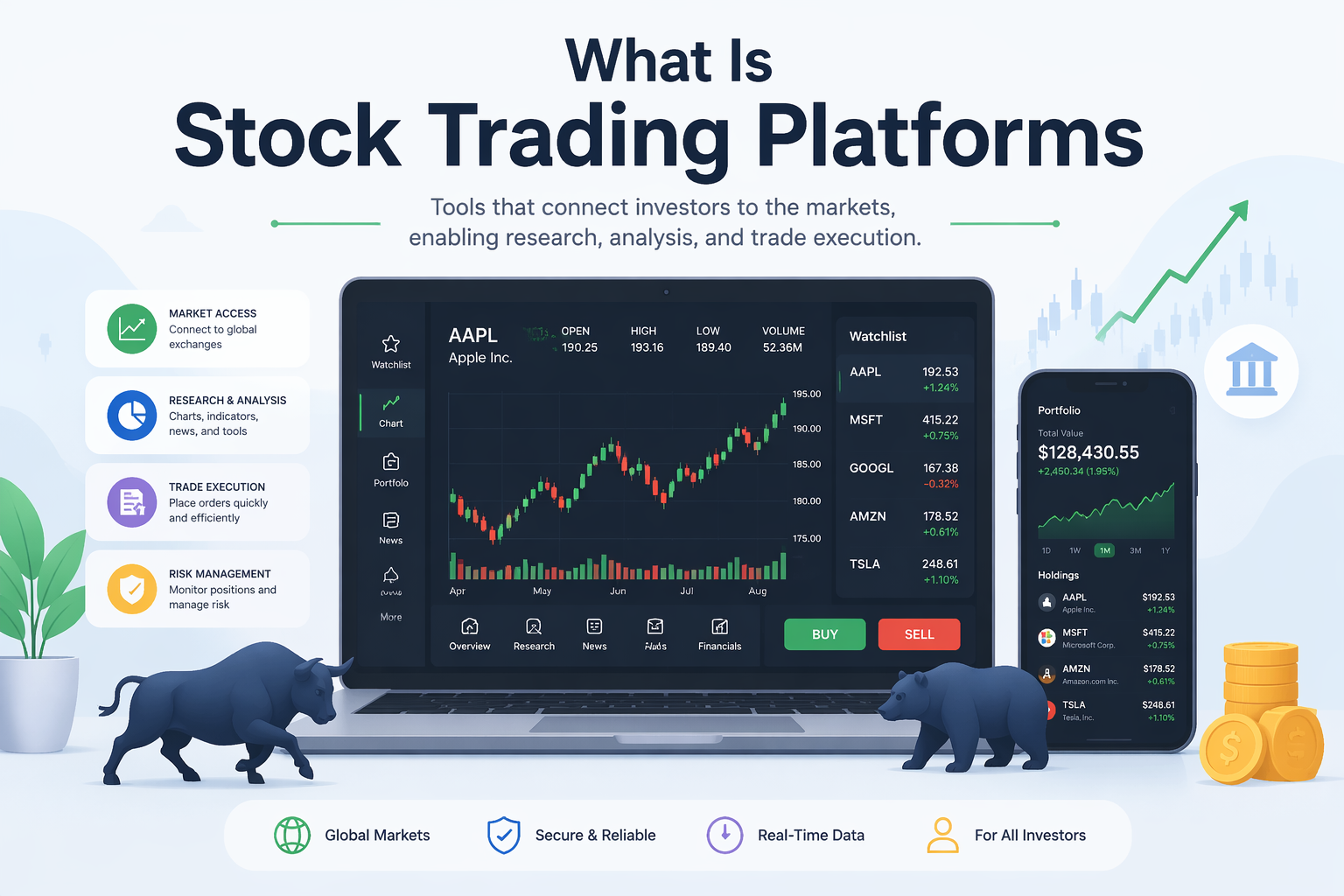
Stock trading platforms are digital services that let you buy and sell stocks, ETFs, options, and other securities through your phone or computer—without calling a human broker or paying $50 per trade like your parents did. In 2026, the baseline expectation is zero-commission trading, fractional shares, and an interface you can figure out without a finance degree.
The real question isn’t what they are. It’s which one you should trust with your money, and how to avoid wasting months on a platform that doesn’t fit how you actually invest.
This guide walks you through what stock trading platforms do, how they make money (hint: not from you directly), the features that matter in 2026, and a comparison of the platforms people actually use—backed by data from over 60 providers reviewed this year.
Table of Contents
- What Stock Trading Platforms Actually Do
- How Trading Platforms Make Money (If Trading Is Free)
- Core Features Every Platform Should Have in 2026
- The 2026 Landscape: Who’s Leading and Why
- How to Pick the Right Platform Without Overthinking It
- Common Mistakes People Make When Choosing a Platform
- FAQ
What Stock Trading Platforms Actually Do
A stock trading platform is software that connects you to the stock market. It sits between you and the exchanges (NYSE, NASDAQ, etc.) and executes your buy and sell orders in milliseconds.
Here’s what happens when you tap “Buy 10 shares of Apple”:
- You place an order through the app or website
- The platform routes it to a market maker or exchange
- The trade executes at the current market price (or your limit price)
- The shares land in your account, held in your name by the brokerage
In 2026, every major platform handles this flow with zero commission on stock trades. The difference is in everything else—the research tools, the speed, the customer service, the asset selection, and whether the interface makes you feel smart or lost.
Stock trading platforms also handle:
- Account custody — your shares are held in a brokerage account insured by SIPC (up to $500,000)
- Tax reporting — generating 1099 forms for your capital gains and dividends
- Dividend reinvestment — automatically buying more shares with your dividend payouts
- Fractional shares — letting you buy $10 worth of Amazon instead of one full share at $3,200
The platforms that win in 2026 are the ones that make this invisible. You shouldn’t need to think about settlement periods or routing—you should be thinking about whether Tesla is overvalued.
How Trading Platforms Make Money (If Trading Is Free)
Zero-commission trading became the standard after Robinhood forced the entire industry to drop fees in 2019. But brokerages still make money—they’ve just shifted where it comes from.
Payment for order flow (PFOF) — When you place a trade, the platform routes it to a market maker (like Citadel Securities or Virtu) instead of directly to an exchange. The market maker pays the platform a tiny fee per share in exchange for the order flow. This is how Robinhood makes most of its revenue. Critics argue it creates a conflict of interest; defenders point out you still get price improvement over the exchange quote most of the time.
Interest on cash balances — Your uninvested cash sits in a sweep account, and the brokerage earns interest on it. Some platforms (like Robinhood) pay you a cut of that interest; others keep most of it.
Margin lending — If you borrow money to trade (buying on margin), you pay interest. Rates vary widely—Interactive Brokers charges around 5.83% in 2026, while some platforms push 10%+.
Premium subscriptions — Robinhood Gold, Moomoo’s premium data feeds, and similar upgrades charge $5–$10/month for faster execution, research tools, or higher margin borrowing power.
Asset management fees — Platforms like Vanguard and Fidelity make most of their money managing mutual funds and ETFs. Trading is just the front door.
The business model matters because it shapes what the platform optimizes for. Robinhood wants you trading frequently (more PFOF revenue). Vanguard wants you holding index funds long-term (more assets under management). Neither is evil—just know what game you’re playing.
Core Features Every Platform Should Have in 2026
The baseline feature set in 2026 is higher than it was even two years ago. If a platform doesn’t have these, it’s not competitive:
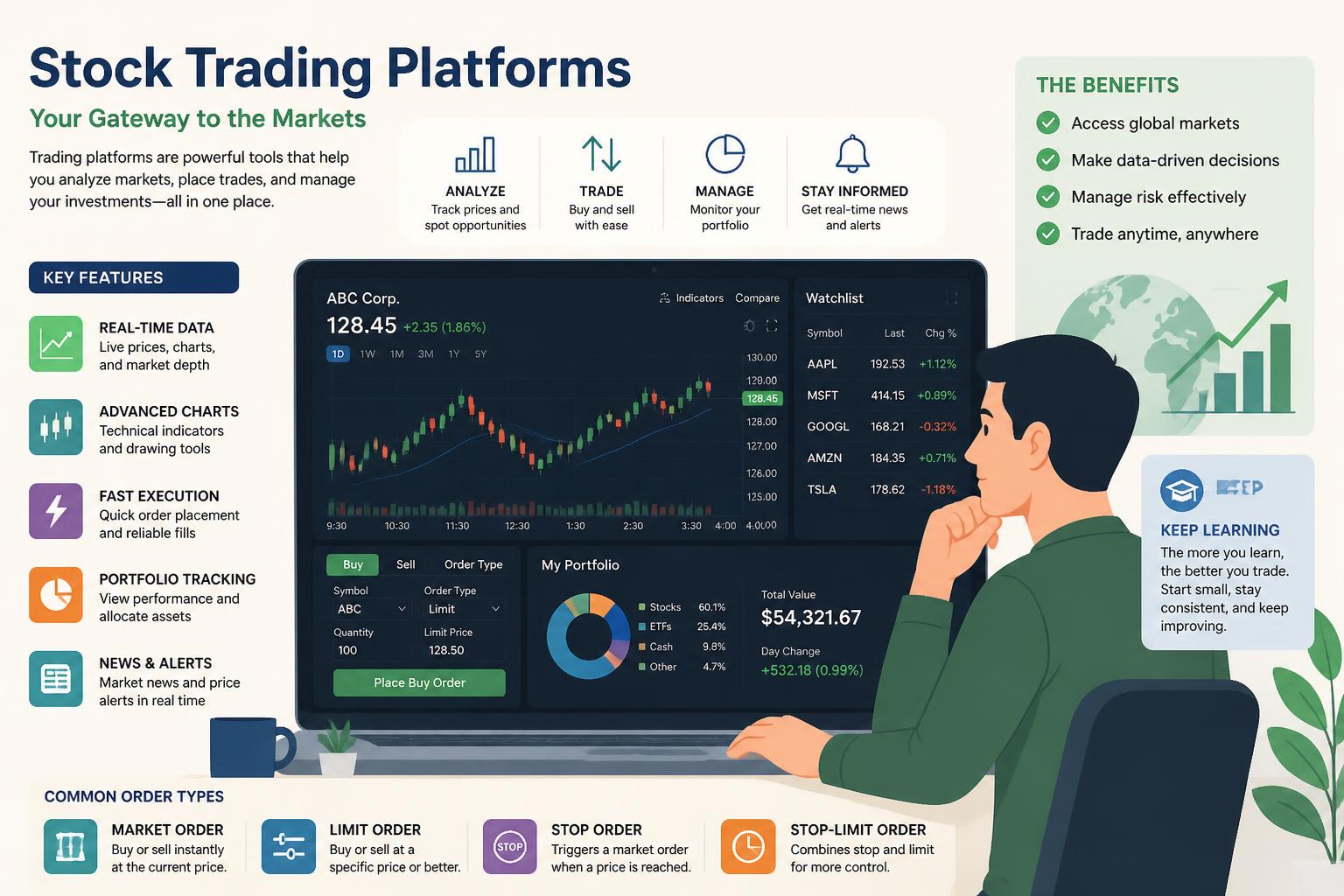
Zero-commission stock and ETF trades — This is table stakes. Over 30 brokerage platforms analyzed in 2026 offer commission-free stock trading. If you’re paying per trade, you’re using the wrong platform.
Fractional shares — You should be able to invest $50 in Amazon, not save up $3,200 for one share. Every major platform now supports fractional shares, often with minimums as low as $1 (Fidelity confirmed this in 2026).
No account minimum — You shouldn’t need $500 or $1,000 to open an account. Robinhood, Ally Invest, and Charles Schwab all have $0 minimums as of 2026.
Mobile app that doesn’t suck — Most people check their portfolio on their phone. The app should load fast, show real-time quotes, and let you place trades without fumbling through five menus. Schwab Mobile has a 4.8/5 rating on Apple as of 2026; Robinhood sits at 4.7/5.
SIPC insurance — Your account should be insured up to $500,000 if the brokerage fails. This is standard but worth confirming.
Automatic dividend reinvestment (DRIP) — Your dividends should automatically buy more shares unless you tell them not to. Vanguard and Fidelity both offer this.
Beyond the baseline, here’s what separates good platforms from great ones in 2026:
Research and education — Does the platform give you analysis, earnings reports, analyst ratings, and educational content—or just a buy button? Fidelity and Charles Schwab are known for robust research tools; Robinhood is learning-first with bite-sized explainers.
Asset variety — Can you trade options, bonds, futures, crypto, fractional shares of international stocks? Interactive Brokers was rated best for investment offerings in 2026 because of its massive selection.
Customer service — Can you get a human on the phone in under 10 minutes? Fidelity earned a top rating for customer service in 2026; Robinhood’s support is notoriously slow.
Trading tools for active investors — If you’re day trading or running options strategies, you need real-time data, customizable charts, hotkeys, and low latency. Moomoo was rated best for overall satisfaction in 2026, partly because of its advanced tools.
Banking integration — Ally Invest combines banking and investing in one app, so you can move money instantly. Vanguard offers automatic cash management that sweeps uninvested cash into a money market fund.
The 2026 Landscape: Who’s Leading and Why
The market leaders in 2026 come from two different eras: the legacy brokerages that adapted (Fidelity, Charles Schwab, Vanguard) and the mobile-first disruptors (Robinhood, Moomoo).
Robinhood — Best for new investors, according to 2026 rankings. The app is dead simple, the learning content is genuinely useful, and fractional shares start at $1. The downside: customer service is still weak, and the platform is optimized for frequent trading (which most people shouldn’t do). Rated 4.2/5 on Google Play and 4.7/5 on Apple in 2026.
Interactive Brokers — Best for investment offerings. If you want access to international stocks, bonds, futures, forex, and 150+ markets, this is the platform. The interface is dense and not beginner-friendly, but serious investors tolerate it for the selection. Rated best broker for investment offerings in 2026.
Moomoo — Best for overall satisfaction in 2026. It combines Robinhood’s ease of use with more advanced charting and research tools. Popular with active traders who don’t need the full firepower of Interactive Brokers.
Fidelity — Best customer service. You can call and get a human who knows what they’re talking about. The platform offers fractional shares for as low as $1, robust research, and a massive selection of mutual funds. Rated top for customer service in 2026.
Charles Schwab — Best for long-term investors. No commission fees, fractional shares, excellent research, and integration with Schwab’s banking products. The mobile app is highly rated (4.8/5 on Apple in 2026).
Ally Invest — Best for people who want banking and investing in one place. Joint accounts, no minimums, and instant transfers between your checking and brokerage accounts.
Vanguard — Best for passive index fund investors. Vanguard invented the index fund, and their platform is optimized for long-term, low-cost investing. Automatic cash management is a nice touch.
Kraken — Best for crypto traders who also want stocks. Rated 4.4/5 on Google Play and 4.7/5 on Apple in 2026. If you’re splitting your portfolio between stocks and Bitcoin, Kraken lets you do both in one app.
The research backing these rankings comes from over 60 investment account providers reviewed in 2026, with more than 50 years of combined experience among the analysts, dozens of objective ratings rubrics, 10 categories evaluated, and over 30 brokerage platforms analyzed using more than 50 data points.
How to Pick the Right Platform Without Overthinking It
Here’s the decision tree that actually works:
If you’re brand new to investing → Robinhood or Fidelity. Robinhood if you want the simplest interface and learning content. Fidelity if you want better customer service and research tools.
If you’re a passive investor (index funds, buy and hold) → Vanguard or Charles Schwab. Both are built for long-term investors and have rock-bottom expense ratios.
If you trade actively (multiple times per week) → Moomoo or Interactive Brokers. Moomoo if you want advanced tools without the learning curve. Interactive Brokers if you need access to everything.
If you want banking and investing in one app → Ally Invest. Move money instantly, no juggling between apps.
If you’re into crypto and stocks → Kraken. One login, one tax form.
The features that matter most, according to 2026 data: fees, trading tools, asset variety, and usability. Match the platform’s strengths to your habits. Don’t pick Interactive Brokers if you’re buying two index funds and forgetting about them. Don’t pick Robinhood if you’re running iron condor spreads on earnings.
One more filter: check the mobile app ratings if you’ll use your phone. Schwab Mobile is 4.8/5 on Apple, which means it works. A platform with a 2.9/5 app rating (like Schwab’s Google Play version) will frustrate you every time you log in.
Common Mistakes People Make When Choosing a Platform
Picking based on the sign-up bonus instead of the features — A $100 deposit bonus sounds great until you realize the platform charges $5/month for basic research tools or has a terrible mobile app. The bonus disappears in three months. The friction stays.
Ignoring customer service until you need it — You’ll eventually need help—a mistaken trade, a tax question, a locked account. Fidelity’s top-rated customer service in 2026 is worth more than a slightly sleeker interface.
Choosing a day trading platform when you’re not a day trader — Studies show that most people who try day trading end up losing money. If you’re buying and holding, you don’t need real-time level 2 data and hotkeys. You need low fees and good research.
Not checking if the platform supports your investing style — If you want to buy fractional shares of international stocks, most platforms won’t let you. If you want options trading, some platforms require a minimum balance or approval process. Check before you transfer money.
Falling for the “this platform has a 3-star rating but a super low expense ratio—should I still buy it?” trap — Ratings reflect the overall experience. A 3-star platform might have low fees but terrible customer service, frequent outages, or a clunky app. The savings aren’t worth the frustration.
Not knowing the margin requirements if you plan to trade on margin — Using a margin account requires a minimum balance of $2,000 in 2026. If you’re starting with $500, margin trading isn’t an option yet. Interactive Brokers charges around 5.83% margin interest; others charge 10%+. Know the cost before you borrow.
Picking a platform that doesn’t work in your state — Some platforms (especially crypto-focused ones) have state restrictions. Confirm it’s available where you live.
Overcomplicating the decision — You’re not locked in forever. Most people switch platforms at least once. Start with a beginner-friendly option (Robinhood, Fidelity, Charles Schwab), and migrate later if your needs change. Transferring your account (an ACATS transfer) takes 5–7 days and is usually free.
FAQ
What is zero-commission trading?
Zero-commission trading means you don’t pay a fee when you buy or sell stocks or ETFs. The platform makes money through payment for order flow, interest on your cash balance, or margin lending instead of charging you per trade. Every major platform offers this in 2026.
What fees should I look for when trading?
Most stock and ETF trades are free, but watch for: margin interest (if you borrow money to trade), options contract fees ($0.50–$0.65 per contract), wire transfer fees, and account closure fees. Expense ratios on mutual funds and ETFs (the annual cost of holding the fund) also matter—lower is better.
What are expense ratios?
Expense ratios are the annual fees charged by mutual funds and ETFs, expressed as a percentage of your investment. A 0.03% expense ratio means you pay $3 per year for every $10,000 invested. Index funds at Vanguard and Fidelity have some of the lowest expense ratios in the industry.
Can I start trading with just $1?
Yes. Fidelity offers fractional shares for as low as $1 as of 2026, and most platforms have no account minimum. You can invest $10 in Apple, $5 in Tesla, and $20 in an S&P 500 ETF on day one.
What are the best times to day trade?
The first and last hour of the trading day (9:30–10:30 AM and 3:00–4:00 PM Eastern) have the highest volume and volatility, which day traders look for. That said, most people who try day trading lose money—it requires significant knowledge, attention, and often a $25,000 minimum balance to avoid pattern day trader restrictions.
What is the pattern day trader rule with a small account?
If you make four or more day trades (buying and selling the same stock in one day) within five business days, and those trades make up more than 6% of your total trades, you’re flagged as a pattern day trader. Once flagged, you need to maintain a $25,000 minimum balance. If you drop below that, you can’t day trade until you’re back above $25,000.
Are online brokers safe?
Yes, if they’re registered with FINRA and offer SIPC insurance (up to $500,000 per account). All major platforms—Robinhood, Fidelity, Charles Schwab, Interactive Brokers, etc.—are SIPC insured. Your bigger risk is your own trading decisions, not the platform stealing your money.
How do I check an online brokerage’s reputation?
Look for: FINRA registration (search the broker on FINRA BrokerCheck), SIPC insurance, user reviews on Google Play and the Apple App Store, and third-party ratings from NerdWallet, Forbes Advisor, or CNBC Select. In 2026, over 60 providers were reviewed using dozens of objective ratings rubrics and more than 50 data points.
What’s the difference between a full-service broker and an online broker?
A full-service broker (like Morgan Stanley or Merrill Lynch) assigns you a human advisor who makes recommendations and manages your portfolio. You pay for that service—often 1% of assets per year plus trading commissions. An online broker (like Fidelity or Robinhood) gives you the tools to trade yourself, with no human advisor and no commissions. If you want advice, you pay separately for it.
What are the best stock trading apps for beginners in 2026?
Robinhood (rated best for new investors), Fidelity (top customer service and research), and Charles Schwab (excellent mobile app with a 4.8/5 rating on Apple) are the top three. All offer zero-commission trading, fractional shares, and no account minimums.
What features should beginners look for in a trading app?
Zero commissions, fractional shares, no account minimum, a mobile app with a rating above 4.5/5, educational content, and SIPC insurance. Avoid platforms that require a $500+ minimum or charge per trade.
How do these apps support new investors?
The best platforms offer learning content (Robinhood’s explainers, Fidelity’s research library), fractional shares so you can start with $10, and customer service that doesn’t make you wait 45 minutes on hold. Access to market insights and educational resources helps new investors make informed decisions without guessing.
Are there any commission-free stock trading apps?
Yes. Robinhood, Fidelity, Charles Schwab, Ally Invest, Moomoo, Interactive Brokers, and Vanguard all offer commission-free stock and ETF trading as of 2026. This is the industry standard now.
Sources:
- CNBC Select: Best Free Stock-Trading Platforms of 2026 (https://www.cnbc.com/select/best-brokerage-free-stock-trading/)
- NerdWallet: Best Day Trading Platforms for 2026 (https://www.nerdwallet.com/investing/best/online-brokers-platforms-for-day-trading)
- Forbes Advisor: 10 Best Online Brokerages For 2026 (https://www.forbes.com/advisor/financial-services/best-online-brokers-2/)
- Kraken: The 11 Best Stock Trading Apps of 2026 (https://www.kraken.com/learn/best-stock-trading-apps)