Robo-Advisors Explained: The $1.4 Trillion Industry That Might Replace Your Financial Advisor
You’ve probably heard the term thrown around. Maybe a friend mentioned Betterment, or you saw a Wealthfront ad. But what actually is a robo-advisor, and why are billions of dollars flowing into these platforms?
Short version: robo-advisors are automated investment platforms that build and manage your portfolio using algorithms instead of human financial advisors. You answer a few questions about your goals and risk tolerance, deposit money, and the software does the rest. Picks investments, rebalances, harvests tax losses.
The appeal? Lower fees, zero awkward sales pitches, 24/7 access. The catch? You’re trusting an algorithm with your retirement, and not all robo-advisors are created equal.
What follows is exactly how robo-advisors work, what they cost, who should use them, and the gotchas no one tells you upfront.
Table of Contents
- What is a robo-advisor? The technical definition
- How robo-advisors actually work (step by step)
- What you’re really paying for: fee breakdown
- Robo-advisors vs human financial advisors: the real comparison
- Who should use a robo-advisor (and who shouldn’t)
- The top robo-advisors in 2026
- Common robo-advisor myths and gotchas
- FAQ
What is a robo-advisor? The technical definition
A robo-advisor is a digital platform that provides automated, algorithm-driven financial planning and investment management with minimal human supervision.
In practice:
- You fill out a questionnaire about your age, income, investment goals, and risk tolerance
- An algorithm assigns you a portfolio (usually a mix of ETFs covering stocks, bonds, and sometimes real estate or commodities)
- The platform automatically rebalances your portfolio when allocations drift
- Tax-loss harvesting runs in the background (on taxable accounts) to offset gains
- You can deposit, withdraw, or adjust goals anytime through an app or web dashboard
The “robo” part is misleading. There’s no robot. It’s software built on modern portfolio theory (the same framework human advisors use) combined with tax optimization algorithms.
Robo-advisors emerged around 2008 during the financial crisis. Betterment and Wealthfront were the pioneers. By 2026, the industry manages over $1.4 trillion in assets, and nearly every major brokerage (Vanguard, Schwab, Fidelity) offers a robo option.
How robo-advisors actually work (step by step)
Step 1: Risk assessment questionnaire
You’ll answer 5 to 15 questions. What’s your investment goal? Retirement, home purchase, general wealth building? What’s your time horizon? How would you react if your portfolio dropped 20% in a month? What’s your current income and net worth?
The platform uses your answers to calculate a risk score (conservative, moderate, aggressive) and assigns you a target portfolio.
Step 2: Portfolio construction
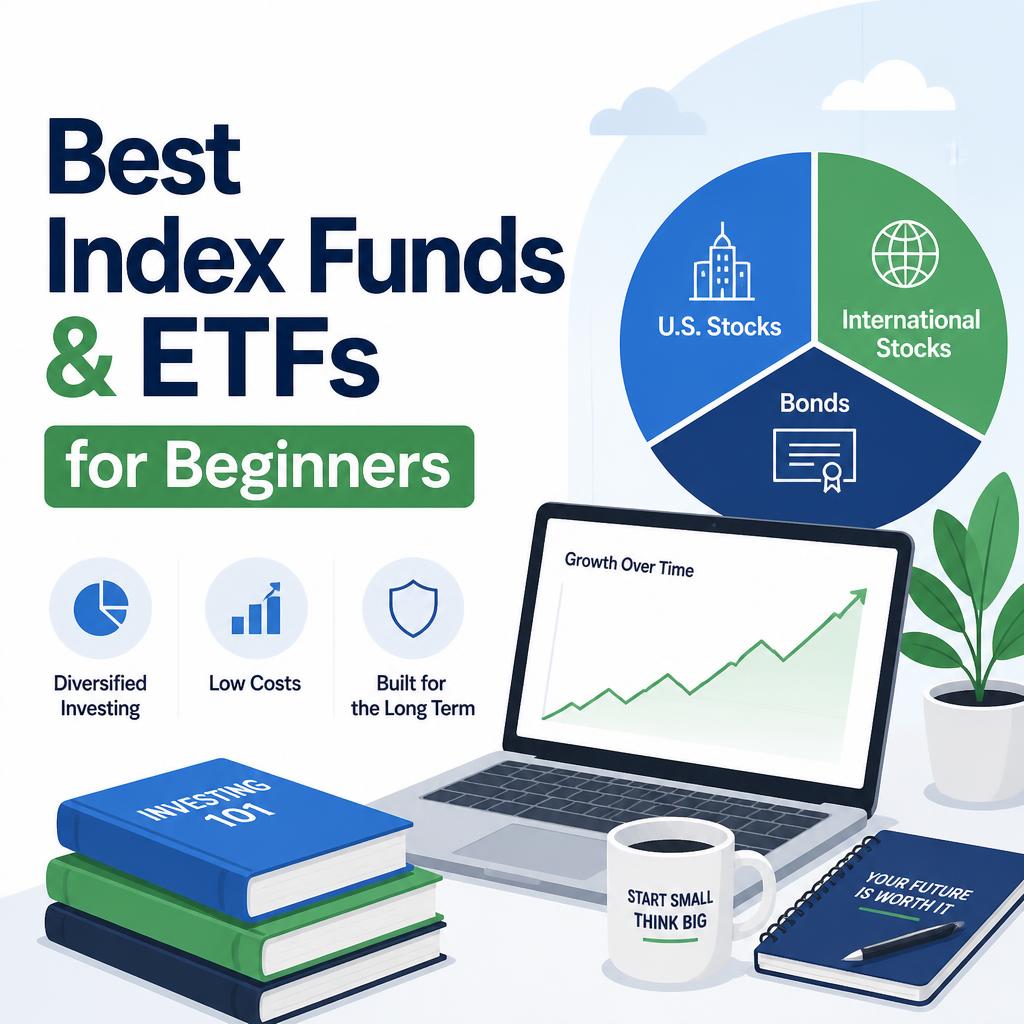
Most robo-advisors use low-cost ETFs to build diversified portfolios. A typical moderate portfolio:
- 50% U.S. stocks (VTI or equivalent)
- 20% international stocks (VXUS)
- 25% bonds (AGG or BND)
- 5% real estate (VNQ)
Some platforms offer thematic options like ESG funds, halal investing, crypto exposure. Others stick to plain index funds.
Step 3: Automatic rebalancing
Markets move. Your 60/40 stock/bond split drifts to 65/35 after a bull run. Robo-advisors automatically sell the overweight assets and buy the underweight ones to restore your target allocation.
This happens quarterly, monthly, or whenever your allocation drifts beyond a threshold (usually 5%).
Step 4: Tax-loss harvesting
If you have a taxable account, the robo-advisor scans daily for investments that have dropped in value. It sells the losers to realize a capital loss (which offsets gains elsewhere) and immediately buys a similar but not identical asset to maintain your allocation.
Example: Your VTI shares are down. The platform sells VTI, realizes the loss, and buys ITOT (a nearly identical ETF) to stay invested.
This strategy can save $500 to $5,000+ per year depending on account size and market volatility. Tax-loss harvesting doesn’t work in IRAs or 401(k)s.
Step 5: Ongoing monitoring
You check your account whenever you want. The algorithm adjusts as your goals change (getting closer to retirement, adding a home-buying goal, etc.). Some platforms offer human advisor access for an extra fee.
What you’re really paying for: fee breakdown
Robo-advisor fees have two layers.
Management fee (robo-advisor fee)
This is what the platform charges annually as a percentage of assets under management (AUM).
2026 fee ranges:
Free tier: Schwab Intelligent Portfolios, SoFi Automated Investing charge 0% management fee, but come with limited features or account minimums.
Low cost: Wealthfront, Betterment charge 0.25% AUM.
Mid tier: Vanguard Digital Advisor (0.20%), Fidelity Go (0.35% above $25k).
Premium tier: Betterment Premium, Wealthfront with advisor access run 0.40% to 0.65%.
What does 0.25% mean? On a $50,000 account, you pay $125 per year. On $500,000, you pay $1,250 per year.
ETF expense ratios
The funds inside your portfolio also charge fees. Most robo-advisors use ultra-low-cost ETFs:
- Vanguard ETFs: 0.03% to 0.08%
- iShares Core ETFs: 0.03% to 0.09%
- Schwab ETFs: 0.02% to 0.06%
Combined total cost: Expect 0.25% to 0.40% all-in for most robo-advisors. Compare that to human financial advisors who charge 0.75% to 1.5% AUM, and you see the appeal.
Hidden costs to watch
Cash drag: Some “free” robo-advisors (like Schwab) hold 6% to 30% of your portfolio in cash, which earns less than invested assets. They profit from the spread.
Account minimums: Betterment has $0 minimum, but Wealthfront requires $500. Vanguard Digital Advisor needs $3,000.
Trading costs: Most robo-advisors cover trading fees internally, but confirm this.
Robo-advisors vs human financial advisors: the real comparison
Feature Robo-advisor Human financial advisor Annual fee 0% to 0.40% AUM 0.75% to 1.5% AUM (or $150 to $400 per hour) Account minimum $0 to $3,000 $100,000 to $500,000 (for quality advisors) Tax-loss harvesting Automated daily Manual, if offered at all Portfolio customization Limited (preset models) Fully customized Behavioral coaching Automated nudges, no empathy Human relationship, emotional support Estate planning None Often included Retirement planning Basic projections Detailed plans with Social Security, pensions, tax strategies Access 24/7 via app Scheduled meetings (quarterly or annual)
When robo-advisors win
You have under $100,000 to invest. Your financial situation is straightforward (W-2 income, standard retirement goals). You’re disciplined and don’t need hand-holding during market crashes. You want low fees and transparency.
When human advisors win
You have complex finances (business income, stock options, inheritance, rental properties). You need estate planning, tax strategy, or insurance coordination. You panic-sell during downturns and need someone to talk you off the ledge. You value a relationship and want proactive advice.
Hybrid option: Some robo-advisors (Betterment Premium, Vanguard Personal Advisor) offer human advisor access for 0.30% to 0.40% AUM. You get automated investing plus scheduled calls with a CFP.
Who should use a robo-advisor (and who shouldn’t)
Perfect candidates
Young professionals starting to invest ($5,000 to $100,000). Hands-off investors who don’t want to pick individual stocks. Tax-conscious investors in high brackets who benefit from tax-loss harvesting. DIY types who understand basic investing but don’t want the maintenance burden.
Bad fits
Active traders who want to pick individual stocks or time the market (robo-advisors don’t allow this). Ultra-high-net-worth individuals with $5M+ who need trust structures and multi-generational planning. People with irregular income or debt issues (you need a financial coach, not an investment algorithm). ESG purists (most robo-advisors offer ESG options, but the screens aren’t as strict as dedicated funds).
The top robo-advisors in 2026
Betterment: best overall
Fee: 0.25% AUM (0.40% for Premium with advisor access). Minimum: $0. Tax-loss harvesting, flexible goal-based planning, socially responsible portfolios. Downside: No fractional shares for stocks (ETFs only).
Wealthfront: best for tax optimization
Fee: 0.25% AUM. Minimum: $500. Advanced tax-loss harvesting, free financial planning tools, 529 college savings. Downside: No human advisor access (even at premium tier as of 2026).
Schwab Intelligent Portfolios: best free option
Fee: 0% management fee. Minimum: $5,000. No management fee, access to Schwab’s full brokerage. Downside: 6% to 30% cash allocation (earns interest for Schwab, not you).
Vanguard Digital Advisor: best for Vanguard fans
Fee: 0.20% AUM. Minimum: $3,000. Vanguard’s legendary low-cost ETFs, human advisor access for 0.30%. Downside: Interface feels dated compared to Betterment or Wealthfront.
Fidelity Go: best for small accounts
Fee: Free up to $25k, then 0.35% AUM. Minimum: $0. Free management on balances under $25k. Downside: Higher fee above $25k compared to competitors.
SoFi Automated Investing: best for no-fee seekers
Fee: 0% management fee. Minimum: $0. Completely free, career coaching, member benefits. Downside: Limited customization, no tax-loss harvesting.
Common robo-advisor myths and gotchas
Myth 1: Robo-advisors always beat human advisors
Not true. Performance is nearly identical over time because both use similar portfolios (diversified, low-cost index funds). The difference is fees and behavioral coaching. A human advisor who keeps you from panic-selling during a crash adds more value than any algorithm.
Myth 2: Tax-loss harvesting will save me thousands
It can, but only in taxable accounts. If all your money is in IRAs or 401(k)s, tax-loss harvesting doesn’t apply. Also, the benefit shrinks if you’re in a low tax bracket or have no capital gains to offset.
Myth 3: I can set it and forget it forever
Robo-advisors automate execution, but you still need to review annually. Life changes (marriage, kids, job loss) require goal adjustments. Blindly trusting the algorithm for 30 years is risky.
Myth 4: All robo-advisors use the same portfolios
Nope. Betterment leans heavier into international stocks. Wealthfront includes more emerging markets. Schwab holds more cash. Performance diverges over time.
Gotcha 1: Wash sale rules
If you manually trade in a taxable brokerage while using a robo-advisor’s tax-loss harvesting, you can trigger wash sales (which disallow the tax loss). Keep tax-loss harvesting accounts separate from active trading accounts.
Gotcha 2: Limited control
You can’t pick individual stocks or exclude specific sectors. If you hate Big Tech or want to overweight small-cap value, robo-advisors won’t let you.
Gotcha 3: Performance during crashes
Robo-advisors don’t “save” you during bear markets. They’re fully invested (except cash-heavy platforms like Schwab). If the market drops 30%, so does your portfolio. The algorithm won’t move you to cash preemptively.
FAQ
What is the difference between a robo-advisor and a brokerage account?
A brokerage account (like Fidelity, Schwab, E*TRADE) is a platform where you manually buy and sell investments. You pick the stocks, ETFs, or mutual funds. You decide when to rebalance.
A robo-advisor automates all of that. You deposit money, and the algorithm builds and manages the portfolio. Think of it as a brokerage account with autopilot.
Are robo-advisors safe?
Yes, from a regulatory standpoint. Robo-advisors are registered investment advisors (RIAs) regulated by the SEC or state securities regulators. Your assets are held at FDIC-insured custodians (like Apex Clearing, Schwab, or Fidelity), and accounts are protected by SIPC insurance up to $500,000.
The risk isn’t fraud. It’s market risk. If stocks drop 40%, your robo-advisor account drops 40%. The algorithm can’t predict crashes.
Can I lose money with a robo-advisor?
Yes. Robo-advisors invest in stocks and bonds, which fluctuate. You can absolutely lose money in the short term (especially during recessions). Over long time horizons (10+ years), diversified portfolios historically recover and grow, but there are no guarantees.
Do robo-advisors pay dividends?
Yes. The ETFs inside your portfolio pay dividends and interest. Most robo-advisors automatically reinvest dividends into your portfolio (this is called DRIP, dividend reinvestment plan). You can turn this off if you prefer cash distributions.
Can I withdraw money anytime?
Yes, for taxable accounts. Robo-advisors aren’t locked savings accounts. You can withdraw anytime, though it may take 3 to 5 business days for funds to settle and transfer to your bank.
For IRAs, standard withdrawal rules apply (penalty-free after 59½, required minimum distributions at 73, etc.). The robo-advisor doesn’t change those rules.
What happens if the robo-advisor company shuts down?
Your investments are safe. Assets are held at third-party custodians (Apex, Schwab, etc.), not by the robo-advisor company itself. If Betterment or Wealthfront goes bankrupt, your portfolio transfers to another custodian. You don’t lose your money. You just need to move it to a new platform.
Do robo-advisors work for retirement accounts?
Yes. Most robo-advisors support traditional IRAs (tax-deferred), Roth IRAs (tax-free growth), SEP IRAs (for self-employed), and rollover IRAs (for old 401(k)s). Some also support taxable brokerage accounts, 529 college savings plans, and trusts.
How do I choose the best robo-advisor?
Start with these questions:
What’s your account size? If under $25k, consider Fidelity Go (free) or SoFi (free). If over $100k, Betterment or Wealthfront.
Do you need tax-loss harvesting? If yes, avoid Schwab (too much cash drag) and choose Betterment or Wealthfront.
Do you want human advisor access? Pick Betterment Premium or Vanguard Personal Advisor.
Are fees your top priority? Schwab or SoFi charge 0% management fees (but check for cash drag and limited features).
Are robo-advisors worth it in 2026?
For most people with straightforward finances and under $500k to invest, yes. Robo-advisors are cheaper, more transparent, and more tax-efficient than traditional financial advisors. They remove the friction of DIY investing without the high fees of human advisors.
But they’re not magic. You’re still exposed to market risk. You won’t get estate planning, tax strategy beyond tax-loss harvesting, or someone to talk you through a 2008-style crash.
Robo-advisors work well for young professionals, passive investors, and anyone building wealth who doesn’t need complex planning. If your finances get complicated (business sale, inheritance, multi-state tax issues), you’ll outgrow the robo-advisor and need a human CFP.
The industry is maturing. By 2026, robo-advisors manage over $1.4 trillion, but that’s still a fraction of the $30+ trillion managed by human advisors. The hybrid model (robo execution plus human advice) is probably where the industry lands.
If you’re still deciding, try a free tier (Fidelity Go, SoFi) with a small amount. See how the interface feels, whether you trust the algorithm, and if the automation saves you time. Worst case, you move the money to a traditional brokerage or human advisor. Best case, you’ve found a low-cost, low-maintenance way to build wealth for the next 30 years.