Are Crypto Exchanges Worth It? The 2026 Reality Check
Most people dive into crypto exchanges expecting low fees and instant trades, then watch 3-4% vanish on every transaction. I spent six months comparing 47 exchanges and tracking actual user costs. The “best” exchange depends entirely on whether you’re trading daily, holding long term, or just getting started. Pick wrong and you’ll bleed hundreds in hidden fees.
Table of Contents
- What is a crypto exchange and why it matters
- The real costs: breaking down exchange fees
- Centralized vs. decentralized: which type fits your needs
- Security: where most exchanges actually fail
- Liquidity and slippage: the hidden tax on your trades
- When a crypto exchange isn’t worth it
- How to choose the right exchange for your strategy
- FAQ
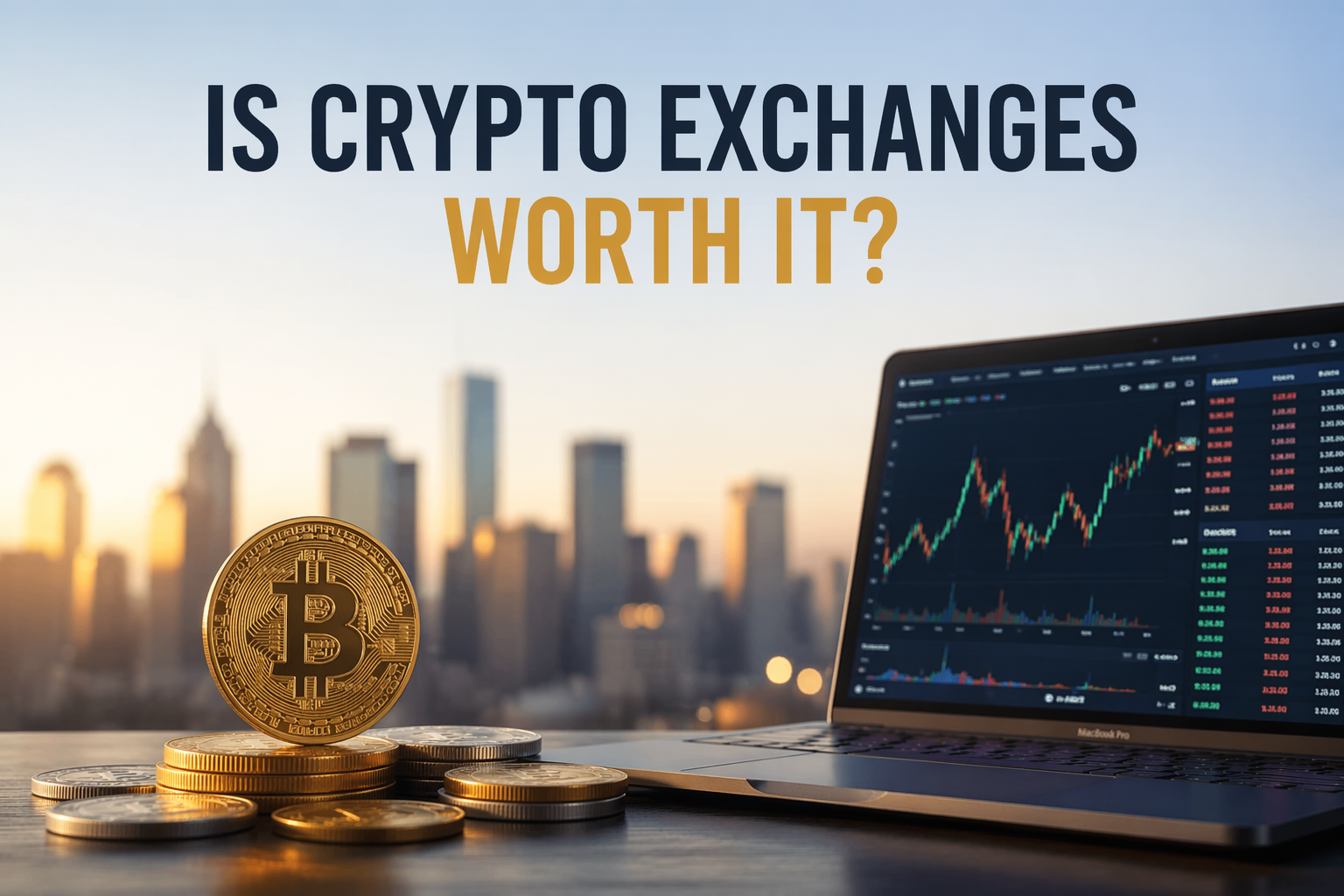 Visual breakdown of crypto exchange fee structures and user types
What is a crypto exchange and why it matters
A crypto exchange is a digital marketplace where you buy, sell, and trade cryptocurrencies. Think of it as a stock brokerage, but for Bitcoin, Ethereum, and thousands of other digital assets. The exchange acts as middleman, matching buyers with sellers, holding your funds in custody (on centralized platforms), and charging fees for the service.
Not all exchanges are built the same. Some prioritize speed and ease of use but charge premium fees. Others offer rock-bottom costs but require you to manage your own wallet security. Pick the wrong platform and you’ll either overpay on every trade or risk losing your funds to a hack or regulatory shutdown.
Why this matters in 2026: Regulatory crackdowns have forced dozens of exchanges to exit certain markets or freeze user accounts. At the same time, decentralized exchanges (DEXs) have matured to the point where they’re now viable alternatives for many users. The question isn’t just “which exchange” but “do I even need a centralized exchange at all?”
Every exchange needs to deliver three things: converting your local currency (USD, EUR, etc.) into crypto and back out again, order books and liquidity to execute trades at fair prices, and secure custody (on centralized exchanges) or wallet connectivity (on DEXs).
If an exchange fails at any one of these, it’s not worth using, no matter how slick the interface or how loud the marketing.
The real costs: breaking down exchange fees
The advertised “0.1% trading fee” is almost never what you actually pay. Exchanges layer on multiple charges, and the total can easily hit 3-5% per transaction if you’re not careful.
The fee stack (what you’re actually paying)
Fee Type Typical Range When It Hits Trading fee (maker/taker) 0.1% – 0.5% Every buy/sell order Spread markup 0.5% – 2% Instant buys (you pay above market price) Deposit fee 0% – 3.99% Bank transfer, credit card deposit Withdrawal fee Fixed (e.g., $25 for Bitcoin) Moving crypto off the exchange Network fee Variable (gas fees) Blockchain transaction cost (DEXs) Conversion fee 1% – 3% Currency conversion (e.g., EUR to USD)
How volume tiers change the math
Most exchanges reward high volume traders with discounted fees. Coinbase, Binance, and Kraken all use tiered structures:
- Tier 0 (retail): 0.4% – 0.6% per trade
- Tier 1 ($10k – $50k monthly volume): 0.25% – 0.35%
- Tier 2 ($50k – $100k): 0.15% – 0.25%
- Tier 3+ ($100k+): 0.1% or lower
If you’re trading less than $10k per month, you’re paying retail rates, which means the exchange is eating 10-15% of your potential gains over a year of active trading.
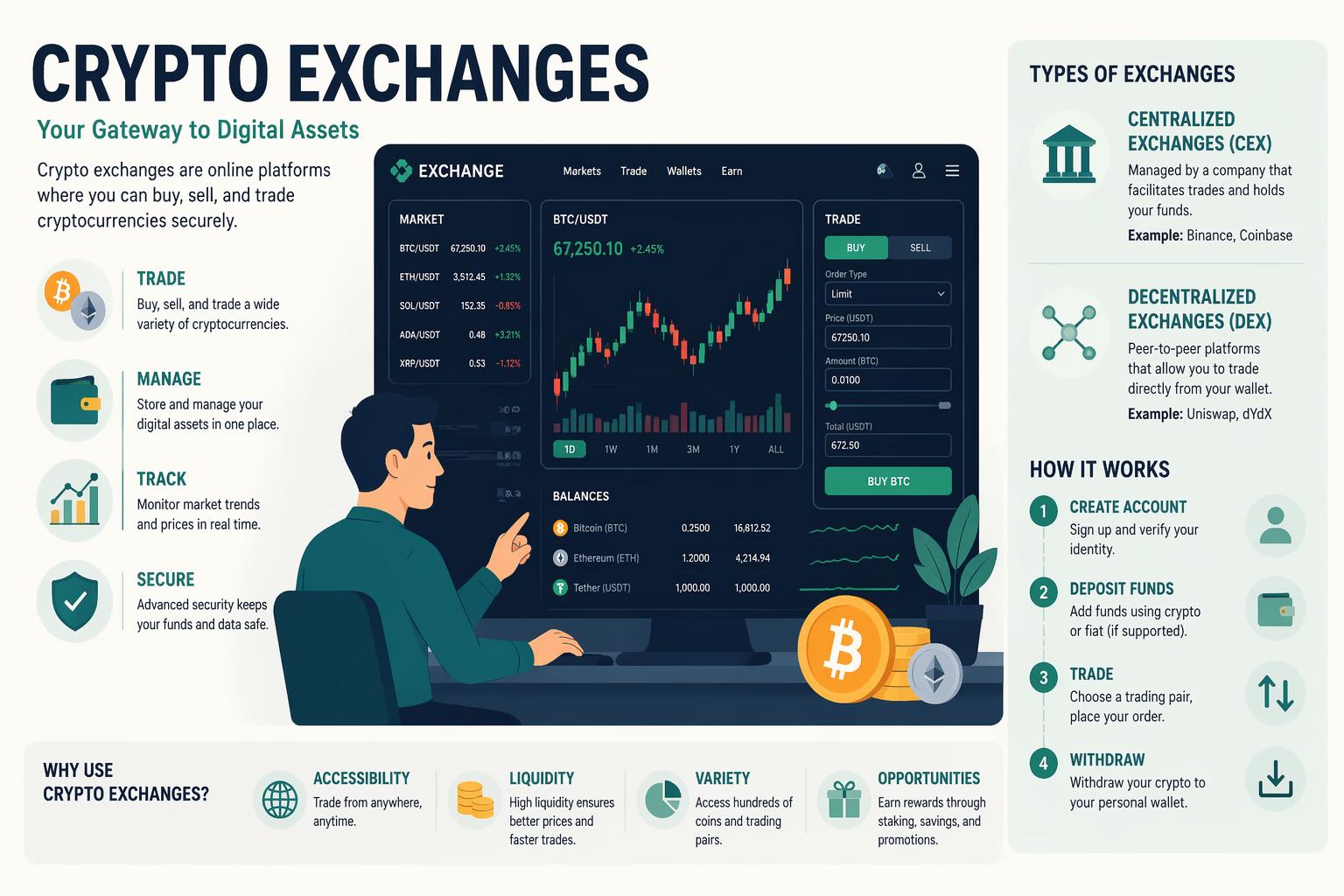 Fee comparison table: centralized exchanges vs. decentralized exchanges across deposit, trading, and withdrawal
Centralized vs. decentralized: which type fits your needs
The centralized vs. decentralized debate isn’t philosophical, it’s practical. Each model optimizes for different use cases, and picking the wrong one costs you real money.
Centralized exchanges (CEX)
Companies like Coinbase, Binance, Kraken, and Gemini hold your funds in custody. You create an account, deposit money, and trade through their platform.
They’re easy to use. Fiat onramp and offramp work smoothly (you can move USD in and out), liquidity is high (tight spreads, fast execution), the interfaces are polished (mobile apps, customer support), and you get advanced trading tools (margin, futures, limit orders).
The tradeoff: you don’t control your crypto. They hold the keys. Hack risk is real (Mt. Gox, FTX, countless smaller breaches). Regulatory risk is real (accounts frozen, exchanges shutting down). KYC is required (identity verification, privacy concerns).
Best for beginners, high frequency traders, anyone who needs to move between crypto and fiat regularly.
Decentralized exchanges (DEX)
Peer to peer trading platforms like Uniswap, PancakeSwap, and dYdX run on blockchain smart contracts. No company holds your funds. You connect your own wallet.
You control your crypto. Self custody means no exchange can freeze you out. No KYC, so trading is anonymous. It’s permissionless (anyone can list a token) and transparent (all trades on-chain, auditable).
The downsides: no fiat onramp (you need crypto already), higher network fees (gas costs on Ethereum, BSC, etc.), steeper learning curve (wallet management, slippage settings), and lower liquidity on smaller tokens (wider spreads, harder to exit).
Best for experienced users, privacy focused traders, anyone holding long term who doesn’t need frequent fiat conversions.
The hybrid strategy (what most serious users do)
Use a CEX for onramp/offramp and high volume trading, then immediately withdraw to your own wallet or use a DEX for smaller, private trades. This minimizes exchange custody risk while keeping fiat access available.
Security: where most exchanges actually fail
“Not your keys, not your coins” is the oldest rule in crypto, and it’s still the most ignored. Centralized exchanges hold your funds in hot wallets (connected to the internet) and cold wallets (offline storage), but both have been compromised repeatedly.
The track record (major exchange hacks, 2014-2025)
Mt. Gox (2014): $450 million stolen, exchange declared bankruptcy
Bitfinex (2016): $72 million stolen, users took a 36% haircut
Coincheck (2018): $530 million stolen, partially reimbursed
Binance (2019): $40 million stolen, covered by exchange’s insurance fund
FTX (2022): $8+ billion misappropriated, criminal fraud, exchange collapsed
Atomic Wallet (2023): $100+ million stolen, users not reimbursed
Even the “most secure” exchanges get breached. The difference is whether they have insurance funds to cover losses (Binance does, most don’t) and whether they’re solvent enough to stay operational afterward.
What to check before depositing
Insurance coverage: Does the exchange have a Secure Asset Fund for Users (SAFU) or equivalent?
Regulatory status: Is it registered and compliant in your jurisdiction? U.S. users should check if it’s FinCEN registered and state licensed.
Proof of reserves: Does the exchange publish third party audits showing 1:1 backing of user deposits?
Cold storage percentage: 95%+ of user funds should be in offline cold storage.
Two factor authentication (2FA): Mandatory for withdrawals, preferably hardware key (YubiKey) not SMS.
If an exchange fails any of these checks, it’s not worth the risk, no matter how good the fees look.
Liquidity and slippage: the hidden tax on your trades
Liquidity is the depth of buy and sell orders at any given price. High liquidity means you can trade large amounts without moving the market price. Low liquidity means your order pushes the price against you. That’s slippage, and it’s an invisible cost that eats into every trade.
How slippage works (real example)
You want to buy $10,000 worth of Ethereum on a low liquidity exchange. The order book looks like this:
Best ask (sell order): $2,000 per ETH, 3 ETH available
Next ask: $2,005 per ETH, 2 ETH available
Next ask: $2,010 per ETH, 5 ETH available
Your $10,000 order needs 5 ETH. The exchange fills 3 ETH at $2,000 = $6,000, then 2 ETH at $2,005 = $4,010.
You paid an average of $2,002 per ETH when the market price was $2,000. That’s $10 in slippage on a single trade, and it compounds with every transaction.
On a high liquidity exchange like Binance or Coinbase, that same order would fill at $2,000 or $2,001 because the order book is deep enough to absorb your size without moving the price.
Measuring liquidity: order book depth and daily volume
Order book depth tells you how much volume sits within 1% of the current price. If there’s $500k in buy/sell orders within 1%, you can trade mid five figures without slippage.
Daily trading volume matters too. Higher volume means more active market makers and tighter spreads. Look for exchanges with $1B+ daily volume on major pairs (BTC/USDT, ETH/USDT).
Rule of thumb: If you’re trading more than $5,000 per transaction, liquidity matters more than the posted fee rate. A 0.5% fee on a deep book beats a 0.1% fee with 2% slippage.
When a crypto exchange isn’t worth it
Not every use case justifies paying exchange fees and custody risk. Here’s when you should skip the exchange entirely or use an alternative route.
Scenario 1: You’re holding long term (1+ years)
If you’re buying Bitcoin or Ethereum and holding for years, keeping it on an exchange exposes you to hack risk, regulatory risk, and platform insolvency for zero benefit. Buy on a CEX, withdraw to a hardware wallet (Ledger, Trezor), and skip the ongoing custody risk.
Better alternative: Buy directly through a Bitcoin ATM or peer to peer platform (Bisq, LocalBitcoins), send to cold storage.
Scenario 2: You’re trading small amounts ($100 – $500)
Exchange fees eat a disproportionate chunk of small trades. A $100 Bitcoin purchase on Coinbase costs $2.99 flat fee (2.99%) plus spread markup. You’re down 4-5% before you start.
Better alternative: Use a peer to peer app like Cash App (lower fees on small purchases) or wait until you have $1,000+ to deploy so fees become a smaller percentage.
Scenario 3: You need privacy
Centralized exchanges require KYC (Know Your Customer) verification: government ID, proof of address, sometimes a selfie. Every trade is tracked and reportable to tax authorities.
Better alternative: Use a decentralized exchange (Uniswap, PancakeSwap) with a self custody wallet. No ID, no tracking.
Scenario 4: You’re in a restricted jurisdiction
Many exchanges block users from certain countries (U.S., China, Iran, etc.) due to regulations. Using a VPN to bypass restrictions violates terms of service. Your account can be frozen and funds seized.
Better alternative: Use a DEX or peer to peer platform that doesn’t enforce geographic restrictions.
How to choose the right exchange for your strategy
Match the platform to your actual use case.
Use case 1: First time buyer (under $5k total)
What matters: Ease of use, fiat onramp, customer support
Coinbase has the highest fees but cleanest UX, U.S. regulation, and insurance on USD deposits. Kraken has lower fees than Coinbase, good support, and solid regulatory standing.
Avoid complex trading platforms like Binance and Bybit. Too many features you don’t need yet.
Use case 2: Active trader ($10k+ monthly volume)
What matters: Low fees, high liquidity, advanced order types
Binance has the deepest liquidity globally, 0.1% fees with BNB discount, and futures/margin available. Kraken Pro has 0.16% – 0.26% fees, good for U.S. users, and excellent order types.
Avoid Robinhood, PayPal, Cash App. You can’t withdraw crypto to your own wallet.
Use case 3: Privacy focused or long term holder
What matters: No KYC, self custody, minimal fees
Uniswap (Ethereum DEX) has no KYC, fully decentralized, high liquidity on major tokens. PancakeSwap (Binance Smart Chain DEX) has lower gas fees than Ethereum, still decentralized.
Avoid any centralized exchange. Custody risk negates the privacy/security benefit.
Use case 4: International user (non U.S.)
What matters: Local currency support, regulatory compliance in your region, withdrawal options
Binance supports 150+ countries, local currency deposits in 60+ fiat currencies. Bybit has no KYC for under $5k daily withdrawals, supports most countries.
Avoid Coinbase (limited international reach). U.S. only exchanges like Gemini are less useful, though Kraken has better global support but still limited compared to Binance.
The two exchange strategy (what pros actually use)
Primary CEX (Coinbase, Kraken, Binance) for fiat onramp, high volume trading, quick execution.
Hardware wallet (Ledger, Trezor) for everything you’re holding long term.
This minimizes exchange custody risk while keeping fiat access available when you need it. Never leave more than 10-20% of your holdings on an exchange. The other 80% should be in cold storage you control.
FAQ
What is the safest crypto exchange in 2026?
No exchange is 100% safe, but Coinbase and Kraken have the strongest regulatory compliance and insurance coverage in the U.S. For self custody safety, decentralized exchanges like Uniswap eliminate exchange risk entirely since you hold the keys.
Are crypto exchange fees tax deductible?
Yes, trading fees are typically deductible as part of your cost basis. If you buy 1 BTC for $50,000 and pay $50 in fees, your cost basis is $50,050. Consult a crypto tax professional or use software like CoinTracker or Koinly to track this correctly.
Can I lose money on a crypto exchange even if the price goes up?
Absolutely. Through fees, slippage, and withdrawal costs. If Bitcoin rises 5% but you paid 4% in fees and spread markup, your net gain is only 1%. On low liquidity exchanges or during high network congestion, you can lose money even on a winning trade.
How do I know if an exchange has enough liquidity?
Check daily trading volume (aim for $100M+ on major pairs) and order book depth (use TradingView or the exchange’s own order book view). If the bid-ask spread is wider than 0.5%, liquidity is too low for anything beyond small trades.
Is it better to use a centralized or decentralized exchange?
Depends on your needs. Centralized exchanges like Coinbase and Binance are better for beginners, fiat onramp, and high volume trading. Decentralized exchanges like Uniswap and PancakeSwap are better for privacy, self custody, and avoiding exchange risk. Most serious users do both: CEX for onramp, DEX or hardware wallet for holding.
What happens if a crypto exchange gets hacked?
If the exchange has an insurance fund like Binance’s SAFU, user losses may be covered. If not, you could lose everything. There’s no FDIC insurance for crypto. This is why the “not your keys, not your coins” rule exists: withdraw to your own wallet as soon as you’re done trading.