Options Trading Explained: The Complete 2026 Guide to Calls, Puts, and Making Money Without the Casino Mentality
Options trading gets a bad reputation. People hear “options” and think gambling, high-stakes risk, or something only Wall Street pros can understand. But most beginners miss this: options aren’t about betting everything on a single coin flip. They’re conditional contracts that give you the right (not the obligation) to buy or sell an asset at a specific price before a certain date. That flexibility creates opportunities stock trading alone can’t match.
The mechanics sound simple enough. You pay a premium for the right to act. If the market moves your way, you exercise the option or sell it for profit. If it doesn’t, you walk away and lose only what you paid upfront. The real power of options shows up when you start combining them: selling covered calls to generate monthly income, using puts as insurance against a market drop, or structuring spreads to profit in sideways markets.
This guide covers what options actually are, how calls and puts work, the strategies that generate consistent returns (without requiring you to predict the next GameStop), and the mistakes that wipe out beginners. By the end, you’ll know whether options belong in your portfolio and, if they do, how to start trading them without lighting your money on fire.
Table of Contents
- What is options trading?
- How options contracts work
- Calls vs. puts: the two types of options
- Why trade options instead of stocks?
- Common options strategies that actually work
- How to start trading options in 2026
- The risks everyone ignores until it’s too late
- Options trading hours and market changes
- Tax implications you need to know
- FAQ
—
What is options trading?
Options trading is buying and selling contracts that give you the right to buy or sell an underlying asset (usually stocks) at a predetermined price (the “strike price”) before a specific expiration date. You’re not trading the stock itself. You’re trading the option to act on that stock later.
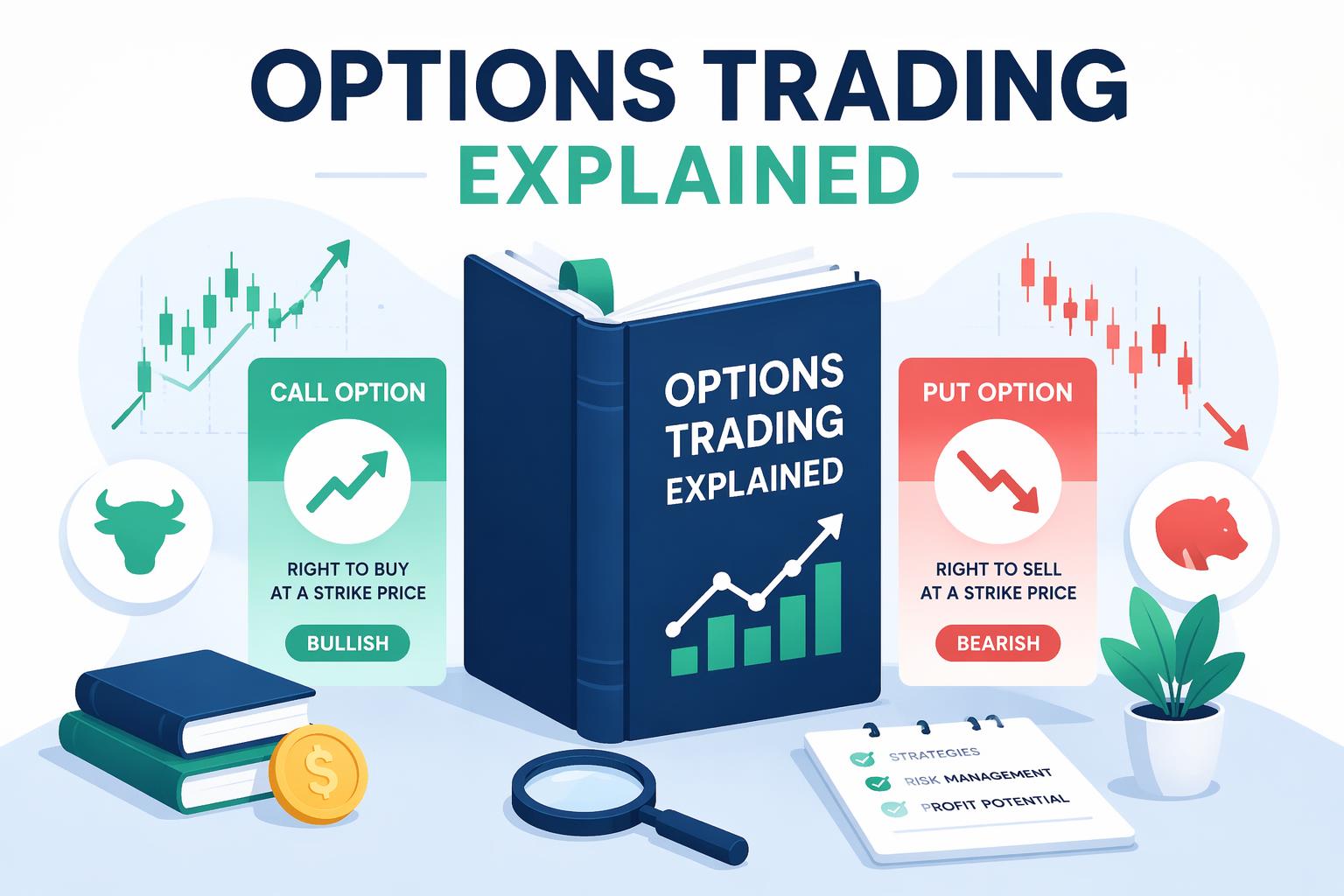
Think of it like paying for a reservation at a restaurant. You pay upfront (the premium) to lock in a table at 7 PM (the strike price and expiration date). If you show up, great. You get the table. If your plans change, you don’t have to go. Either way, the restaurant keeps your deposit.
The key difference between options and stocks: obligation versus choice. When you buy a stock, you own it until you sell. When you buy an option, you control when (or if) you act. That conditional structure is what makes options powerful for income generation, hedging, and speculation.
Options are conditional forward transactions tied to an exchange-traded asset. The buyer can execute the transaction but doesn’t have to. No other financial vehicle offers as many strategic opportunities.
—
How options contracts work
Every options contract represents 100 shares of the underlying stock. If you buy one call option on Tesla with a $250 strike price, you’re buying the right to purchase 100 shares of Tesla at $250 per share, regardless of where Tesla is actually trading when you exercise.
The components of an options contract:
- Underlying asset: the stock (or ETF, index, etc.) the option is tied to
- Strike price: the price at which you can buy or sell the underlying asset
- Expiration date: the last day you can exercise the option
- Premium: the upfront cost to buy the option (paid per share, so multiply by 100 for the total contract cost)
- Type: call (right to buy) or put (right to sell)
Let’s say Tesla is trading at $240, and you buy a call option with a $250 strike expiring in 30 days. You pay a $3 premium per share ($300 total for the contract). If Tesla climbs to $270 before expiration, you can exercise your option to buy 100 shares at $250 and immediately sell them at $270. That’s a $20 gain per share, minus the $3 premium you paid upfront. Net profit: $1,700 on a $300 investment.
If Tesla stays below $250, you let the option expire worthless. You lose the $300 premium, but that’s it. You’re not stuck holding shares you don’t want.
The guaranteed price in the option contract creates security for the buyer. It caps your downside (the premium) while leaving your upside open.
—
Calls vs. puts: the two types of options
Options come in two flavors: calls and puts. Every strategy you’ll ever use is built from these two contracts.
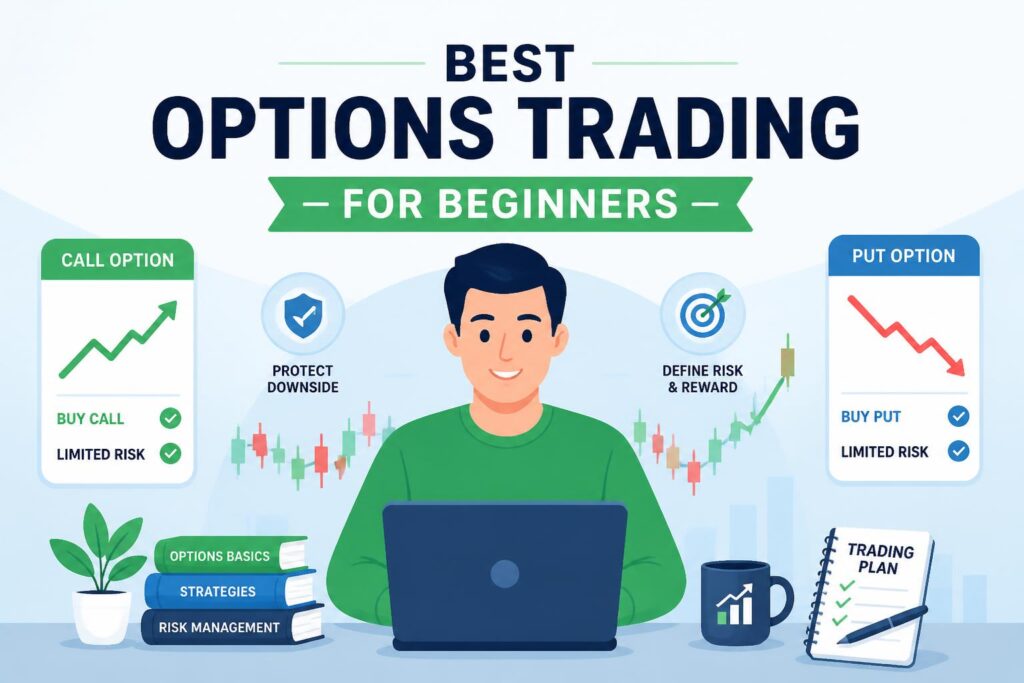
Call options
A call option gives you the right to buy the underlying stock at the strike price. You buy calls when you think the stock price will go up.
Example: Apple is trading at $180. You buy a call option with a $185 strike expiring in 60 days for a $4 premium. If Apple jumps to $200, your option is now “in the money.” You can buy Apple at $185 and sell it at $200. Profit: $15 per share minus the $4 premium = $11 per share ($1,100 per contract).
Put options
A put option gives you the right to sell the underlying stock at the strike price. You buy puts when you think the stock price will fall or when you want insurance against a drop.
Example: You own 100 shares of Nvidia, currently at $900. You’re worried about a pullback but don’t want to sell yet. You buy a put option with a $850 strike for a $10 premium. If Nvidia drops to $750, you can still sell your shares at $850, limiting your loss. The put acts as insurance.

Calls profit from price increases. Puts profit from price decreases. Both cap your risk at the premium you paid.
—
Why trade options instead of stocks?
Options add income, protection, and leverage to a portfolio.
1. Leverage
Options let you control 100 shares with a fraction of the capital required to buy the stock outright. A Tesla call option might cost $500, while buying 100 shares of Tesla costs $24,000. If Tesla jumps 10%, your stock position gains $2,400 (10% return). Your call option might double in value, a 100% return on the same $500.
The flip side: if Tesla drops, your stock position loses 10%, but your option could expire worthless, a 100% loss.
2. Income generation
Selling options generates immediate cash. When you sell a covered call (you own the stock and sell someone the right to buy it from you), you collect the premium upfront. If the stock stays below the strike price, you keep the premium and the stock. Repeat monthly.
Selling cash-secured puts works the same way. You collect premium for agreeing to buy a stock at a lower price. If the stock drops, you buy it at a discount. If it doesn’t, you keep the premium.
This is the slow, predictable wealth-building approach. Just a few extra percentage points each year compound significantly over time. $10,000 invested per year for 40 years at a 9% return grows to about $3.4 million. Adding an extra 2-4% per year through options income turns that into almost $11 million.
3. Hedging and protection
Buying puts acts as portfolio insurance. If you hold a large stock position and the market crashes, your puts gain value as your stocks lose value, offsetting the damage. Professional investors use this constantly.
4. Flexibility in any market
Options work in bull markets, bear markets, and sideways markets. Stocks only make money when they go up (or when you short them, which carries unlimited risk). Options let you profit from movement in either direction or from no movement at all.
—
Common options strategies that actually work
Options offer hundreds of possible strategies. Most are overcomplicated. These five generate consistent results without requiring a PhD in quantitative finance.
1. Covered calls (income)
Setup: You own 100 shares of a stock. You sell a call option above the current price.
Goal: Collect premium income while holding the stock.
Example: You own 100 shares of Microsoft at $420. You sell a call option with a $430 strike expiring in 30 days for a $3 premium ($300 total). If Microsoft stays below $430, you keep the $300 and still own the stock. If it rises above $430, your shares get “called away.” You sell them at $430 and keep the premium. Either way, you profit.
Risk: You cap your upside. If Microsoft rockets to $500, you only get $430.
2. Cash-secured puts (income + stock acquisition)
Setup: You sell a put option on a stock you’d be happy to own, and you set aside enough cash to buy the shares if assigned.
Goal: Get paid to wait for a stock to drop to your target buy price.
Example: Tesla is at $240, but you’d buy it at $220. You sell a put option with a $220 strike for a $5 premium ($500 total). If Tesla drops below $220, you’re obligated to buy 100 shares at $220. But you wanted to buy anyway, and you collected $500 for agreeing to it. If Tesla stays above $220, you keep the $500 and repeat next month.
Risk: You’re obligated to buy the stock if it drops below the strike. If Tesla crashes to $150, you still pay $220.
3. Long calls (speculation)
Setup: You buy a call option on a stock you think will rise.
Goal: Profit from a price increase with limited downside.
Example: Nvidia is at $900. You buy a call option with a $950 strike expiring in 90 days for a $20 premium ($2,000 total). Nvidia jumps to $1,100. Your option is now worth $150 per share ($15,000 total). You sell it for a $13,000 profit.
Risk: If Nvidia stays flat or drops, your option expires worthless. You lose the entire $2,000 premium.
4. Protective puts (insurance)
Setup: You own a stock and buy a put option to protect against a drop.
Goal: Limit downside without selling your position.
Example: You own 100 shares of Apple at $180. You’re nervous about earnings. You buy a put option with a $170 strike for a $4 premium ($400 total). If Apple crashes to $140, your put lets you sell at $170, limiting your loss to $10 per share plus the $4 premium. If Apple rises, you lose the $400 premium but your shares gain value.
Risk: The premium is a sunk cost. If nothing bad happens, you paid for insurance you didn’t need.
5. Vertical spreads (defined risk + reward)
Setup: You buy one option and sell another option at a different strike price (same expiration, same underlying stock).
Goal: Reduce the cost of the trade by capping both risk and reward.
Example: Tesla is at $240. You buy a call option with a $250 strike for $8 and sell a call option with a $270 strike for $3. Net cost: $5 per share ($500 total). If Tesla rises above $270, your max profit is $15 per share ($1,500 total, minus the $500 cost = $1,000 profit). If Tesla stays below $250, you lose the $500.
Risk: You cap your upside. If Tesla goes to $350, you still only make $1,000.
—
How to start trading options in 2026
You can’t trade options from a standard brokerage account. You need approval from your broker, and the approval level determines which strategies you can use.
Step 1: Choose a broker
Options contracts can only be obtained from specific brokers. CapTrader is one of the cheapest providers for options in Europe, offering low trading costs and a wide selection of trading centers.
In the U.S., most brokers (Fidelity, TD Ameritrade, E*TRADE, Interactive Brokers, Robinhood) offer options trading. Look for:
- Low or zero commissions per contract
- A solid options trading platform (desktop or mobile)
- Educational resources
- Paper trading (practice accounts with fake money)
Step 2: Apply for options trading approval
Your broker will ask about your trading experience, financial situation, and risk tolerance. They’ll assign you an approval level:
- Level 1: Covered calls and cash-secured puts (safest)
- Level 2: Long calls and puts (buying options)
- Level 3: Spreads
- Level 4: Naked calls and puts (selling options without owning the stock, high risk)
Start with Level 1 or 2. You don’t need Level 4 unless you’re running a hedge fund.
Step 3: Paper trade first
Most brokers offer paper trading accounts where you practice with fake money in a realistic trading environment. Use it. Test your strategies. Make mistakes when they don’t cost real money.
Step 4: Start small
Your first trade should be one contract. Not ten. Not a hundred. One. Learn how expiration works. Learn how the bid-ask spread eats into your profits. Learn how theta (time decay) chips away at your option’s value every day.
Step 5: Track everything
Keep a trading journal. Record the trade setup, your reasoning, the outcome, and what you learned. Options traders who journal their trades outperform those who don’t because they stop repeating the same mistakes.
—
The risks everyone ignores until it’s too late
Buying options limits your loss to the premium paid. Selling (writing) options exposes you to larger risks.
1. Time decay (theta)
Every day that passes, your option loses value, even if the stock doesn’t move. Options are wasting assets. If you buy a call with 30 days until expiration and the stock goes nowhere, your option loses money every single day.
Solution: Don’t buy short-term options unless you expect the stock to move fast. Give yourself time.
2. Volatility crush
Options prices are determined by time decay and volatility. When volatility spikes (like before earnings), option premiums skyrocket. After the event, volatility collapses, and so does your option’s value, even if the stock moved in your favor.
Example: You buy a call before Tesla earnings. Tesla beats estimates and the stock jumps 5%. But implied volatility drops from 80% to 40% after the announcement. Your call loses money anyway.
Solution: Don’t buy options right before earnings unless you understand IV crush.
3. Overleveraging
Because options are cheap relative to stocks, beginners buy too many contracts. If you have $5,000 and you buy 50 call options at $100 each, a single bad trade wipes you out.
Solution: Risk no more than 2-5% of your account on a single trade.
4. Selling naked options
Selling a call option without owning the stock (a “naked call”) exposes you to unlimited risk. If the stock moons, you’re obligated to deliver 100 shares at the strike price, meaning you have to buy them at the current (much higher) price.
Solution: Only sell covered calls (you own the stock) or cash-secured puts (you have the cash to buy the stock). Stay away from naked options until you deeply understand risk management.
5. Ignoring liquidity
Thinly traded options have wide bid-ask spreads. You might pay $5 to buy an option but only be able to sell it for $3, an instant 40% loss. Always check the bid-ask spread and daily volume before trading.
Solution: Stick to high-volume stocks and options with tight spreads (penny-wide or less).
High risks accompany high chances of winning. But risk without strategy is just gambling.
—
Options trading hours and market changes
In 2026, options trading got a major upgrade. On May 28, 2026, Cboe received SEC approval to offer extended trading hours for select multi-listed single stock options. According to the announcement, this marked an important milestone for the U.S. options industry.
New trading sessions
Cboe now offers:
- Pre-market session: 7:30 a.m. ET to 9:25 a.m. ET
- Post-market session: 4:00 p.m. ET to 4:15 p.m. ET
Which stocks qualify?
At launch, approximately 20 names were anticipated for trading, including Magnificent 7 stocks such as Nvidia, Tesla, and Apple. To be eligible, equity options must meet:
- Market capitalization requirement: $50 billion or higher
- Average daily trading volume: 10 million shares or higher
- Average daily volume: 150,000 contracts
Cboe plans to update the equity options class list semi-annually.
Why extended hours matter
Extended trading hours help manage risk around market-moving events: earnings releases, geopolitical news, or Fed announcements that happen outside regular market hours. Before this, if Tesla announced earnings after the bell and the stock gapped 10% the next morning, options traders were stuck. Now, they can adjust positions in real time.
Cboe also noted the initiative aims to broaden market access for international investors in different time zones.
This is a big deal for active options traders. It’s not full 24-hour trading yet, but it’s a step toward matching the flexibility of futures and crypto markets.
—
Tax implications you need to know
Options are taxed differently depending on how you use them. Consult a tax professional for your specific situation.
1. Short-term capital gains
If you buy and sell an option within a year, profits are taxed as short-term capital gains, the same rate as your ordinary income (up to 37% federally in 2026).
2. Long-term capital gains
If you hold a stock for more than a year and sell it, you pay long-term capital gains tax (0%, 15%, or 20%, depending on income). But options almost never qualify because they expire in weeks or months, not years.
3. Covered calls and taxable events
If you sell a covered call and it gets exercised, you’re selling the underlying stock. The stock sale is taxable. The premium you collected is added to your proceeds.
4. Wash sale rule
If you sell a stock at a loss and buy a call option on the same stock within 30 days, the IRS treats it as a wash sale, meaning you can’t claim the loss.
5. Section 1256 contracts
Index options (SPX, NDX) are taxed under Section 1256, which gives you a 60/40 split: 60% long-term capital gains, 40% short-term, regardless of how long you held the option. This is more favorable than equity options.
Taxes can eat a chunk of your profits. Plan accordingly.
—
FAQ
What happens when I buy an option?
You pay a premium upfront and receive a contract that gives you the right to buy (call) or sell (put) 100 shares of the underlying stock at a specific price before expiration. You control when (or if) you exercise that right.
What does exercising an option mean?
Exercising means you’re using the right the contract gave you. If you exercise a call, you buy 100 shares at the strike price. If you exercise a put, you sell 100 shares at the strike price. Most traders sell the option for a profit instead of exercising.
Is trading options better than stocks?
Different, not better. Options offer leverage, income strategies, and hedging that stocks don’t. But they’re riskier, more complex, and time-sensitive. Stocks are easier and less likely to expire worthless.
What is the difference between American options and European options?
American options can be exercised any time before expiration. European options can only be exercised on the expiration date. Most stock options in the U.S. are American-style.
How is risk measured with options?
Risk is measured using “Greeks”: delta (sensitivity to stock price), theta (time decay), vega (sensitivity to volatility), and gamma (rate of change of delta). You don’t need to master Greeks on day one, but understanding theta and delta will save you money.
Can you make money with options?
Yes. Options can generate recurring income through strategies like covered calls and cash-secured puts. They can also produce large gains through speculation, but those same strategies can produce large losses. Options are not about gambling but about building wealth slowly and predictably.
How are options taxed?
Most options are taxed as short-term capital gains if held less than a year. Index options (Section 1256 contracts) get preferential 60/40 tax treatment. Always consult a tax professional for your situation.
What are covered calls?
A covered call is when you own 100 shares of a stock and sell a call option against it. You collect premium income. If the stock rises above the strike price, your shares get called away. If it doesn’t, you keep the premium and the stock.
What are cash-secured puts?
A cash-secured put is when you sell a put option and set aside enough cash to buy the underlying stock if you’re assigned. You get paid to agree to buy a stock at a lower price. If the stock drops, you buy it. If it doesn’t, you keep the premium.
Is options trading risky?
Yes, but the risk profile depends on the strategy. Buying options limits your risk to the premium paid. Selling naked options exposes you to large or unlimited losses. Covered calls and cash-secured puts are lower-risk income strategies. High risks accompany high chances of winning.
—
Final thoughts
Options trading isn’t a lottery ticket. It’s a toolset. Used correctly, options can generate income, hedge risk, and amplify returns without requiring you to bet the farm on a single stock pick. Used incorrectly, they can drain your account faster than almost any other financial instrument.
Start with the basics: learn what calls and puts are, practice with paper trading, and stick to simple strategies like covered calls and cash-secured puts. Once you’ve made money (and lost money) and understood why both happened, you can explore more complex strategies.
Options offer strategic opportunities no other financial vehicle can match. But those opportunities only work if you approach them with discipline, risk management, and a willingness to learn from mistakes.
If you’re ready to start, pick a broker, apply for Level 1 or Level 2 options approval, and make your first trade. Keep it small. Keep it simple. Keep a journal. The market will teach you the rest.