What Is Debt Payoff? A Beginner’s Guide to Getting Out of Debt in 2026
Debt payoff is eliminating what you owe through structured repayment. If you’re buried in credit card balances, personal loans, or student debt, the choice between debt snowball, debt avalanche, or consolidation comes down to one number: your debt load relative to income.
I’ll show you what debt payoff actually means, how to calculate whether you can handle this yourself or need help, and which strategy gets you out fastest based on your situation.
Table of contents
- What is debt payoff?
- Calculate your debt load first
- Debt payoff strategies: snowball vs avalanche
- When to consolidate high-interest debt
- Debt payoff tools and planners
- How to speed up your debt payoff
- FAQ
What is debt payoff?
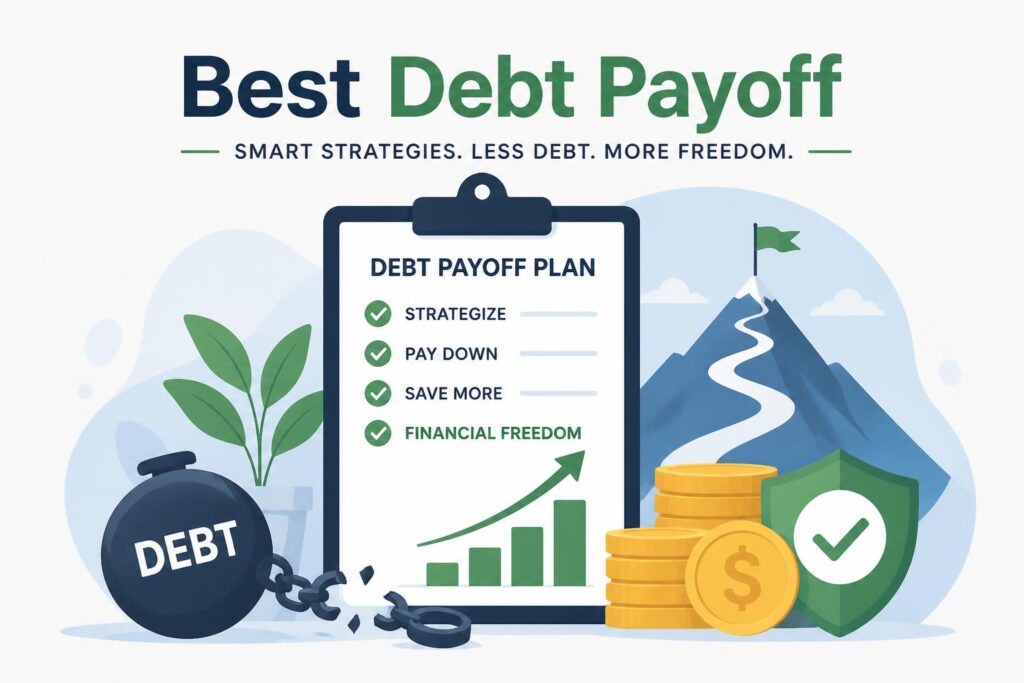
Debt payoff is the systematic elimination of outstanding balances through planned repayment. Not making minimum payments forever. Choosing a strategy, sticking to a timeline, and directing extra money toward debt until it’s gone.
The question isn’t “should I pay off debt?” It’s “which debt first, and how fast?”
What separates successful debt payoff from spinning your wheels:
- A clear target. You know exactly how much you owe, to whom, and at what interest rate.
- A repayment strategy. You’ve picked snowball, avalanche, or consolidation based on your debt load.
- Extra payments. Minimum payments keep you in debt forever. Debt payoff requires throwing extra money at the balance.
- A timeline. You know when you’ll be debt-free if you stick to the plan.
Most people skip step one: calculating their debt load. That number determines whether you can handle this alone or need outside help.
Calculate your debt load first
Your debt load is the percentage of your gross monthly income that goes toward debt payments (excluding mortgage). This single number tells you which strategy will actually work.
Add up all monthly debt payments: credit cards, personal loans, car loans, student loans. Skip your mortgage or rent. Divide that total by your gross monthly income (before taxes). Multiply by 100 to get your debt load percentage.
Example:
- Monthly debt payments: $1,200
- Gross monthly income: $4,000
- Debt load: ($1,200 ÷ $4,000) × 100 = 30%
Your debt load determines your path:
- Under 36%: A DIY approach makes sense. Snowball or avalanche will work.
- 36% to 42%: Try DIY and consider getting help if progress stalls.
- 43% or more: Consider debt relief options like debt management plans, which can get you debt-free in three to five years.
Debt greater than 43% of income often requires professional help because the math doesn’t work on minimum payments alone. Not a moral judgment. Just math.

Debt payoff strategies: snowball vs avalanche
If your debt load is under 42%, you have two proven DIY strategies. Both work. The difference is psychological vs mathematical optimization.
Debt snowball method
List all debts from smallest balance to largest. Pay minimums on everything except the smallest debt, which gets every extra dollar. When that’s paid off, roll that payment into the next smallest debt.
Quick wins boost motivation. Paying off a $500 credit card in two months feels like progress, even if it’s not the highest interest debt.
Best for people who need visible wins to stay motivated, or anyone with several small balances under $1,000.
Example:
- $500 credit card at 18% APR
- $2,000 medical bill at 0% interest
- $8,000 car loan at 6% APR
You’d attack the $500 card first, even though the car loan has a higher total balance.
Debt avalanche method
List all debts from highest interest rate to lowest. Pay minimums on everything except the highest rate debt, which gets all extra payments. When that’s gone, move to the next highest rate.
Paying off high interest debt first reduces the total interest paid over time. Mathematically, this is the fastest way out.
Best for people who can stay motivated without quick wins, or anyone with one very high interest debt (like a 24% APR credit card).
Example:
- $3,000 credit card at 24% APR
- $5,000 personal loan at 12% APR
- $10,000 car loan at 6% APR
You’d attack the 24% card first, even though it’s not the smallest balance.
Which one should you pick?
If you’re disciplined and want to save the most money: avalanche.
If you need momentum and visible progress to stay on track: snowball.
Both work. The best one is the one you’ll actually stick with for 12 to 36 months.
When to consolidate high interest debt
Consolidation makes sense when you have multiple high interest debts (usually credit cards above 18% APR) and you qualify for a lower rate elsewhere.
Two consolidation options
Balance transfer card
A balance transfer card offers 0% interest for 15 to 21 months. You roll existing credit card balances onto this card and pay them off interest free during the promotional period.
You’ll need good or excellent credit (typically 670+ credit score) and the ability to pay off the balance before the 0% period ends.
Best for people with $3,000 to $8,000 in credit card debt who can pay it off in 15 to 18 months.
Watch out for balance transfer fees (usually 3% to 5% of the amount transferred) and the interest rate that kicks in after the promo period ends.
Debt consolidation loan
A debt consolidation loan lets you roll multiple debts into one fixed payment. Rates range from 7% to 36% depending on your credit, but even a 12% rate beats a 24% credit card.
Best for people with multiple debts at different rates who want one predictable monthly payment and a fixed payoff date.
Watch out for origination fees (1% to 6% of the loan amount) and the temptation to rack up new credit card debt after consolidating the old balances.
When consolidation doesn’t help
Skip consolidation if your debt load is above 42% (you need debt relief, not a new loan), you can’t qualify for a rate lower than what you’re currently paying, or you’ll just run up new credit card debt after consolidating.
Consolidation only helps if it genuinely lowers your interest rate and you commit to not adding new debt.
Debt payoff tools and planners
A debt payoff planner tracks your debts, calculates your payoff date, and shows you exactly how much to pay each month. You don’t need one to get out of debt, but it makes the process less overwhelming.
In 2026, Investopedia evaluated eight debt payoff planners based on 36 factors and compiled nearly 300 data points. The top picks:
Debt Payoff Planner
Cost: Free or $2/month for premium features
Rating: 4.8 out of 5 stars
Supports avalanche, snowball, and custom debt repayment methods. Includes progress visualizations and a simple interface. You’ll need to input your debt details manually, but this is common among debt planners.
Best for anyone who wants a visual tracker without paying $15/month.
You Need a Budget (YNAB)
Cost: $14.99/month or $109/year
Rating: 3.7 out of 5 stars
Zero based budgeting app with mobile support and thorough spending analysis.
Best for people who need help budgeting and debt payoff, not just a debt tracker.
Unbury.me
Cost: Free
Rating: 3.3 out of 5 stars
Very simple interface. Track unlimited debts and choose from snowball or avalanche methods.
Best for minimalists who just want a calculator, not a full app.
Vertex42 Debt Reduction Calculator (Extended)
Cost: Free or $9.95 for extended features
Rating: 3.5 out of 5 stars
Downloadable for Excel and Google Sheets. Allows custom debt strategies.
Best for spreadsheet people who want to track everything offline.
Do you actually need a planner?
Not necessarily. A planner helps if you have 4+ debts and lose track of what you owe, you need visual motivation (progress bars, payoff countdowns), or you want to compare snowball vs avalanche side by side.
You can also just use a spreadsheet or pen and paper. The tool matters less than the habit of tracking progress every month.
How to speed up your debt payoff
Debt payoff timelines aren’t set in stone. You can cut months or even years off your repayment.
Create a bare bones budget
A bare bones budget strips spending down to essentials: rent, utilities, groceries, minimum debt payments, and nothing else. Every discretionary dollar goes toward debt.
You don’t have to live this way forever. Just long enough to knock out one or two high interest debts. Using cash for discretionary spending can reduce impulse purchases and help you stick to the plan.
Cancel subscriptions you don’t use daily. Meal prep instead of takeout for 30 days. Pause hobbies with recurring costs (gym memberships, streaming services).
Track your spending for two weeks, then build a budget that redirects every possible dollar toward debt.
Increase your income (even temporarily)
Extra income accelerates debt payoff faster than cutting expenses. A side gig that brings in $500/month can shave 6 to 12 months off a $10,000 debt.
Freelance your existing skill (writing, design, bookkeeping). Pick up weekend shifts in retail or food service. Sell things you don’t use (furniture, electronics, old tools).
You don’t need a permanent side hustle. Even 6 to 12 months of extra income makes a massive dent.
Use windfalls wisely
A windfall is any unexpected money: tax refund, bonus, inheritance, stimulus check, or cash gift. Most people spend windfalls on discretionary purchases. Debt free people throw them at debt.
If you get a $2,000 tax refund and you’re using the avalanche method, that $2,000 goes straight to your highest interest debt. On a $5,000 credit card at 24% APR, that windfall saves you $480 in interest over the next year.
Know your debt inside and out
Write down every debt: creditor name, balance owed, interest rate, minimum payment, due date.
Update this list every month. Watching the balances shrink builds momentum. Not knowing exactly what you owe keeps you stuck.
Money management apps can track debts and monitor progress automatically, but a handwritten list on your fridge works just as well.
FAQ
What is the debt snowball method?
The debt snowball method is a repayment strategy where you pay off debts from smallest balance to largest, regardless of interest rate. You make minimum payments on all debts except the smallest, which gets every extra dollar. When the smallest debt is paid off, you roll that payment into the next smallest debt. Quick wins boost motivation and build momentum.
What is the debt avalanche method?
The debt avalanche method is a repayment strategy where you pay off debts from highest interest rate to lowest. You make minimum payments on all debts except the highest rate debt, which gets all extra payments. Paying off high interest debt first reduces total interest paid over time, making this the fastest mathematical route out of debt.
What is a debt payoff planner?
A debt payoff planner is a tool (app, spreadsheet, or calculator) that tracks your debts, calculates your payoff date, and shows how much to pay each month. Most planners support snowball and avalanche methods and provide progress visualizations. Debt Payoff Planner is the top choice due to its simple interface and low cost (free or $2/month).
How do I choose the best debt payoff planner for my needs?
Pick a planner based on how you prefer to work. If you want a mobile app with visual progress tracking, use Debt Payoff Planner (4.8/5 stars). If you need budgeting help alongside debt tracking, use YNAB ($14.99/month). If you just want a free calculator, use Unbury.me. If you prefer spreadsheets, use Vertex42. The best planner is the one you’ll actually open every month.
What are some strategies for managing larger debt loads?
If your debt load is 36% to 42% of income, try DIY methods (snowball or avalanche) and consider getting help if progress stalls. If debt is 43% or more of your income, consider debt relief options like debt management plans, which can get you debt free in three to five years. Consolidating high interest debts into a lower rate loan or balance transfer card can also help if you qualify.
—
Debt payoff isn’t about perfection. It’s about knowing your number (your debt load), picking a strategy (snowball, avalanche, or consolidation), and making consistent progress every month. Calculate your debt load today, choose your method, and set a payoff date. The fastest way out of debt is the plan you’ll actually follow.