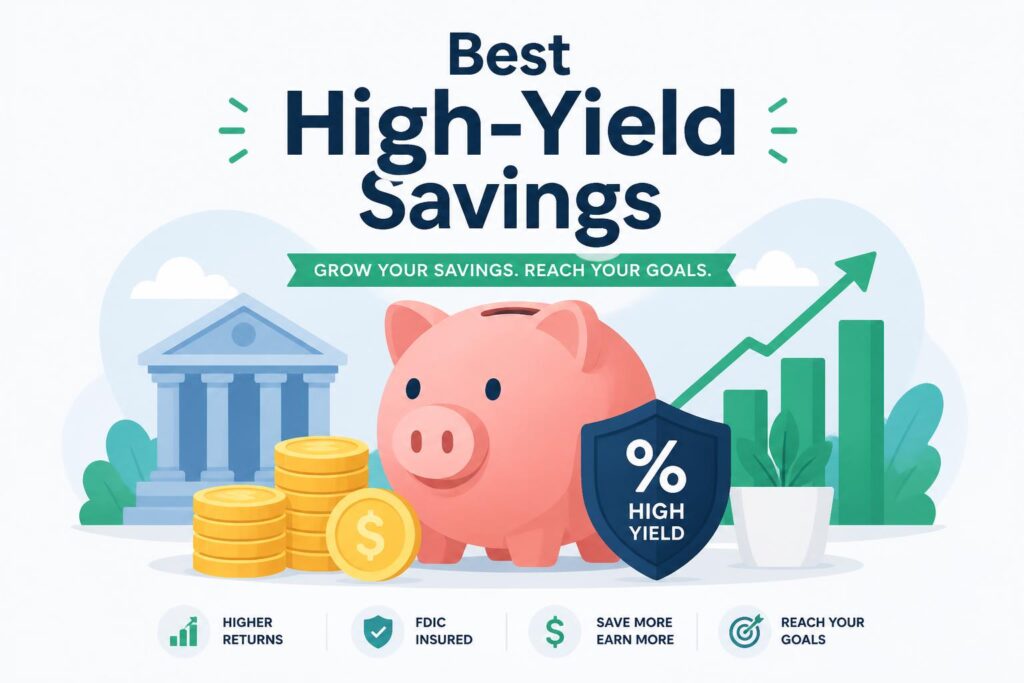
High-yield savings accounts for smaller budgets in 2026
Overview
If you’re saving on a tight monthly budget, the difference between savings accounts mostly comes down to three things: interest rate stability, fees, and how restrictive the account feels in day-to-day use.
Most of the options below have no minimum deposit and no monthly fees. The real variation is in rate conditions and extra features like automation or bundled banking tools.
—
At a glance
Account Best for Typical APY Minimum Ally Bank Simple beginner savings ~4% variable $0 SoFi High rates + banking bundle ~4–5% variable $0 Capital One 360 Straightforward traditional banking ~4% variable $0 Marcus by Goldman Sachs Low-risk savings focus ~4–5% variable $0 Discover Financial Services All-in-one banking ecosystem ~4% variable $0 American Express Brand stability ~4% variable $0 Wealthfront Automated cash management ~4–5% variable $1
How these were evaluated
The comparison is based on:
- Interest rates and how often they change
- Fees and balance requirements
- Ease of use in apps and web interfaces
- Flexibility for deposits and withdrawals
- Additional tools like automation or budgeting features
- Overall reliability of the provider
—
1. Ally Bank
Ally Bank is often used as a baseline option for people starting out with high-yield savings.
It keeps things simple: no monthly fees, no minimum balance, and a mobile app that covers basic savings goals without much setup.
What stands out
- No fees or minimum deposit
- Simple goal-based savings tools
- Automated transfers (“buckets”)
- Consistent user experience
Limitations
- Rate is competitive but not always at the top
- No physical branches
- Limited advanced investing features
—
2. SoFi
SoFi combines savings with checking, lending, and investing in one platform.
The highest advertised rates usually depend on meeting direct deposit conditions, so the actual yield can vary depending on how you use the account.
What stands out
- Higher APY when conditions are met
- Full banking + investing ecosystem
- No account fees
- Strong mobile experience
Limitations
- Best rates depend on eligibility requirements
- Less traditional banking structure
—
3. Capital One 360 Performance Savings
Capital One 360 is closer to a traditional bank experience than most fintech options.
It focuses on stability and straightforward usage rather than feature depth.
What stands out
- Simple setup with no fees
- Reliable app and transfers
- Backed by a large financial institution
Limitations
- Fewer automation tools
- Rate is not always the highest available
—
4. Marcus by Goldman Sachs
Marcus by Goldman Sachs is designed for users who want a low-maintenance savings account.
There are no extra product layers or bundled services, just a savings account with a competitive rate.
What stands out
- No fees or minimum balance
- Stable, predictable structure
- Clean online interface
Limitations
- No checking account
- Limited feature set
—
5. Discover Online Savings
Discover Financial Services works well if you already use its credit or banking products.
It’s more of an ecosystem account than a standalone savings tool.
What stands out
- No fees or minimums
- Integrated banking products
- Reliable customer support
Limitations
- Features are fairly standard
- Rate changes over time like most competitors
—
6. American Express High Yield Savings
American Express offers a simple savings account backed by a well-known brand.
It avoids complexity and focuses on basic savings with consistent access.
What stands out
- Strong brand trust
- Simple account structure
- No fees or minimum balance
Limitations
- No additional financial tools
- Limited ecosystem outside savings
—
7. Wealthfront Cash Account
Wealthfront combines savings with automated cash allocation features.
It sits between a savings account and an investment platform.
What stands out
- Automated cash allocation
- Competitive yield potential
- Links with investment tools
- Low entry requirement
Limitations
- Not a traditional bank account
- Setup needed to use features fully
—
Quick comparison
Feature Ally SoFi Capital One Marcus Discover Amex Wealthfront No fees Yes Yes Yes Yes Yes Yes Yes High APY range Medium High Medium Medium Medium Medium High Ease of use High High High Medium Medium Medium Medium Automation Medium Medium Low Low Low Low High Minimum deposit $0 $0 $0 $0 $0 $0 $1
Choosing one
A simple way to narrow it down:
- If you want something uncomplicated: Ally Bank
- If you want higher yield and don’t mind conditions: SoFi
- If you prefer a traditional bank feel: Capital One 360
- If you want a basic long-term savings account: Marcus by Goldman Sachs
- If you want automation: Wealthfront
Most people with small balances start with a no-fee account first, then add another later if they want to separate goals or optimize yield.
—
FAQ
What’s the safest option here? Accounts from large established institutions like Goldman Sachs, Capital One, and American Express are generally considered stable for cash savings.
Do I need a minimum deposit? Most of these accounts don’t require one. Wealthfront is the only one with a small $1 minimum.
Do interest rates stay the same? No. APYs change over time based on market rates.
Is it better to use one account or several? One is simpler. Multiple accounts can help separate goals like emergency funds and short-term savings.
—
Bottom line
For most people saving small amounts, a simple no-fee account is usually enough to start. Ally Bank is often chosen for that role because it doesn’t add much friction.
If you want higher yield and don’t mind rate conditions, SoFi or Wealthfront are the main alternatives.