How to Use Debt Payoff Strategies That Actually Work: A 2026 Guide
Affiliate Disclaimer: This article contains affiliate links. If you purchase a product or service through these links, we may earn a commission at no additional cost to you. We only recommend products we’ve thoroughly researched and believe will help you achieve your financial goals.
If you’re staring at multiple credit card statements and loan balances, you already know that knot-in-stomach feeling. The average American now carries around $104,215 of debt, which makes getting out feel pretty impossible.
But here’s the thing: the difference between staying buried and becoming debt-free usually isn’t about earning more money (though that helps). It’s about having a system. A concrete, step-by-step plan that removes the guesswork and keeps you accountable.
By the end of this guide, you’ll know exactly which debt payoff method matches your situation, how to set up a tracking system that keeps you motivated, and what steps to take today to start making real progress.
What you need before starting:
- A complete list of all your debts (balances, interest rates, minimum payments)
- 30 minutes to assess your debt load and choose your strategy
- A debt tracking tool (we’ll cover the best free and paid options)
- Estimated time to become debt-free: varies based on your total debt and available monthly payment amount
Step 1: Calculate Your Actual Debt Load Percentage
Before choosing any payoff strategy, you need to understand how serious your debt situation is. This one number tells you which approach will work for you.
How to calculate it:
- Add up your total monthly debt payments (credit cards, personal loans, student loans, car payments, everything except mortgage)
- Divide that number by your gross monthly income (before taxes)
- Multiply by 100 to get your percentage
What your number means:
Under 36%: A DIY debt payoff approach makes sense. You have enough breathing room to tackle this yourself with the right strategy.
36% to 42%: Try DIY methods first, but consider getting additional help if you’re not making progress within 3-6 months.
43% or more: Your debt load is serious enough that you should explore debt relief options beyond standard payoff strategies.
You should see: A clear percentage that tells you whether you can handle this on your own or need professional help.
Note: This percentage is based on guidance from financial experts and helps you avoid wasting months on a strategy that was never going to work for your debt level.
Step 2: List Every Single Debt You Owe
You can’t pay off what you don’t acknowledge. This step feels uncomfortable, but it’s necessary.
- Open a spreadsheet or grab paper and pen
- Write down each debt with these details:
– Creditor name
– Current balance
– Interest rate (APR)
– Minimum monthly payment
– Due date
- Total everything at the bottom
Don’t skip any debts. Include credit cards, personal loans, student loans, medical bills, store credit cards, money owed to family or friends, car loans, any other money you owe.
You should see: The complete picture of your debt. Yes, the total might be scary. That’s normal. Knowing the real number is the first step to changing it.
Step 3: Create a Bare-Bones Budget to Find Extra Money
Most people think they need a massive income boost to pay off debt. The truth? Most people have $200-500 per month hiding in their current spending that could go toward debt.
- Track every single expense for one week using your bank and card statements
- Use a budgeting worksheet to categorize your spending
- Identify non-essential spending you can temporarily cut:
– Subscription services you rarely use
– Dining out and delivery
– Entertainment and leisure spending
– Premium versions of services when free options exist
- Calculate how much you can realistically put toward debt beyond minimum payments
You should see: A specific dollar amount you can add to your debt payments each month. Even $100 extra per month makes a big difference over time.
Note: This isn’t about living miserably forever. It’s about temporarily cutting back while you demolish your debt. Once you’re debt-free, you’ll have more money for the things you actually enjoy.
Step 4: Choose Your Debt Payoff Method
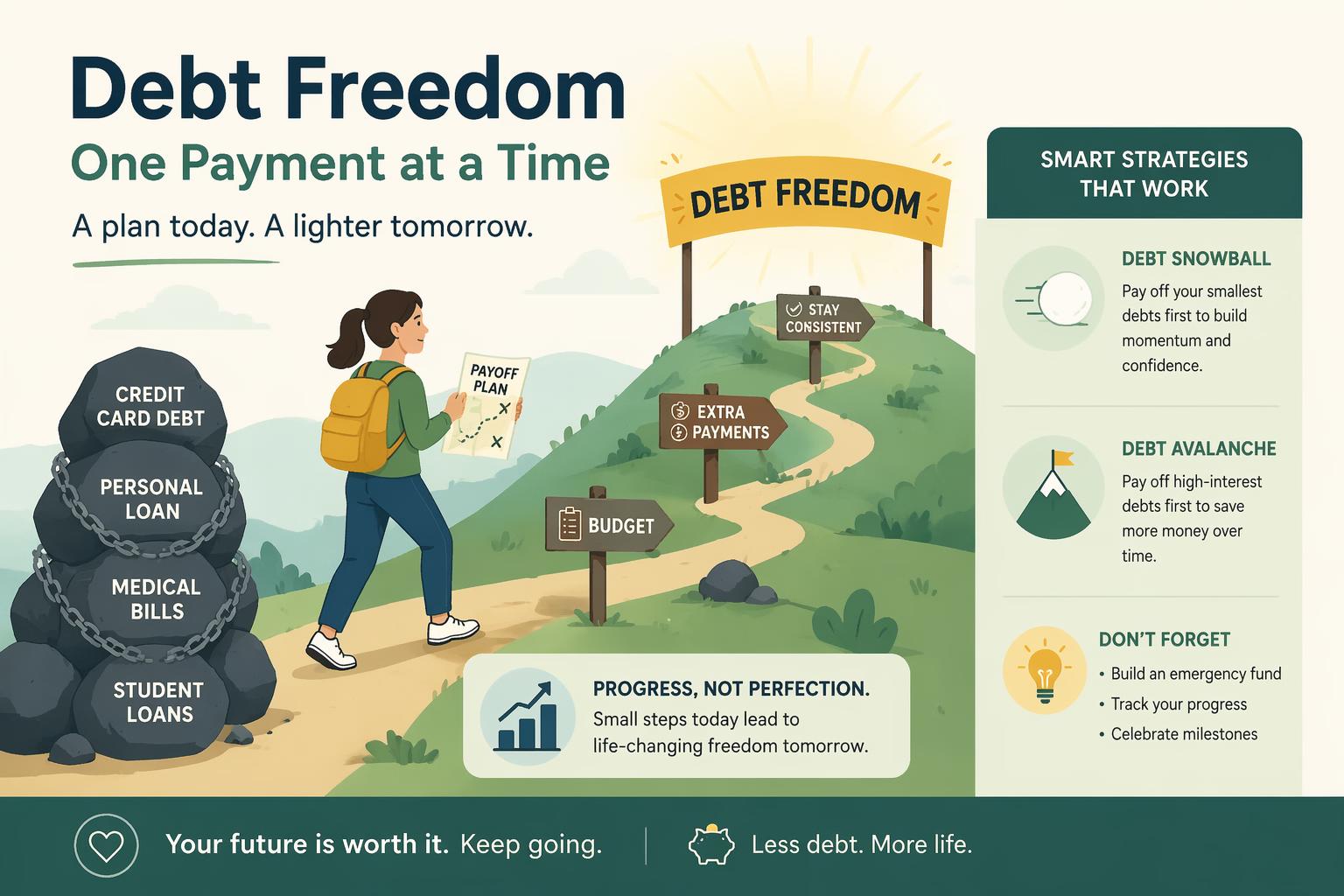
There are two proven debt payoff methods, each with different psychological and mathematical advantages.
Debt Avalanche Method (mathematically better):
- List your debts by interest rate, highest to lowest
- Make minimum payments on everything
- Put all extra money toward the highest-interest debt
- When that’s paid off, roll that entire payment to the next highest-interest debt
- Repeat until debt-free
Best for: People motivated by numbers and saving the most money on interest. You’ll pay less overall, but it might take longer to see that first debt disappear.
Debt Snowball Method (psychologically better):
- List your debts by balance, smallest to largest
- Make minimum payments on everything
- Put all extra money toward the smallest balance
- When that’s paid off, roll that entire payment to the next smallest debt
- Repeat until debt-free
Best for: People who need quick wins to stay motivated. You’ll pay slightly more in interest, but you’ll see debts disappearing faster, which keeps you engaged.
Which should you choose?
If your highest-interest debt is also one of your smallest balances, the methods converge. Do that one first regardless. Otherwise, choose avalanche if you’re analytical and disciplined. Choose snowball if you’ve tried debt payoff before and quit.
You should see: A clear, numbered list of which debts you’ll attack in order.
Step 5: Set Up a Debt Tracking Tool
Most debt payoff plans fail because people try to track everything in their heads or on random pieces of paper. You need a system that automatically calculates your progress and keeps you accountable.
Best debt payoff planners for 2026:
Debt Payoff Planner (4.8 out of 5 stars):
- Cost: Free or $2/month for premium features
- Methods: Avalanche, snowball, or custom strategies
- Platforms: Apple/Android apps plus webpage
- Best for: Most people. Good balance of features and affordability
You Need a Budget (YNAB) (3.7 out of 5 stars):
- Cost: $14.99/month or $109/year
- Methods: Avalanche, snowball, or custom strategies
- Platforms: Apple/Android apps plus webpage
- Best for: People who need comprehensive budgeting beyond just debt tracking
Unbury.me (3.3 out of 5 stars):
- Cost: Free
- Methods: Avalanche or snowball only
- Platform: Webpage only
- Best for: People who want a simple, no-frills calculator without any account setup
- Choose one planner from the options above based on your budget and feature needs
- Enter all your debts with current balances, interest rates, and minimum payments
- Enter the extra monthly amount you found in Step 3
- Select your chosen payoff method (avalanche or snowball)
- Review your projected debt-free date
You should see: A timeline showing when each debt will be paid off and your final debt-free date. This visual representation is motivating.
Note: If your projected debt-free date is longer than 5 years with your current extra payment amount, revisit Step 3 to find more money or consider debt consolidation (covered in Step 7).
Step 6: Automate Your Debt Payments
Manual payments are where good intentions go to die. You forget, you procrastinate, you “borrow” from this month’s debt payment for something else.
- Log into each creditor’s website or app
- Set up automatic minimum payments for every debt except your target debt
- Set up an automatic payment for your target debt equal to: minimum payment + your extra monthly amount
- Schedule all payments for 3-5 days after your payday
- Set a monthly calendar reminder to check that payments processed correctly
You should see: Automatic payment confirmations from each creditor. Your debt payoff now happens whether you “feel like it” that month or not.
Step 7: Decide If Debt Consolidation Makes Sense
For some debt situations, consolidating multiple high-interest debts into a single lower-interest loan can speed up your payoff and simplify your life.
When debt consolidation makes sense:
- You have multiple credit cards with interest rates above 18%
- You have good or excellent credit (usually 670+ credit score)
- You’re disciplined enough not to run up the cards you just paid off
Two main consolidation options:
Balance Transfer Credit Cards:
- 0% promotional period (usually 15-21 months)
- You pay no interest during the promotional period
- Usually requires good or excellent credit
- Typically has a 3-5% balance transfer fee
- Best for: Debts you can realistically pay off within the 0% period
Debt Consolidation Loans:
- Combines multiple debts into one monthly payment
- Fixed interest rate over a set repayment term (2-7 years typically)
- Rates range from 7% to 36% depending on credit
- No temptation to reuse paid-off credit cards
- Best for: Larger debt loads you need multiple years to repay
- Calculate your current total monthly interest charges across all debts
- Use a debt consolidation calculator to compare against potential consolidation rates
- If consolidation saves you real money and simplifies payments, apply
- If approved, use the funds to immediately pay off your high-interest debts
- Close or freeze the paid-off accounts to avoid racking up new debt
You should see: Either serious interest savings that justify consolidation, or confirmation that your current approach is already better.
Note: Debt consolidation is a tool, not a solution. If you consolidate and then accumulate new debt on your now-empty credit cards, you’ll end up in worse shape than before.
Step 8: Find Extra Money with Temporary Income Boosts
Even a few hundred extra dollars per month can shave years off your debt payoff timeline.
Temporary income strategies that work in 2026:
- Sell items you no longer use (Facebook Marketplace, eBay, Poshmark)
- Take on freelance work in your professional field (Upwork, Fiverr)
- Drive for rideshare or delivery services during peak hours only
- Pick up overtime at your current job if available
- Rent out a spare room or parking space
Apply 100% of this extra income directly to your target debt. This isn’t permanent, just a sprint to speed up your debt freedom date.
You should see: Extra cash hitting your account that goes straight to debt, not into your regular spending.
Step 9: Use Windfalls Strategically
Tax refunds, work bonuses, gift money, stimulus payments can make massive dents in your debt if you use them correctly.
The 50/30/20 windfall rule:
- Put 50% directly toward your target debt (the one you’re focusing on)
- Put 30% toward building a small emergency fund ($1,000-2,000)
- Use 20% for something that matters to you (prevents burnout)
This balanced approach keeps you motivated while still making real progress.
You should see: Sudden jumps in your debt payoff progress that feel good.
Note: If you don’t have any emergency fund yet, adjust the ratio to 30% debt / 50% emergency fund / 20% personal until you hit $1,000 saved.
Step 10: Review and Adjust Monthly
Debt payoff isn’t a “set it and forget it” process. Monthly check-ins keep you on track and let you adapt as circumstances change.
Your monthly debt review (takes 15 minutes):
- Log into your debt tracking tool
- Verify that all payments processed correctly
- Update any changed balances or interest rates
- Check your progress toward this month’s goal
- Celebrate any paid-off accounts (acknowledge your wins)
- Adjust your extra payment amount if your income or expenses changed
Schedule this review for the same day each month, right after payday.
You should see: Steady progress downward on your total debt balance. Some months will show more progress than others. That’s normal.
What You’ve Just Accomplished
You now have a complete debt payoff system. You know your exact debt load and whether you can DIY this or need professional help. You’ve chosen a proven payoff method that matches your psychology. You have a tracking tool that keeps you accountable. Your payments are automated so they happen consistently. You know how to find extra money and use windfalls well.
The difference between you and someone still drowning in debt? You have a plan. You’re not just hoping your debt will magically disappear. You’re systematically destroying it.
The tracking tools mentioned here can help you stay on course. Debt Payoff Planner’s premium features include extra visualization tools and “what-if” scenarios that let you experiment with different payment amounts to see how they affect your debt-free date.
Common Debt Payoff Problems and Solutions
“I made my payments but my balance barely decreased”
This usually means your minimum payments are mostly covering interest, not principal. Even adding $25-50 extra per month to your payment makes a big difference. Run the numbers in your debt tracking tool to see the impact.
“I had to use my credit card for an emergency, now I’m behind”
This is why Step 9 emphasized building a small emergency fund alongside debt payoff. Don’t abandon your plan entirely. Absorb this setback, adjust your timeline, and keep going. Progress isn’t always linear.
“I’m not seeing results fast enough and want to quit”
Debt payoff is a marathon, not a sprint. If you chose debt avalanche and aren’t seeing accounts close, switch to debt snowball for the psychological wins. Also, track your total interest saved in addition to balance paid. It’s another form of progress.
“My income dropped and I can’t afford the extra payments anymore”
Life happens. Temporarily drop back to minimum payments only, but keep your system in place. When your income stabilizes, resume extra payments immediately. Don’t cancel your tracking tools or lose your progress visibility.
“I paid off one debt and immediately took on new debt”
This is the most dangerous trap in debt payoff. Freeze or close paid-off accounts until you’re completely debt-free. If you needed to take on new debt for a genuine emergency, you likely need a larger emergency fund before continuing aggressive debt payoff.
Next Steps: What to Do After Your First Debt Disappears
Once you pay off your first debt (or your first several if you chose snowball with small balances):
- Do not reduce your monthly debt payment amount. Roll that entire payment to your next target debt
- Update your tracking tool to remove the paid-off account and watch your debt-free date move closer
- Check if refinancing remaining debts makes sense now that you’ve reduced your debt-to-income ratio
- Reassess your bare-bones budget. Maybe you can free up even more money now that you’ve adjusted to spending less
- Share your win with a friend or family member who will celebrate with you (accountability matters)
The momentum you build with each paid-off debt is powerful. That first account closure proves the system works. The second one comes faster. The third even faster. This is the debt snowball effect in action, regardless of which method you chose.
Frequently Asked Questions
Do I need a paid debt tracking tool to follow this plan?
No. Free options like Unbury.me and the free version of Debt Payoff Planner provide everything you need for basic debt tracking. Paid tools like YNAB ($14.99/month or $109/year) add comprehensive budgeting features beyond debt tracking, which some people find valuable. Choose based on your budget and how much hand-holding you need.
How long does debt payoff actually take?
It depends entirely on your total debt, interest rates, and how much you can put toward debt each month beyond minimums. Someone with $15,000 in credit card debt putting an extra $500/month toward payoff might be debt-free in 2-3 years. Someone with $50,000 putting an extra $300/month might need 5-7 years. Your debt tracking tool will calculate your specific timeline.
Can I do this without cutting my spending drastically?
You can, but it will take longer. The bare-bones budget in Step 3 is temporary, not forever. The more aggressively you cut spending now, the faster you’ll be debt-free and able to spend freely again. Many people find that a 12-18 month sprint of serious spending cuts is more tolerable than 5 years of half-hearted debt payoff.
Should I save for emergencies or pay off debt first?
Both, but in this order: Save $1,000-2,000 for a basic emergency fund first, then attack debt aggressively, then build a full 3-6 month emergency fund after you’re debt-free. That small starter emergency fund prevents you from going deeper into debt when unexpected expenses hit during your payoff journey.
What if I have both federal student loans and credit card debt?
Focus on credit card debt first unless your student loan interest rates are higher than your credit card rates (rare but possible). Credit card debt typically carries higher interest rates (18-25%) compared to federal student loans (4-7%). Pay minimums on student loans while aggressively tackling credit cards, then shift focus to student loans once cards are clear.
Is debt consolidation better than paying off debts one by one?
It depends. Debt consolidation makes sense if you can get a significantly lower interest rate than your current average (typically needs good credit) and you’re disciplined enough not to accumulate new debt on your now-empty credit cards. For people with poor credit or who might run up cards again, paying off debts one by one with debt avalanche or snowball is safer.