Cheapest robo-advisors in 2026 (ranked for low fees)
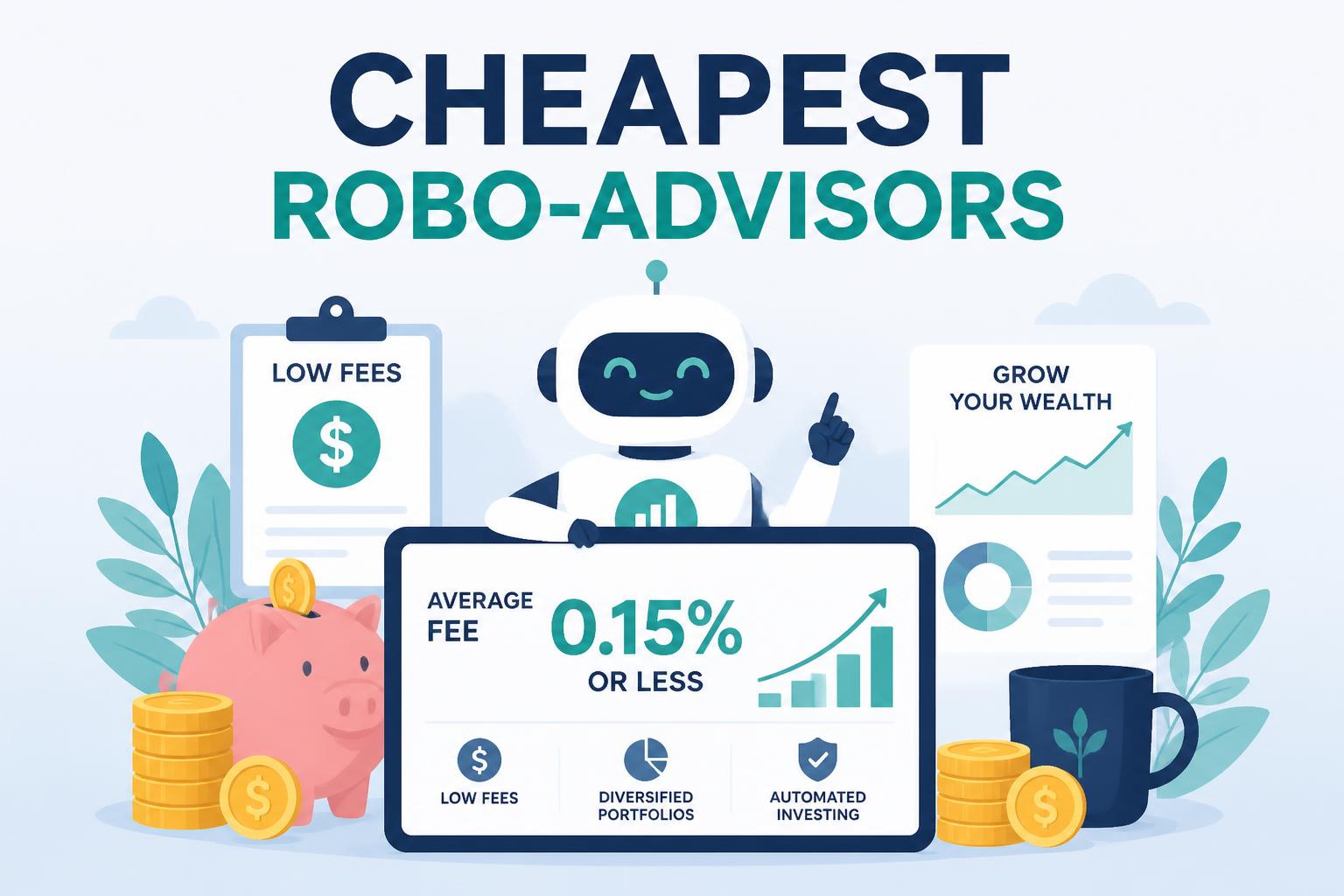
Robo-advisors can make investing fairly hands-off, especially if you don’t want to manage portfolios yourself. The tricky part is that “low fee” doesn’t always mean what it seems. Advisory charges, ETF expense ratios, and minimum balance rules can quietly change the real cost.
This guide looks at some of the cheapest options in 2026, focusing on total cost, transparency, portfolio design, and how easy they are to actually use day to day. Platforms like Betterment, Wealthfront, Schwab Intelligent Portfolios, along with newer low-cost options like SoFi and M1 Finance, all show up here.
—
At a glance
Robo-advisor Best for Starting cost Free plan M1 Finance Low-cost flexible investing $0 Yes SoFi Automated Investing Simple beginner setup $0 Yes Fidelity Go Straightforward retirement investing $0 (under threshold) Limited Schwab Intelligent Portfolios No advisory fee option $5,000 min Yes Vanguard Digital Advisor Long-term index investing $100 No Wealthfront Tax optimization tools $500 No Betterment Balanced automated portfolios $0 No
How the selection was made
The focus here is on total cost rather than just the headline advisory fee. That includes:
- Advisory fees plus fund expense ratios
- Minimum deposit requirements
- Tax-loss harvesting features
- Portfolio diversification
- Automation quality (rebalancing, goal tracking)
- Ease of use
- Fee transparency
A platform that looks free can still cost more once ETF expenses or constraints are included.
—
1. M1 Finance — lowest cost with flexibility
M1 Finance is one of the few platforms that offers automated investing without charging a management fee on standard accounts. It sits somewhere between a robo-advisor and a self-directed broker.
You build a portfolio using “pies,” which are collections of ETFs and stocks. Once set, the system keeps everything balanced automatically.
Key features
- No advisory fee on basic accounts
- Fractional shares for full allocation
- Automatic rebalancing
- Custom portfolio “pies”
- Optional borrowing features
Pricing
| Tier | Cost |
|---|---|
| Basic | $0 |
| Plus | About $3/month |
What stands out
- Very low ongoing cost
- More control than most robo-advisors
- No minimum balance
Tradeoffs
- Not the easiest for beginners
- Tax-loss harvesting is limited compared to others
- Interface takes some getting used to
Best suited for people who want automation but still like shaping their own portfolio.
—
2. SoFi Automated Investing — simple and free
SoFi offers one of the most accessible entry points into automated investing. The appeal is straightforward: no advisory fees and a very simple setup.
Key features
- Automated ETF portfolios
- No management fees
- Fractional shares
- Basic socially responsible options
Pricing
- Advisory fee: $0
Strengths
- Easy to start
- Clean mobile experience
- No minimum deposit barrier
Limitations
- Limited tax optimization
- Less control over portfolio design
- Fewer advanced features
This tends to work best for people who just want something simple running in the background.
—
3. Fidelity Go — simple retirement focus
Fidelity Go is designed around simplicity and retirement saving. It’s tightly integrated with the broader Fidelity ecosystem, which helps if you already use their brokerage.
Key features
- Professionally managed portfolios
- Automatic rebalancing
- Integrated retirement planning
Pricing
| Balance | Cost |
|---|---|
| Under $25k | $0 |
| Above $25k | ~0.35% |
Strengths
- Strong institutional backing
- Very simple setup
- No cost for smaller balances
Limitations
- Limited customization
- Fewer tax strategies
- Fees rise with larger accounts
—
4. Schwab Intelligent Portfolios — no advisory fee, but with cash drag
Schwab Intelligent Portfolios is unusual because it charges no advisory fee at the basic level. Instead, it requires holding a portion of the portfolio in cash.
Key features
- No advisory fee (basic tier)
- Automatic rebalancing
- Diversified ETF portfolios
- Optional premium tier with advisor access
Pricing
- Basic: $0 advisory fee
- Premium: 0.80% annually
Strengths
- Backed by a major brokerage
- Simple and stable structure
- No advisory cost at entry level
Drawbacks
- Required cash allocation can reduce growth
- Higher minimum investment ($5,000)
- Premium tier becomes expensive
—
5. Vanguard Digital Advisor — built for long-term index investing
Vanguard Digital Advisor leans heavily on low-cost index funds and long-term investing discipline.
Key features
- Automated ETF portfolios
- Goal-based investing tools
- Rebalancing
Pricing
- Around 0.20% advisory fee
Strengths
- Very low fund expense ratios
- Strong long-term track record philosophy
- Simple, hands-off structure
Limitations
- Small minimum investment ($100)
- Not very customizable
- Basic interface compared to competitors
—
6. Wealthfront — strong tax optimization
Wealthfront is often chosen for its tax-loss harvesting and planning tools rather than pure cost.
Key features
- Daily tax-loss harvesting
- Automated rebalancing
- Financial planning tools
- Cash account integration
Pricing
- 0.25% annual fee
Strengths
- Strong tax optimization system
- Solid automation
- Helpful planning features
Limitations
- Not free
- $500 minimum deposit
- Less customization than hybrid platforms
—
7. Betterment — balanced all-in-one experience
Betterment is one of the most polished robo-advisors, especially for people who want something straightforward.
Key features
- Automated rebalancing
- Tax-loss harvesting
- Goal-based investing
- Multiple account types
Pricing
- Digital: 0.25%
- Premium: 0.40%
Strengths
- Very smooth user experience
- Strong automation tools
- Reliable long-term approach
Limitations
- No free tier
- Higher fees than ultra-low-cost competitors
- Limited customization
—
Comparison snapshot
Platform Fee Minimum Tax-loss harvesting Customization M1 Finance $0 $0 Limited High SoFi $0 $0 No Low Fidelity Go $0–0.35% $0 No Low Schwab $0 $5,000 Premium only Low Vanguard ~0.20% $100 No Low Wealthfront 0.25% $500 Strong Medium Betterment 0.25% $0 Strong Medium
How to think about choosing one
If cost is the only concern, the decision is simple. In practice, most people end up balancing cost with convenience.
- Lowest cost with flexibility: M1 Finance
- Simple free setup: SoFi
- Big brokerage, no advisory fee: Schwab Intelligent Portfolios
- Long-term index focus: Vanguard Digital Advisor
- Tax optimization focus: Wealthfront
- Polished all-in-one experience: Betterment
A lot of investors start with a free or low-cost option, then move later if their needs change.
—
FAQ
What is the cheapest robo-advisor?
M1 Finance and SoFi are the lowest-cost options since both have $0 advisory fees.Are robo-advisors worth it?
They can be useful if you prefer automated investing and don’t want to manage portfolios manually.Which robo-advisor has no fees?
SoFi and Schwab’s basic tier both have $0 advisory fees, though other costs may still apply depending on portfolio structure.Is Betterment better than Wealthfront?
Betterment is generally simpler to use. Wealthfront tends to be stronger on tax optimization.Can you lose money with robo-advisors?
Yes. They invest in markets, so returns go up and down like any other investment.—
Final note
If the goal is minimizing cost, M1 Finance is usually the most straightforward starting point. If you prefer something simpler with no setup complexity, SoFi is often enough on its own.
Neither is “perfect” for everyone, and most people end up adjusting as their portfolio grows.