Best Brokerage Accounts 2026: Your Complete Guide to Choosing the Right Platform
Choosing a brokerage account shouldn’t feel like navigating a minefield of hidden fees, confusing platforms, and endless options. Yet millions of investors waste thousands of dollars annually on high-cost brokers or struggle with platforms that don’t match their investing style. Whether you’re starting your first investment journey or looking to switch from an outdated broker, this guide cuts through the noise to help you find the best brokerage accounts for your specific needs.
Why Your Brokerage Account Choice Matters More Than Ever
The brokerage landscape has transformed dramatically. Commission-free trading has become standard, but that doesn’t mean all platforms are created equal. Hidden costs lurk in spreads, margin rates, fund expense ratios, and account fees. The wrong choice can cost you thousands over time—or worse, prevent you from executing your investment strategy effectively.
The real cost of choosing poorly:
- Missing out on compound growth due to high fees
- Limited investment options that restrict your portfolio diversification
- Poor execution quality that shaves returns off every trade
- Inadequate research tools leading to uninformed decisions
- Frustrating user experiences that discourage consistent investing
What Makes a Brokerage Account “Best” in 2026
Before diving into specific recommendations, understand that the best brokerage account depends on your investor profile. A day trader needs different features than a buy-and-hold index fund investor. Here’s what matters:
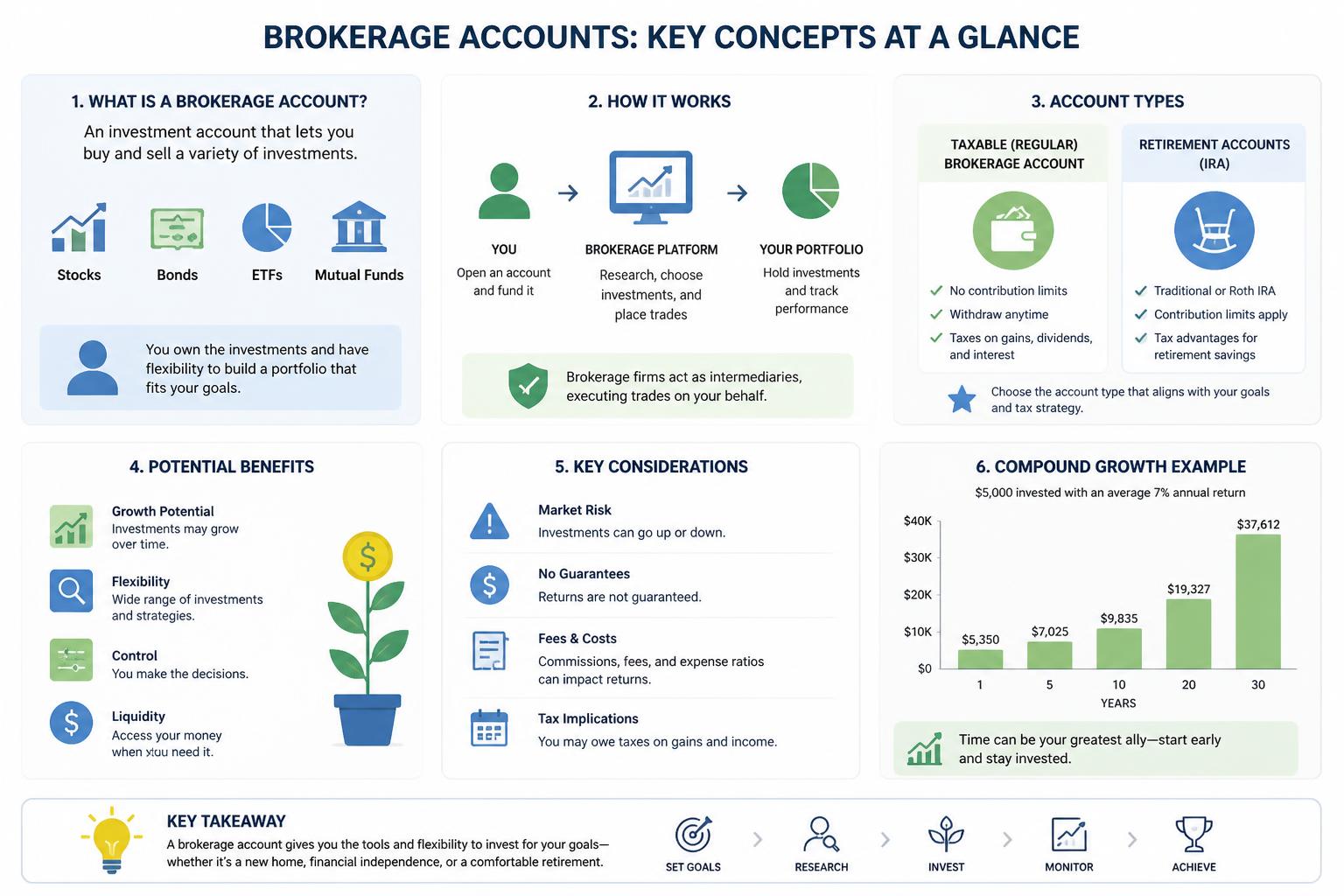
Key Evaluation Criteria
Cost Structure: While most brokers offer $0 commissions on stocks and ETFs, scrutinize mutual fund fees, options contracts, margin rates, and foreign transaction fees. Small percentage differences compound significantly over decades.
Investment Selection: Can you access the assets you want? International stocks, cryptocurrency, fractional shares, IPOs, bonds, and alternative investments vary widely by platform.
Platform Quality: An intuitive interface matters whether you’re on desktop, mobile, or tablet. Complex platforms create barriers; overly simple ones may lack essential features.
Research and Tools: Quality analysis tools, real-time data, screening capabilities, and educational resources separate adequate brokers from exceptional ones.
Customer Service: When issues arise—and they will—responsive, knowledgeable support makes the difference between a minor inconvenience and a major problem.
Account Protection: SIPC insurance is standard, but additional coverage and security features provide peace of mind.
Top Brokerage Accounts for Different Investor Types
Best Overall: Fidelity
Fidelity strikes the optimal balance for most investors, combining zero commissions, extensive investment options, excellent research tools, and outstanding customer service.
Standout features:
- No account minimums or maintenance fees
- Exceptional fractional share trading on stocks and ETFs
- Industry-leading mutual fund selection with thousands of no-transaction-fee options
- Robust research from 20+ providers
- Top-tier mobile and desktop platforms
- 24/7 phone support with knowledgeable representatives
Ideal for: Long-term investors, retirement savers, and those wanting a comprehensive platform without compromises.
Considerations: Options trading interface could be more advanced for active traders.
Best for Beginners: Charles Schwab
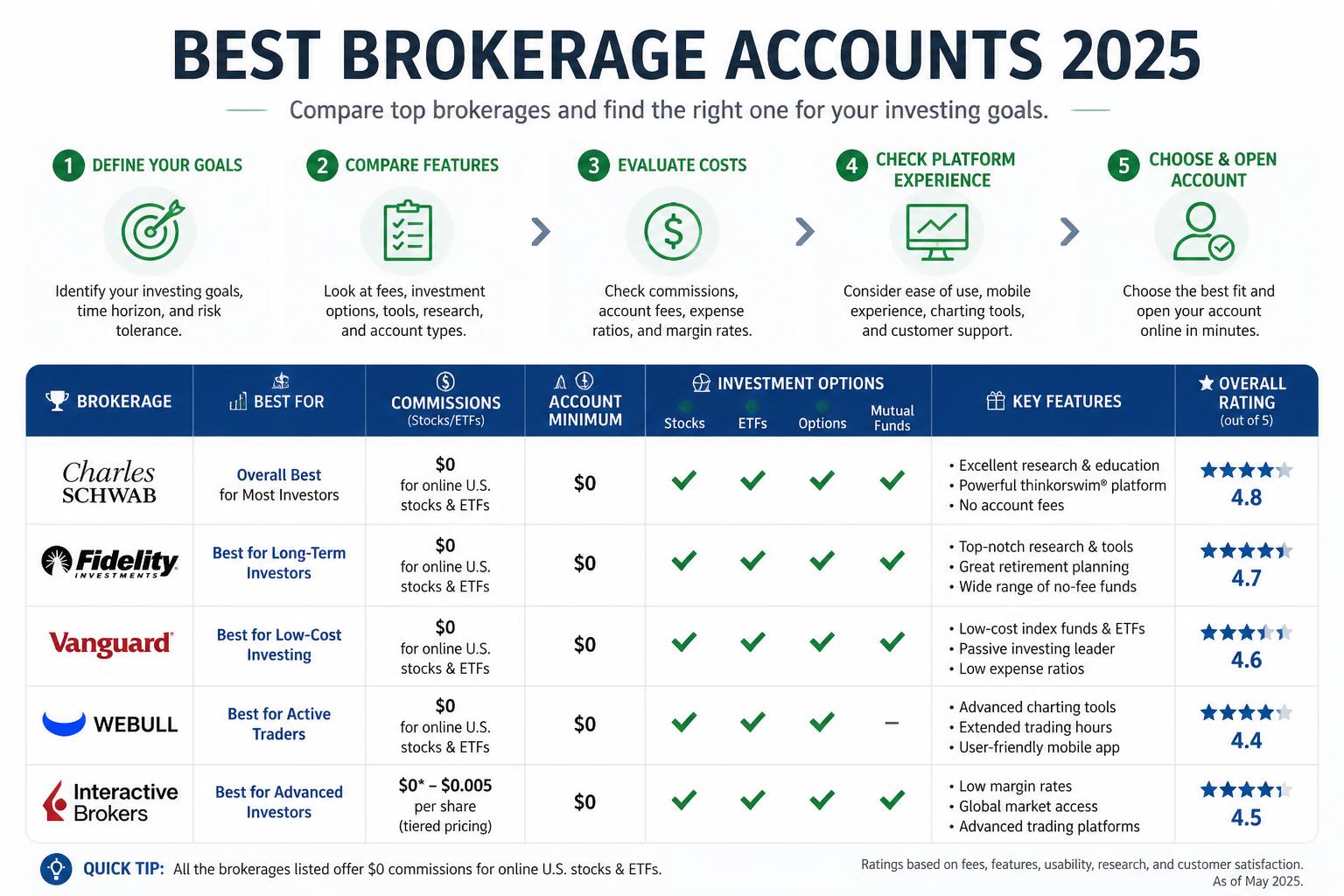
Schwab excels at making investing approachable without sacrificing sophistication as you grow.
Standout features:
- Intuitive platform design that doesn’t overwhelm
- Extensive educational content and in-person branch support
- Excellent checking account integration with ATM fee rebates worldwide
- Schwab Intelligent Portfolios offers free robo-advisory
- Strong customer service culture
- No account minimums
Ideal for: New investors wanting education and support, those who value in-person service, and investors seeking banking integration.
Considerations: Mutual fund selection narrower than Fidelity.
Best for Active Traders: Interactive Brokers
For traders executing frequent transactions or using advanced strategies, Interactive Brokers offers institutional-grade capabilities at retail prices.
Standout features:
- Lowest margin rates in the industry (currently 5.83% for balances over $100k)
- Access to 150+ markets globally
- Advanced order types and sophisticated trading tools
- Excellent for currency trading and international investing
- Very competitive options and futures pricing
- Best execution quality
Ideal for: Active traders, sophisticated investors, international traders, and those using margin extensively.
Considerations: Steeper learning curve; platform complexity overwhelming for casual investors. Inactivity fees apply for accounts under $100k with low trading activity.
Best for Options Trading: Tastyworks
Built by options traders for options traders, Tastyworks prioritizes derivatives trading above all else.
Standout features:
- Capped options commissions ($10 maximum per leg)
- Free to close options positions
- Exceptional options-focused education and analysis tools
- Clean, trader-focused interface
- Strong probability-based analysis features
- Active trading community
Ideal for: Options-focused traders, sellers of premium, and those learning options strategies.
Considerations: Limited for stock-focused investing; fewer research tools for fundamental analysis.
Best for Retirement Accounts: Vanguard
For long-term, passive investors focused on retirement, Vanguard’s low-cost index fund heritage makes it unbeatable.
Standout features:
- Lowest-cost index funds and ETFs in the industry
- Excellent retirement planning tools
- Strong reputation and financial stability
- No conflicts of interest (owned by fund shareholders)
- Robust target-date fund offerings
Ideal for: Buy-and-hold index investors, retirement savers, and those prioritizing rock-bottom costs.
Considerations: Platform feels dated; limited trading tools and slower execution. Not suitable for active traders.
Best for Mobile Investing: Robinhood
Despite past controversies, Robinhood pioneered mobile-first investing and continues leading in user experience.
Standout features:
- Best mobile app design in the industry
- Intuitive interface encourages consistent investing
- Fractional shares on most stocks
- Cryptocurrency trading integrated
- 1% match on IRA contributions (up to $200/year)
- Instant deposit availability
Ideal for: Mobile-first investors, cryptocurrency enthusiasts, and those wanting simplicity.
Considerations: Limited research tools; customer service historically weak; less suitable for complex portfolios.
Understanding Hidden Costs That Erode Returns
Zero-commission trading doesn’t mean zero costs. Here’s where brokers still extract fees:
Payment for Order Flow: Brokers routing your orders to market makers receive rebates. While controversial, this practice enables commission-free trading. Quality brokers ensure this doesn’t compromise execution quality.
Margin Interest: Borrowing to invest costs significantly more at some brokers than others. Interactive Brokers charges 5.83% for large balances while some brokers exceed 10%.
Fund Expense Ratios: Even at brokers with extensive no-transaction-fee mutual funds, the funds themselves charge expense ratios. A 0.50% difference in expense ratio costs $5,000 on a $1 million portfolio annually.
Currency Conversion: Trading international securities often involves 1-2% currency conversion spreads—a massive hidden cost.
Options Contracts: Per-contract fees range from $0.50 to $0.65 at most brokers. For active options traders, this adds up quickly.
Account Transfer and Wire Fees: Moving money in and out can cost $50-75 per transfer at some brokers.
How to Choose Your Best Brokerage Account
Follow this decision framework:
Step 1: Define Your Investment Approach
- Are you buying and holding index funds for decades?
- Do you actively trade stocks or options?
- Will you use margin or advanced strategies?
- Do you need international market access?
Step 2: Calculate Your Real Costs
Don’t focus solely on commission-free stocks. Calculate total costs based on your actual trading patterns, including margin usage, options contracts, and fund expenses.
Step 3: Test Platform Usability
Most brokers offer paper trading accounts. Test the platform before funding it. Can you execute your strategies efficiently? Is the research adequate?
Step 4: Evaluate Your Need for Support
Value self-sufficiency? A streamlined platform works. Prefer guidance? Prioritize educational resources and accessible customer service.
Step 5: Consider Your Growth Path
Your needs will evolve. Choose a platform that scales with increasing sophistication rather than requiring you to switch brokers later.
Special Considerations for Different Account Types
Retirement Accounts (IRAs, 401(k) Rollovers)
Prioritize:
- Low-cost index funds and target-date funds
- Robust retirement planning calculators
- Easy beneficiary management
- Required Minimum Distribution (RMD) support
- Strong track record and financial stability
Top choices: Vanguard, Fidelity, Schwab
Taxable Brokerage Accounts
Prioritize:
- Tax-loss harvesting capabilities
- Tax-efficient fund options
- Quality tax reporting and documentation
- Access to municipal bonds and tax-advantaged investments
Top choices: Fidelity, Interactive Brokers, Schwab
Joint and Custodial Accounts
Prioritize:
- Clear beneficiary and ownership documentation
- Educational resources for teaching investing
- Fractional shares for smaller accounts
- Gifting capabilities
Top choices: Fidelity, Schwab, Vanguard
Common Brokerage Account Mistakes to Avoid
Chasing Promotions Over Quality: Signup bonuses might offer a few hundred dollars, but choosing the wrong long-term platform costs far more in fees, poor execution, and missed opportunities.
Overvaluing Flashy Features: Real-time news feeds and advanced charting look impressive but matter little if you’re a long-term index investor. Match features to your actual strategy.
Ignoring Customer Service Until You Need It: You won’t care about customer service quality until you desperately need help. By then, it’s too late to switch easily.
Spreading Accounts Too Thin: Managing multiple brokerage accounts creates administrative burden and prevents you from reaching balance tiers that unlock better pricing or features.
Neglecting Security: Using weak passwords or ignoring two-factor authentication puts your wealth at risk. Treat brokerage security as seriously as bank security.
Making the Switch: How to Transfer Brokers Painlessly
Chosen a new broker? Here’s how to transfer without selling your positions (which would trigger taxes):
- Open your new account first and ensure it’s fully approved
- Initiate an ACATS transfer from the receiving broker (not the old one)
- Provide your old account statement showing positions and account number
- Wait 5-7 business days for the transfer to complete
- Verify all positions transferred correctly and cost basis carried over
- Request reimbursement for any transfer fees from your new broker (many offer this)
Pro tip: Keep small balances in your old account during transfer to avoid margin calls if you’re using borrowed funds.
The Bottom Line on Best Brokerage Accounts
The best brokerage account for you depends entirely on your investing approach, experience level, and specific needs. For most investors, Fidelity offers the optimal combination of low costs, extensive options, and quality tools without significant compromises.
However, specialized needs may point elsewhere:
- Beginners: Charles Schwab’s education and support
- Active traders: Interactive Brokers’ advanced tools and low margin rates
- Options enthusiasts: Tastyworks’ trader-centric platform
- Passive indexers: Vanguard’s rock-bottom fund costs
- Mobile-first investors: Robinhood’s superior app experience
The critical insight: Don’t let decision paralysis keep you from investing. While choosing the optimal broker matters, starting to invest consistently matters far more. Most major brokers now offer solid core functionality at minimal cost. Pick one aligned with your needs, start investing, and switch later if necessary—your positions can transfer without triggering taxes.
Focus less on finding the single perfect broker and more on beginning your investment journey. The best brokerage account is ultimately the one you’ll actually use to build long-term wealth.