Best Index Funds & ETFs for Beginners: A Complete Guide to Smart, Low-Cost Investing
Picking the right index funds and ETFs feels overwhelming when you’re starting out. With thousands of options available, how do you know which ones offer the best returns without overpaying in fees or wasting hours researching every detail?
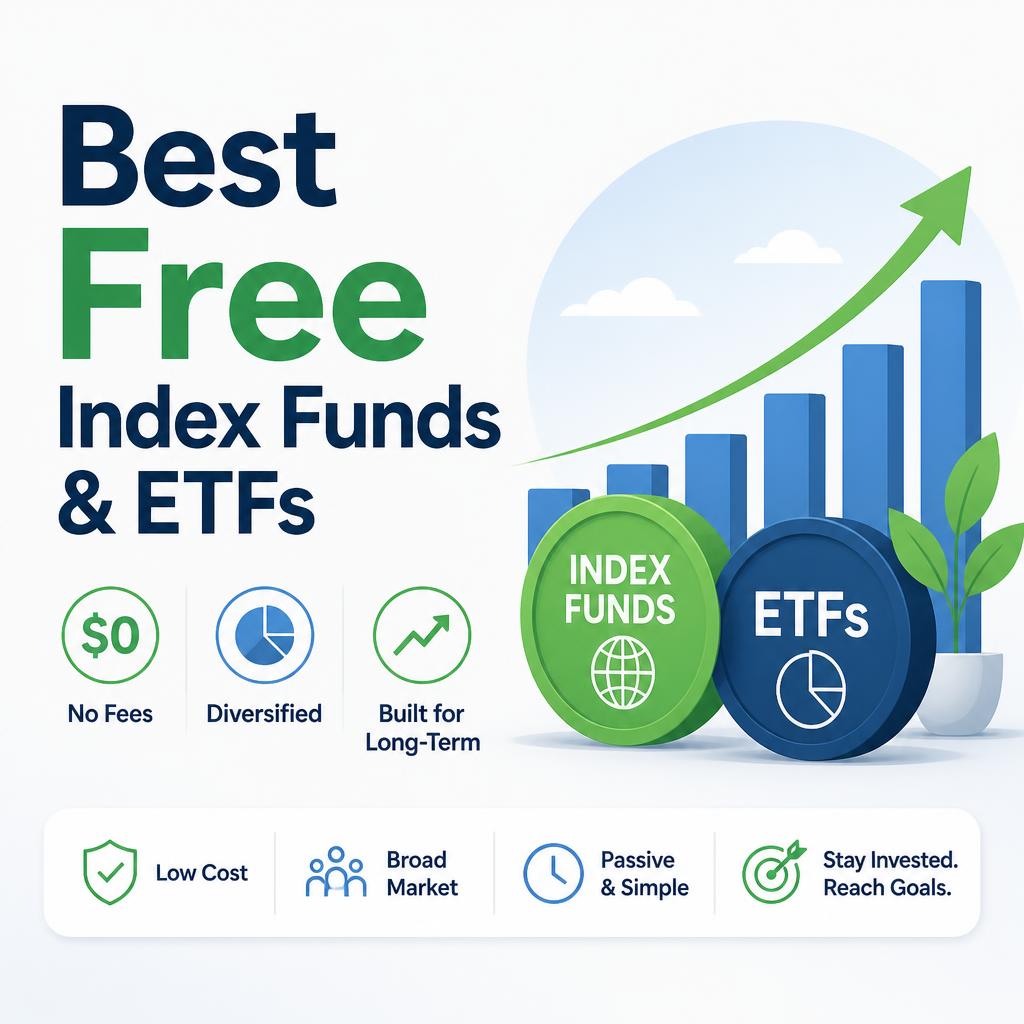
The truth is, most beginners overcomplicate this decision. The best index funds and ETFs share a few simple characteristics: broad market exposure, rock-bottom fees, and solid liquidity. This guide cuts through the noise to show you exactly what to look for and which funds consistently deliver for long-term investors.
What Are Index Funds and ETFs?
Before diving into specific recommendations, let’s clarify what you’re actually buying.
Index funds are mutual funds that track a specific market index, like the S&P 500 or the total U.S. stock market. When you invest in an index fund, you’re buying a small piece of every company in that index. You typically buy shares directly from the fund company at the end of each trading day at the net asset value (NAV).
ETFs (Exchange-Traded Funds) work similarly but trade on stock exchanges throughout the day like individual stocks. This gives you more flexibility in timing your purchases, though for long-term investors, this rarely matters.
Both options offer instant diversification and low costs compared to actively managed funds. The key difference? ETFs often have slightly lower expense ratios and no minimum investment requirements, while index funds may require $1,000-$3,000 to start but allow automatic investments more easily.
Why Index Funds and ETFs Beat Stock Picking for Beginners
The data is clear: over 90% of actively managed funds fail to beat their benchmark index over 15-year periods. Even professional fund managers with teams of analysts struggle to consistently outperform simple index tracking.
Here’s why index funds and ETFs make sense when you’re starting out:
Lower costs mean more money stays invested. The average actively managed fund charges 0.60-1.00% annually. A broad market index fund or ETF? Often 0.03-0.20%. That difference compounds dramatically over decades.
Instant diversification reduces risk. Instead of betting on individual companies, you own hundreds or thousands of stocks in one purchase. If one company fails, it barely affects your portfolio.
Less time wasted on research. You don’t need to analyze earnings reports, follow market news obsessively, or time your trades. Buy regularly, hold long-term, and let compound growth work.
Tax efficiency. ETFs especially are structured to minimize taxable events, and you only pay capital gains when you sell. Index funds with low turnover also generate fewer taxable distributions than actively managed funds.
What Makes an Index Fund or ETF “Best” for Beginners?
Not all index funds and ETFs are created equal. Focus on these criteria:
Expense ratio under 0.20%. This is the annual fee expressed as a percentage of your investment. The lower, the better. Many top funds charge 0.03-0.04%.
Broad market exposure. For beginners, funds tracking the total U.S. stock market or the S&P 500 provide better diversification than sector-specific or niche index funds.
High liquidity and trading volume. For ETFs, average daily trading volume above 1 million shares ensures you can buy or sell easily without price impact. For index funds, this isn’t a concern.
Assets under management (AUM) above $1 billion. Larger funds are less likely to close or merge, and they often have the lowest fees due to economies of scale.
Tracking error below 0.10%. This measures how closely the fund follows its index. Lower is better—you want your fund to mirror the index, not lag behind it.
The Best Index Funds for Beginners
Vanguard Total Stock Market Index Fund (VTSAX)
Expense ratio: 0.04%
Minimum investment: $3,000
What it tracks: CRSP U.S. Total Market Index (about 4,000 stocks)
This fund owns virtually every publicly traded U.S. company, from mega-cap tech giants to small-cap growth stocks. It’s the gold standard for one-fund simplicity. If you’re using a best brokerage account for beginners and can meet the minimum, this is hard to beat.
Best for: Investors who want maximum U.S. stock market exposure in one fund and plan to hold long-term.
Fidelity 500 Index Fund (FXAIX)
Expense ratio: 0.015%
Minimum investment: $0
What it tracks: S&P 500
Fidelity’s S&P 500 index fund has one of the lowest expense ratios available and no minimum investment requirement. The S&P 500 focuses on large-cap U.S. companies, which means you miss out on small and mid-cap exposure compared to total market funds, but you still capture about 80% of U.S. market value.
Best for: Beginners who want to start investing immediately without meeting a minimum and are comfortable with large-cap focus.
Schwab Total Stock Market Index Fund (SWTSX)
Expense ratio: 0.03%
Minimum investment: $0
What it tracks: Dow Jones U.S. Total Stock Market Index
Similar coverage to VTSAX but with no minimum investment. If you’re already using Schwab as your best brokerage account, this is an excellent choice for building a diversified portfolio from your first dollar.
Best for: Schwab customers who want total market exposure without a high minimum investment barrier.
The Best ETFs for Beginners
Vanguard Total Stock Market ETF (VTI)
Expense ratio: 0.03%
What it tracks: CRSP U.S. Total Market Index
The ETF version of VTSAX, with an even lower expense ratio and no minimum investment. VTI trades throughout the day and is perfect if you’re investing smaller amounts regularly or want more flexibility than mutual funds offer.
Best for: Investors who want total U.S. market exposure with maximum flexibility and the lowest possible costs.
Vanguard S&P 500 ETF (VOO)
Expense ratio: 0.03%
What it tracks: S&P 500
Tracks the 500 largest U.S. companies. VOO competes directly with SPY (the original S&P 500 ETF) but has a significantly lower expense ratio. Over decades, that small difference adds up to thousands of dollars saved.
Best for: Beginners who want large-cap U.S. stock exposure with rock-bottom fees.
Schwab U.S. Broad Market ETF (SCHB)
Expense ratio: 0.03%
What it tracks: Dow Jones U.S. Broad Stock Market Index
Nearly identical coverage to VTI but through Schwab. The performance difference is negligible—choose based on which brokerage you prefer.
Best for: Schwab users who want total market exposure in ETF format.
iShares Core S&P Total U.S. Stock Market ETF (ITOT)
Expense ratio: 0.03%
What it tracks: S&P Total Market Index
Another excellent total market option with broad exposure and ultra-low costs. The main difference from VTI is the specific index tracked, but in practice, performance is nearly identical.
Best for: Investors who want total market exposure and prefer BlackBerry’s iShares family of funds.
Adding International Exposure
While U.S. stocks have historically delivered strong returns, geographic diversification reduces risk. Most experts recommend allocating 20-40% of your stock portfolio to international markets.
Vanguard Total International Stock Index Fund (VTIAX)
Expense ratio: 0.11%
Minimum investment: $3,000
What it tracks: FTSE Global All Cap ex US Index
Covers developed and emerging markets outside the U.S.—about 8,000 stocks across Europe, Asia, Latin America, and more.
Vanguard Total International Stock ETF (VXUS)
Expense ratio: 0.07%
What it tracks: FTSE Global All Cap ex US Index
The ETF version of VTIAX with a lower expense ratio and no minimum investment. Pair this with VTI and you own the entire global stock market in two funds.
Building Your Portfolio: Simple Combinations That Work
You don’t need a complicated portfolio to succeed. Here are three proven approaches:
The Two-Fund Portfolio
- 70% VTI (or VTSAX) — Total U.S. stock market
- 30% VXUS (or VTIAX) — Total international stock market
This captures the entire global stock market. Adjust the ratio based on your preference for U.S. vs. international exposure.
The Three-Fund Portfolio
- 60% VTI (or VTSAX) — Total U.S. stock market
- 30% VXUS (or VTIAX) — Total international stock market
- 10% BND or VBTLX — Total U.S. bond market
Adding bonds reduces volatility, making this suitable for those within 10-15 years of retirement or anyone uncomfortable with 100% stocks.
The One-Fund Solution
- 100% VT (Vanguard Total World Stock ETF) — Covers U.S. and international stocks in one fund
The simplest option. You own the global stock market automatically weighted by market cap. The expense ratio (0.07%) is slightly higher than holding VTI and VXUS separately, but you gain maximum simplicity.
Common Mistakes to Avoid
Chasing past performance. Last year’s top-performing sector fund rarely repeats. Stick with broad market exposure instead of jumping between hot sectors.
Overcomplicating with too many funds. Owning 10 different index funds doesn’t improve diversification if they all track similar markets. Three funds or fewer is usually sufficient.
Ignoring expense ratios. A 0.50% expense ratio vs. 0.03% might seem small, but on a $100,000 portfolio over 30 years, that’s roughly $50,000 in lost returns due to higher fees.
Panic selling during downturns. Market crashes are when index funds go on sale. If you’re investing for 10+ years, downturns are buying opportunities, not selling signals.
Forgetting about tax-advantaged accounts. Prioritize investing through retirement accounts like IRAs and 401(k)s before taxable brokerage accounts. The tax benefits dramatically accelerate wealth building.
Where to Buy Index Funds and ETFs
The brokerage you choose matters less than it used to—most major platforms now offer commission-free trading and access to top index funds. Focus on these factors:
No transaction fees for the funds you want. Vanguard funds are free to trade at Vanguard, Fidelity funds at Fidelity, etc. Most brokers now offer commission-free ETF trading.
Low or no account minimums. Some brokers require $0 to open an account, others $500-1,000.
User-friendly platform. If you’re a beginner, prioritize simplicity over advanced trading features you won’t use.
Good customer service. When you have questions about dividend investing or portfolio allocation, responsive support helps.
Top choices include Vanguard, Fidelity, Schwab, and Interactive Brokers. Compare them in detail in our guide to best brokerage accounts.
How Much Should You Invest?
Start with whatever you can afford consistently. Investing $100/month beats waiting until you have $10,000 saved. The market rewards time invested more than timing the market.
Build an emergency fund first. Before investing significantly, save 3-6 months of expenses in a high-yield savings account. This prevents forced selling during emergencies.
Contribute enough to get employer 401(k) match. If your employer matches contributions, prioritize this—it’s an instant 50-100% return on your money.
Increase contributions with raises. When you get a raise, increase your investment contributions by at least half the raise amount. You’ll barely notice the difference in take-home pay, but your portfolio will grow faster.
Dollar-cost average during market highs. If you have a lump sum to invest during an expensive market, consider spreading purchases over 6-12 months to reduce timing risk.
Monitoring and Rebalancing Your Portfolio
Once invested, resist the urge to check your portfolio daily. Quarterly or annual reviews are sufficient.
Rebalance once per year. If your target is 70% U.S. stocks and 30% international, but growth shifts it to 75/25, sell some U.S. and buy international to restore the balance. This forces you to sell high and buy low.
Don’t react to short-term volatility. The stock market drops 10% or more about once per year on average. These corrections are normal and temporary for long-term investors.
Stay the course. The biggest returns come from simply holding quality index funds and ETFs through market cycles, not from trying to outsmart the market.
Final Thoughts: Simplicity Wins
The best index funds and ETFs for beginners aren’t exotic or complicated. They’re boring, low-cost funds that track broad markets and compound reliably over decades.
You don’t need perfect timing or expert knowledge. You need a simple plan, consistent contributions, and the discipline to stick with it during inevitable downturns.
Start with a total market index fund or ETF, add international exposure if desired, and contribute regularly. That approach has created more wealth for average investors than any stock-picking strategy ever has.
The sooner you start, the more time compound growth has to work in your favor. Pick one or two funds from this list, open an account, and make your first investment today.
—
Affiliate Disclosure: We may earn a commission from some of the products mentioned in this article.