Best Retirement Accounts: IRA vs 401(k) Guide for 2025
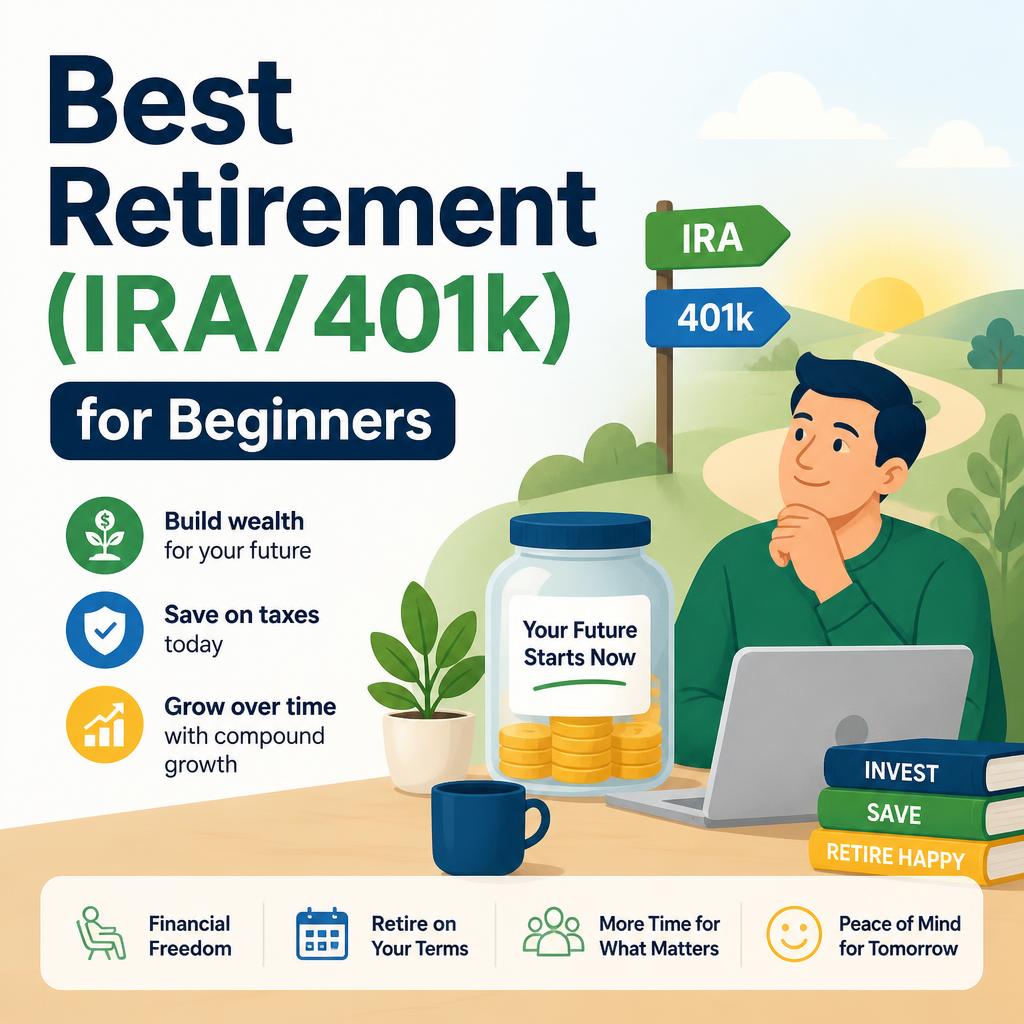
Choosing the right retirement account shouldn’t feel like deciphering a foreign language. Whether you’re just starting your career or playing catch-up on retirement savings, understanding the difference between IRAs and 401(k)s—and which one works best for your situation—can save you thousands in taxes and fees while maximizing your nest egg.
Understanding Your Retirement Account Options
Retirement accounts come in several flavors, but IRAs and 401(k)s are the workhorses of retirement planning. Each has distinct advantages depending on your employment situation, income level, and retirement timeline.
What Is a 401(k)?
A 401(k) is an employer-sponsored retirement plan that lets you contribute pre-tax dollars directly from your paycheck. Many employers sweeten the deal with matching contributions—essentially free money that can significantly accelerate your retirement savings.
Key 401(k) Features:
– 2025 contribution limit: $23,000 ($30,500 if you’re 50 or older)
– Employer matching (varies by company)
– Limited investment options chosen by your employer
– Loans may be available in emergencies
– Required minimum distributions (RMDs) start at age 73
What Is an IRA?
An Individual Retirement Account (IRA) is a retirement account you open independently, giving you complete control over investment choices and provider selection. IRAs come in two main varieties: Traditional and Roth.
Key IRA Features:
– 2025 contribution limit: $7,000 ($8,000 if you’re 50 or older)
– Complete investment flexibility
– Choose from thousands of providers
– No employer required
– Multiple IRA types with different tax treatments
Traditional vs Roth: The Tax Question
The biggest decision you’ll face is whether to pay taxes now or later. This choice fundamentally shapes your retirement strategy.
Traditional Accounts (Pay Taxes Later)
Traditional 401(k)s and IRAs give you an upfront tax deduction. Your contributions reduce your taxable income today, but you’ll pay ordinary income tax on withdrawals in retirement.
Best for:
– High earners in peak earning years
– Those expecting lower tax brackets in retirement
– People who need immediate tax relief
– Anyone prioritizing maximum current-year contributions
Example: If you’re in the 24% tax bracket and contribute $10,000 to a traditional 401(k), you save $2,400 in taxes this year. That $10,000 grows tax-deferred, but withdrawals in retirement are taxed as ordinary income.
Roth Accounts (Pay Taxes Now)
Roth 401(k)s and Roth IRAs flip the script. You contribute after-tax dollars, but all future growth and withdrawals are completely tax-free in retirement.
Best for:
– Young professionals early in their careers
– Those expecting higher tax brackets later
– People who want tax-free retirement income
– Anyone seeking tax diversification
Example: Contributing $10,000 to a Roth IRA doesn’t reduce your taxes today, but if it grows to $100,000 over 30 years, you can withdraw every penny tax-free.
The Best 401(k) Plans: What to Look For
Not all 401(k) plans are created equal. Here’s what separates the best from the rest.
Employer Match: The First Priority
If your employer offers matching contributions, contribute at least enough to capture the full match. This is an immediate 50-100% return on your investment—impossible to beat anywhere else.
Common matching formulas:
– 50% match up to 6% of salary (you contribute 6%, they add 3%)
– Dollar-for-dollar match up to 3-4% of salary
– Tiered matching (100% on first 3%, 50% on next 2%)
Low-Cost Investment Options
High fees silently erode returns over decades. Look for plans offering:
– Index funds with expense ratios under 0.20%
– Target-date funds with all-in costs below 0.50%
– Access to best index funds and ETFs covering major asset classes
A seemingly small 1% fee difference costs you hundreds of thousands over a 40-year career.
Plan Features That Matter
Automatic features:
– Auto-enrollment (starts saving for you)
– Auto-escalation (increases contributions annually)
– Roth 401(k) option for tax diversification
Flexibility features:
– Low-cost loan provisions
– In-service rollovers to IRAs
– Self-directed brokerage window for advanced investors
The Best IRA Providers for 2025
IRAs offer freedom to choose your provider and investments. Top providers distinguish themselves through low costs, excellent platforms, and robust investment selections.
Vanguard: Best for Index Fund Investors
Vanguard pioneered low-cost index investing and remains the gold standard for buy-and-hold investors.
Strengths:
– Rock-bottom expense ratios on index funds
– Excellent target-date retirement funds
– No account fees with electronic statements
– $1,000 minimum for most mutual funds
Best for: Passive investors who want to set it and forget it with index funds.
Fidelity: Best All-Around Platform
Fidelity combines zero-fee index funds, excellent tools, and top-tier customer service.
Strengths:
– Zero expense ratio index funds (FZROX, FZILX)
– No minimum investment requirements
– Exceptional mobile app and research tools
– Fractional share trading
Best for: Investors who want flexibility without sacrificing low costs.
Charles Schwab: Best for Active Traders
Schwab offers comprehensive tools for investors who want more control and trading capabilities.
Strengths:
– Robust trading platform
– Excellent research and education
– No account minimums or fees
– Strong brokerage account integration
Best for: Investors comfortable building and managing their own portfolios.
Wealthfront: Best Robo-Advisor Option
Automated investing platforms handle portfolio management for hands-off investors.
Strengths:
– Automated rebalancing and tax-loss harvesting
– Low 0.25% annual advisory fee
– $500 minimum to start
– Smart beta and socially responsible options
Best for: Beginners who want professional management without hiring a financial advisor.
Strategic Considerations: Optimizing Your Retirement Mix
The best retirement strategy often involves using multiple account types strategically.
The Power of Employer Match First
Priority 1: Contribute enough to your 401(k) to capture the full employer match. This guaranteed return beats every other investment.
Priority 2: Max out an IRA for investment flexibility and potentially lower fees.
Priority 3: Return to your 401(k) and contribute up to the annual limit if you can afford it.
Priority 4: Consider taxable brokerage accounts for additional savings beyond retirement account limits.
Income Limits and Workarounds
High earners face contribution restrictions on Roth IRAs and deductibility limits on traditional IRAs.
2025 Roth IRA phase-out ranges:
– Single filers: $150,000-$165,000
– Married filing jointly: $236,000-$246,000
Backdoor Roth strategy: High earners can contribute to a non-deductible traditional IRA and immediately convert it to a Roth IRA, bypassing income limits. This strategy works best if you have no existing traditional IRA balances (to avoid the pro-rata rule).
Tax Diversification Strategy
Don’t put all your eggs in one tax basket. A mix of traditional and Roth accounts gives you flexibility to manage taxes in retirement.
Example allocation:
– 401(k) traditional contributions to reduce current taxes
– Roth IRA for tax-free growth
– Taxable accounts for flexibility before age 59½
This trio lets you strategically choose which accounts to tap in retirement based on your tax situation each year.
Self-Employed and Small Business Owners
If you work for yourself, you have access to specialized retirement accounts with much higher contribution limits.
SEP IRA: Simplest for Solo Operators
SEP IRAs let you contribute up to 25% of your net self-employment income or $69,000 in 2025, whichever is less.
Best for: Freelancers and solo business owners who want simple setup and administration with high contribution limits.
Solo 401(k): Maximum Flexibility
Solo 401(k)s let you contribute as both employer and employee, potentially maxing out at $69,000 ($76,500 if 50+).
Best for: Self-employed individuals with no employees who want to maximize contributions and have both traditional and Roth options.
SIMPLE IRA: For Small Businesses with Employees
SIMPLE IRAs work for businesses with up to 100 employees, allowing $16,000 in employee contributions ($19,500 if 50+) plus mandatory employer contributions.
Best for: Small businesses that want to offer retirement benefits without the complexity and cost of a traditional 401(k).
Common Mistakes That Cost You Money
Mistake 1: Not Contributing Enough for the Match
Leaving employer matching on the table is literally rejecting free money. If you can only afford one retirement contribution, make it enough to capture the full match.
Mistake 2: Paying High Fees
A 401(k) charging 1.5% in combined fees versus 0.15% in an IRA can cost you over $100,000 on a $500,000 balance over 30 years. Always check expense ratios and administrative fees.
Mistake 3: Wrong Tax Treatment for Your Situation
Contributing to a Roth account when you’re in a high tax bracket (and expecting lower taxes in retirement) costs you real money. Conversely, traditional contributions when you’re in a low bracket miss out on decades of tax-free growth.
Mistake 4: Cashing Out When Changing Jobs
Taking a lump-sum distribution when you leave a job triggers immediate taxes and a 10% early withdrawal penalty. Always roll old 401(k)s to an IRA or your new employer’s plan.
Mistake 5: Ignoring Asset Location
Some investments are tax-efficient (index funds), while others generate lots of taxable income (bonds, REITs). Place tax-inefficient investments in retirement accounts and tax-efficient ones in taxable accounts when possible.
Making Your Decision: A Practical Framework
Follow this decision tree to determine your best retirement account strategy:
Step 1: Does your employer offer a 401(k) match?
– YES: Contribute enough to get the full match, then proceed to Step 2
– NO: Start with an IRA (proceed to Step 3)
Step 2: Have you maxed out your IRA contribution limit ($7,000)?
– NO: Open an IRA with a low-cost provider and max it out
– YES: Return to your 401(k) and contribute more (up to $23,000)
Step 3: Which IRA type should you choose?
– High current income + expect lower retirement income: Traditional IRA
– Low/moderate current income OR high future income expectations: Roth IRA
– Unsure: Split contributions between both
Step 4: Self-employed or small business owner?
– Consider SEP IRA or Solo 401(k) for higher contribution limits
– Evaluate SIMPLE IRA if you have employees
Taking Action Today
The best retirement account is the one you actually fund consistently. Here’s your action plan:
- Calculate your retirement savings target using the 25x rule (multiply annual retirement expenses by 25)
- Determine your savings rate by subtracting your target age from your current age, then dividing your goal by the years remaining
- Claim your employer match by contributing at least enough to capture all matching dollars
- Open an IRA with a low-cost provider like Vanguard, Fidelity, or Schwab
- Automate contributions so saving happens without thinking about it
- Choose simple, diversified investments like target-date funds or a three-fund portfolio until you’re comfortable with more complexity
- Review annually to rebalance, increase contributions with raises, and adjust strategy as needed
The retirement account landscape offers powerful tools for building wealth, but only if you use them. Whether you choose a 401(k), IRA, or both, the most important decision is starting now and staying consistent. The tax advantages, compound growth, and employer matching add up to hundreds of thousands of dollars over a career—money that can mean the difference between a comfortable retirement and financial stress in your golden years.
Don’t let analysis paralysis keep you from taking action. Pick the best option available to you today, contribute what you can afford, and refine your strategy as your knowledge and income grow. Your future self will thank you.
Affiliate Disclosure: We may earn a commission from some of the products mentioned in this article.