Best Free Index Funds & ETFs: A Complete Guide to Low-Cost Investing
Picking the right index funds and ETFs shouldn’t feel like decoding a foreign language. Yet millions of investors waste hours comparing expense ratios, tracking errors, and fund performance—only to second-guess their choices. If you’re tired of overpaying for mediocre returns or paralyzed by endless options, you’re not alone.
The good news? The best index funds and ETFs combine rock-bottom costs with solid performance, and many are completely free to trade. This guide cuts through the noise to show you exactly which funds deserve your money and why.
What Makes an Index Fund or ETF “Best”?
Before diving into specific recommendations, let’s establish what separates exceptional index funds from the rest:
Ultra-Low Expense Ratios: The best funds charge 0.20% or less annually. Many now offer expense ratios under 0.05%, meaning you keep more of your returns.
High Liquidity: Top ETFs trade millions of shares daily, ensuring you can buy or sell without moving the market price.
Tight Tracking: Quality index funds mirror their benchmark indexes with minimal tracking error, delivering the returns you expect.
Zero Commission Trading: Major brokerages now offer commission-free trading on thousands of ETFs, eliminating a major cost barrier.
Tax Efficiency: ETFs generally outperform mutual funds on taxes due to their unique structure, though both index approaches beat active management.
Top Index Funds and ETFs by Category
Total Market Index Funds
Vanguard Total Stock Market Index Fund (VTSAX/VTI)
- Expense Ratio: 0.04%
- Assets: $1.5+ trillion combined
- Coverage: Entire U.S. stock market (large, mid, small-cap)
This is the gold standard for U.S. equity exposure. VTSAX (mutual fund) and VTI (ETF) own over 4,000 stocks, giving you instant diversification across every sector and company size. The microscopic expense ratio means more money compounds in your account instead of disappearing into management fees.
Fidelity Total Market Index Fund (FSKAX/ITOT)
- Expense Ratio: 0.015% (FSKAX), 0.03% (ITOT)
- Zero minimum investment (FSKAX)
- Nearly identical holdings to Vanguard
Fidelity’s total market offerings undercut even Vanguard on fees. FSKAX works beautifully in tax-advantaged accounts, while ITOT serves as the ETF alternative. Both deliver comprehensive U.S. market exposure without the premium price tag.
S&P 500 Index Funds
Vanguard S&P 500 ETF (VOO)
- Expense Ratio: 0.03%
- Average Daily Volume: 5+ million shares
- Tracks: S&P 500 (500 largest U.S. companies)
VOO captures America’s corporate giants—Apple, Microsoft, Amazon, and 497 others. With decades of history proving the S&P 500’s long-term growth, this ETF provides a simple, low-cost way to own a piece of the U.S. economy’s backbone.
SPDR S&P 500 ETF Trust (SPY)
- Expense Ratio: 0.0945%
- Highest liquidity among all ETFs
- Ideal for active traders
SPY invented the ETF category in 1993. While its expense ratio exceeds newer competitors, its massive trading volume makes it perfect for investors who trade frequently or use options strategies. For best brokerage accounts, SPY remains the most liquid choice.
Fidelity 500 Index Fund (FXAIX)
- Expense Ratio: 0.015%
- Zero minimum investment
- Automatic investment options available
FXAIX delivers S&P 500 exposure at a fraction of the cost of traditional mutual funds. Its zero minimum makes it accessible for beginners building their first portfolio through best brokerage accounts for beginners.
International Index Funds
Vanguard Total International Stock ETF (VXUS)
- Expense Ratio: 0.07%
- Coverage: 8,000+ stocks across developed and emerging markets
- Excludes U.S. stocks entirely
Diversification doesn’t stop at U.S. borders. VXUS gives you exposure to European, Asian, and emerging market companies, reducing your portfolio’s dependence on U.S. economic performance.
iShares Core MSCI Total International Stock ETF (IXUS)
- Expense Ratio: 0.07%
- Similar holdings to VXUS
- Integrated with BlackRock ecosystem
IXUS provides virtually identical international exposure to VXUS at the same low cost. Choose based on your brokerage’s ecosystem—both funds deliver excellent results.
Schwab International Index Fund (SWISX)
- Expense Ratio: 0.06%
- Covers developed markets only
- Excludes emerging markets
For investors seeking developed-market exposure without emerging market volatility, SWISX offers a focused alternative at a competitive price point.
Bond Index Funds
Vanguard Total Bond Market ETF (BND)
- Expense Ratio: 0.03%
- Holdings: 10,000+ U.S. bonds
- Average duration: 6-7 years
BND provides comprehensive exposure to U.S. investment-grade bonds, including Treasury, corporate, and mortgage-backed securities. It serves as the cornerstone bond holding for balanced portfolios and best retirement IRA 401k accounts.
iShares Core U.S. Aggregate Bond ETF (AGG)
- Expense Ratio: 0.03%
- Highly liquid
- Tracks Bloomberg U.S. Aggregate Bond Index
AGG mirrors BND in holdings and performance. Both funds work equally well for building the fixed-income portion of diversified portfolios.
Schwab U.S. Aggregate Bond ETF (SCHZ)
- Expense Ratio: 0.03%
- Commission-free at Schwab
- Identical benchmark to AGG and BND
SCHZ completes the trifecta of excellent total bond market ETFs. All three offer institutional-quality bond exposure at retail-friendly prices.
Dividend-Focused Index Funds
Vanguard Dividend Appreciation ETF (VIG)
- Expense Ratio: 0.06%
- Holdings: 300+ dividend growth stocks
- 10+ years of consecutive dividend increases required
VIG focuses on companies with proven track records of raising dividends annually. This quality screen filters out dividend traps while capturing reliable income growers. Learn more about best dividend investing strategies.
Schwab U.S. Dividend Equity ETF (SCHD)
- Expense Ratio: 0.06%
- Dividend yield: 3-4%
- Value-tilted holdings
SCHD has become legendary among dividend investors for its combination of yield, quality metrics, and consistent performance. It screens for financial health, sustainability, and yield—delivering a concentrated portfolio of 100 dependable dividend payers.
Vanguard High Dividend Yield ETF (VYM)
- Expense Ratio: 0.06%
- 400+ holdings
- Focus on current yield over growth
VYM casts a wider net than VIG or SCHD, capturing more companies with above-average current yields. Its broader diversification reduces concentration risk while still delivering meaningful income.
Sector-Specific Index Funds
Vanguard Information Technology ETF (VGT)
- Expense Ratio: 0.10%
- Heavy weighting in mega-cap tech
- Tracks MSCI U.S. IMI Information Technology Index
For investors seeking pure technology exposure, VGT concentrates holdings in software, semiconductors, hardware, and IT services without dilution from other sectors.
Vanguard Health Care ETF (VHT)
- Expense Ratio: 0.10%
- Demographics-driven growth potential
- Pharmaceuticals, biotech, equipment, and services
Healthcare’s aging population tailwinds make VHT attractive for long-term growth investors seeking defensive characteristics with upside potential.
Vanguard Real Estate ETF (VNQ)
- Expense Ratio: 0.12%
- Dividend yield: 3-4%
- REIT-focused portfolio
VNQ provides real estate exposure without property management headaches, delivering both income and inflation protection through REIT holdings.
How to Choose the Right Index Funds for Your Portfolio
Match Funds to Your Goals
Retirement savers benefit most from total market funds providing maximum diversification. Income seekers should emphasize dividend-focused and bond funds. Risk-tolerant investors might overweight sector funds, while conservative portfolios lean heavier into bonds.
Consider Your Account Type
Tax-advantaged accounts like IRAs and 401(k)s work best for bond funds and dividend payers, sheltering income from taxes. Taxable accounts favor tax-efficient total market ETFs that minimize distributions.
Mind the Overlap
Owning both VOO (S&P 500) and VTI (Total Market) creates unnecessary overlap since the S&P 500 represents 80%+ of total market value. Choose one or the other, or pair S&P 500 with small-cap funds to fill the gap.
Expense Ratios Matter Long-Term
A 0.50% expense ratio versus 0.05% costs you $45,000 on a $500,000 portfolio over 20 years. Even small differences compound dramatically over decades, making ultra-low-cost funds non-negotiable for serious wealth building.
Building a Simple Three-Fund Portfolio
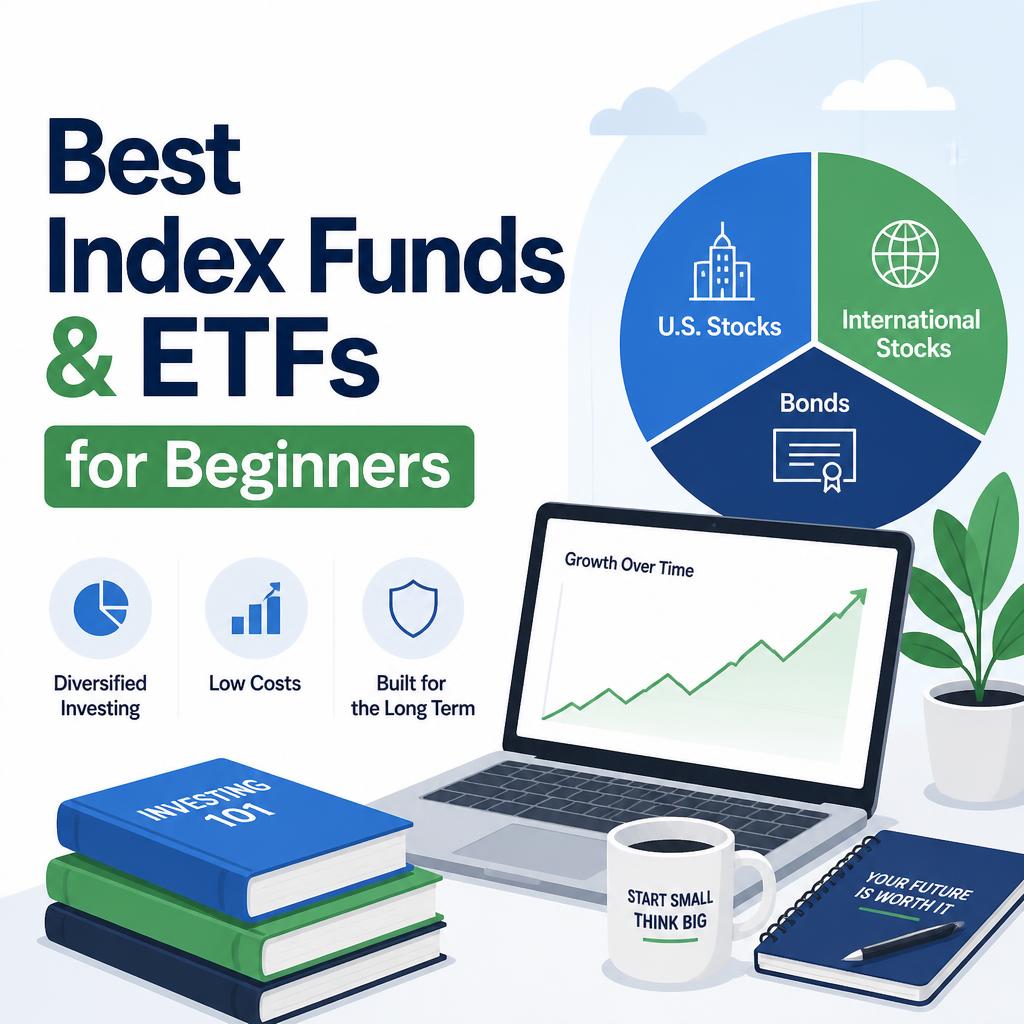
The three-fund portfolio remains the most elegant solution for most investors:
- U.S. Stock Market Fund (60%): VTSAX/VTI or FSKAX/ITOT
- International Stock Fund (30%): VXUS or IXUS
- Bond Market Fund (10%): BND or AGG
This allocation provides global diversification, automatic rebalancing opportunities, and minimal maintenance. Adjust percentages based on age, risk tolerance, and time horizon.
For aggressive younger investors, shift to 70% U.S., 30% international, 0% bonds. Conservative retirees might prefer 35% U.S., 15% international, 50% bonds.
Where to Buy Commission-Free Index Funds
Modern brokerages eliminated most barriers to index fund investing:
Vanguard: Zero commissions on Vanguard ETFs and mutual funds, though outside ETFs may carry fees. Best for Vanguard fund enthusiasts building long-term best index funds & etfs portfolios.
Fidelity: Commission-free trading on all stocks and ETFs, including competitors’ funds. Zero minimum investments on Fidelity mutual funds. Exceptional platform for beginners.
Charles Schwab: No commissions on stocks, ETFs, or Schwab mutual funds. Seamless integration with Schwab index products.
Interactive Brokers: Ultra-low margin rates and access to global markets. Best for sophisticated investors trading beyond basic index funds.
All major platforms now offer fractional shares, letting you invest exact dollar amounts rather than full shares—perfect for systematic investing strategies.
Common Mistakes to Avoid
Chasing Past Performance
Last year’s top-performing sector fund often becomes this year’s laggard. Stick with broad market exposure rather than jumping between hot sectors.
Overcomplicating Your Portfolio
Owning 15 different index funds doesn’t improve diversification—it just creates tracking headaches. Three to five funds cover all necessary bases.
Ignoring Tax Efficiency
Placing bond funds in taxable accounts triggers annual tax bills on interest income. Keep bonds and REITs in tax-advantaged accounts whenever possible.
Paying for Redundant Holdings
Many investors unknowingly own the same companies multiple times through overlapping funds. An S&P 500 fund plus a total market fund creates 80% overlap with double the costs.
Timing the Market
Waiting for the “right time” to invest costs more than any market downturn. Regular investments through dollar-cost averaging beats market timing consistently over decades.
Advanced Strategies for Index Fund Investors
Tax-Loss Harvesting
Sell losing positions in taxable accounts to offset capital gains, then immediately buy a similar (but not identical) fund to maintain market exposure. Swap VTI for ITOT or VOO without triggering wash-sale rules.
Asset Location Optimization
Place tax-inefficient investments (bonds, REITs, dividend funds) in IRAs and 401(k)s. Hold tax-efficient total market funds in taxable accounts to minimize annual tax drag.
Roth Conversion Ladder
For early retirees, converting traditional IRA funds to Roth accounts during low-income years creates tax-free withdrawal opportunities later. Index funds’ tax efficiency makes them ideal candidates.
Mega Backdoor Roth
High earners can contribute after-tax 401(k) dollars beyond the standard limit, then immediately convert to Roth. Index funds simplify this strategy through predictable, low-turnover growth.
The Bottom Line: Keep It Simple and Cheap
The best index funds and ETFs share three characteristics: rock-bottom expense ratios, broad diversification, and proven long-term performance. You don’t need exotic strategies or dozens of holdings—just consistent contributions to low-cost funds tracking major market indexes.
Start with a total market fund like VTI or FSKAX. Add international exposure through VXUS. Include bonds via BND as you approach retirement. This three-fund approach beats the vast majority of active management while consuming almost none of your time or money in fees.
Stop second-guessing your choices. Pick funds from the list above, automate your investments, and let compound growth do its work. The difference between good and great isn’t complicated—it’s simply choosing funds that cost less and diversify more.
Your future wealth depends less on finding the perfect fund and more on starting now with excellent funds. Every day you delay costs more than any minor optimization could recover.
—
Affiliate Disclosure: We may earn a commission from some of the products mentioned in this article.