How to Save Money on Brokerage Accounts: A Step-by-Step Guide (2026)
This article contains affiliate links. If you sign up through these links, we may earn a commission at no additional cost to you. This helps support our content.
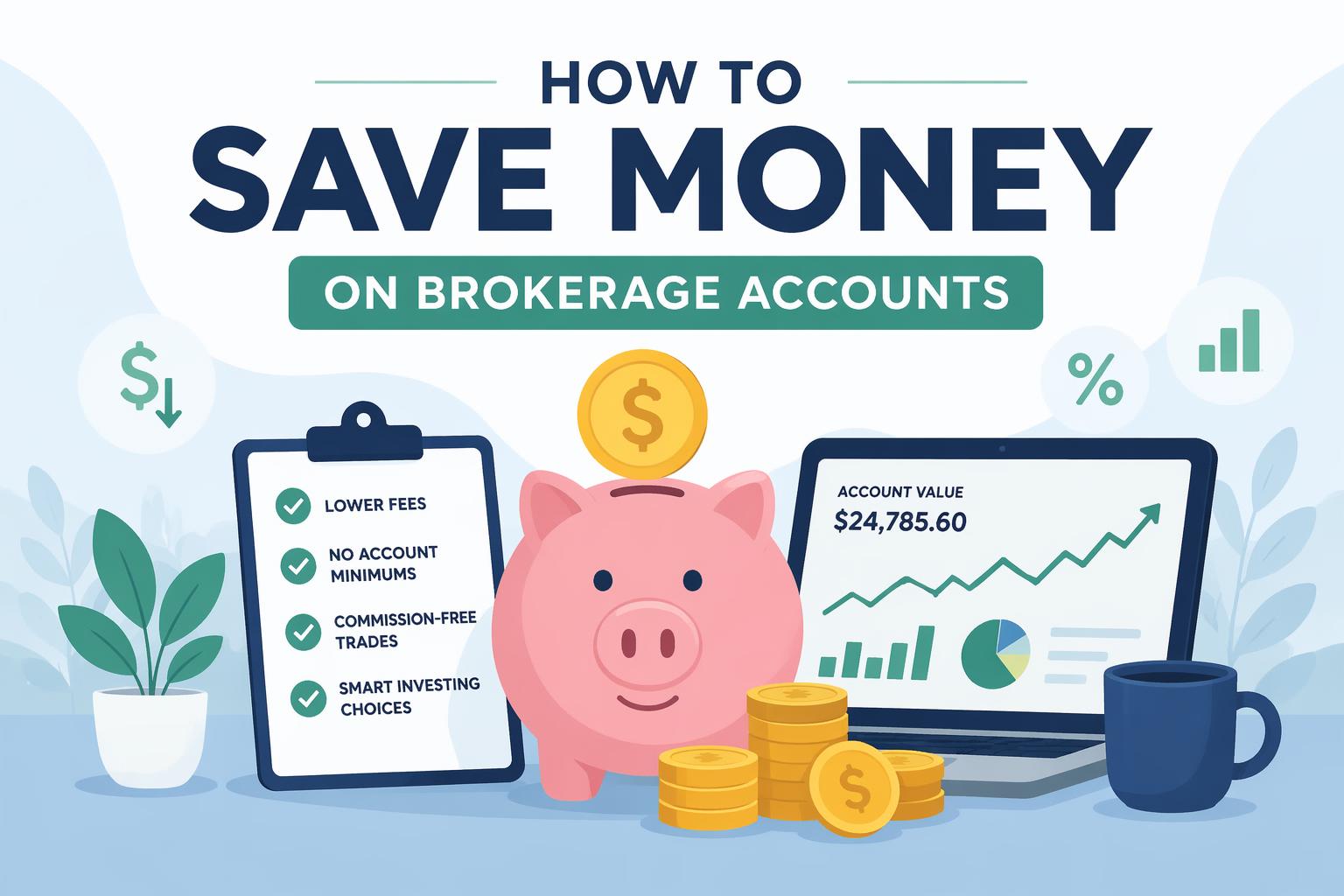
Every dollar you save on brokerage fees is a dollar that stays invested and compounds over time. In 2026, competition among brokers has driven trading commissions down to zero for most platforms, but hidden fees and poor account choices can still cost you hundreds or thousands of dollars every year.
By the end of this guide, you’ll know exactly how to choose a brokerage account that minimizes costs, avoid common fee traps, and set up your account to maximize your investment returns. Whether you’re opening your first account or reconsidering your current broker, these strategies work for beginners and experienced investors alike.
Estimated time: 30-40 minutes to research and open your account
Experience level: Beginner-friendly
—
What You Need Before Starting
Before you start comparing brokers and opening accounts, gather:
- Your basic information: Social Security number, employment details, and bank account information for linking
- Initial investment amount: Many brokers in 2026 allow you to open accounts with $1,000 or less, and some have no minimum at all
- Investment goals: Know whether you’re investing for retirement, general wealth building, or active trading — this affects which account type saves you the most money
Time commitment: 30-40 minutes total
—
Step 1: Choose a Zero-Commission Broker
The single biggest way to save money on brokerage accounts is to avoid paying trading commissions entirely.
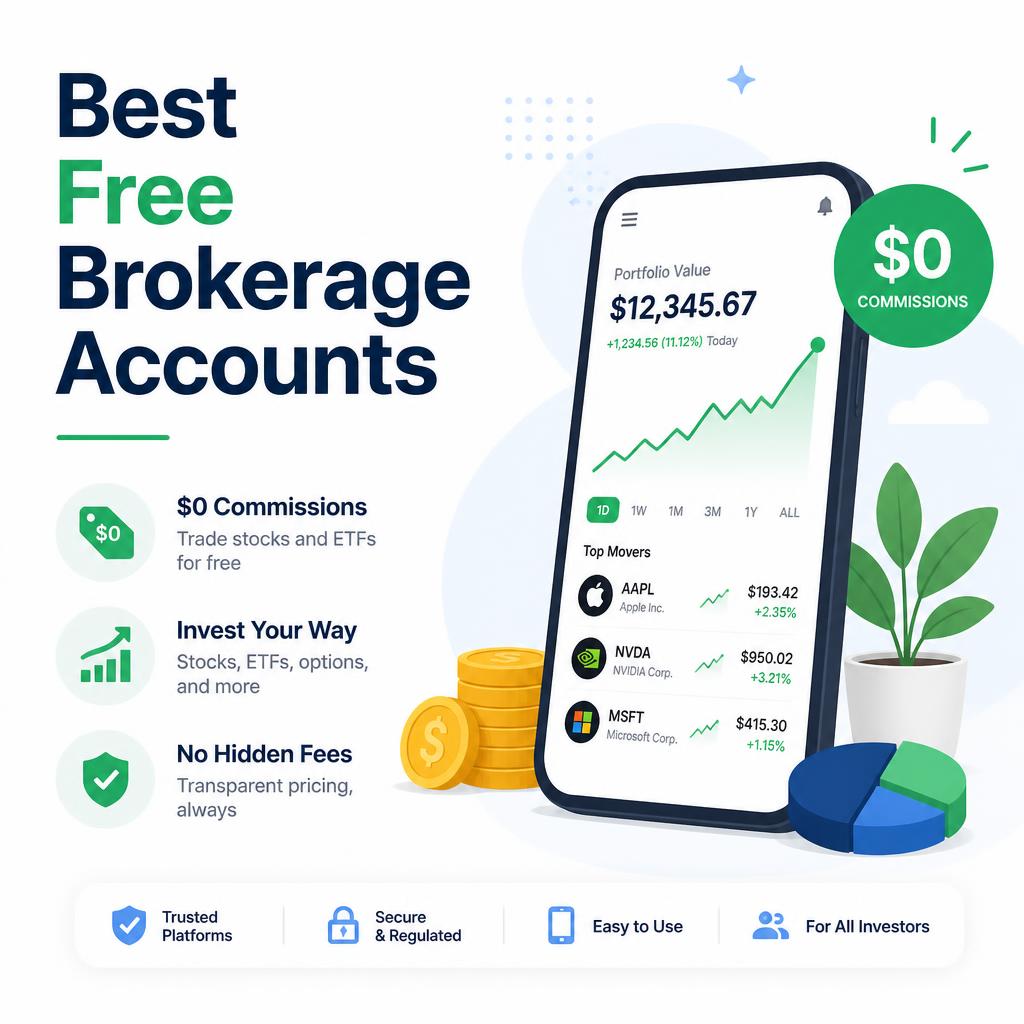
In 2026, commission-free trading has become the standard. According to NerdWallet’s analysis published in June 2026, platforms like Fidelity, Robinhood, E*TRADE, Webull, and SoFi Active Investing all charge $0 per trade for online U.S. stocks and ETFs.
Action steps:
- Verify that your chosen broker offers $0 commissions on stock and ETF trades
- Check if options trading (if you need it) is also commission-free or has minimal fees
- Confirm there are no account maintenance fees or inactivity charges
You should see: Clear fee disclosure on the broker’s website stating “$0 per trade” or “commission-free trading” for stocks and ETFs.
> Note: Zero commissions are now standard, but not universal. Some traditional brokers still charge per-trade fees. Always verify before opening an account.
—
Step 2: Verify There’s No Account Minimum
Account minimums lock up your capital before you even start investing. Choose brokers that let you open accounts with minimal or zero initial deposits.
According to NerdWallet’s 2026 broker rankings, Fidelity requires no account minimum to open an account, making it accessible regardless of your starting capital. Robinhood similarly has no minimum deposit requirement.
Action steps:
- Look for the “Account Minimum” or “Minimum Deposit” disclosure on the broker’s website
- Confirm whether this is a one-time opening minimum or an ongoing balance requirement
- If a minimum exists, verify whether falling below it triggers monthly fees
You should see: A statement like “No account minimum” or “$0 to open” on the account opening page.
Why this matters: An account minimum of even $1,000 means you must keep that capital tied up rather than investing it immediately or keeping it in a high-yield savings account until you’re ready to invest.
—
Step 3: Compare Promotional Incentives
Many brokers offer cash bonuses or promotional benefits for new accounts in 2026. These can immediately offset costs or boost your starting capital.
E*TRADE, for example, runs promotions for new accounts according to their 2026 offerings. SoFi Active Investing also advertises promotional incentives for new users.
Action steps:
- Search “[broker name] new account promotion 2026” to find current offers
- Note the requirements: minimum deposit amounts, time periods for keeping funds invested, and trading volume requirements
- Calculate whether the promotion is worth meeting the requirements (e.g., depositing $10,000 for a $100 bonus is a 1% return — worthwhile if you planned to deposit that amount anyway)
You should see: Promotional banners on broker homepages or dedicated landing pages explaining bonus terms.
> Warning: Never deposit more than you planned just to chase a bonus. Only take promotions that align with your actual investment timeline and capital.
—
Step 4: Check Interest Rates on Uninvested Cash
Money sitting in your brokerage account waiting to be invested should earn interest. In 2026, some brokers offer competitive rates on uninvested cash — others pay nearly nothing.
Webull offers high interest on uninvested cash according to SmartAsset’s analysis, while Public advertises high-interest cash accounts as part of their 2026 platform features.
Action steps:
- Navigate to the broker’s cash management or sweep account information page
- Find the current annual percentage yield (APY) on uninvested cash balances
- Compare this rate to current high-yield savings accounts (typically 4-5% in 2026)
You should see: A clearly stated APY percentage, often shown as “Cash interest rate” or “Uninvested cash APY.”
Why this matters: If you keep $5,000 uninvested for six months in an account paying 0.01% versus 4.5%, you lose approximately $112 in interest. Over multiple years, this compounds significantly.
—
Step 5: Understand the Expense Ratios on Available Funds
Even with zero trading commissions, the funds you invest in charge ongoing fees called expense ratios. Lower expense ratios mean more of your money stays invested.
According to the 2026 research data, expense ratios for index funds range from 0.02% to 0.6%. A $10,000 investment in a fund with a 0.6% expense ratio costs you $60 per year; the same investment in a 0.02% fund costs just $2 annually.
Action steps:
- On your broker’s platform, search for the index fund you want to buy (e.g., S&P 500 index fund)
- View the fund details and locate the “Expense Ratio” field
- Compare multiple options tracking the same index — choose the one with the lowest expense ratio
- Verify that your chosen broker offers low-cost index funds from providers like Vanguard, Fidelity, or Schwab
You should see: Expense ratios listed as percentages (e.g., “0.03%” or “0.15%”) in the fund’s prospectus or details page.
Why this matters: Over 30 years, a 0.5% difference in expense ratios on a $100,000 portfolio costs you approximately $30,000 in lost returns due to compounding.
—
Step 6: Avoid Margin Account Fees Unless Necessary
A margin account allows you to borrow money from your broker to invest, but it comes with interest charges that can quickly erode your returns.
According to Investopedia’s 2026 guidance, margin accounts are an option for investors wanting to leverage their positions, but they introduce borrowing costs that most long-term investors don’t need.
Action steps:
- When opening your account, select “Cash Account” rather than “Margin Account” unless you specifically plan to trade on margin
- If you already have a margin account, verify that you’re not paying monthly maintenance fees
- Confirm you understand margin interest rates if you do choose a margin account — these can range from 7-12% annually
You should see: Account type selection during the signup process, clearly labeled as “Cash Account” or “Margin Account.”
> Note: Most investors never need a margin account. If you’re unsure, start with a cash account. You can always upgrade later if your strategy changes.
—
Step 7: Look for Fractional Share Trading
Fractional shares let you invest any dollar amount in expensive stocks without paying a premium. This feature saves money by eliminating the need to leave cash uninvested while you save up for a full share.
SoFi Invest offers fractional share trading according to their 2026 platform features, allowing you to invest with whatever capital you have available.
Action steps:
- Verify whether your chosen broker supports fractional shares for the stocks and ETFs you want to buy
- Confirm there are no additional fees for fractional share purchases
- Test the feature by searching for a high-priced stock (e.g., one trading at $500+ per share) and checking if you can purchase a partial share
You should see: An option to enter a dollar amount (e.g., “$50”) rather than number of shares when placing an order.
Why this matters: Without fractional shares, a $1,000 investment budget and a stock trading at $450/share leaves you with $100 sitting uninvested. Fractional shares eliminate this inefficiency.
—
Step 8: Verify SIPC Insurance Coverage
While not directly a cost savings, SIPC insurance protects your account in case your broker fails. Ensuring this protection exists prevents catastrophic financial loss.
According to Investopedia’s 2026 brokerage guidance, investors should verify their money is insured at brokerage firms through SIPC coverage, which protects up to $500,000 in securities and cash per account.
Action steps:
- Navigate to your broker’s security or legal information page
- Look for language confirming “SIPC member” or “SIPC protection”
- Verify the coverage limits — standard is $500,000 per account
You should see: A statement like “Member SIPC” prominently displayed on the broker’s website, often in the footer or About section.
—
Step 9: Use Paper Trading to Avoid Learning Costs
Practicing with a simulated account before investing real money helps you avoid costly beginner mistakes.
According to NerdWallet’s 2026 analysis, Webull is ideal for those wanting to practice trading through their paper trading platform, and E*TRADE also offers paper trading features. Investopedia’s research confirms that investors can practice trading with simulated accounts to learn without financial risk.
Action steps:
- Open a paper trading or practice account with your chosen broker (if available)
- Simulate your intended investment strategy with fake money for 2-4 weeks
- Track your hypothetical performance and identify mistakes you would have made with real capital
- Once comfortable, transition to your live account
You should see: A separate “Paper Trading” or “Practice Account” option in your broker’s platform, often in account settings or as a separate app mode.
Why this matters: Beginner mistakes with real money — panic selling, buying high, overtrading — can cost hundreds or thousands of dollars. Paper trading eliminates these learning costs.
—
Step 10: Review and Compare Research Tools Included
Quality research tools help you make better investment decisions, potentially saving you from poor investments. Many brokers include these tools for free.
According to SmartAsset’s 2026 broker analysis, Interactive Brokers provides strong research tools, and Webull offers robust research tools as part of their commission-free platform.
Action steps:
- Log into your broker’s platform and explore the research section
- Verify access to: stock screeners, analyst ratings, earnings calendars, and financial statements
- Compare the quality of these tools across 2-3 brokers before committing
- Confirm these tools are included at no additional cost
You should see: A “Research” or “Analysis” tab in your broker’s interface with multiple free tools and reports.
Why this matters: Subscribing to third-party research services can cost $30-100 per month. Getting comparable tools free from your broker is a significant savings.
—
Step 11: Confirm Educational Resources Are Free
High-quality educational content helps you become a better investor without paying for courses or advisors.
E*TRADE offers extensive educational content according to NerdWallet’s June 2026 rankings, including a large selection of educational resources, webinars, and daily market discussions. Charles Schwab also provides extensive educational materials as part of their 2026 platform.
Action steps:
- Navigate to your broker’s “Learn” or “Education” section
- Verify the availability of: beginner guides, video tutorials, webinars, and market analysis
- Check whether these resources are freely available or gated behind premium memberships
You should see: A library of articles, videos, and live webinar schedules accessible without additional fees.
—
Step 12: Set Up Automated Investing to Save Time
Automated investing ensures you consistently invest without manual effort, reducing the risk of market-timing mistakes that cost money.
According to SmartAsset’s 2026 analysis, SoFi Invest provides automated investing options as part of their platform features.
Action steps:
- In your broker’s platform, locate the “Automated Investing” or “Recurring Investments” feature
- Set up automatic transfers from your bank account on a regular schedule (e.g., bi-weekly or monthly)
- Configure automatic purchases of your chosen index funds or ETFs
- Verify there are no fees for automatic investment transactions
You should see: Setup screens allowing you to specify transfer amounts, frequencies, and target investments.
Why this matters: Manual investing often leads to hesitation, market-timing attempts, and missed investment opportunities. Automation enforces discipline and dollar-cost averaging, which historically improves long-term returns.
—
Your Money-Saving Brokerage Setup Is Complete
You now have a brokerage account configured to minimize costs at every level: zero trading commissions, no account minimums, competitive cash interest rates, low-cost index funds, and free research tools. These choices compound over decades — a $10,000 portfolio managed with these cost-saving strategies could be worth $15,000-20,000 more after 30 years compared to a high-fee alternative.
The platforms mentioned in this guide — Fidelity, Robinhood, E*TRADE, Webull, and SoFi Active Investing — all meet the zero-commission standard as of 2026. Compare their specific features using the steps above to find your best fit.
Your next actions:
- Fund your account with your initial investment
- Set up your first automated investment in a low-cost index fund
- Bookmark your broker’s research and education sections for ongoing learning
—
Common Issues and Solutions
“My broker is charging me a fee I didn’t expect”
→ Check your account statements for: wire transfer fees, paper statement fees, or margin interest. Most of these can be avoided by using electronic transfers, paperless statements, and cash accounts.
“I can’t find the expense ratio for a fund”
→ Search for the fund’s ticker symbol, then look for “Prospectus” or “Fund Details.” The expense ratio is required to be disclosed in these documents.
“The promotional bonus didn’t appear in my account”
→ Promotion bonuses typically take 30-90 days to credit after meeting requirements. Review the promotion terms for specific timelines and contact customer support if the deadline has passed.
“I don’t have enough money to meet the minimum deposit”
→ Focus on brokers with zero account minimums: Fidelity, Robinhood, and several others in 2026 allow you to start with any amount.
—
Frequently Asked Questions
Do I need a lot of money to open a brokerage account in 2026?
No. According to NerdWallet’s 2026 research, many brokers allow opening an account with $1,000 or less, and several require no minimum at all. Fidelity and Robinhood both have no account minimums as of 2026.
Are zero-commission brokers safe?
Yes, if they’re SIPC members. Zero-commission brokers make money through other revenue streams like interest on cash balances and premium subscription services. Verify SIPC membership to ensure your account is protected up to $500,000.
Can I open accounts at multiple brokers to take advantage of different promotions?
Yes. According to Investopedia’s 2026 guidance, investors can open more than one online brokerage account. This strategy can help you capture multiple signup bonuses and access different platform strengths.
Do I pay taxes on money in my brokerage account?
You pay taxes on realized gains (when you sell investments for a profit) and on dividends received. Simply holding investments in a brokerage account doesn’t trigger taxes. Tax-advantaged accounts like IRAs offer different tax treatment.
What’s the difference between a cash account and a margin account?
A cash account only lets you invest money you’ve deposited. A margin account allows you to borrow money from your broker to invest, but charges interest on borrowed amounts. Most long-term investors only need a cash account.
Should I choose the cheapest broker or look for other features?
According to Investopedia’s 2026 research, the cheapest broker is not always the best broker. Compare account features, research tools, educational resources, and customer service quality alongside costs. A broker that saves you $50 in fees but provides poor research tools could cost you far more in poor investment decisions.
—
Data and broker information current as of June 2026 based on NerdWallet, SmartAsset, and Investopedia analyses. Brokerage fees, promotions, and features may change. Always verify current terms directly with brokers before opening accounts.