How to Choose Real Estate / REITs: Step-by-Step Guide (2026)
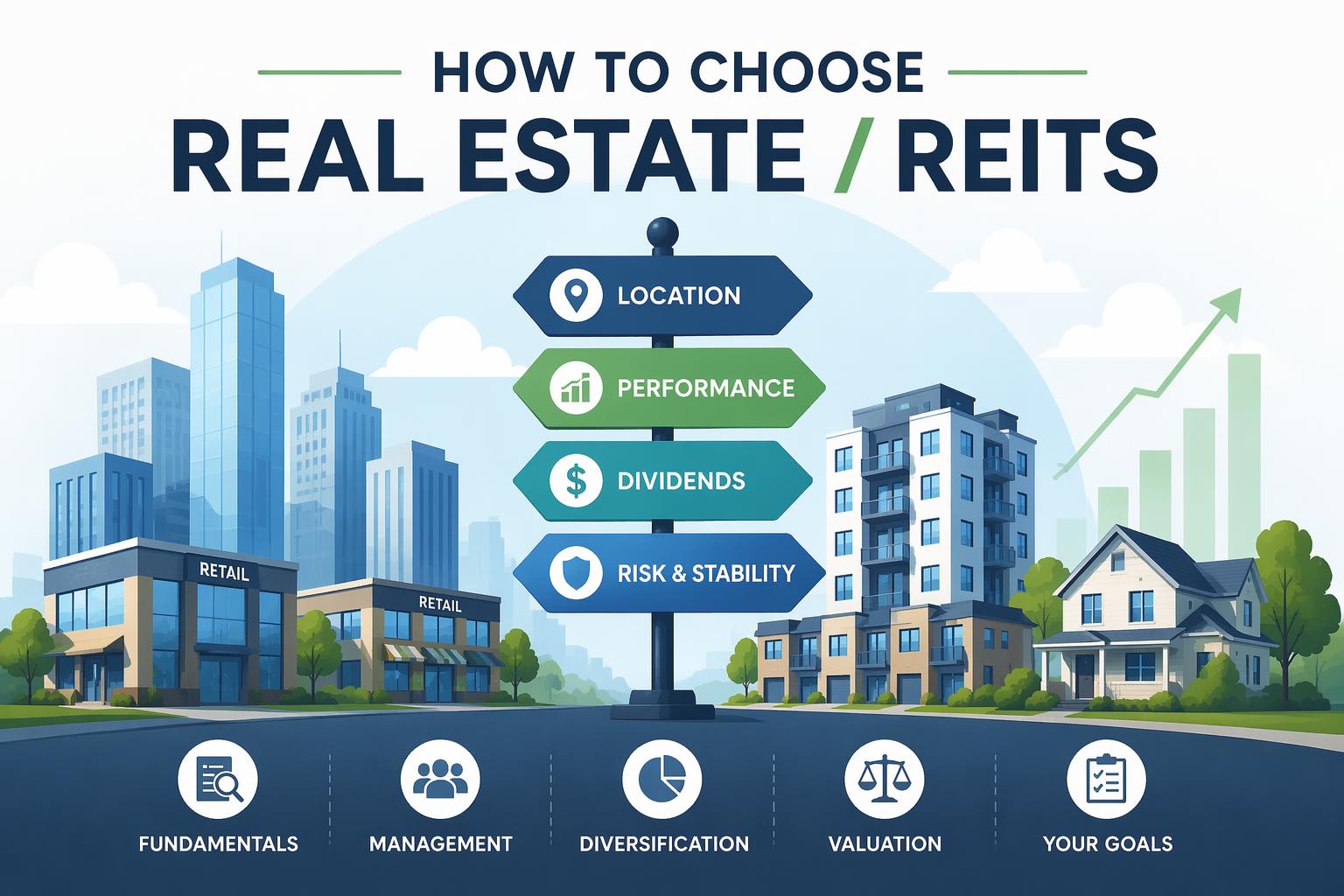
Real estate investment trusts sound simple in theory — buy shares, collect dividends, diversify your portfolio. But when you’re staring at more than 225 publicly traded REITs in the U.S., each with different property sectors, yield percentages, and risk profiles, the choice becomes anything but straightforward.
Which REIT type fits your goals? Should you pick individual REITs or go with an ETF? How do you avoid overpaying in a market where sector divergence is reshaping returns?
By the end of this guide, you’ll have a clear framework for evaluating and selecting REITs that align with your investment strategy — whether you’re chasing income, diversification, or both.
What you need before starting:
- A brokerage account (most online brokers offer commission-free REIT trading)
- Basic understanding of your investment goals (income vs growth, risk tolerance, time horizon)
- Estimated time: 30-40 minutes for initial research and selection
This article contains affiliate links. If you make a purchase through these links, we may earn a commission at no additional cost to you.
—
What Are REITs and Why Consider Them in 2026?
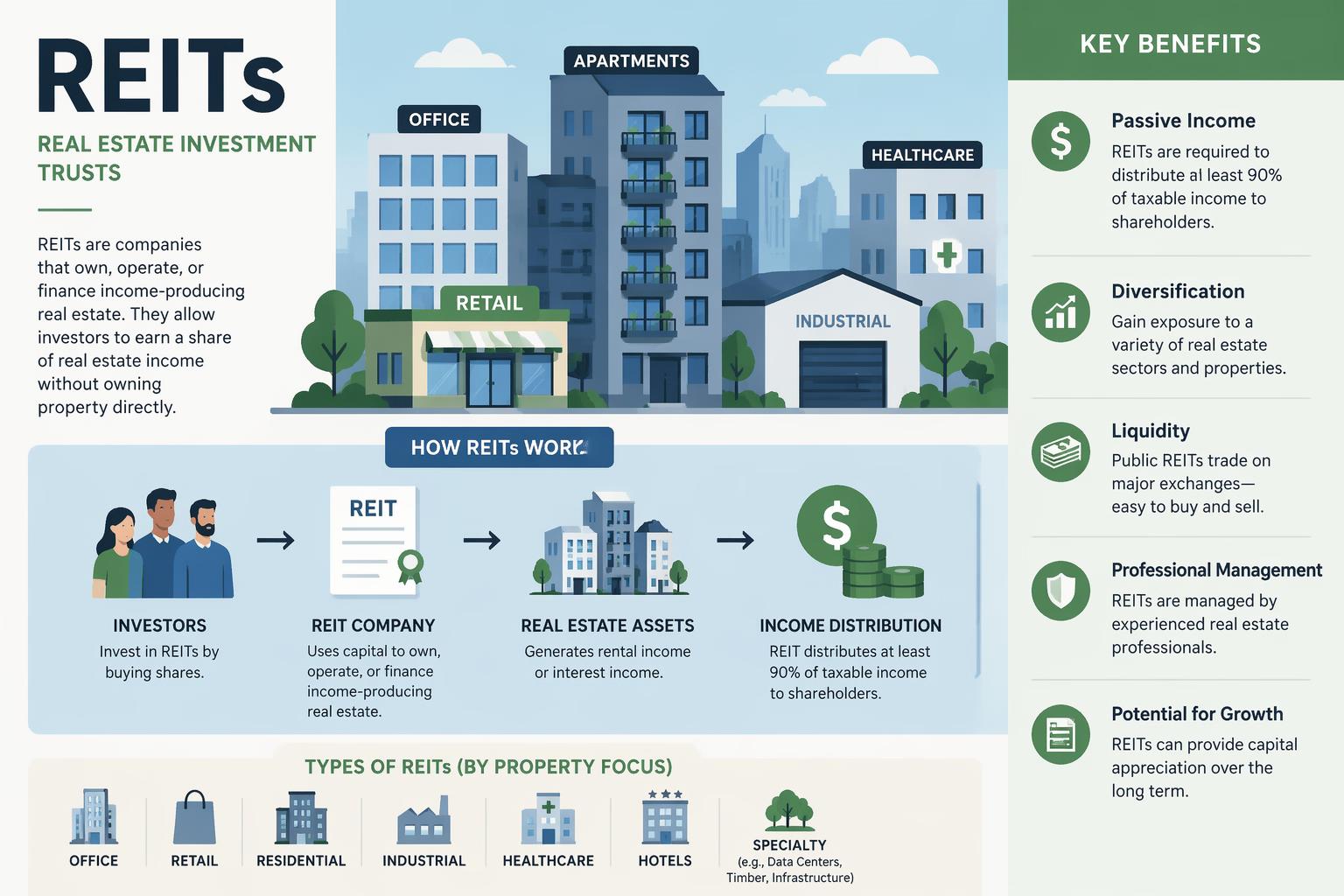
Real estate investment trusts (REITs) are companies that own, operate, or finance income-producing real estate. By law, REITs must distribute at least 90% of their taxable income to shareholders as dividends — which makes them attractive for income-focused investors.
As of 2026, REITs are up 9.5% year to date, with earnings forecasted to grow 5-6%. More importantly, they offer something many portfolios lack right now: virtually no exposure to AI and technology bubbles that have dominated market headlines.
The FTSE NAREIT All Equity REITs Index three-year total return as of March 2026 was 21.9% — nearly matching the S&P 500’s 21.69% three-year return as of April 2026, but with a completely different risk profile.
—
Step 1: Decide Between Equity REITs, Mortgage REITs, or Hybrid REITs
The first decision shapes everything else: what type of REIT matches your investment approach?
Equity REITs own and operate physical properties (apartment buildings, shopping centers, data centers). They generate income from rent and property appreciation. These are the most common type and make up the majority of publicly traded REITs.
Mortgage REITs (mREITs) don’t own properties — they finance them. They earn income from interest on mortgages and mortgage-backed securities. They’re more sensitive to interest rate changes and typically offer higher yields but with more volatility.
Hybrid REITs combine both approaches, owning properties and financing real estate.
You should see: A clearer picture of which income source aligns with your goals. If you want exposure to physical real estate with moderate volatility, equity REITs are the baseline choice. If you’re comfortable with interest rate risk for potentially higher yields, mortgage REITs deserve consideration.
> Note: For most investors building diversified portfolios, equity REITs or REIT ETFs (which primarily hold equity REITs) are the starting point.
—
Step 2: Understand Which Property Sectors Are Performing in 2026
Not all real estate sectors move together. In 2026, sector divergence is reshaping REIT returns — meaning your sector choice matters as much as the REIT itself.
According to current market analysis, these sectors show strength:
- Industrial properties: Demand is increasing due to reshoring trends
- Retail: Showing pricing power
- Senior housing: Strong fundamentals with demographic tailwinds
- Hotels: Recovering with pricing power
- Data centers: Continued growth despite broader tech concerns
Meanwhile, apartments are down 1-2% in 2026, and there’s noted oversupply in for-sale housing.
Research the sectors you’re considering:
- Look at recent performance data for each sector
- Consider macroeconomic trends (e.g., reshoring benefits industrial, aging population benefits senior housing)
- Evaluate whether the sector aligns with long-term demographic or economic shifts
You should see: A shortlist of 2-3 property sectors that match both current performance trends and your investment thesis.
—
Step 3: Choose Between Individual REITs or REIT ETFs
Now comes the structure question: buy individual REIT stocks or invest through a REIT ETF?
Individual REITs give you:
- Precise sector and property exposure
- Higher potential returns if you pick well
- More research burden
- Higher concentration risk
REIT ETFs give you:
- Instant diversification across dozens or hundreds of properties
- Lower research requirements
- Professional management or index tracking
- Lower individual stock risk
For most investors, especially those new to REITs, ETFs provide the right balance of exposure and diversification.
If you choose the ETF route, evaluate these factors:
- Expense ratio: Lower is better (index funds typically range from 0.07% to 0.12%)
- Geographic focus: U.S. only, global, or ex-U.S.
- Management style: Active management or passive index tracking
- Yield: Compare current yields (typically 2.5% to 4.5% for REIT ETFs)
You should see: A clear direction — either a shortlist of 3-5 individual REITs to research further, or 2-3 REIT ETFs that match your geographic and management preferences.
—
Step 4: Evaluate REIT ETF Options (If Going the ETF Route)
If you’ve decided on REIT ETFs, here’s how to compare your options using 2026 data:
Review these characteristics for each ETF on your shortlist:
- Morningstar Rating: Look for Silver or Gold rated funds
- Expense Ratio: Compare costs (lower is better for long-term holdings)
- Yield: Evaluate current dividend yield
- Holdings: Review the top 10-15 holdings to understand concentration
- Performance: Check 1-year, 3-year, and 5-year returns
Example comparison from 2026:
- Dimensional US Real Estate ETF: Gold rating, active management, 2.69% yield
- Schwab US REIT ETF: Silver rating, index fund, 2.76% yield
- Vanguard Real Estate ETF: Silver rating, index fund, 3.63% yield
- Vanguard Global ex-US Real Estate ETF: Bronze rating, index fund, 4.25% yield
- State Street SPDR Dow Jones Global Real Estate ETF: Bronze rating, index fund, 3.27% yield
You should see: A ranked list based on your priorities. If you want U.S. exposure with low costs, Schwab or Vanguard U.S. options stand out. If you want international diversification, Vanguard Global ex-US offers the highest yield at 4.25%.
> Note: The iShares Core U.S. REIT ETF had the best-performing one-year return of 17.29% among major REIT ETFs in 2026.
—
Step 5: Research Individual REIT Stocks (If Taking the Individual Route)
If you’re building a portfolio of individual REITs, each position requires deeper research:
For each REIT on your shortlist, investigate:
- FFO and NOI growth: Funds From Operations (FFO) is the REIT equivalent of earnings. As of 2026, FFO is up 6.2% across the sector, and Net Operating Income (NOI) is up 4.7%
- Dividend history: Check consistency and growth of dividend payments (total dividends paid are up 6.3% sector-wide in 2026)
- Property quality and location: High-quality assets in prime locations are stabilizing, while secondary markets face vacancy challenges
- Debt levels: REITs depend heavily on external capital — evaluate debt-to-equity ratios
- Management track record: Look at historical performance through different market cycles
Access this information through:
- The REIT’s investor relations page
- Financial news sites with REIT data
- SEC filings (10-K and 10-Q reports)
- REIT.com for industry analysis
You should see: A detailed profile for each REIT showing financial health, growth trajectory, and risk factors. You should be able to articulate why each REIT belongs in your portfolio.
—
Step 6: Check Valuation Metrics
Don’t overpay. Even strong REITs become poor investments at the wrong price.
Compare these metrics against sector averages and historical norms:
- Price-to-FFO ratio: The REIT equivalent of P/E ratio
- Dividend yield: Compare to the REIT’s historical yield and sector peers
- Price-to-NAV (Net Asset Value): Trading below NAV may indicate undervaluation
According to 2026 analysis, there’s a significant divergence between REIT and broader market valuation multiples — which may present opportunities for value-focused investors.
Use screening tools available through:
- Your brokerage platform’s research section
- REIT.com’s screening tools
- Financial data providers like Morningstar
You should see: A valuation assessment for each REIT or ETF on your shortlist. Flag any that appear significantly overvalued relative to their sector.
—
Step 7: Assess Your Portfolio Allocation
Determine how much of your overall portfolio should go into REITs.
Consider these factors:
- Current portfolio composition: How much real estate exposure do you already have?
- Income needs: Are you investing for current income or long-term growth?
- Risk tolerance: REITs can be volatile, especially during interest rate changes
- Diversification goals: REITs provide diversification benefits but shouldn’t dominate your portfolio
General guidelines (adjust based on your situation):
- Conservative income portfolios: 10-15% in REITs
- Balanced portfolios: 5-10% in REITs
- Growth portfolios: 3-5% in REITs or none
More than 70% of U.S. pensions by assets incorporate REITs into their strategies, and more than 75% of pension plans with above $25 billion in assets use REITs — but their allocations are part of sophisticated diversification strategies, not concentrated bets.
You should see: A target percentage allocation that fits your overall investment strategy.
—
Step 8: Understand the Tax Implications
REIT dividends receive different tax treatment than qualified dividends from regular stocks.
Key tax considerations:
- REIT dividends are typically taxed as ordinary income (not at the lower qualified dividend rate)
- Exception: Some portion may qualify as capital gains or return of capital
- Tax-advantaged accounts: Consider holding REITs in IRAs or 401(k)s to defer taxes
Consult your tax advisor or review IRS Publication 550 for detailed guidance on REIT taxation.
You should see: A clear understanding of the tax impact on your after-tax returns and whether tax-advantaged accounts make sense for your REIT holdings.
—
Step 9: Make Your First REIT Purchase
Once you’ve completed your research and determined your allocation, execute your purchase through your brokerage account.
The mechanics are simple:
- Log into your brokerage account
- Search for the REIT ticker symbol
- Enter the dollar amount or number of shares you want to purchase
- Review the order details
- Submit your order
For ETFs: Consider dollar-cost averaging by setting up automatic monthly purchases rather than investing a lump sum.
For individual REITs: Start with your highest-conviction pick, then add others over time as you continue researching.
You should see: Confirmed orders in your brokerage account showing your REIT positions and their current values.
> Note: Most major online brokers offer commission-free trading for REITs and REIT ETFs.
—
Step 10: Monitor and Rebalance Quarterly
REITs aren’t set-and-forget investments. Set up a quarterly review process.
What to monitor:
- Dividend announcements: Has your REIT maintained, increased, or cut its dividend?
- FFO and NOI growth: Are earnings growing as expected?
- Sector performance: Are the property sectors you chose still showing strength?
- Portfolio drift: Has your REIT allocation grown beyond your target percentage?
- New developments: Capital raises, acquisitions, property sales
Set calendar reminders for:
- Quarterly earnings releases
- Annual rebalancing of your overall portfolio
- Dividend reinvestment decisions
You should see: A tracking system (spreadsheet, portfolio app, or brokerage tools) that shows your REIT performance against your goals and benchmarks.
—
What You’ve Accomplished
You’ve just built a framework for selecting REITs that goes beyond blindly chasing yield percentages or following generic “best REIT” lists.
You now know how to:
- Distinguish between REIT types and choose the right structure
- Evaluate sectors based on current market dynamics
- Compare individual REITs against ETF options
- Assess valuations to avoid overpaying
- Integrate REITs into your broader portfolio strategy
REITs remain attractive for income generation and diversification in 2026, with institutional investors heavily incorporating them into pension strategies. But the key is matching the right REIT type, sector exposure, and structure to your specific investment goals.
—
Troubleshooting Common REIT Selection Issues
“The REIT I’m looking at has a 3-star rating but a super low expense ratio — should I still buy it?”
If it’s an ETF, low expense ratio matters for long-term returns, but a 3-star rating suggests below-average expected performance. Look deeper into why the rating is lower — is it holdings quality, management, or just recent underperformance? Compare it to similar ETFs with 4- or 5-star ratings.
“I found a REIT with a 12% yield — is this a great deal?”
Probably not. Extremely high yields often signal dividend risk. Check if the REIT recently cut its dividend (the high yield may reflect a dropped price), investigate FFO coverage of the dividend, and look for news about financial stress. Sustainable REIT yields typically range from 3% to 6%.
“Should I wait for interest rates to stabilize before buying REITs?”
Timing the market rarely works. If you’re investing for the long term (5+ years), current interest rate uncertainty matters less than property fundamentals and dividend sustainability. Consider dollar-cost averaging to spread your entry points rather than trying to time a perfect moment.
“Are public nontraded REITs a good alternative to publicly traded ones?”
Exercise caution. Public nontraded REITs often don’t estimate their value for investors until 18 months after their offering closes, creating liquidity risk and valuation uncertainty. For most investors, publicly traded REITs or REIT ETFs provide better transparency and liquidity.
—
Next Steps
Now that you understand how to choose REITs, here’s what to do next:
- Open or review your brokerage account to ensure you can trade REITs commission-free
- Start with one REIT ETF to gain diversified exposure while you continue learning
- Set up dividend reinvestment to compound your returns automatically
- Join REIT investor communities to learn from experienced investors
- Read quarterly earnings reports from your REIT holdings to deepen your understanding
The real estate market continues evolving — stay informed about sector trends, interest rate impacts, and new opportunities as they emerge.
—
Frequently Asked Questions
Do I need a paid brokerage account to invest in REITs?
No. Most major online brokers offer free accounts with commission-free trading for REITs and REIT ETFs. You only need enough capital to purchase shares (some brokers also offer fractional shares, letting you invest with as little as $1).
How long does it take to research and select a REIT?
For a REIT ETF, expect 30-60 minutes to compare options and make an informed choice. For individual REITs, plan 2-3 hours per REIT to review financials, property portfolios, and management track records thoroughly.
Can I invest in REITs without a brokerage account?
You could access REITs through mutual funds in a 401(k) or IRA, but direct REIT investing requires a brokerage account. Opening one online takes 10-15 minutes with most providers.
What should I do if the REIT sector I chose starts underperforming?
Don’t react to short-term volatility. Review the fundamental reasons you chose that sector — have they changed? If the long-term thesis remains intact (e.g., demographic trends supporting senior housing), consider holding or even adding during weakness. If fundamentals have deteriorated, rebalance into stronger sectors.
How do REITs perform compared to direct real estate ownership?
REITs offer liquidity, diversification, and professional management without the responsibilities of property ownership. The FTSE NAREIT All Equity REITs Index returned 21.9% over three years through March 2026. Direct ownership can offer more control and potential tax benefits but requires significantly more capital and effort.
Are REITs a good investment during economic uncertainty?
It depends on the type of uncertainty. REITs remain attractive for income generation and diversification, but they’re sensitive to interest rate changes since they depend heavily on external capital. During economic growth periods, REITs typically perform well. Evaluate your specific economic concerns against REIT fundamentals rather than making blanket assumptions.