How to Get Started with Real Estate / REITs: A Step-by-Step Guide (2026)
This post contains affiliate links. If you make a purchase through these links, I may earn a commission at no additional cost to you. Read full disclosure
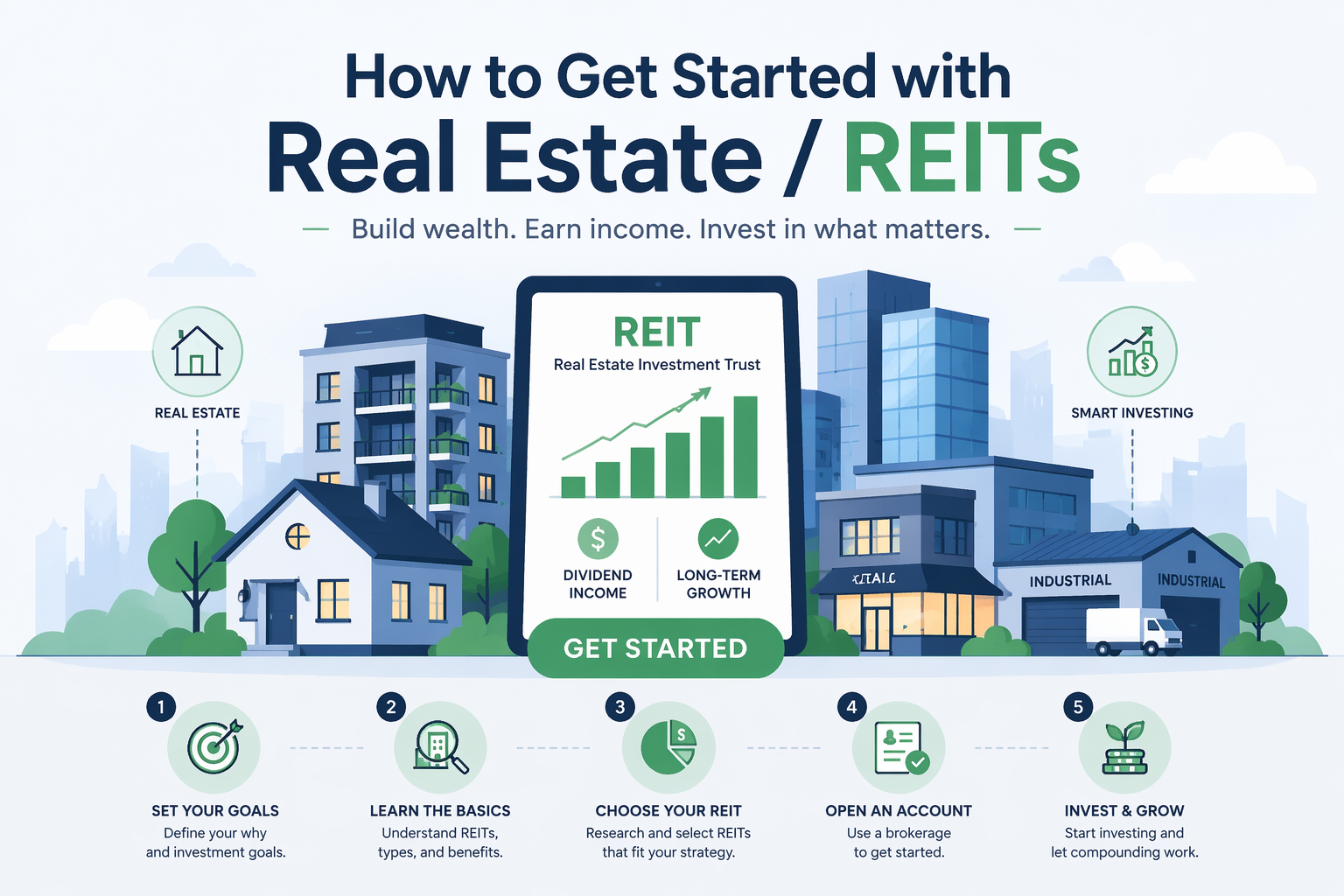
You’ve heard that real estate builds wealth, but you don’t have the capital or time to buy properties directly. You’re watching rental prices climb and wondering how to tap into that market without becoming a landlord. The good news? Real Estate Investment Trusts (REITs) let you invest in real estate with the ease of buying stocks—and 2026 is shaping up to be a strong year for them.
REITs are up 9.5% year-to-date in 2026 and are currently trading at a discount to their net asset value, presenting potential buying opportunities during this recovery cycle. Economic resilience and easing financial conditions are creating a supportive environment, with forecasted funds from operations (FFO) growth of approximately 6.5% this year.
By the end of this guide, you’ll know exactly how to evaluate, select, and invest in REITs—even if you’re starting from scratch. You’ll understand which types fit your goals, how to avoid overpaying, and how to build a diversified real estate portfolio without the headaches of property management.
What you need before starting:
- A brokerage account (most major platforms support REIT investing)
- Basic understanding of stock investing (if you can buy stocks, you can buy REITs)
- Estimated time: 20-30 minutes to read and plan, then ongoing as you research specific investments
Step 1: Understand What REITs Actually Are and How They Work
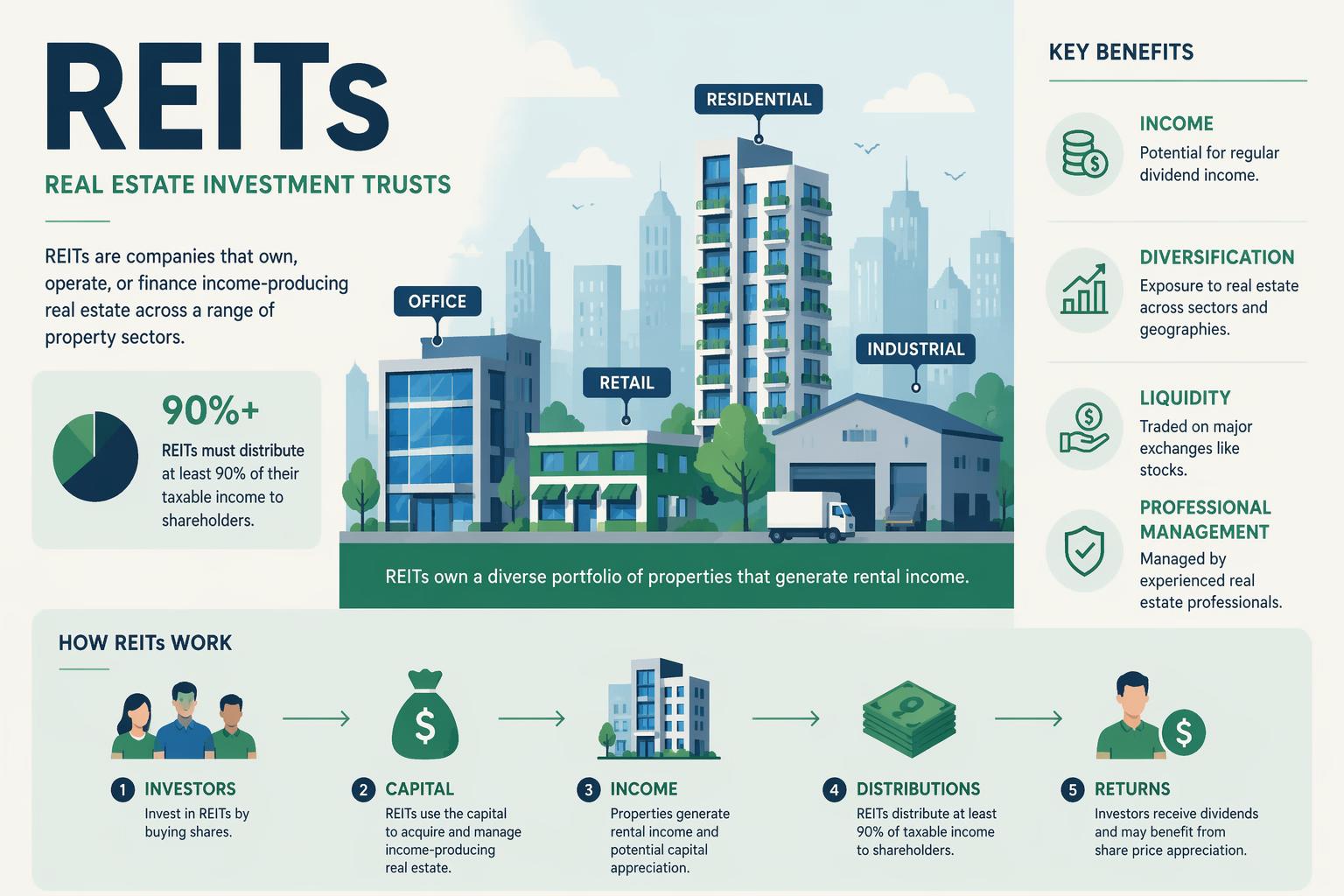
Before you invest a dollar, you need to understand the structure. REITs are companies that own, operate, or finance income-producing real estate. They’re required by law to distribute at least 90% of their taxable income to shareholders as dividends each year—which is why they’re attractive for income-focused investors.
There are three main types:
- Equity REITs: Own and operate properties (apartments, offices, shopping centers). They act like landlords and handle property management.
- Mortgage REITs: Own debt securities backed by properties. These typically carry higher risk and are more sensitive to interest rate changes.
- Hybrid REITs: Own both properties and commercial mortgages.
For most beginners, equity REITs or REIT ETFs (exchange-traded funds that hold multiple REITs) are the safer starting point.
You should see: A clear picture of how REITs differ from direct real estate ownership—you’re buying shares in companies that manage properties, not buying properties yourself.
Step 2: Know the Current Market Context (2026 Reality Check)
Timing matters in real estate investing. Here’s what you need to know about where REITs stand right now in 2026:
- REITs are trading at approximately a 2% discount to their net asset value (NAV) as of late 2025, according to market analysis
- Funds from operations (FFO) are up 6.2% overall
- Net operating income (NOI) is up 4.7%
- Total dividends paid increased 6.3%
- Certain property sectors have pricing power to raise rents above inflation
The FTSE NAREIT All Equity REITs Index showed a three-year total return of 21.9% and a five-year total return of 21.4% as of March 2026—outpacing many equity indices over the same period.
Why this matters: You’re not entering at a peak. The discount to NAV means you’re potentially buying below intrinsic value, and the strong operational metrics (FFO and NOI growth) suggest the underlying businesses are healthy.
> Note: REITs tend to perform well when interest rates fall or the economy strengthens. They typically underperform when rates rise or the economy weakens. Monitor Federal Reserve policy as you invest.
Step 3: Decide Between Individual REITs or REIT ETFs
You have two main paths: buy individual REIT stocks or invest in REIT ETFs that hold baskets of REITs.
Individual REITs give you:
- Control over specific property types (healthcare, residential, industrial)
- Potentially higher returns if you pick winners
- More research required and higher risk if you choose poorly
REIT ETFs give you:
- Instant diversification across dozens or hundreds of properties
- Lower risk through spreading exposure
- Professional management (for active ETFs) or low-cost tracking (for index ETFs)
- Lower expense ratios than mutual funds
For beginners, REIT ETFs are typically the smarter starting point. You avoid the risk of picking a single underperforming property sector.
You should see: A clear decision on your approach. If you’re new to real estate investing or don’t have time for deep research, lean toward ETFs.
Step 4: Research Top-Performing REIT ETFs for 2026
If you’re going the ETF route, here are the top-rated options as of 2026:
Dimensional US Real Estate ETF (DFAR)
- Morningstar Gold Rating
- Active management approach
- Yield: 2.69%
- Best for: Investors who want professional active selection of US real estate stocks
Vanguard Real Estate ETF (VNQ)
- Morningstar Silver Rating
- Index tracking (passive)
- Yield: 3.63%
- Best for: Low-cost broad exposure to US real estate
Schwab US REIT ETF (SCHH)
- Morningstar Silver Rating
- Index tracking
- Yield: 2.76%
- Best for: Cost-conscious investors wanting US REIT exposure
Vanguard Global ex-U.S. Real Estate ETF (VNQI)
- Morningstar Bronze Rating
- Index tracking
- Yield: 4.25%
- Best for: Diversifying beyond US markets with international real estate exposure
State Street SPDR Dow Jones Global Real Estate ETF (RWO)
- Morningstar Bronze Rating
- Index tracking
- Yield: 3.27%
- Best for: Global diversification including both US and international properties
For comparison, the iShares Core U.S. REIT ETF (USRT) delivered a 17.29% one-year return with a net expense ratio of just 0.08%—demonstrating that low-cost index ETFs can deliver strong performance.
You should see: 2-3 ETF candidates that match your goals (US-only vs. global, active vs. passive management, yield preferences).
> Note: Higher yields aren’t always better. A 4%+ yield might indicate higher risk or exposure to more volatile property sectors. Balance yield with overall total return potential.
Step 5: Evaluate Individual REIT Stocks (If Going That Route)
If you’re confident enough to pick individual REITs, focus on these factors:
Operational metrics:
- FFO growth (funds from operations—the REIT equivalent of earnings)
- NOI growth (net operating income)
- Occupancy rates
- Dividend payout ratio and history
Property sector exposure:
- Residential (apartments, single-family homes)
- Commercial (offices, retail)
- Industrial (warehouses, distribution centers)
- Specialized (healthcare, data centers, cell towers)
2026 sector insights from research:
- Certain property sectors currently have pricing power to raise rents above inflation
- The apartment rental market shows balanced supply and demand supporting rent growth
- Asia REITs delivered 28.0% total return, while Americas posted 5.5% and Europe 19.9%
As of July 2026, Diversified Healthcare Trust (DHC) was the best-performing REIT stock by one-year return at 145.74%—though past performance doesn’t guarantee future results.
You should see: A shortlist of 3-5 individual REITs with strong fundamentals in sectors you believe will perform well in 2026 and beyond.
Step 6: Check Valuation and Avoid Overpaying
Just because REITs are trading at a discount to NAV on average doesn’t mean every REIT is a good deal. Here’s how to avoid overpaying:
Price-to-FFO ratio: Similar to P/E ratio for stocks. Compare to historical averages and sector peers.
Dividend yield vs. historical range: If a REIT’s yield is significantly higher than its historical average, it might signal the market expects dividend cuts or operational problems.
Discount/premium to NAV: If you can find net asset value estimates, compare the current stock price. A discount suggests undervaluation; a premium means the market expects strong growth.
Valuation dispersion note: According to 2026 market analysis, valuation dispersion across property types remains elevated, meaning some sectors are expensive while others are cheap. This creates opportunity for selective investors.
You should see: Confidence that you’re not buying at inflated prices. If most metrics suggest overvaluation, wait for a better entry point or choose a different REIT.
Step 7: Open a Brokerage Account (If You Don’t Have One)
You’ll need a brokerage account to buy REITs or REIT ETFs. Most major platforms support this:
- Choose a broker that offers commission-free trading on stocks and ETFs
- Complete the account application (typically 10-15 minutes online)
- Fund your account via bank transfer
- Wait for funds to settle (usually 1-3 business days)
Popular options include Fidelity, Charles Schwab, Vanguard, and Interactive Brokers—all support REIT investing with no transaction fees on most ETFs.
You should see: A funded brokerage account ready to place trades, typically within 2-4 business days of starting the application.
Step 8: Place Your First REIT Trade
Now you’re ready to invest. Here’s the step-by-step:
- Log into your brokerage platform
- Search for your chosen REIT ticker symbol (e.g., VNQ for Vanguard Real Estate ETF)
- Review the current price and decide how many shares to buy
- Select “Market Order” for immediate execution at current price, or “Limit Order” to specify your maximum price
- Review and confirm the trade
Position sizing rule: Don’t put more than 10-15% of your portfolio in real estate/REITs initially. You want diversification across asset classes.
You should see: A confirmation screen showing your purchase, the number of shares, total cost, and settlement date.
> Note: Most brokers offer fractional shares for ETFs, meaning you can invest with as little as $10-$50 rather than buying full shares. This makes it easier to allocate exact dollar amounts.
Step 9: Set Up Dividend Reinvestment (DRIP)
Since REITs distribute at least 90% of income as dividends, you’ll receive regular dividend payments. Maximize compounding by setting up automatic reinvestment:
- Navigate to your brokerage account settings
- Find “Dividend Reinvestment Program” or “DRIP”
- Enable it for your REIT holdings
- Choose whether to reinvest all dividends or only specific securities
With DRIP enabled, your dividends automatically purchase additional shares (or fractional shares) without transaction fees, accelerating your wealth building.
You should see: DRIP confirmation for your REIT holdings. Your next dividend payment will automatically buy more shares instead of sitting as cash.
Step 10: Monitor Performance and Rebalance Quarterly
REITs aren’t a “set it and forget it” investment. Check your holdings quarterly:
What to review:
- FFO growth trends (target: at least 5-6% annually based on 2026 expectations)
- Dividend sustainability (payout ratio should be 75-90% of FFO)
- Occupancy rates and rent growth
- Overall portfolio allocation (rebalance if REITs grow beyond your target 10-15%)
When to sell or reduce:
- FFO declining for 2+ consecutive quarters
- Dividend cuts (unless temporary and explained by management)
- Your REIT allocation exceeds 20% of total portfolio
- Fundamental thesis changes (e.g., retail REITs if e-commerce disruption accelerates)
You should see: A quarterly review calendar in your system, and clear rules for when to rebalance or exit positions.
Step 11: Understand Tax Implications
REIT dividends are taxed differently than regular stock dividends:
- Most REIT dividends are taxed as ordinary income (not qualified dividend rates)
- This means your marginal tax rate applies (potentially 22-37% for higher earners)
- Holding REITs in tax-advantaged accounts (IRA, 401k) can significantly boost after-tax returns
Tax strategy: If possible, prioritize REIT holdings in retirement accounts and hold regular stocks in taxable accounts to take advantage of lower qualified dividend and long-term capital gains rates.
You should see: A clear understanding of how REIT dividends will impact your tax situation, and ideally a plan to hold them in tax-advantaged accounts.
> Note: Consult a tax professional for personalized advice, especially if you’re in a high tax bracket or have complex financial situations.
Step 12: Diversify Across Property Sectors Over Time
Once you’re comfortable with your initial REIT investment, consider diversifying across property types:
Residential REITs: Apartments, single-family homes (benefit from housing demand)
Industrial REITs: Warehouses, logistics centers (benefit from e-commerce growth)
Healthcare REITs: Medical facilities, senior housing (benefit from aging demographics)
Data Center REITs: Server facilities (benefit from cloud computing and AI growth)
Office REITs: Commercial office space (face headwinds from remote work, but may offer value at current discounts)
Retail REITs: Shopping centers, malls (selective opportunities in well-located properties)
Global diversification is also worth considering: Asia delivered 28.0% total return while Americas posted 5.5% and Europe 19.9% according to 2026 data. ETFs like VNQI (Vanguard Global ex-U.S. Real Estate) provide international exposure.
You should see: A plan to gradually build exposure across 3-4 different property sectors over 6-12 months, reducing concentration risk.
What You’ve Accomplished
You now have a working REIT portfolio providing passive real estate income without the hassles of property management. You’ve learned to evaluate REITs using FFO and NAV metrics, selected investments aligned with 2026 market conditions, and set up dividend reinvestment to compound your returns.
With REITs expected to grow earnings by 5-6% in 2026 and trading at attractive valuations, you’re positioned to benefit from both income and capital appreciation as the market recognizes their value.
Troubleshooting Common Issues
“My REIT ETF is down 5% since I bought it”
This is normal short-term volatility. REITs can fluctuate with interest rate expectations and broader market sentiment. Focus on the underlying FFO growth and dividend yield. If fundamentals remain strong, market price will eventually follow.
“The dividend yield looks too good to be true”
It might be. Yields above 7-8% often signal market concerns about dividend sustainability. Check the payout ratio (dividends divided by FFO)—if it exceeds 100%, the dividend may be at risk of being cut.
“Should I wait for interest rates to drop more before investing?”
Timing the market is difficult. REITs are already up 9.5% year-to-date in 2026, and waiting might mean missing gains. Consider dollar-cost averaging: invest a fixed amount monthly rather than all at once.
“My brokerage doesn’t offer fractional shares for the REIT I want”
Look for ETFs instead of individual REITs—most brokers support fractional ETF shares. Alternatively, save until you can afford a full share, or choose a lower-priced REIT.
“How do I know if I’m too concentrated in real estate?”
A general rule: REITs should represent 10-15% of your total investment portfolio, and real estate (including your home equity) should not exceed 25-30% of your net worth.
Next Steps
Now that you have your first REIT investment working for you:
- Set up quarterly reviews to monitor FFO growth and dividend sustainability
- Build positions in 2-3 more property sectors over the next 6 months to diversify
- Consider global exposure through international REIT ETFs if you’re currently US-only
- Optimize tax placement by moving REIT holdings to IRAs or 401(k)s when possible
- Track total return (dividends plus price appreciation) rather than just focusing on yield
REITs offer a powerful way to access real estate returns with stock-market liquidity. With over 70% of U.S. pension funds by assets incorporating REITs into their strategies, you’re following institutional best practices—just at an individual investor scale.
Frequently Asked Questions
Do I need a paid brokerage account to invest in REITs?
No. Most major brokers offer free accounts with commission-free trading on REITs and REIT ETFs. You only need enough money to buy shares (often as little as $10-$50 with fractional shares).
How long does it take to see returns from REIT investing?
You’ll receive your first dividend payment within 1-3 months of purchasing, depending on the REIT’s payment schedule. Price appreciation typically takes 1-3 years to materialize as the market recognizes value.
Can I invest in REITs without a brokerage account?
Generally, no. REITs trade on stock exchanges, so you need a brokerage account. However, some 401(k) plans offer REIT mutual funds or ETFs as investment options—check your plan’s fund lineup.
What’s the difference between active and passive REIT ETFs?
Passive (index) ETFs track a benchmark and typically have lower fees (0.08-0.15%). Active ETFs have managers selecting specific REITs and may charge 0.30-0.60%. The Dimensional US Real Estate ETF (DFAR) is an example of an active approach, while VNQ and SCHH are passive.
Should I invest in US REITs or include international exposure?
Both have merit. US REITs offer familiarity and strong governance standards. International REITs (especially Asia in 2026) have delivered higher returns but come with currency and regulatory risks. A 70/30 or 80/20 US/international split is reasonable for most investors.
Is a 3-4% dividend yield from REITs considered good?
Yes. As of 2026, REIT ETF yields range from 2.69% (DFAR) to 4.25% (VNQI). These are significantly higher than the S&P 500’s typical 1.5-2% yield. Combined with potential price appreciation, total returns of 8-12% annually are realistic long-term targets.
—
FTC Disclosure: This post contains affiliate links, which means I may earn a commission if you click through and make a purchase or sign up for a service. This comes at no additional cost to you. I only recommend products and services I believe provide genuine value. All opinions expressed are my own. For more information, please see my full disclosure policy.