Beginner’s Guide to Day Trading: What 96% of New Traders Wish They Knew Before They Started
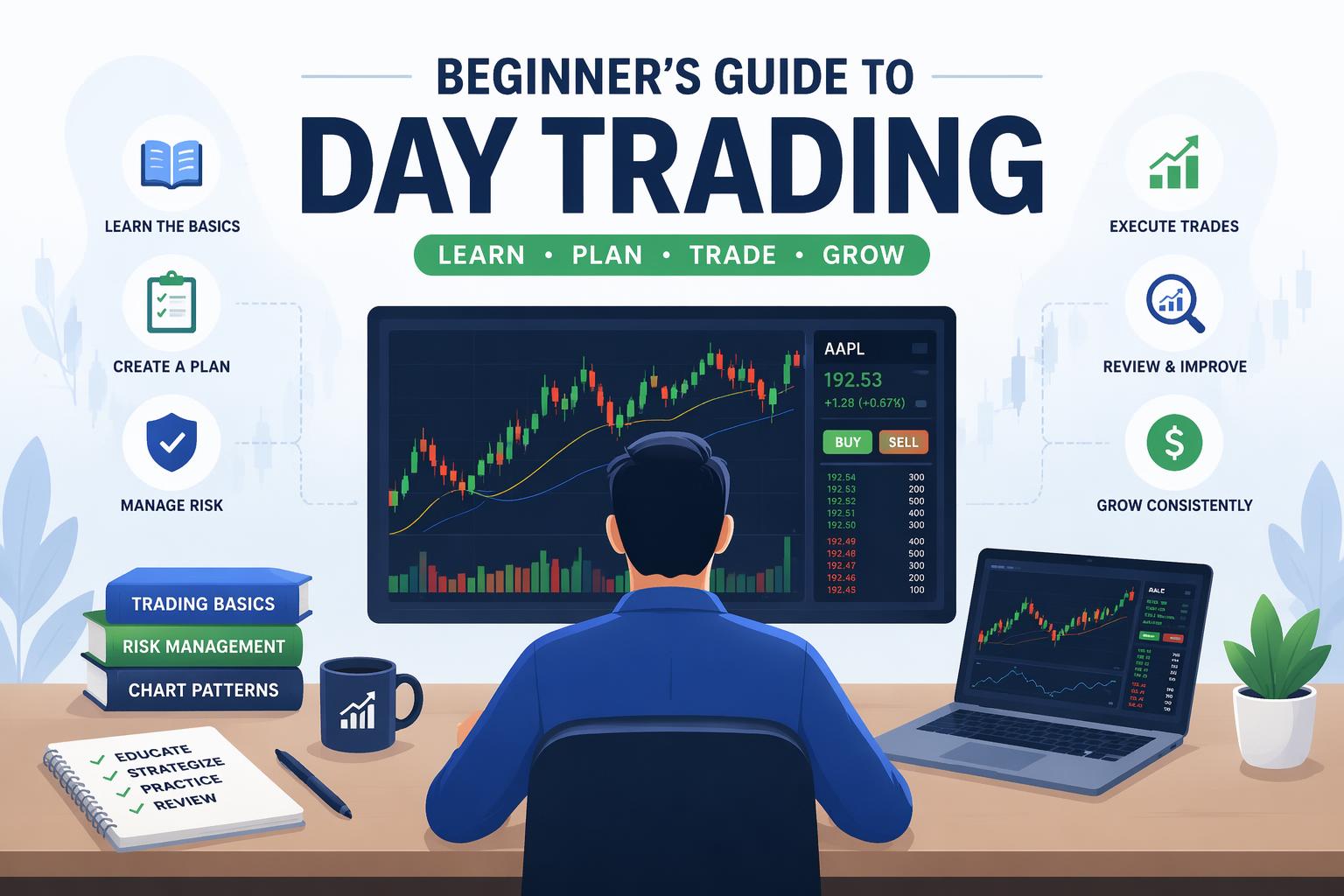
Day trading sounds like a shortcut to financial freedom. Buy low in the morning, sell high by lunch, repeat until you’re rich. Except it doesn’t work that way for most people. According to FINRA data, only 1 to 4% of day traders make money over the long term, and 72% lose money overall. That means the vast majority of people who start day trading end up worse off than when they began.
So why does anyone do it? Because the 1-4% who succeed aren’t just lucky—they treat day trading like a serious business, with rules, discipline, and a realistic understanding of what they’re getting into. This guide walks you through what day trading actually is, how it works in 2026, and what separates the rare winners from the overwhelming majority who lose.
Table of Contents
- What Is Day Trading, Really?
- How Day Traders Make (and Lose) Money
- The Pattern Day Trader Rule: The $25,000 Minimum You Need to Know About
- Day Trading vs. Long-Term Investing: What’s the Difference?
- What Markets Can You Day Trade?
- The Tools Day Traders Use: Technical Analysis and Platforms
- 7 Day Trading Strategies That Actually Work (With Real Success Rates)
- Why 96% of Day Traders Fail (and How to Avoid It)
- How Much Time Does Day Trading Really Take?
- Can You Day Trade While Working Full-Time?
- What Are Realistic Profit Goals for Beginners?
- Tax Rules for Day Traders Who Lose Money
- FAQ
—
What Is Day Trading, Really?
Day trading is buying and selling financial instruments—stocks, options, futures, currencies—within the same trading day. The goal is to profit from small price movements. You don’t hold positions overnight. By the time the market closes, you’re out of everything.
This is not investing. Investors buy assets they believe will grow over months or years. Day traders don’t care about a company’s long-term prospects. They’re looking at price patterns, volume spikes, and news events that move prices right now. If a stock jumps 2% in 10 minutes, a day trader wants to capture that move and get out before it reverses.
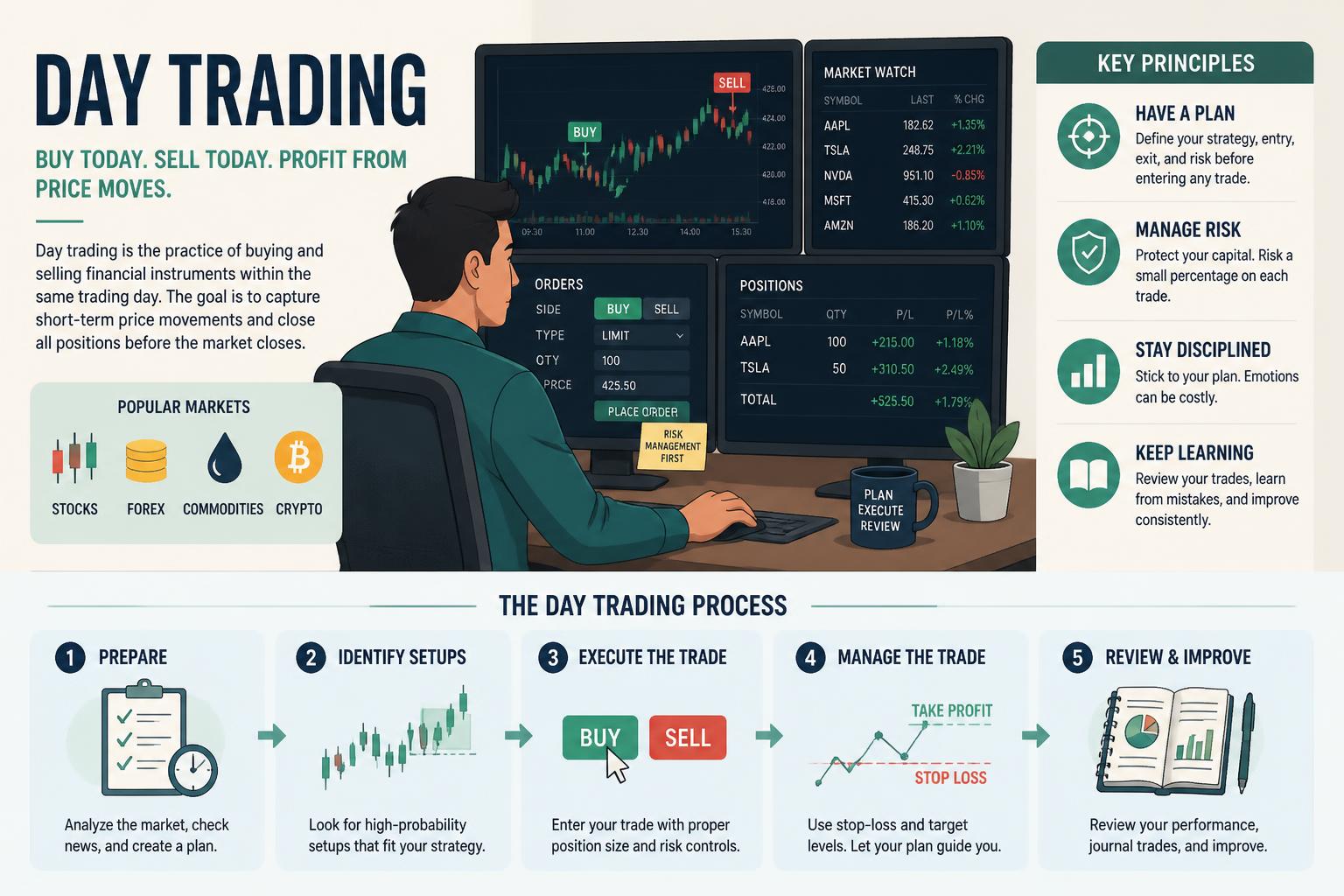
The appeal is obvious: time freedom, location freedom, and the potential for fast profits. The reality is harder. According to data from DayTrading.com, which has helped 387,586 traders across 195 countries since 2018, successful day trading requires a structured plan, disciplined risk management, and treating it like a serious business—not a hobby.
—
How Day Traders Make (and Lose) Money
Day traders profit from volatility. When a stock moves up or down quickly, there’s an opportunity. The trader buys when they think the price will go higher, or sells short when they think it will drop. The profit comes from the difference between the entry and exit price, minus fees and commissions.
Here’s the catch: every trade has a cost. Commissions, spreads, platform fees, and slippage eat into your gains. A trader who makes 10 trades a day with $5 commissions per trade is spending $50 daily just to participate. Over a month, that’s $1,000. Over a year, $12,000. Those costs mean a day trader needs to be right consistently just to break even.
And most aren’t. Traders using leverage—borrowed money to amplify their positions—averaged returns of -4.53%, according to research cited by Amerisave. Leverage magnifies gains, but it magnifies losses even faster. A 2% move against you on a 10x leveraged position wipes out 20% of your account.
The traders who succeed follow a strict rule: risk no more than 1-2% of your account on any single trade. If you have a $10,000 account, you risk $100-$200 per trade. That limits the damage when you’re wrong, which you will be—often. Even the best day traders lose on 40-50% of their trades. They win by cutting losses fast and letting winners run.
—
The Pattern Day Trader Rule: The $25,000 Minimum You Need to Know About
If you’re trading stocks or options in the U.S., you need to know about the Pattern Day Trader (PDT) rule. FINRA requires anyone who makes four or more day trades within five business days to maintain a minimum account balance of $25,000. If your account drops below that, you’re restricted from day trading until you bring the balance back up.
This rule exists to protect inexperienced traders from blowing up their accounts with leverage. But it also creates a high barrier to entry. Most beginners don’t have $25,000 to start with. That’s why many new traders turn to futures or forex, which aren’t subject to the PDT rule. Others use prop firms, which let you trade with the firm’s capital after passing an evaluation—no $25,000 required.
The PDT rule has been a source of controversy. Critics argue it locks out small traders and protects institutional players. In 2026, there’s been talk of reform, but as of now, the $25,000 minimum is still in place for stock and options day trading.
—
Day Trading vs. Long-Term Investing: What’s the Difference?
Long-term investors buy assets they believe will appreciate over years. They care about fundamentals: earnings, revenue growth, competitive advantages. They hold through volatility, collecting dividends and waiting for compound growth to do its work.
Day traders ignore all of that. They’re looking at charts, price action, and short-term catalysts. A company could be losing money and still be a great day trade if there’s a news event that spikes the stock price. The holding period is minutes to hours, not years.
This difference in approach means the skills required are completely different. A long-term investor needs to understand financial statements, industry trends, and valuation metrics. A day trader needs to read charts, manage emotions under pressure, and execute trades fast. One is not better than the other—they’re different games entirely.
For most people, long-term investing is the better choice. It requires less time, less stress, and has a much higher success rate. Day trading is for the rare person who thrives under pressure, can handle frequent losses without tilting, and is willing to treat it like a full-time job.
—
What Markets Can You Day Trade?
Day traders aren’t limited to stocks. In 2026, the most actively traded markets include:
- Stocks: U.S. equities on exchanges like NYSE and NASDAQ. High liquidity, thousands of options, but subject to the PDT rule.
- Options: Contracts that give you the right to buy or sell a stock at a specific price. Higher leverage and risk than stocks.
- Futures: Contracts based on commodities (oil, gold, agriculture), equity indexes (S&P 500, Nasdaq), and currencies. Popular because there’s no PDT rule and the market is open nearly 24 hours. Examples include energy, metals, and equity index products.
- Forex: Currency pairs like EUR/USD. The largest financial market in the world, open 24/5, with high leverage.
- Crypto: Bitcoin, Ethereum, and altcoins. Extremely volatile, 24/7 trading, but risky and unregulated in many jurisdictions.
Each market has different characteristics. Stocks are more regulated and predictable. Futures require understanding contract specs and tick values—for example, the NQ (Nasdaq-100 futures) has an average tick value of $5. Forex is highly leveraged and moves on macroeconomic news. Crypto is the Wild West.
New traders often start with stocks because they’re familiar, but many move to futures once they learn the PDT rule doesn’t apply. The key is picking a market that matches your schedule and risk tolerance.
—
The Tools Day Traders Use: Technical Analysis and Platforms
Day traders rely on technical analysis—the study of price charts, patterns, and indicators—to make decisions. They don’t care what a company does. They care what the chart says the price is likely to do next.
Common tools include:
- Candlestick charts: Show open, high, low, and close prices for each time period. Traders look for patterns like engulfing candles, hammers, and dojis.
- Support and resistance levels: Price levels where the stock tends to reverse. Support is where buyers step in; resistance is where sellers appear.
- Volume: Measures how many shares are traded. High volume confirms a move; low volume suggests a false breakout.
- Moving averages: Smooth out price data to show the trend. The 50-day and 200-day moving averages are popular for identifying long-term trends.
- Indicators: RSI (relative strength index), MACD (moving average convergence divergence), and Bollinger Bands help spot overbought or oversold conditions.
Platforms matter too. According to DayTrading.com, which reviewed 141 brokers as of July 2026, top-rated platforms include Interactive Brokers (rating: 4.3), NinjaTrader (rating: 4.5), eToro USA (rating: 3.4), and Plus500US (rating: 4). TradingView is widely used for charting and social networking among traders. Tradeovate offers simulation trading for futures, and Wagmi Trader provides an automated trading journal that tracks live trades.
The platform you choose affects your costs, execution speed, and available tools. Beginners often start with a free platform like TradingView or a broker with a demo account to practice before risking real money.
—
7 Day Trading Strategies That Actually Work (With Real Success Rates)
Not all strategies are created equal. According to Amerisave’s 2026 expert guide on day trading strategies, successful traders use these seven approaches:
- Momentum Trading: Buying stocks that are moving strongly in one direction on high volume. The idea is to ride the wave until momentum fades. This works best during market open when volatility is highest.
- Scalping: Making dozens of trades per day, holding positions for seconds to minutes, aiming for small profits each time. High frequency, low margin per trade. Requires fast execution and low commissions.
- Swing Trading: Holding positions for a few days to capture larger moves. Technically not pure day trading, but many day traders swing trade when they see a strong setup that needs more time to play out.
- News-Based Trading: Trading around earnings reports, economic data releases, or breaking news. Prices spike when news hits, creating opportunities for fast movers.
- Breakout Trading: Entering when price breaks through a key support or resistance level. The theory is that once a barrier is broken, momentum accelerates.
- Reversal Trading: Betting that a strong move in one direction will reverse. Riskier because you’re fighting the trend, but profitable if you catch the turn.
- Range Trading: Buying at support and selling at resistance in sideways markets. Works when the stock is bouncing between two price levels.
Over 24,000 people have been trained on these strategies, according to the Amerisave guide. But knowing the strategy isn’t enough. Execution, discipline, and risk management separate winners from losers.
—
Why 96% of Day Traders Fail (and How to Avoid It)
The failure rate is brutal. FINRA’s 2020 retail trading data shows 72% of day traders experience net losses, and only 1-4% achieve consistent long-term profitability. That means 96-99% either lose money or break even at best.
Why?
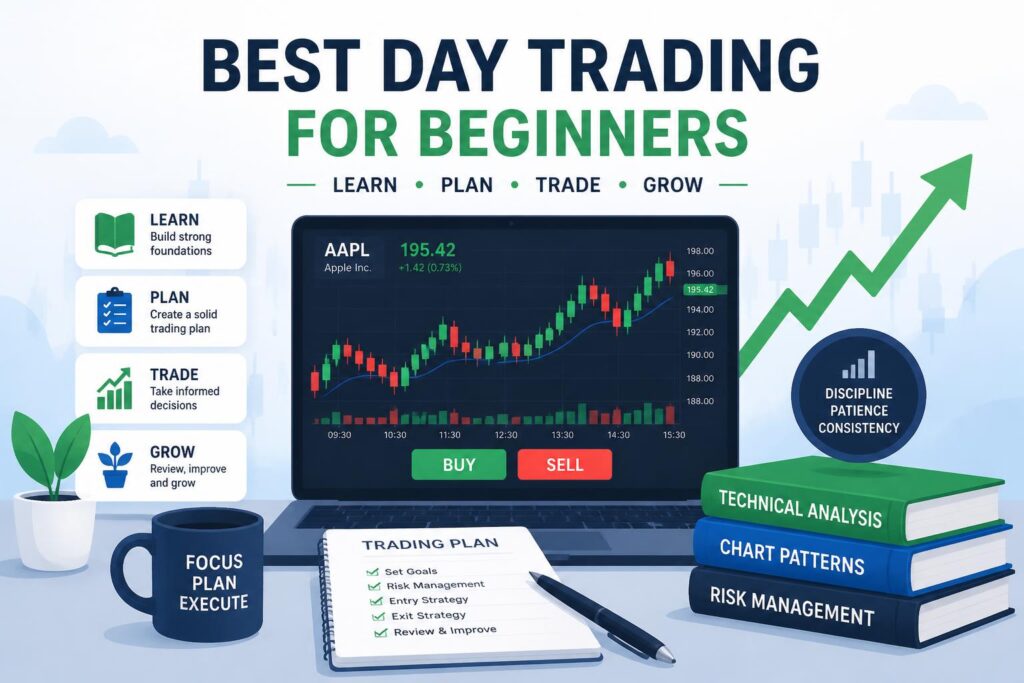
Lack of a trading plan. Most beginners trade on gut feel. They see a stock moving and jump in. No entry rules, no exit plan, no risk management. When the trade goes against them, they freeze or panic. A structured plan defines exactly when you enter, where you set your stop-loss, and when you take profit.
Overtrading. Beginners think more trades = more profit. In reality, every trade costs money. Commissions, spreads, and slippage add up. Traders who make 50 trades a day are often just churning their account and paying fees.
Ignoring risk management. Successful traders risk 1-2% per trade. Beginners risk 10%, 20%, or more because they’re chasing big wins. A few bad trades in a row and the account is blown.
Emotional trading. Losing streaks trigger revenge trading—trying to win back losses by taking bigger risks. Winning streaks trigger overconfidence—thinking you’ve figured it out and abandoning your rules. Both destroy accounts.
No backtesting. Traders jump into live trading without testing their strategy on historical data. Backtesting shows whether your approach would have worked in the past. It’s not a guarantee, but it’s better than guessing.
The traders who succeed treat day trading like a business. They have a written plan, track every trade in a journal, review their performance weekly, and adjust based on data—not emotions.
—
How Much Time Does Day Trading Really Take?
This depends on your strategy. Scalpers might be glued to their screens for hours, making dozens of trades. Swing traders check the market a few times a day to manage positions.
For pure day trading—entering and exiting within the same day—expect to dedicate at least 2-4 hours during market hours. The U.S. stock market is open 9:30 AM to 4 PM Eastern, but the most active period is the first hour (9:30-10:30 AM). Many day traders focus only on that window, when volume and volatility are highest.
Then there’s prep time. Before the market opens, traders scan for setups, check economic calendars, and review overnight news. After the market closes, they journal trades and review what worked and what didn’t. Add it all up, and serious day traders spend 4-6 hours a day on trading-related activities.
This is why most people can’t sustain day trading long-term. It’s not passive income. It’s an active job that requires focus, discipline, and mental stamina.
—
Can You Day Trade While Working Full-Time?
Technically, yes. Realistically, it’s hard.
If you work a 9-5 job in the U.S., you’re at work during market hours. You can’t monitor trades or react to fast-moving price action. Some people try to day trade on lunch breaks or before/after work, but they miss the most active hours.
Futures and forex are better options for people with day jobs because those markets are open nearly 24 hours. You can trade the evening session or early morning before work. But you still need uninterrupted time to focus. Trying to day trade while answering emails or attending meetings is a recipe for mistakes.
The reality is that day trading and a full-time job don’t mix well unless you’re willing to sacrifice sleep or trade less liquid markets. Most successful day traders either trade full-time or trade part-time with a flexible schedule that aligns with market hours.
—
What Are Realistic Profit Goals for Beginners?
Beginners often have wildly unrealistic expectations. They see YouTube videos of traders making $1,000 in a day and think they can do the same. The truth is most beginners lose money for the first 6-12 months while they learn.
A realistic goal for a beginner is to not lose too much while you’re learning. Aim for small, consistent gains—1-2% per month. If you have a $10,000 account, that’s $100-$200 per month. It doesn’t sound like much, but it’s a sign you’re trading with discipline and not gambling.
Once you’re consistently profitable for several months, you can aim for 3-5% per month. That’s still conservative, but sustainable. A trader making 5% per month compounds to 80% annually—far better than the stock market’s long-term average.
The traders making 20%, 50%, or 100% per month are either taking massive risks (and likely to blow up eventually) or they’re rare outliers. Don’t compare yourself to them. Focus on consistency, not home runs.
—
Tax Rules for Day Traders Who Lose Money
Day trading has tax implications, and they’re not intuitive.
If you’re classified as a “trader” by the IRS (not an investor), your trading activity is considered a business. That means you can deduct losses against other income, up to $3,000 per year. Any losses beyond that carry forward to future years.
But there’s a catch: to qualify as a trader, you need to trade frequently and consistently throughout the year. If you only trade occasionally, the IRS considers you an investor, and your losses are treated as capital losses, which have stricter rules.
Day traders also face wash sale rules. If you sell a stock at a loss and buy it back within 30 days, the loss is disallowed and added to the cost basis of the new position. This can complicate your tax return if you’re not tracking it carefully.
Some day traders elect Mark-to-Market (MTM) accounting, which treats all positions as if they were closed at the end of the year. This avoids wash sale rules and lets you deduct all losses, but you have to elect it by April 15 of the year you start trading, and it’s irrevocable without IRS approval.
Bottom line: talk to a tax professional who understands trader taxation. Mistakes can cost you thousands in extra taxes or trigger an audit.
—
FAQ
What is day trading?
Day trading is buying and selling financial instruments—stocks, options, futures, or currencies—within the same trading day. The goal is to profit from short-term price movements. Day traders close all positions before the market closes, so they’re not holding anything overnight.
How much money do you need to start day trading?
For U.S. stocks and options, you need at least $25,000 due to the Pattern Day Trader rule. For futures and forex, there’s no minimum, but most experts recommend starting with at least $5,000-$10,000 to have enough capital to manage risk properly. Some traders use prop firms, which let you trade with the firm’s capital after passing an evaluation.
What is the Pattern Day Trader rule?
The PDT rule, enforced by FINRA, requires anyone who makes four or more day trades within five business days to maintain a minimum account balance of $25,000. If your account drops below that, you’re restricted from day trading until you bring the balance back up. This rule applies to stocks and options, but not futures or forex.
What percentage of day traders actually make money?
According to FINRA data, only 1 to 4% of day traders achieve consistent long-term profitability. 72% lose money overall. The small percentage who succeed are disciplined, educated, and treat day trading like a serious business with strict risk management rules.
Can you day trade with less than $25,000?
Yes, but not U.S. stocks or options without running into the PDT rule. You can day trade futures, forex, or crypto with less than $25,000. You can also use a prop firm, which provides capital after you pass an evaluation, so you’re trading the firm’s money instead of your own.
What markets can you day trade?
Day traders work with stocks, options, futures (commodities, equity indexes, currencies), forex, and cryptocurrencies. Each market has different rules, hours, and characteristics. Futures and forex are popular because they’re not subject to the PDT rule and are open nearly 24 hours.
How much time does day trading take?
Expect to spend at least 2-4 hours during market hours if you’re actively day trading, plus prep time before the market opens and review time after it closes. The first hour of the U.S. stock market (9:30-10:30 AM Eastern) is the most active, and many day traders focus exclusively on that window.
What is the difference between day trading and investing?
Day trading focuses on short-term price movements and technical analysis. Traders close positions within the same day. Investing focuses on long-term growth and fundamentals. Investors hold assets for months or years. Day trading is active, time-intensive, and high-risk. Investing is passive, lower-stress, and has a much higher success rate.
What tools do day traders use?
Day traders rely on technical analysis tools like candlestick charts, support and resistance levels, volume indicators, moving averages, and oscillators like RSI and MACD. Popular platforms include Interactive Brokers, NinjaTrader, TradingView, and Tradeovate. Many traders also use automated journals like Wagmi Trader to track performance.
Why do most day traders fail?
Most fail because they lack a trading plan, overtrade, ignore risk management, trade emotionally, and don’t backtest their strategies. Successful traders risk only 1-2% per trade, follow a structured plan, and treat trading like a business. The majority of beginners risk too much, chase losses, and blow up their accounts.
Can you day trade while working full-time?
It’s difficult. U.S. stock market hours (9:30 AM – 4 PM Eastern) overlap with most work schedules. Futures and forex are open nearly 24 hours, so you can trade before or after work, but you still need uninterrupted time to focus. Most successful day traders either trade full-time or have flexible schedules that align with market hours.
What are realistic profit goals for day trading?
Beginners should aim to not lose too much while learning. A realistic goal is 1-2% per month once you’re consistently profitable. That’s $100-$200 per month on a $10,000 account. Once you’re experienced, 3-5% per month is sustainable. Traders claiming 20-50% monthly returns are either taking massive risks or are rare outliers.
How are day trading profits taxed?
Day traders are usually classified as traders (not investors) by the IRS, which means trading is treated as a business. You can deduct losses up to $3,000 per year against other income, with excess losses carrying forward. Day traders face wash sale rules, which disallow losses if you buy back the same security within 30 days. Some elect Mark-to-Market accounting to avoid this. Consult a tax professional.
What is a prop firm?
A prop firm (proprietary trading firm) lets you trade with the firm’s capital after you pass an evaluation. You keep a percentage of the profits (usually 70-90%), and the firm takes the rest. This allows traders to access larger capital without risking their own money. Examples include The Funded Trader, which offers instant funding with no challenge phases.
What role does AI play in day trading?
AI is increasingly used for automated trading strategies, pattern recognition, and backtesting. Some platforms offer AI-driven alerts and trade suggestions. However, most successful day traders still rely on their own analysis and judgment. AI can assist, but it’s not a replacement for discipline and a solid trading plan.