Debt Payoff Pros and Cons: The Real Trade-offs Nobody Tells You
You’ve Googled “what is debt payoff,” watched the YouTube videos, and you still don’t know which method to trust. Most advice treats debt payoff like a math problem. It’s actually a psychology problem wrapped in a spreadsheet.
Every debt payoff strategy has a hidden cost. The avalanche method saves you interest but tests your patience. The snowball method keeps you motivated but costs you more. Consolidation simplifies everything but requires credit you might not have. Debt relief tanks your credit score for years.
This guide walks through every major debt payoff approach in 2026: the mechanics, the real world pros and cons, and who each method works for. No fluff. Just the trade-offs you need to make an informed call.
Table of Contents
- What Is Debt Payoff? (And Why Strategy Matters More Than You Think)
- First: Calculate Your Debt Load — It Changes Everything
- The Debt Snowball Method: Wins Early, Pays More Later
- The Debt Avalanche Method: Maximum Savings, Minimum Dopamine
- Balance Transfer Cards: 0% Interest Is Great — If You Qualify
- Debt Consolidation Loans: One Payment, One Big Catch
- Debt Management Plans: The 3-to-5-Year Grind
- When to Walk Away: Debt Relief and Settlement
- The Tools: Debt Payoff Planners That Actually Work in 2026
- FAQ
—
What Is Debt Payoff? (And Why Strategy Matters More Than You Think)
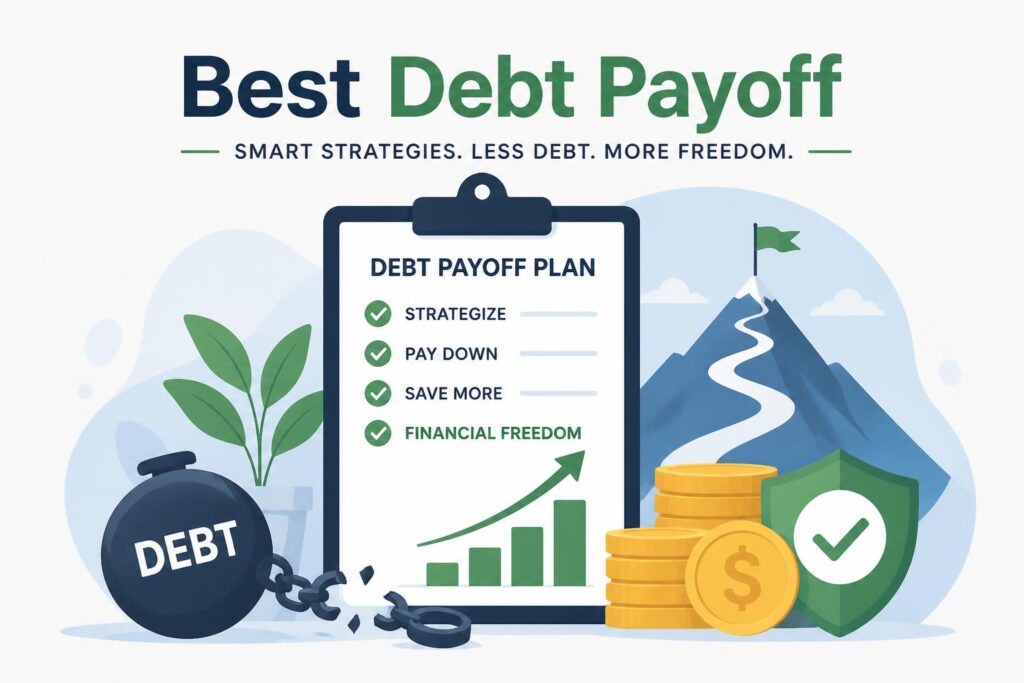
Debt payoff is the process of eliminating outstanding balances (credit cards, personal loans, medical bills, student loans) using a structured plan. It’s not “pay more when you can.” It’s a deliberate sequence: which debt to hit first, how much extra to throw at it, and what to do when motivation runs out.
The strategy you pick changes two things: how much interest you pay, and whether you’ll finish.
Most people bail on debt payoff plans within 90 days. Not because the math is hard. Because the emotional payoff arrives too late. A method that saves you $2,000 in interest over five years is mathematically sound, but if you quit in month two because you don’t feel progress, you’ve saved nothing.
That’s why your debt load matters more than the strategy itself.
—
First: Calculate Your Debt Load — It Changes Everything
Before you pick a method, calculate your debt to income ratio. This number determines whether you can DIY your way out or if you need outside help.
How to calculate it:
Total monthly debt payments ÷ gross monthly income = debt load percentage
Example: $1,800 in debt payments ÷ $5,000 gross income = 36%
What the number means (as of 2026):
- Under 36%: A DIY approach makes sense. Snowball, avalanche, or consolidation can work.
- 36% to 42%: Try DIY first, but consider getting help if progress stalls.
- 43% or more: You’re in debt relief territory. DIY methods will take too long and cost too much in interest.
This threshold isn’t arbitrary. Debt greater than 43% of income means minimum payments alone eat most of your discretionary income, leaving almost nothing for extra payments. At that load, even aggressive DIY plans can stretch 10+ years.
If you’re above 43%, skip to the debt relief section. If you’re under 36%, you’ve got options.
—
The Debt Snowball Method: Wins Early, Pays More Later
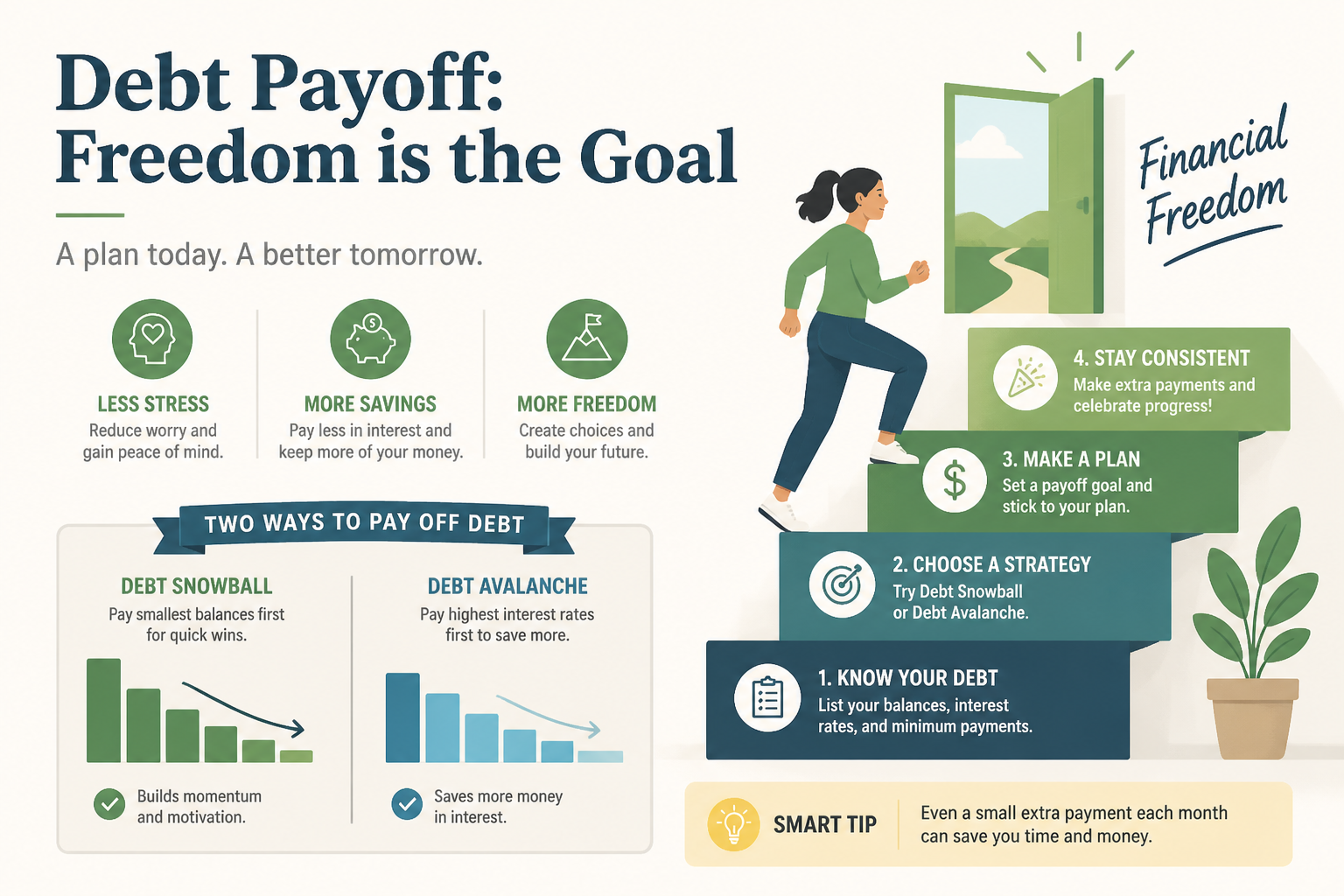
How it works: Pay minimums on everything, then throw all extra money at your smallest balance. When that’s gone, roll that payment into the next smallest debt. Repeat until you’re done.
Wiping out a $400 medical bill in month one feels like progress because it is. Quick wins boost motivation and build momentum, which matters when you’re staring down a multi year slog. The method is simple to execute. No interest rate calculations, no spreadsheet gymnastics. Smallest balance first, every time. If you’ve abandoned debt payoff plans before, the snowball’s early wins make it easier to stick with.
But you’ll pay more interest. By ignoring interest rates, you’re letting high APR debts sit untouched while you chip away at smaller, lower interest balances. Over the life of the payoff, this can cost you hundreds or thousands depending on your debt mix. The math doesn’t care about your feelings. If your smallest debt has a 9% APR and your largest has a 24% APR, you’re paying 24% interest on a growing balance while celebrating the small win.
If most of your debt is high interest credit cards, the snowball delays attacking the most expensive balances. That’s the trade.
The snowball is for people who’ve tried logical, math first methods and quit. If you know you need the dopamine hit of crossing debts off a list, the snowball keeps you in the game. It’s not the cheapest path, but finishing an expensive plan beats abandoning a cheap one.
—
The Debt Avalanche Method: Maximum Savings, Minimum Dopamine
How it works: Pay minimums on everything, then throw all extra money at the debt with the highest interest rate. When it’s gone, move to the next highest rate. Repeat.
You’ll pay the least interest. Paying off high interest debt first reduces the total interest paid over time. If you have a mix of 24% credit cards and 6% personal loans, avalanche saves you real money. Mathematically, there’s no faster way to eliminate debt by the numbers. Every extra dollar goes toward the most expensive balance. If you’re motivated by spreadsheets, interest savings projections, and long term optimization, avalanche keeps you engaged.
Your first win can take months. If your highest interest debt is also your largest balance, you might spend 6+ months making extra payments before you see a balance hit zero. That’s a long time to stay motivated on faith alone. You don’t get the psychological reward of quick wins. You’re trusting the math while your progress feels slow. If life throws an unexpected expense in month three and you lose momentum, the avalanche method offers no small victories to pull you back in.
The avalanche is for people who are motivated by long term optimization and don’t need frequent validation. If you can stay disciplined for 6 to 12 months before seeing a balance disappear, and you want to minimize total interest, avalanche is your method.
—
Balance Transfer Cards: 0% Interest Is Great — If You Qualify
How it works: Open a balance transfer credit card with a 0% intro APR (typically 15 to 21 months as of 2026), move your existing credit card balances to it, and pay off the balance before the promo period ends.
No interest for 15 to 21 months. Every dollar you pay goes directly to principal. If you’re paying 20%+ APR on existing cards, this is massive interest savings. It simplifies payments too. Instead of juggling multiple credit card bills, you’ve got one payment to one card. Once balances are on the 0% card, you can use any payoff method you want without interest working against you.
You need good or excellent credit. If your credit score has taken hits from late payments or high utilization, you won’t qualify for the best 0% offers, or any offer at all. Most cards charge 3 to 5% of the transferred amount upfront. Transferring $10,000 costs you $300 to $500 immediately. The clock is ticking. If you don’t pay off the balance before the promo ends, the remaining balance gets hit with the card’s standard APR (often 18 to 25%). That defeats the entire purpose.
Balance transfers don’t address spending habits. If you transferred balances but kept using the old cards, you’ve just added more debt on top of the balance transfer.
This is for people with good credit, a clear payoff timeline, and the discipline to not rack up new debt. If you can realistically pay off the transferred balance in 12 to 18 months, balance transfers are one of the most cost effective tools available in 2026.
—
Debt Consolidation Loans: One Payment, One Big Catch
How it works: Take out a personal loan (rates range from 7% to 36% as of 2026), use it to pay off multiple debts, and then make one fixed monthly payment on the consolidation loan.
One loan, one due date, one payment amount. No more juggling five credit cards and two medical bills. Unlike credit cards with variable APRs, consolidation loans lock in your rate and give you a clear payoff date. If your credit cards are at 22% and you qualify for a 12% consolidation loan, you’re cutting your interest cost in half. Fixed payment means you know exactly what you owe every month. No surprises.
That 7 to 36% range isn’t a typo. If your credit is shaky, you might get stuck with a 28% consolidation loan that’s higher than your current credit card rates. Consolidation doesn’t reduce the principal. You still owe the same total debt. You’ve just moved it. Once your credit cards are paid off via the loan, those cards have zero balances again. If you start using them, you’ll end up with the consolidation loan plus new credit card debt. Many lenders charge 1 to 6% of the loan amount upfront. Borrowing $15,000 might cost you $150 to $900 just to open the loan.
Consolidation is for people with decent credit who are drowning in payment logistics, not the debt itself. If your main problem is “I can’t keep track of seven due dates” and your credit qualifies you for a rate lower than your current average, consolidation makes sense. If your rate would be higher, skip it.
—
Debt Management Plans: The 3 to 5 Year Grind
How it works: A nonprofit credit counseling agency negotiates with your creditors to lower interest rates and set up a single monthly payment. You pay the agency, they distribute payments to creditors. The process takes three to five years.
Creditors agree to reduce rates to 6 to 10% (sometimes lower) as part of the plan. Like consolidation, but without taking out a new loan. The agency handles creditor communication, which is helpful if you’re overwhelmed or don’t want to negotiate yourself. You know exactly when you’ll be debt free if you stick to the plan.
Most plans require you to close the enrolled accounts. You won’t be able to use them during the plan. That’s a long commitment. If your situation changes or you miss payments, you’re back to square one. Agencies charge $25 to $75 per month (varies by state and agency). Over five years, that’s $1,500 to $4,500 in fees. Some creditors refuse to work with debt management plans, meaning you’d still owe those debts separately. While not as severe as debt settlement, enrolling in a DMP can show up on your credit report and affect your ability to get new credit.
DMPs are for people in the 36 to 42% debt load range who need creditor cooperation but don’t qualify for consolidation loans or balance transfers. If you’re past the point of DIY but not desperate enough for settlement, a DMP is the middle ground option.
—
When to Walk Away: Debt Relief and Settlement
How it works: You stop paying creditors. A debt settlement company negotiates with creditors to accept less than you owe (usually 40 to 60% of the balance). You pay the settlement amount, and the rest is forgiven.
If a $20,000 credit card balance gets settled for $10,000, you’ve wiped out $10,000 of debt. Settlements can happen in 2 to 4 years, which is shorter than most DMPs. If your debt load is 43%+ and there’s no realistic path to repayment, settlement is built for your situation.
Your credit score will tank. Stopping payments and settling for less than owed will wreck your score for years. Expect it to drop 100+ points and stay low until the settled accounts age off your report. While you’re not paying and the settlement is being negotiated, creditors will call. A lot. Forgiven debt over $600 is considered taxable income by the IRS. If $10,000 is forgiven, you’ll owe income tax on that amount. Settlement companies charge 15 to 25% of the enrolled debt. Settling $30,000 in debt could cost you $4,500 to $7,500 in fees. Some creditors will sue instead of negotiating. If they win, you’re facing wage garnishment. The debt settlement industry has a lot of bad actors. Many companies take your money and deliver nothing.
Settlement is for people with debt loads at or above 43% of income, who are already missing payments or facing default. If bankruptcy feels like the only option but you want to avoid it, settlement is the step before that nuclear option. It’s not pretty, but it’s faster and less destructive than bankruptcy.
—
The Tools: Debt Payoff Planners That Actually Work in 2026
You don’t need a planner to execute debt payoff, but a good one makes it easier to visualize progress and stay on track. As of 2026, here are the debt payoff planners that deliver.
Debt Payoff Planner (4.8/5 stars)
Cost: Free or $2/month for premium features
What it does: Avalanche, snowball, and custom debt repayment methods with progress visualizations and a clean interface.
Simple, low fees, clear progress tracking. Rated best overall in 2026 based on an evaluation of eight debt payoff planners across 36 factors. You’ll need to input your debt details manually, but this is common among debt planners.
For anyone using snowball or avalanche who wants a visual tracker without paying $15 per month.
You Need a Budget (YNAB) (3.7/5 stars)
Cost: $14.99/month or $109/year
What it does: Zero based budgeting with spending analysis and mobile app support. Not a debt specific tool, but excellent for finding extra cash to throw at debt.
Forces you to account for every dollar, which reveals spending leaks fast. Mobile app makes it easy to track on the go. Steep learning curve. YNAB’s method requires commitment to learn and maintain. Expensive compared to debt only trackers.
For people who need to overhaul their entire budget to find money for debt payoff, not just track the debt itself.
Unbury.me (3.3/5 stars)
Cost: Free
What it does: Simple interface, track unlimited debts, choose from snowball or avalanche methods.
Free, fast, no account required. You can start modeling your debt payoff in under two minutes. No mobile app. No syncing across devices. Bare bones feature set.
For people who want a quick, no friction way to see avalanche vs. snowball projections without downloading an app or paying.
Vertex42 Debt Reduction Calculator (3.5/5 stars)
Cost: Free basic version or $9.95 for extended features
What it does: Downloadable for Excel and Google Sheets, allows custom debt strategies, one time fee for the extended version.
Works offline. Full control over formulas and customization. One time payment instead of subscription. Requires Excel or Google Sheets knowledge. Not as visually appealing as app based planners.
For spreadsheet people who want full control and don’t need a mobile app.
—
FAQ
What is the debt snowball method?
The debt snowball method prioritizes paying off your smallest balance first, regardless of interest rate. You pay minimums on all debts, then throw extra money at the smallest one. Once it’s paid off, you roll that payment into the next smallest debt. The method creates quick psychological wins that keep you motivated, though it costs more in interest than the avalanche method.
What is the debt avalanche method?
The debt avalanche method prioritizes paying off the debt with the highest interest rate first. You pay minimums on everything, then put extra money toward the highest APR balance. Once that’s gone, you move to the next highest rate. This method minimizes total interest paid but can take longer to see your first debt fully eliminated, which tests motivation.
Should I use a balance transfer card or a consolidation loan?
If you have good credit and can pay off the balance within the 0% promo period (15 to 21 months in 2026), a balance transfer card saves you more on interest. If you need a longer timeline or don’t qualify for 0% offers, a consolidation loan with a fixed rate and term is more predictable. Balance transfers win on cost if you finish before the promo ends. Consolidation wins on structure and timeline flexibility.
When should I consider debt relief or settlement?
If your debt load is 43% or more of your gross income and you’re already missing payments or facing default, debt relief or settlement is worth exploring. It will damage your credit score and come with tax consequences, but it’s faster than trying to DIY your way out of a load that size. Settlement should be a last resort before bankruptcy, not a shortcut to avoid payments you can realistically make.
How do I choose the best debt payoff planner for my needs?
Pick based on what derails you. If you need visual motivation and progress tracking, use Debt Payoff Planner (4.8/5 stars, free or $2/month). If your problem is budgeting and finding extra cash, use You Need a Budget ($14.99/month). If you just want a free, fast projection of avalanche vs. snowball, use Unbury.me. If you’re a spreadsheet person who wants full control, use Vertex42. Don’t overthink the tool. Pick one and start. Switching planners wastes more time than using an imperfect one consistently.
—
Every debt payoff method trades one thing for another. Snowball trades interest cost for motivation. Avalanche trades early wins for long term savings. Balance transfers trade upfront fees and credit requirements for 0% interest. Consolidation trades simplicity for origination fees and the risk of reusing credit cards. Debt relief trades credit score damage for a faster exit.
There’s no universally “best” method. There’s only the method you’ll actually finish, and that depends on your debt load, your credit, and whether you’re motivated by quick wins or long term math. Calculate your debt load, pick the strategy that matches it, and commit. The worst plan is the one you abandon in month two.