Is Cashback & Rewards Worth It? The Real Math Behind Card Rewards in 2026
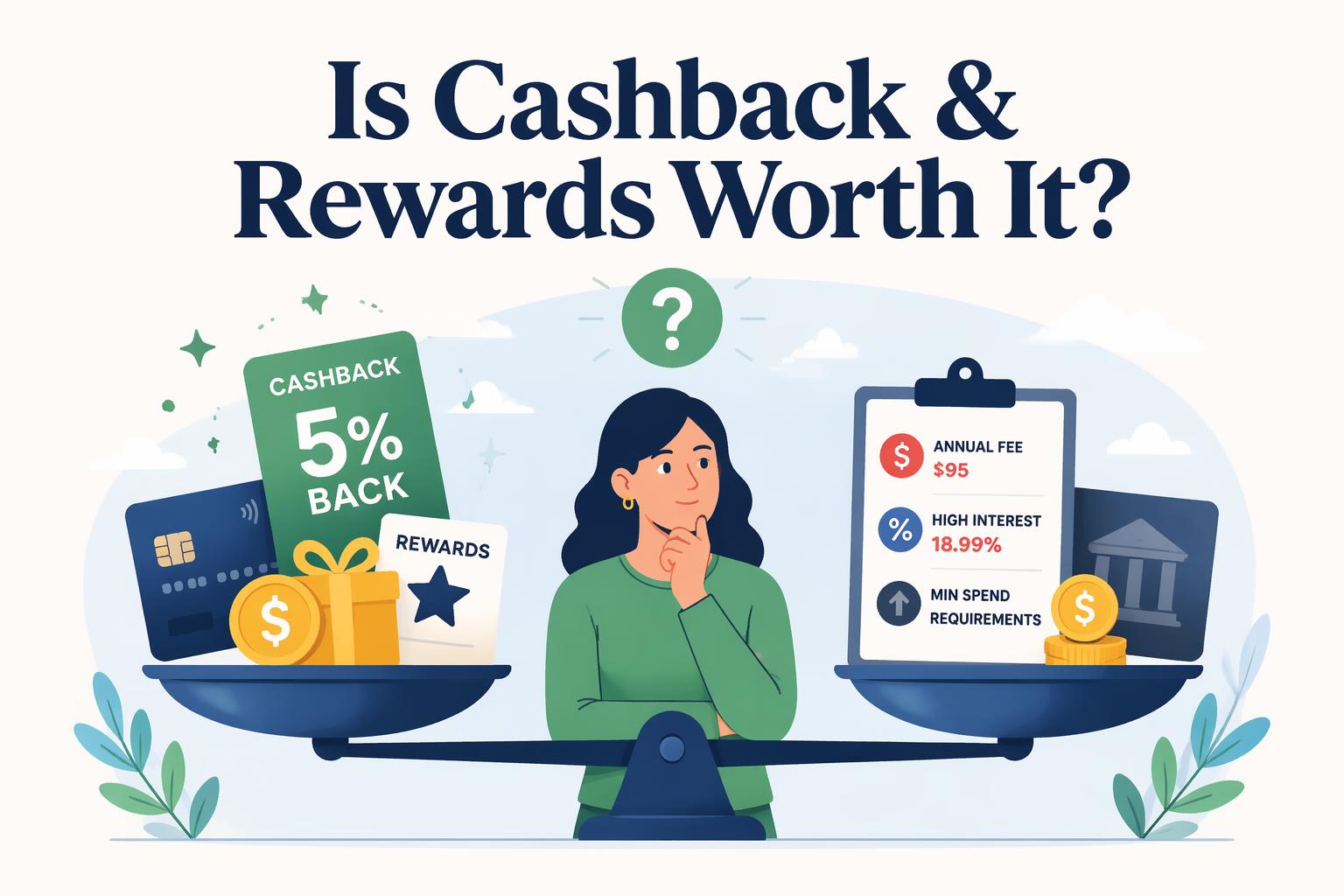
You’ve seen the ads. 5% back on groceries. 3% on dining. Unlimited 1.5% on everything. It sounds incredible—until you start doing the actual math on what you earn versus what you spend chasing those rewards.
Here’s what most cashback marketing won’t tell you: the average American household spends $77,280 annually, according to 2026 data. But after you strip out housing, vehicles, and healthcare—categories most cards exclude—you’re looking at $28,210 in eligible spending. That’s the real pot you’re earning from. And suddenly, those percentages don’t look quite so generous.
So is cashback actually worth it? Or are you just giving credit card companies free data on your spending habits while they pocket the merchant fees?
Let’s cut through the promotional language and look at the numbers.
Table of Contents
- What Cashback & Rewards Actually Are (And How They Work)
- The Real Math: How Much You’ll Actually Earn
- The Hidden Costs Nobody Talks About
- Who Actually Benefits From Cashback Cards
- Flat-Rate vs Rotating Categories: Which Wins?
- When Cashback Cards Are NOT Worth It
- How to Pick the Right Card (If You Decide It’s Worth It)
- FAQ
What Cashback & Rewards Actually Are (And How They Work)
Cashback credit cards give you a percentage of your purchase amount back as a reward. Spend $100, get $2 back. Spend $1,000, get $20 back. The rate varies wildly depending on the card and what you’re buying.
There are three main types:
Flat-rate cards give you the same percentage on everything. The Citi Double Cash® Card, for example, gives 2% back on every purchase—1% when you buy, 1% when you pay it off. No categories to track, no quarterly activation. You spend, you earn.
Rotating category cards change their bonus categories every quarter. In Q1 2026, Discover it® Cash Back offered 5% on grocery stores, wholesale clubs, and select streaming services. By Q2, that shifted to restaurants and home improvement stores. Q3 brought gas stations, transportation, and drug stores into the 5% tier. But here’s the catch: you can only earn that 5% rate on up to $1,500 in purchases per quarter. After that, you drop to 1%. That’s a maximum of $75 cashback per quarter, or $300 annually, if you max it out every time.
Tiered category cards lock in higher rates for specific spending types year-round. The Blue Cash Preferred® Card from American Express gives 6% back at U.S. supermarkets and 3% at gas stations—but charges a $95 annual fee after the first year. The Chase Freedom Unlimited® offers 5% on travel booked through Chase, 3% at restaurants and drugstores, and 1.5% on everything else, with no annual fee.
The redemption part matters too. Most cards let you redeem for statement credits (cash applied to your balance), direct deposit, or gift cards. Some travel cards push you toward booking through their portal, where “cash back” becomes points with restricted value. For pure cashback cards, you’re getting actual dollars you can use however you want.
One thing the marketing glosses over: you only earn on purchases the card issuer considers eligible. Balance transfers, cash advances, fees, and interest charges don’t count. And depending on the card, certain merchant categories might be excluded from bonus rates even if they seem like they should qualify.
The Real Math: How Much You’ll Actually Earn
Let’s run the numbers with real 2026 spending data and see what these cards actually deliver.
The average American household has $28,210 in annual spending that’s eligible for cashback after excluding housing, vehicles, and healthcare. Let’s break that into realistic category spending and see what six popular cards would earn you:
Chase Freedom Unlimited® (no annual fee):
- 5% on travel through Chase: assume $800 = $40
- 3% on dining and drugstores: assume $4,200 = $126
- 1.5% on everything else: $23,210 = $348.15
- Total annual cashback: $514.15
But here’s where it gets interesting. According to Yahoo Finance’s 2026 analysis, this same card structure could generate $482.15 in annual cashback under their spending model—about $32 less than our estimate. The difference? How much you actually spend in the bonus categories.
Discover it® Cash Back (no annual fee):
- 5% on rotating categories (capped at $1,500/quarter): $6,000 max = $300
- 1% on everything else: $22,210 = $222.10
- First-year Cashback Match doubles everything: first year $1,044.20, then $522.10/year
The Cashback Match is the real hook here. Discover doubles whatever you earn in your first year. If you max out those rotating categories and put another $22,210 through the card, you’re looking at over $1,000 in year one. But after that, you’re back to $522.10 annually—assuming you remember to activate each quarter and actually spend in the right categories.
Citi Double Cash® Card (no annual fee):
- 2% on everything: $28,210 = $564.20
- Total annual cashback: $564.20
This is the simplest math. No categories, no activation, no tracking. Just 2% back, always. For someone who doesn’t want to think about their card, this wins on convenience. And according to both our math and Yahoo Finance’s 2026 data, it delivers $564.20 annually—making it one of the highest flat-rate earners.
Blue Cash Preferred® Card from American Express ($95 annual fee after first year):
- 6% at U.S. supermarkets: assume $5,000 = $300
- 3% at gas stations: assume $2,000 = $60
- 1% on everything else: $21,210 = $212.10
- Total: $572.10 before fee, $477.10 after fee
The $95 fee is the killer. You need to spend at least $1,584 on groceries annually just to break even with a 2% flat-rate card. If you’re spending $5,000+ at supermarkets, you come out ahead. If not, you’re paying for the privilege of worse returns.
Capital One Savor Cash Rewards (no annual fee, but sometimes offered with fees on other versions):
- 3% on dining and entertainment: assume $4,500 = $135
- 1% on everything else: $23,710 = $237.10
- Plus $200 sign-up bonus in first year
- Total: $372.10 annually, $572.10 in year one with bonus
The sign-up bonus makes year one attractive. After that, unless you’re spending heavily on dining and entertainment, a flat 2% card will likely beat it.
Best for variable spending (Yahoo Finance, 2026): $522.10 annually
Best for groceries (Yahoo Finance, 2026): $590.65 annually
Best for online shopping (Yahoo Finance, 2026): $451.08 annually
The takeaway? If you’re strategic and your spending aligns with the card’s strengths, you can realistically earn $450 to $600 per year in cashback. That’s real money. But it requires discipline, category awareness, and often juggling multiple cards to maximize returns.
The Hidden Costs Nobody Talks About
Cashback sounds like free money. But there are costs—some obvious, some buried in the fine print.
Annual fees are the most visible. The Blue Cash Preferred® charges $95 after the first year. The Capital One QuicksilverOne hits you with a $39 annual fee for a 1.5% flat rate—a deal that makes no sense when the Chase Freedom Unlimited® offers 1.5% with no fee. Any card with an annual fee needs to clear that cost in extra earnings before you’re actually ahead. Run the math before you apply.
Interest charges obliterate cashback value instantly. Let’s say you carry a $2,000 balance on a card with an 18% APR. You’re paying $360 in interest annually. Even if you earned $500 in cashback that year, you’re still $140 in the hole. Cashback cards are only worth it if you pay your balance in full every month. If you can’t, you’re better off with a low-APR card or no card at all.
The mental tax of tracking categories is real but hard to quantify. Rotating category cards like Discover it® require you to:
- Check which categories are active each quarter
- Activate the bonus (yes, you have to manually opt in)
- Remember which card to use for which purchase
- Track your spending to know when you’ve hit the $1,500 cap
Miss any of those steps and you’re leaving money on the table. One missed activation costs you up to $60 that quarter. For some people, that’s worth the effort. For others, it’s cognitive overhead that makes a simple 2% flat-rate card more valuable.
Spending more to earn more is the trap card issuers are betting on. If you’re buying things you wouldn’t have bought otherwise just to hit a bonus category or sign-up spending threshold, the cashback isn’t a reward—it’s a small refund on unnecessary purchases. You’re still net negative.
Redemption restrictions vary by card. Most cashback cards let you redeem for statement credits or direct deposit with no strings attached. But some travel cards market “cashback” that’s actually points you can only use in their booking portal, often at inflated prices or limited availability. Read the redemption terms before you sign up.
Credit score requirements lock out a chunk of potential users. Most cashback cards want a credit score of 670 or higher. If your score is below that, you’ll either get denied or pushed toward cards with worse terms—higher fees, lower rates, or both.
Who Actually Benefits From Cashback Cards
Not everyone comes out ahead with cashback cards. Here’s who does:
People who pay off their balance in full every month. This is the non-negotiable. If you carry a balance, interest charges will eat your cashback and then some. Cashback cards are for transactors, not revolvers.
High spenders in specific categories. If you’re spending $5,000+ annually on groceries, the Blue Cash Preferred® makes sense even with the $95 fee. If you’re spending $6,000+ in rotating categories and willing to track them, Discover it® could deliver over $500/year after the first-year match ends. But if your spending is spread thin across many categories, a flat 2% card is often better.
People who already track their finances. If you’re monitoring your spending, setting budgets, and reviewing statements regularly, adding “check which card to use” isn’t a big lift. If you’re not doing any of that, a cashback card with rotating categories will just frustrate you.
Strategic optimizers willing to juggle multiple cards. The highest earners in 2026 aren’t using one card—they’re using three or four. One for groceries, one for gas, one for dining, one for everything else. That’s how you hit $600+ in annual cashback. But it requires organization and discipline.
Who should skip cashback cards entirely?
Anyone carrying a balance. Use a low-APR card or pay down debt first. Cashback is irrelevant if you’re paying 18% interest.
People who hate complexity. If tracking categories, activating bonuses, and remembering which card to use sounds exhausting, stick with a simple 2% flat-rate card or just use a debit card.
Low spenders. If you’re putting less than $10,000 annually on cards, the difference between a great cashback card and a mediocre one is maybe $50/year. That’s $4/month. Not worth the mental overhead.
Flat-Rate vs Rotating Categories: Which Wins?
This is the central choice: simplicity versus optimization.
Flat-rate cards give you the same percentage on everything. No categories, no quarterly activations, no caps. The Citi Double Cash® is the benchmark here: 2% back on every purchase, no annual fee. You earn $564.20 annually on $28,210 in spending. That’s it. You don’t think about it.
The advantage: zero cognitive load. You use the card, you get 2%, you move on. No activation, no tracking, no risk of using the wrong card and leaving money on the table.
The disadvantage: you’ll never max out earnings. If you spend heavily in a specific category, a tiered or rotating card will beat you.
Rotating category cards offer higher rates (usually 5%) on categories that change every quarter. Discover it® is the standard here: 5% on up to $1,500/quarter in rotating categories, 1% on everything else. Max earnings: $300 in bonus cashback plus 1% on your other spending.
In 2026, Discover’s Q1 categories were grocery stores, wholesale clubs, and select streaming services. Q2 shifted to restaurants and home improvement stores. Q3 moved to gas stations, transportation, and drug stores. Q4 categories get announced closer to the quarter.
The advantage: higher earning potential. If you max out the $1,500 each quarter in bonus categories and put another $22,210 through the card, you’re earning $522.10 annually—and that’s before the first-year Cashback Match doubles it to over $1,000.
The disadvantage: you have to work for it. Activate each quarter. Track your spending. Remember which categories are active. Miss one activation and you’ve left $60–$75 on the table.
Which one wins?
If your spending is concentrated in specific categories and you’re willing to track it: rotating categories win. You can clear $500+ annually, especially in the first year with Discover’s match.
If your spending is spread evenly and you value simplicity: flat-rate wins. The Citi Double Cash® delivers $564.20 with zero effort.
If you’re somewhere in between: consider a tiered card. The Chase Freedom Unlimited® gives 5% on travel, 3% on dining and drugstores, 1.5% on everything else. No activation, no rotating, but still some category optimization. You can earn $482–$514 annually depending on your spending mix.
The worst choice? A rotating category card you never activate. You’re earning 1% on everything and doing more work than a flat-rate card for worse results.
When Cashback Cards Are NOT Worth It
There are situations where cashback cards are a bad deal, even if the marketing makes them sound appealing.
When you carry a balance. We’ve said it three times now because it’s that important. If you’re paying interest, cashback is irrelevant. A card with 2% cashback and 18% APR is bleeding you $16 for every $100 you earn. Get a low-APR card or pay down the balance first.
When the annual fee exceeds your bonus earnings. The Blue Cash Preferred® charges $95/year. If you’re earning 6% on groceries but only spending $1,000 at supermarkets annually, you’re getting $60 in bonus cashback. After the fee, you’re down $35 compared to a no-fee 2% card. The fee only makes sense if you’re spending $1,584+ on groceries annually.
When you’re chasing spending thresholds. Sign-up bonuses often require you to spend $500 or $1,000 in the first three months. If you’re buying things you don’t need just to hit that threshold, the bonus isn’t a reward—it’s a discount on wasteful spending. Only chase bonuses if you’d be making those purchases anyway.
When your credit score is below 670. Most cashback cards require good to excellent credit. If your score is lower, you’ll either get denied or offered a card with worse terms—higher fees, lower cashback rates, or both. In that case, focus on building your credit first with a secured card or credit-builder loan.
When you’re not organized enough to manage it. If you regularly forget to pay bills, miss due dates, or don’t track your spending, a cashback card will cost you more in late fees and interest than you’ll ever earn in rewards. Fix the habits first, optimize later.
When the card doesn’t match your spending. A card that gives 6% on groceries is useless if you eat out every night. A card that gives 5% on gas is wasted if you take public transit. Before you apply, look at your actual spending over the last three months. Pick the card that aligns with reality, not aspiration.
How to Pick the Right Card (If You Decide It’s Worth It)
If you’ve decided cashback is worth pursuing, here’s how to pick the right card without overthinking it.
Step 1: Look at your actual spending. Pull up the last three months of transactions. Break it into categories: groceries, gas, dining, travel, everything else. This tells you which card will actually earn you the most. Don’t guess.
Step 2: Decide if you want simplicity or optimization. If you’re willing to track categories and activate bonuses, rotating or tiered cards will earn you more. If you want to set it and forget it, go flat-rate.
Step 3: Check the annual fee. Any card with an annual fee needs to earn you more in bonus cashback than a no-fee card would. If the Blue Cash Preferred® is earning you $590/year but has a $95 fee, you’re netting $495. The Citi Double Cash® at $564/year with no fee might actually beat it depending on your grocery spending. Run the math.
Step 4: Confirm your credit score. Most cashback cards want 670+. If you’re below that, don’t waste a hard inquiry on a card you won’t get approved for. Check your score first (Credit Karma, your bank’s app, or AnnualCreditReport.com).
Step 5: Read the redemption terms. Make sure you can redeem for statement credits or direct deposit without restrictions. Avoid cards that force you into a points portal or limit redemption options.
Cards to consider in 2026:
- Best for simplicity: Citi Double Cash® — 2% on everything, no fee, no thinking.
- Best for groceries (if you spend $1,584+/year there): Blue Cash Preferred® — 6% at supermarkets, but $95 annual fee.
- Best for rotating categories (if you’ll activate): Discover it® Cash Back — 5% on up to $1,500/quarter, first-year Cashback Match.
- Best for everyday flexibility: Chase Freedom Unlimited® — 5% on travel, 3% on dining/drugstores, 1.5% on everything else, no fee.
Don’t apply for multiple cards at once unless you’re intentionally building a multi-card strategy. Each application is a hard inquiry that dings your credit score by a few points. Space them out by at least three months if you’re planning to carry more than one.
And once you have the card: pay it off in full every month. That’s the only rule that matters.
FAQ
Are cash-back credit cards worth it?
Yes, if you pay off your balance in full every month and your spending aligns with the card’s bonus categories. You can realistically earn $450–$600/year. But if you carry a balance, the interest charges will erase your cashback and then some.
What credit score do you need for a cash-back credit card?
Most cashback cards require a credit score of 670 or higher. Below that, you’ll struggle to get approved for the best offers.
How do I get the best cash-back rewards?
Match the card to your actual spending. If you spend heavily on groceries, get a grocery-focused card. If your spending is spread evenly, get a flat-rate 2% card. And always pay in full to avoid interest.
Do cash back cards actually give you cash?
Yes. Most let you redeem for statement credits (cash applied to your balance) or direct deposit. Some offer gift cards or travel booking options, but the core benefit is actual dollars you can use however you want.
Is cash back from a credit card taxable?
No. The IRS treats cashback as a rebate on spending, not income. You don’t report it on your taxes.
Does cash back expire?
It depends on the card. Most cashback doesn’t expire as long as your account is open and in good standing. But check your card’s terms—some issuers reserve the right to forfeit rewards if you close the account or go delinquent.
Which credit card gives the most cash back?
The Citi Double Cash® gives 2% on every purchase with no categories or caps, making it the highest flat-rate earner at $564.20/year on $28,210 in spending. For category spending, the Blue Cash Preferred® can deliver $590.65/year if you max out grocery purchases, but it has a $95 annual fee.
How do you get 5% cash back on everything?
You don’t. No card offers 5% on all purchases. The highest flat-rate card is 2%. To get 5%, you need a rotating category card like Discover it®, and you’re capped at $1,500/quarter in bonus categories.
What doesn’t count toward cash back?
Balance transfers, cash advances, fees, interest charges, and sometimes certain merchant categories (depending on the card). Check your card’s terms for the full exclusion list.
Should I get a cash back card or a travel card?
If you travel frequently and can use points for flights or hotels at good value, travel cards might win. But travel cards are harder to manage, and points can lose value if you don’t use them strategically. For most people, cashback is simpler and more flexible.