What Is AI SEO? The 2026 Guide to Ranking in AI-Powered Search
SEO metadata:
- Title tag: What Is AI SEO? The 2026 Guide to AI-Powered Search
- Meta description: AI SEO is optimization for AI-powered search. With 2B monthly users on Google AI Overviews and ChatGPT citing 50% business sites, here’s how to adapt.
- URL slug: /what-is-ai-seo
- Target keyword: what is ai seo
- Secondary keywords: ai seo strategy, ai experience optimization, ai visibility, ai search optimization
—
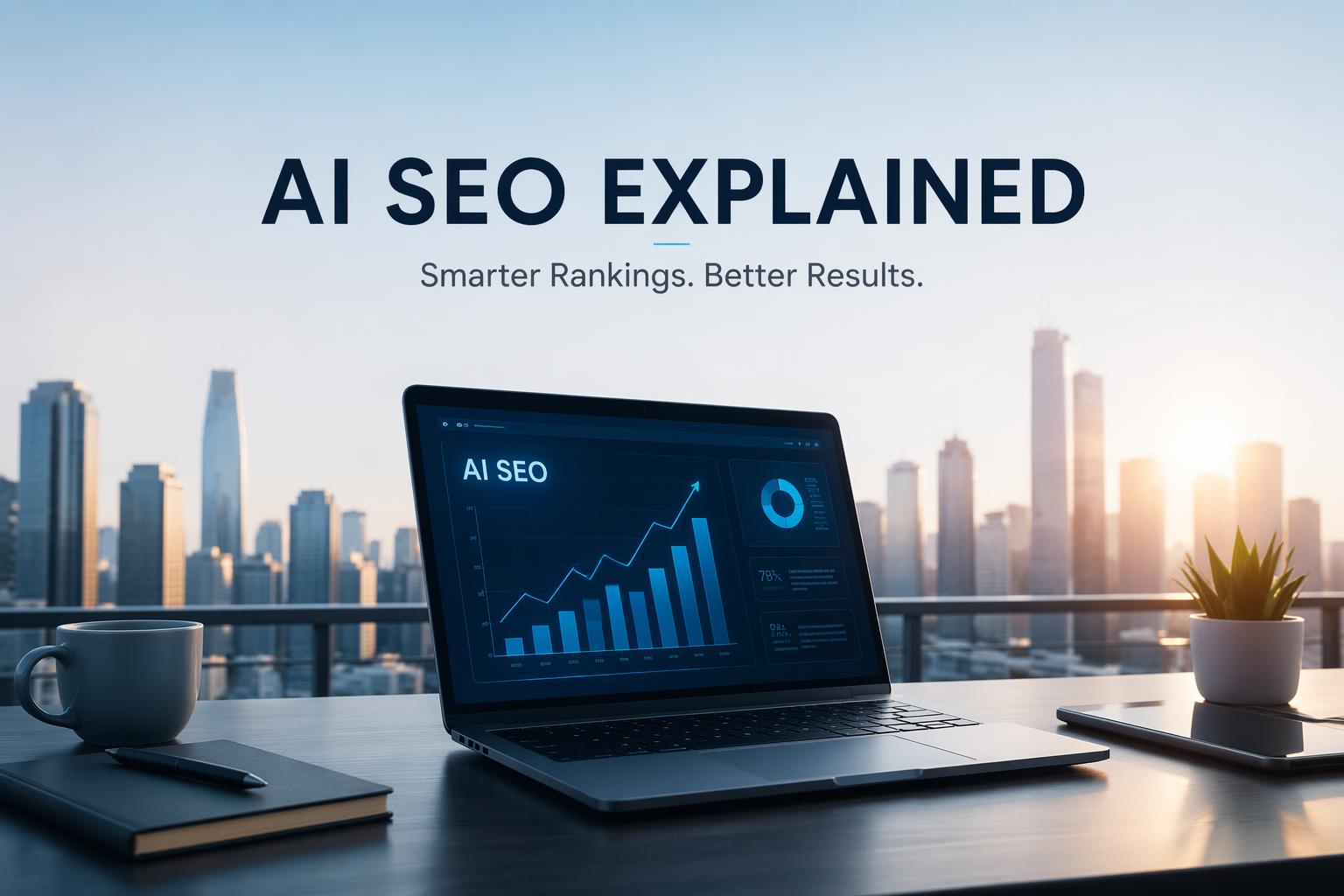
Traditional SEO is still alive in 2026, but it’s no longer the only game. AI-powered search engines—Google AI Overviews, ChatGPT, Perplexity—are pulling 2 billion monthly users, and the way people search is fundamentally different now. Instead of clicking through ten blue links, they’re reading AI-generated summaries. Instead of typing “best CRM software,” they’re asking ChatGPT, “What CRM should I use for a 20-person sales team?”
If your business isn’t optimized for AI search, you’re invisible to a massive (and growing) segment of your audience. This isn’t speculation—AI search traffic is up 527% year over year, and analysts predict AI search traffic may surpass traditional search by 2028. The shift is here, and businesses that wait will lose ground they can’t recover.
So what is AI SEO, exactly? It’s the practice of optimizing your content, structured data, and brand signals so AI engines can find, understand, trust, and cite your business when users ask relevant questions. It’s not about gaming algorithms—it’s about becoming the most authoritative, transparent, accessible answer in your space.
This guide walks through what AI SEO actually means in 2026, why it matters, how it differs from traditional SEO, and the specific tactics businesses are using right now to show up in AI-generated answers.
Table of Contents
- What Is AI SEO?
- How AI SEO Differs From Traditional SEO
- Why AI SEO Matters in 2026
- How AI Search Engines Work
- The Core Components of AI SEO
- AI SEO vs. AEO: What’s the Difference?
- How to Optimize for AI Search in 2026
- Common AI SEO Mistakes to Avoid
- FAQ
—
What Is AI SEO?
AI SEO is the practice of optimizing your website, content, and brand presence so that AI-powered search engines—like Google AI Overviews, ChatGPT, Perplexity, and others—can surface, understand, and recommend your business to users.
Unlike traditional SEO, which focuses on ranking in a list of ten blue links, AI SEO is about becoming the cited source in an AI-generated answer. When someone asks ChatGPT, “What’s the best project management tool for remote teams?” or Google AI Overviews synthesizes an answer to “how much does a website redesign cost,” AI SEO determines whether your brand gets mentioned—or ignored.
The mechanics are different, but the goal is the same: visibility at the moment of intent.
Here’s what’s new:
- AI engines synthesize answers instead of returning a list of links. That means your content has to be structured so AI can pull the exact answer it needs.
- Citations replace rankings. Getting cited by ChatGPT or featured in a Google AI Overview is the new page-one placement.
- Trust signals matter more than keywords. Reviews, structured data, pricing transparency, and demonstrated expertise carry more weight than keyword density ever did.
The data backs this up. According to Semrush’s 2026 AI SEO statistics, over 88% of searches that trigger AI Overviews are informational, and nearly 80% fall into the low-volume, long-tail category. Translation: AI is dominating the “research” phase of the buyer journey, which is exactly where most B2B and service businesses need visibility.

Even more striking: 50% of all the sources ChatGPT cites are business and service websites (per Semrush). That means half of ChatGPT’s citations go to sites like yours—if you’re optimized for it.
—
How AI SEO Differs From Traditional SEO
Traditional SEO and AI SEO share the same foundation—you still need good content, fast page speeds, mobile optimization, and backlinks—but the execution diverges in a few critical ways.
Traditional SEO AI SEO Optimize for keyword rankings Optimize to be cited by AI engines Target high-volume keywords Target informational, long-tail queries Focus on backlinks and domain authority Focus on structured data, reviews, and transparency Goal: rank #1 in search results Goal: appear in AI-generated summaries Measure success with click-through rate Measure success with citation rate and AI visibility score
Example:
- Traditional SEO approach: Write a 2,000-word guide on “best email marketing tools,” optimize for that keyword, build backlinks, hope to rank #1.
- AI SEO approach: Write the same guide, but add schema markup for each tool (SoftwareApplication), include verified customer reviews, publish transparent pricing, and structure the content so an AI can extract a comparison table in two seconds.
Both approaches can work, but AI SEO prioritizes machine-readability and trust signals over keyword density and backlink volume.
The other major shift: 60% of searches yield no clicks in 2026 (per Semrush). Users are getting their answers directly from AI summaries and never visiting your site. That’s why citation—not traffic—is becoming the primary KPI for top-of-funnel visibility.
—
Why AI SEO Matters in 2026
The numbers make the case better than any argument:
- Google AI Overviews reach 2 billion monthly users (source)
- ChatGPT has 700 million weekly active users (source)
- 35% of Gen Z people in the U.S. use AI chatbots for information (source)
- The average AI search visitor is worth 4.4x more than a traditional organic search visitor (source)
That last stat is the one that should get your attention. AI search users aren’t just browsing—they’re further along in the decision process, asking more specific questions, and converting at higher rates. If you’re optimizing only for traditional Google search, you’re missing the highest-intent segment of your audience.
There’s also a competitive angle. Most businesses are still treating AI search as a “nice-to-have” instead of a core channel. 70% of businesses report higher ROI from using AI in SEO (source), but adoption is still uneven. The businesses investing in AI visibility now are building a moat that will be hard to cross in 12-18 months.
And the trend is only accelerating. Analysts predict website traffic from AI search may surpass traffic from traditional search by 2028 (source). If that plays out, traditional SEO will still matter—but AI SEO will be the primary driver of discovery.
—
How AI Search Engines Work
Understanding how AI engines surface and cite content is the foundation of AI SEO. Here’s the simplified version:
- User asks a question. “What’s the best CRM for small businesses?” or “How much does a website redesign cost?”
- AI retrieves relevant data. The engine pulls from indexed web pages, structured data, reviews, forums, and other sources. This is where your optimization matters—if your content isn’t structured or accessible, the AI can’t retrieve it.
- AI synthesizes an answer. Using natural language processing, the engine generates a coherent response that combines information from multiple sources.
- AI cites sources. The engine includes inline citations or a “sources” section linking back to the original content.
The key insight: AI engines don’t rank content the way Google does. There’s no position #1, #2, #3. Instead, AI evaluates trustworthiness, relevance, and clarity, then pulls the best answer from whichever source has it.
That means:
- Domain authority matters less than content quality. A smaller site with better-structured content can get cited over a high-authority site with vague answers.
- Long-tail queries are your friend. AI engines excel at answering specific, niche questions—exactly the kind of queries traditional SEO often ignores.
- Machine-readable formatting wins. Structured data (schema markup), clear headings, tables, and bullet points make it easy for AI to extract the answer.
Salesforce’s 2026 AI for SEO guide notes that AI can process millions of data points in seconds and goes beyond just matching keywords to understand search intent. That processing power is why AI search feels so much more conversational—and why optimizing for it requires a different approach.
—
The Core Components of AI SEO
AI SEO isn’t one tactic—it’s a combination of technical optimization, content strategy, and trust-building. Here are the five pillars:
1. Structured Data (Schema Markup)
Schema markup is code you add to your website that tells AI engines exactly what your content is about. Think of it as metadata that machines can read.
Why it matters: AI engines rely on structured data to extract specific information—pricing, reviews, FAQs, product specs—without having to parse unstructured text.
What to implement:
- FAQPage schema for FAQ sections
- Product schema for product pages (includes price, reviews, availability)
- LocalBusiness schema for location-based businesses
- HowTo schema for step-by-step guides
- Review schema for customer testimonials
According to Wingman Planning’s 2026 AI SEO framework, structured data will become crucial for AI recognition in 2026. If your content doesn’t have schema markup, AI engines may skip it entirely.
2. First-Party Reviews
AI engines prioritize trust, and verified customer reviews are the #1 trust signal.
Wingman Planning reports that first-party reviews will be the top trust signal for AI recommendations in 2026. That means reviews hosted on your site (not just third-party platforms) carry the most weight.
How to optimize:
- Collect and display customer reviews directly on product/service pages
- Use Review schema markup so AI can parse ratings and testimonials
- Keep reviews recent—stale reviews signal inactivity
3. Pricing Transparency
AI engines favor businesses that publish clear, upfront pricing. Hiding your pricing behind a “Request a Quote” form is a visibility killer.
Wingman Planning’s framework emphasizes that pricing transparency will become essential for AI visibility in 2026. If an AI engine can’t find your pricing, it won’t recommend you.
What to do:
- Publish starting prices, even if you offer custom quotes
- Use structured data to mark up pricing (Offer or PriceSpecification schema)
- If pricing varies, provide a range or a pricing calculator
4. Demonstrated Expertise
Wingman Planning notes that demonstrated expertise will replace keyword targeting as the focus for businesses in 2026. That means publishing content that proves you know what you’re talking about—case studies, original research, detailed how-tos, and specific examples.
How to build expertise signals:
- Publish case studies with real client results
- Share original data or research findings
- Use author bylines with credentials
- Link to authoritative sources to back up claims
5. Content Structure
AI engines can’t cite what they can’t parse. That means your content needs to be scannable, organized, and machine-readable.
Best practices:
- Use clear H2/H3 headings to break up content
- Answer questions directly (don’t bury the answer 800 words in)
- Use bullet points, numbered lists, and tables
- Keep paragraphs short (2-4 sentences)
Salesforce’s guide points out that AI tools go beyond just matching keywords, helping marketers understand search intent. If your content doesn’t match the intent behind a query—or if the answer is hard to extract—AI will skip it.
—
AI SEO vs. AEO: What’s the Difference?
You’ll hear the term AEO (AI Experience Optimization) thrown around in 2026. Some experts argue it’s distinct from AI SEO; others use the terms interchangeably. Here’s the practical difference:
- AI SEO focuses on optimizing your site and content so AI engines can find and cite you.
- AEO focuses on the entire user experience after the AI surfaces your brand—how users interact with your content, how you guide them to conversion, and how you stay visible across multiple AI touchpoints.
Wingman Planning predicts that AEO will surpass traditional SEO in importance as AI search matures. The logic: getting cited is just the first step. Keeping users engaged, building trust, and converting them is the full experience.
For most businesses, the distinction doesn’t matter yet. If you’re not showing up in AI-generated answers at all, focus on AI SEO first. Once you have visibility, you can refine the experience.
—
How to Optimize for AI Search in 2026
Here’s the step-by-step framework businesses are using in 2026 to improve AI visibility:
Step 1: Audit Your AI Visibility
Before you optimize, know where you stand. Use tools like Semrush’s AI Visibility Toolkit (mentioned in their 2026 AI SEO statistics report) to track how often your brand appears in AI-generated answers.
What to track:
- Citation rate (how often you’re cited vs. competitors)
- Which queries trigger citations
- Which content types get cited most (blog posts, product pages, FAQs)
Step 2: Add Structured Data
If you don’t have schema markup on your key pages, start there. Focus on:
- FAQPage for any page with Q&A content
- Product for product/service pages
- Review for testimonials
- LocalBusiness if you serve a geographic area
Test your markup with Google’s Rich Results Test or Schema.org’s validator.
Step 3: Publish Transparent Pricing
Add a pricing page or pricing section to your site. Even if you offer custom quotes, publish a starting price or range. Use Offer or PriceSpecification schema to mark it up.
Step 4: Collect and Display First-Party Reviews
Set up a system to collect reviews on your site (not just third-party platforms). Display them prominently on product/service pages and mark them up with Review schema.
Step 5: Optimize Content for AI Retrieval
Rewrite your key pages to make them more AI-friendly:
- Lead with the answer (don’t bury it)
- Use clear headings and subheadings
- Add FAQ sections targeting common questions
- Include tables, bullet points, and short paragraphs
Step 6: Build Demonstrated Expertise
Publish content that only someone with real experience could write:
- Case studies with specific results
- Original research or data
- Detailed how-tos with screenshots or examples
Wingman Planning’s framework emphasizes that AI SEO must integrate with the full marketing ecosystem—it’s not a standalone channel. That means aligning your content, CRM, and sales process so every touchpoint reinforces your expertise.
Step 7: Monitor and Iterate
AI search is still evolving. What works in Q1 2026 may shift by Q4. Track your citation rate, test different content formats, and adapt as the landscape changes.
—
Common AI SEO Mistakes to Avoid
Even businesses investing in AI SEO make avoidable mistakes. Here are the most common:
1. Treating AI SEO as a One-Time Project
AI SEO isn’t a checklist you complete once. It’s an ongoing process—monitoring citations, updating content, collecting new reviews, and adapting to algorithm changes.
2. Ignoring Pricing Transparency
Hiding your pricing might have worked in 2020, but in 2026 it’s a dealbreaker. AI engines won’t recommend businesses that don’t publish pricing.
3. Over-Optimizing for Keywords
Traditional keyword stuffing doesn’t work with AI engines. They evaluate meaning and intent, not keyword density. Write for humans first, then add structured data to help AI parse it.
4. Skipping Structured Data
If your content doesn’t have schema markup, AI engines have to guess what it’s about—and they often guess wrong (or skip it entirely). Structured data is non-negotiable.
5. Relying Only on Third-Party Reviews
Google reviews and Trustpilot matter, but AI engines prioritize reviews hosted on your own site (marked up with Review schema). If you don’t have first-party reviews, you’re invisible.
6. Writing Generic Content
AI engines can spot filler content. If your page reads like every other result—same advice, same structure, no unique insight—you won’t get cited. Salesforce notes that businesses must focus on personalized, data-driven content to stand out.
—
FAQ
Can AI replace human SEO specialists?
No. AI tools can automate parts of SEO—keyword research, content optimization, data analysis—but they can’t replace strategic thinking, creativity, or understanding of business context. Salesforce’s guide confirms that AI allows optimization of hundreds or thousands of pages simultaneously, but human oversight is still required to ensure quality and relevance.
What kind of data does AI analyze for SEO?
AI engines analyze structured data (schema markup), content quality, user reviews, backlinks, page speed, mobile usability, and brand mentions across the web. Salesforce notes that AI can process millions of data points in seconds, giving it a much broader view than traditional ranking algorithms.
How can businesses track their AI visibility?
Use tools like Semrush’s AI Visibility Toolkit (mentioned in their 2026 AI SEO statistics) to monitor citation rates, track which queries trigger AI answers, and compare your visibility to competitors.
What metrics should be used to measure AI search success?
Traditional metrics like click-through rate don’t apply to AI search. Instead, track:
- Citation rate (how often your brand is cited)
- AI visibility score (varies by tool)
- Conversion rate from AI traffic (AI visitors convert at higher rates, per Wingman Planning)
Why is structured data essential for SEO in 2026?
Structured data (schema markup) tells AI engines exactly what your content is about, making it easy to extract and cite. Without it, AI engines have to guess—and they often guess wrong or skip your content entirely. Wingman Planning’s framework emphasizes that structured data will become crucial for AI recognition in 2026.
What role do reviews play in AI recommendations?
Reviews are the #1 trust signal for AI engines. Wingman Planning reports that first-party reviews will be the top trust signal for AI recommendations in 2026. That means collecting and displaying reviews on your own site (marked up with Review schema) is critical.
How should pricing be presented on websites for AI?
AI engines favor businesses that publish clear, transparent pricing. If you can’t publish exact prices, provide a starting price, a range, or a pricing calculator. Use Offer or PriceSpecification schema to mark up pricing so AI can extract it. Wingman Planning’s framework confirms that pricing transparency will become essential for AI visibility.
—
Next steps: If you’re ready to optimize for AI search, start with an AI visibility audit. Track where you currently show up (or don’t), identify gaps in your structured data and content, and prioritize the highest-impact fixes. The businesses investing in AI SEO now are building a competitive advantage that will compound over the next 12-24 months.