What Is AI Writing? The 2026 Reality Check Nobody’s Telling You
AI writing isn’t just “using ChatGPT anymore.” In 2026, it’s an entire category of tools promising to save you time, rank your content, and sound human. But only 13% of consumers actually trust AI-generated brand content, according to research from Olivia Cal. Worse? 52% will stop reading the moment they suspect your text came from a bot.
So what is AI writing in 2026? It’s the gap between what the tools can do and what works. The difference between hitting “generate” and shipping content people trust. And it’s why you’re here—because picking the wrong tool, or using the right one badly, wastes time and tanks your credibility.
What AI writing means now, which tools deliver, what gives away AI content instantly, and how to use these systems without sounding like every other generated blog post flooding the web.
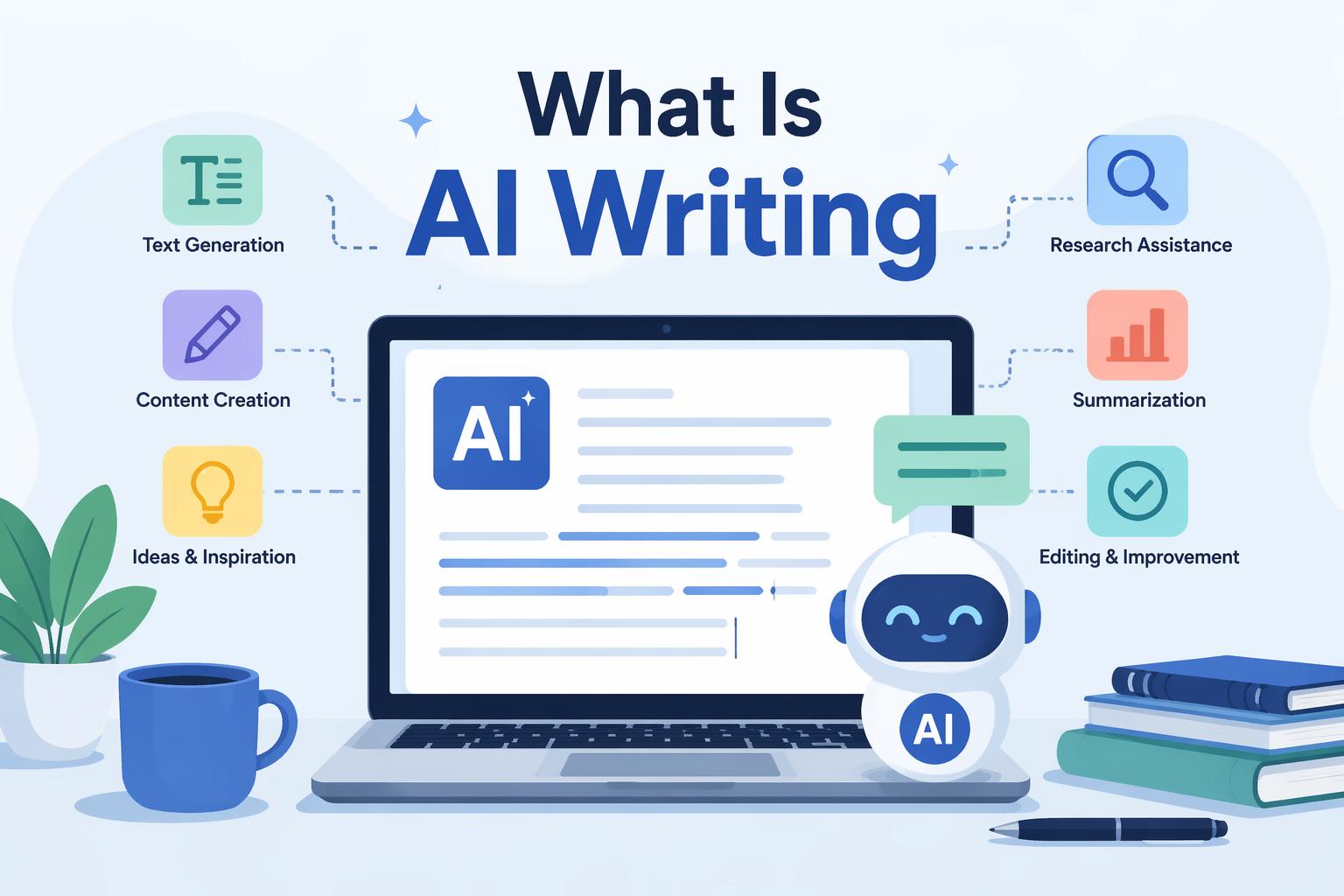
Table of Contents
- What AI writing means in 2026
- The tools that matter (and the ones that don’t)
- 15 dead giveaways your content is AI-written
- How to use AI writing without getting clocked
- When AI writing works (and when it fails)
- FAQ
What AI writing means in 2026
AI writing in 2026 isn’t one thing. It’s a spectrum that runs from full automation to assisted editing. Most people use the wrong end for the wrong job.
At one extreme: tools that generate entire articles from a keyword. You input “best running shoes,” hit go, and get 1,500 words of SEO-optimized nothing. These exist, they’re cheap, and they produce content that readers—and increasingly, Google—ignore.
At the other: AI writing assistants that help you research faster, structure better, and edit tighter. These tools don’t replace the thinking. They speed up the parts that don’t require it.
What separates the two is alignment with real search demand. According to Conductor’s 2026 review, performance now beats speed. Modern AI writing tools should anchor content to search intent, not just spit out words that match a keyword density formula.
The shift happened because AI-powered search changed the game. Google’s AI Overviews pull from content that demonstrates experience and answers the user’s question. Generic AI slop—paragraphs that restate common knowledge without adding insight—gets filtered out before it even reaches a human reader.
When someone asks “what is AI writing,” the answer in 2026 depends on whether you’re using it to think faster or to avoid thinking entirely.
The tools that matter (and the ones that don’t)
AI writing tools are everywhere in 2026, but most solve the wrong problem. You don’t need more words faster. You need words people trust, that rank, and that don’t immediately signal “a bot wrote this.”
Zemith tested 12 AI writing tools in 2026 and found that the best ones aren’t the “AI writing” brands charging $59/month. They’re the general-purpose models with better reasoning and tone control.
ChatGPT Plus ($20/month)
Best for: research-heavy blog posts, structured content, anything that needs tight organization.
ChatGPT excels at pulling together research, outlining, and keeping content on-rails. If you’re writing a how-to guide or a comparison post, it handles the structure cleanly.
The limitation: tone. ChatGPT output tends toward formal, slightly stiff phrasing. You’ll need to edit for natural rhythm.
Free tier: 10 messages per 5 hours. Workable for light experimentation, not for daily content production.
Claude Pro ($20/month)
Best for: creative writing, anything that needs a natural, conversational tone, and following specific style instructions.
Claude produces the most human-sounding output in 2026. It handles long-form content well, respects voice guidelines, and doesn’t fall into the predictable AI phrasing traps as often as other models. If your audience clocks AI tells easily, Claude is the safer bet.
Free tier: roughly 1/5 of Pro usage. Enough to test, not enough to rely on.
Jasper AI ($59/month)
Jasper adds workflow features—brand voice templates, campaign briefs, team collaboration—but costs three times what the general models charge. Unless you’re running a content team that needs those specific features, you’re paying for process management, not writing quality.
Specialized SEO tools (Surfer AI, Frase, Semrush SEO Writing Assistant)
These tools optimize for traditional SEO: keyword density, readability scores, SERP structure analysis. They’re useful if you’re targeting a competitive keyword and need data-driven content briefs.
The downside: they encourage formulaic writing. If everyone targeting “best project management software” follows the same SERP structure, you end up with ten identical posts. Differentiation beats matching the format perfectly.
What free tools are good for
Free AI writing tools—ChatGPT Free, Claude Free—work for ideation, outlining, and low-stakes copy drafting. They’re not reliable for high-volume production or content that needs to perform. The token limits and rate restrictions make them experimental tools, not daily drivers.
From Zemith’s testing: for most writers, Claude Pro or ChatGPT Plus beats specialized tools at one-third the price. If you need workflow automation or team guardrails, Jasper and Writer make sense. If you just need solid writing, the general models win.
15 dead giveaways your content is AI-written
Your readers can tell. Olivia Cal’s 2026 research found that 52% of consumers stop reading the moment they suspect AI. Google’s algorithms are getting better at filtering predictable AI patterns. And your competitors are using the same tools, producing the same tells.
Forbes published an updated list in May 2026 tracking how AI writing reveals itself. These aren’t the obvious signs from 2023 (overly formal tone, hedging language). These are the newer, subtler patterns that emerged as models improved.
The word list
Certain words spike in AI-generated content. They’re not wrong, but they’re overused to the point of becoming signals:
- quietly
- shift
- matters
- shape
- land
- actually
- real
- earn
- the work
- hold
- pull
- compound
- signal
- built different
These words don’t make content bad. But when three of them show up in two paragraphs, readers start to notice.
Contrast reframe sentences
AI loves to set up a contrast and then flip it. The pattern: “It’s not about X. It’s about Y.” Or: “Most people think X. But the reality is Y.”
One of these per article is fine. Five starts to sound like a formula.
Empty hedging phrases
“It depends.” “Many factors contribute.” “It’s important to consider.” These phrases add nothing. Human writers use them occasionally when genuinely uncertain. AI uses them constantly as filler.
Missing personal detail
Human writing includes small, specific observations: “I spent three hours debugging this error.” “One client told me they tried five tools before finding one that worked.”
AI can fake this—”users often report frustration”—but it’s always generic. The details are never specific enough to be verifiable.
Predictable structure
Every section opens the same way. Every paragraph follows the same rhythm. Human writers vary sentence length naturally. AI tends toward uniformity unless explicitly instructed otherwise.
Over-explanation
AI explains things readers already understand. “Social media, which includes platforms like Facebook and Twitter…” Nobody reading an article about social media strategy needs that clarification. Human writers assume context. AI assumes ignorance.
The “landscape” tell
“In today’s digital landscape…” “The evolving landscape of content marketing…” This phrase became an AI signature in 2025 and hasn’t gone away.
Lack of commitment
“This tool may help improve your workflow.” “It could potentially save time.” AI hedges constantly. Human experts commit: “This tool cuts review time by 40%.”
The three-point everywhere
AI loves lists of three. Three benefits. Three strategies. Three examples. One list of three is normal. Every section ending in three bullet points is a pattern.
Generic transitions
“However, it’s worth noting that…” “On the other hand…” “In addition to this…” AI transitions are functional but repetitive. Human writers mix it up or skip transitions when the logic is obvious.
No contractions
AI defaults to formal phrasing. “It is important” instead of “It’s important.” “You will find” instead of “You’ll find.” Contractions make writing conversational. Their absence makes it stiff.
Vague intensifiers
“Highly effective.” “Extremely important.” “Incredibly useful.” These words add emphasis without adding meaning. Human writers either commit to specific claims or skip the intensifier.
The “it’s worth noting” trap
This phrase shows up in almost every AI-generated blog post. Once you notice it, you can’t un-notice it.
Bullet points that restate the heading
AI will write a heading like “Benefits of AI writing tools,” then list bullets that say “AI writing tools save time,” “AI writing tools improve consistency,” “AI writing tools reduce costs.” A human would just list the benefits without repeating “AI writing tools” every time.
Over-reliance on the passive voice
“Mistakes can be avoided.” “Time is saved.” “Results are improved.” Passive voice isn’t always wrong, but AI uses it constantly to avoid committing to a subject.
How to use AI writing without getting clocked
You’re not trying to “bypass AI detection.” You’re making sure the content is useful, specific, and human—because that’s what performs in 2026.
Conductor’s guide to AI writing tools shows that editing AI tells out of your content increases traffic compared to raw AI output. You’re not trying to fool readers. You’re making sure the content is good.
Start with research, not generation
Don’t ask AI to “write a blog post about X.” Ask it to pull research, summarize sources, identify gaps in what’s already ranking. Use AI to speed up the thinking phase, not replace it.
Add specific examples
Generic AI output: “Many companies struggle with content consistency.”
Human-edited version: “One client we worked with published 40 blog posts in six months using three different writers. None of them matched the brand voice, and their bounce rate climbed 15%.”
The second version is verifiable. It includes a real scenario. Even if the scenario is anonymized, it reads like first-hand experience.
Vary sentence length
AI defaults to medium-length sentences. You need short ones for emphasis. And longer ones that walk the reader through a chain of thought, connecting ideas that need context to make sense.
Mix them.
Cut the hedging
Go through your draft and delete every “may,” “might,” “could potentially,” and “it’s worth noting.” If you’re not sure about a claim, either research it until you are or cut the claim entirely.
Use contractions
Read your draft out loud. Every time you hit a phrase like “it is” or “you will,” ask if you’d say it that way in conversation. If not, contract it.
Remove filler phrases
“In today’s digital landscape” → Delete.
“It goes without saying” → Then don’t say it.
“At the end of the day” → Cut.
If a phrase adds no meaning, it’s filler. AI loves filler. Readers hate it.
Add one contrarian or unexpected take
AI writes consensus. “Email marketing is important for customer retention.” That’s true, but it’s also obvious.
A human writer might add: “But most companies ruin it by sending weekly newsletters nobody asked for. We cut our send frequency by 60% and saw open rates double.”
Contrarian doesn’t mean wrong. It means you’re committing to a specific opinion instead of restating common knowledge.
Train your team
If your team is using AI tools—and 40% of U.S. employees were using AI at least a few times a year in 2025—train them to edit.
Writer, an enterprise AI platform, helps operationalize AI writing safely by codifying brand voice and usage rules. Without that structure, you get inconsistent output and predictable AI tells.
Own the copyright issue
If an employee uses ChatGPT or Midjourney to generate content, you don’t own the copyright to that work, according to Olivia Cal’s legal breakdown.
Establish a policy: AI-generated content must be substantially edited, reviewed, and approved by a human. That editing step not only improves quality—it clarifies ownership.
When AI writing works (and when it fails)
AI writing tools aren’t universally good or bad. They’re good at specific tasks and terrible at others.
Where AI writing works
Research synthesis. AI can pull together information from multiple sources faster than a human can. It’s not creative, but it’s thorough.
Outlining. Give AI a topic and ask for a structure. You’ll get a solid starting point in seconds.
Drafting repetitive content. Product descriptions, meta descriptions, FAQ answers—anything formulaic where the structure is consistent and the content just needs to be filled in.
Editing for clarity. AI can tighten sentences, spot redundancy, and suggest simpler phrasing. It’s a decent line editor.
Ideation. Stuck on an angle? Ask AI for ten different ways to approach a topic. Half will be generic. Two will be interesting.
Where AI writing fails
Anything requiring first-hand experience. AI can’t test a product, interview a customer, or observe a trend. It can fake it, but the fakes are always generic.
Persuasive or emotional writing. Sales copy, storytelling, anything that needs to land on a human level—AI produces flat, unconvincing drafts.
Nuanced takes. AI writes consensus. It can’t commit to a contrarian position or defend a complex argument without human guidance.
Content that needs to differentiate. If ten competitors are targeting the same keyword, AI will produce the same structure they all used. Differentiation requires strategy, and strategy is still a human job.
Anything mission-critical. Legal writing, medical content, financial advice—if getting it wrong has consequences, don’t let AI draft it unsupervised.
FAQ
Can AI writing tools replace human writers?
No. AI tools make writers faster—they handle research, outlining, and drafting repetitive content—but they don’t replace the judgment, experience, or voice that makes content valuable. In 2026, the best content comes from writers who use AI to speed up the mechanical parts and focus their time on strategy, differentiation, and editing.
How do I know if my content sounds like AI?
Read it out loud. If it sounds stiff, repetitive, or like it’s hedging constantly, it reads like AI. Check for the 15 giveaway signs from Forbes’ May 2026 list—overused words, contrast reframe sentences, lack of specific detail. Better yet, have someone outside your team read it and ask if it sounds human.
Are free AI writing tools good enough for SEO?
For research and ideation, yes. For publishing content that needs to rank and convert, no. Free tools like ChatGPT Free and Claude Free have token limits and rate restrictions that make them impractical for consistent production. If you’re serious about content performance, pay for Claude Pro or ChatGPT Plus.
Can Google penalize my site for using AI-generated content?
Google doesn’t penalize content because it’s AI-generated. It penalizes content that’s low-quality, thin, or doesn’t match search intent—and raw AI output often falls into that category. If you edit AI drafts to add experience, specificity, and value, Google treats it like any other content. The key is making sure it passes the “last click” test: would the reader need to search again, or did you answer their question completely?
What’s the difference between ChatGPT and Claude for writing?
ChatGPT is better for structured, research-heavy content—how-to guides, comparisons, anything that needs tight organization. Claude is better for natural, conversational tone and creative writing. Zemith’s 2026 testing found that Claude produces output that sounds more human, while ChatGPT excels at following tight instructions and pulling together research.
Do I own the copyright to AI-generated content?
It depends on how much you edit it. According to Olivia Cal’s analysis, if an employee uses ChatGPT or Midjourney to generate content and publishes it with minimal changes, you don’t own the copyright. Substantial human editing—restructuring, rewriting, adding original analysis—establishes ownership. Train your team to treat AI as a drafting tool, not a final-output machine.
Why do only 13% of consumers trust AI-generated content?
Because most of it is generic, repetitive, and doesn’t demonstrate real experience. Olivia Cal’s research found that 52% of readers stop reading the moment they suspect AI. The trust gap comes from over-reliance on tools without editing—content that reads like it was assembled, not written. If your content includes specific examples, commits to a position, and sounds like a human with experience, trust goes up.