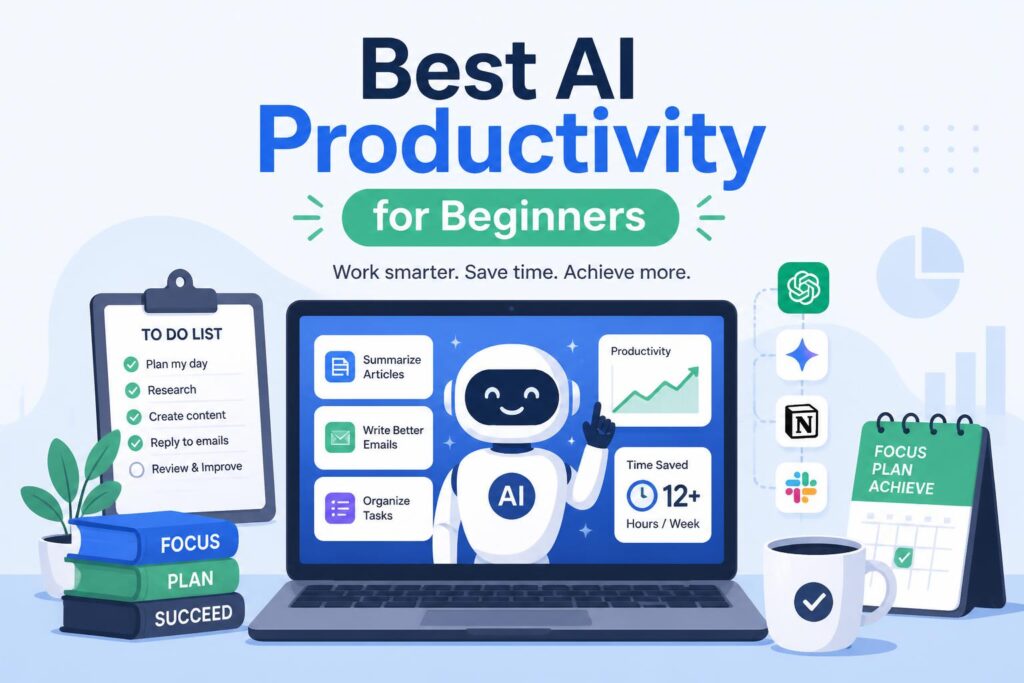
Beginner’s Guide to AI Productivity: What Actually Works in 2026 (And What Doesn’t)
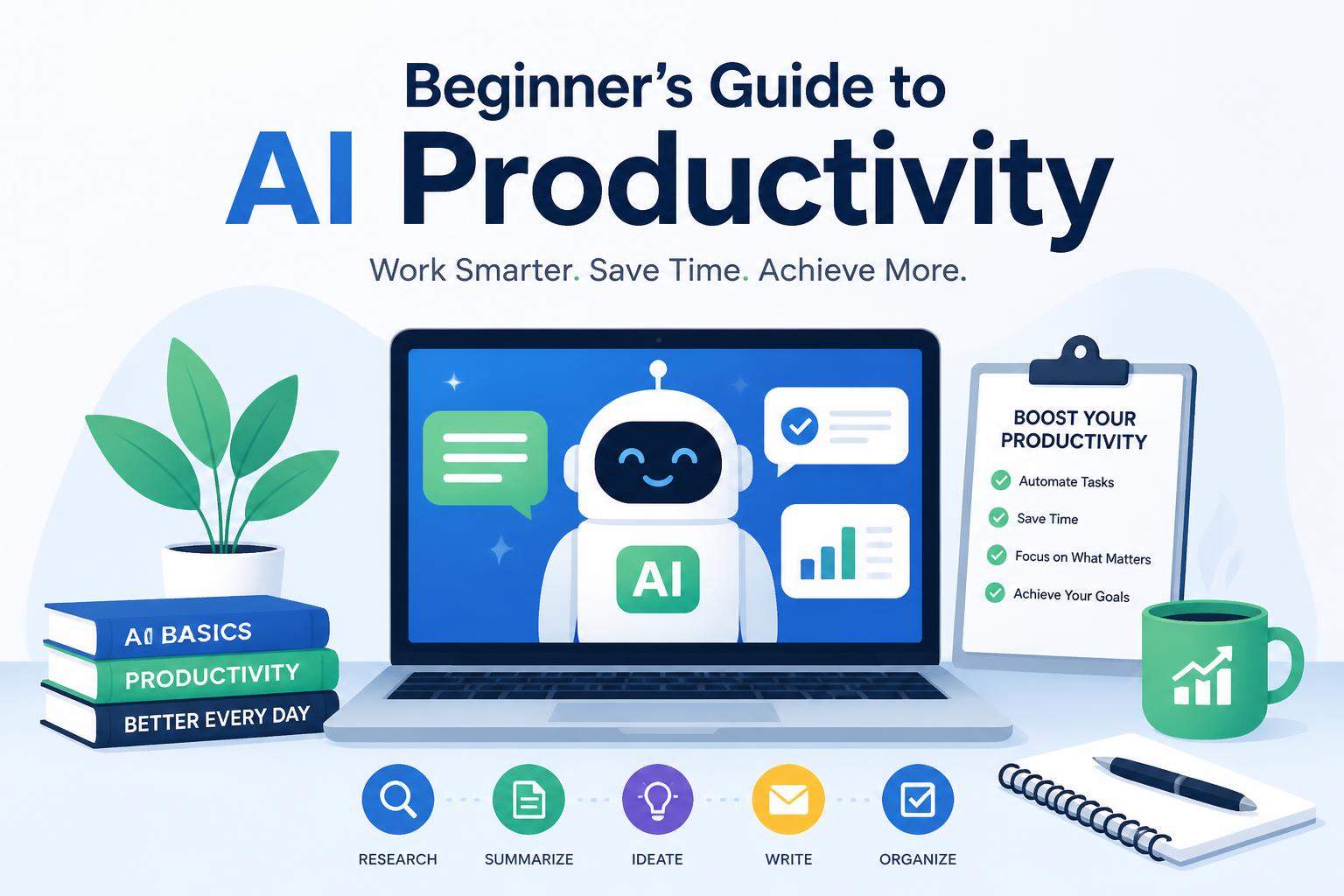
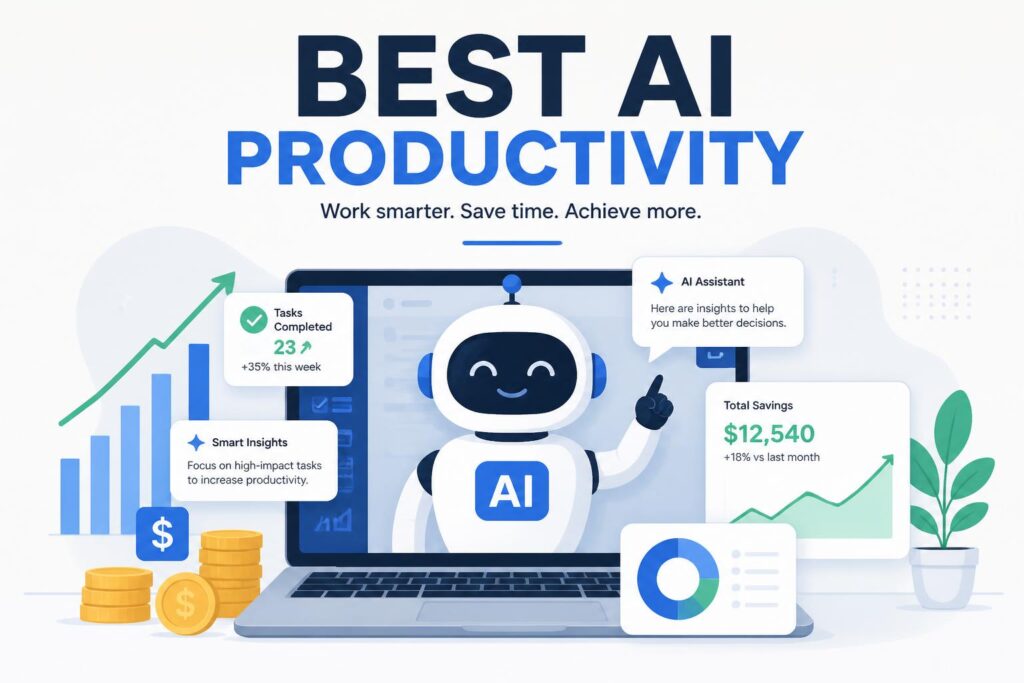
AI productivity saved employees an average of 7.5 hours per week in 2026. That’s nearly a full workday, worth roughly £14,000 per person annually. But 66% of workers got little to no guidance on what to do with that time, and half aren’t using it for anything strategic.
The tools work. Leadership doesn’t.
If you’re trying to figure out whether AI productivity is worth the effort, this guide shows you what’s working in 2026, what the data says about real gains, and where companies are failing despite having the right tech.
Table of Contents
- What Is AI Productivity? (And Why It Matters Now)
- The 2026 Reality: What the Numbers Actually Show
- Where AI Productivity Delivers Real Gains
- The Leadership Problem Nobody’s Talking About
- How to Pick AI Productivity Tools Without Overpaying
- Common Mistakes That Kill AI Productivity
- FAQ
What is AI productivity? (And why it matters now)
AI productivity is using artificial intelligence to get more done. That means automating repetitive tasks, speeding up decision-making, and freeing up time for work that actually requires thinking.
In 2026, this isn’t experimental. 88% of organizations use AI, and 88% say it increased annual revenue. What used to be a competitive advantage is now baseline.
What changed: AI capability accelerated in 2025. DeepSeek-R1 matched top U.S. models in February 2025, and Gemini Deep Think earned a gold medal at the International Mathematical Olympiad. The U.S.-China AI model performance gap closed. These aren’t lab curiosities. They’re production-ready tools that ordinary businesses deploy daily.

The big difference in 2026 is that you can measure this stuff. Unlike vague “digital transformation” promises, AI delivers specific time savings you can track. 42% of respondents in a 2026 study reported eight hours of saved time per week. Well-trained employees save up to 11 hours weekly, twice as much as untrained ones.
But productivity gains only matter if you know what to do with them. Most companies don’t.
The 2026 reality: what the numbers actually show
The data from 2026 tells two stories.
Story one: AI works. 64% of organizations actively use AI, jumping to 76% among large companies. In North America, usage hits 70%. The impact is financial: 88% report increased annual revenue, 87% reduced costs, and 53% improved employee productivity. Over 40% of executives saw revenue increases above 10%.
Specific applications show sharper gains. Chatbots reduce customer handle time by 30%. Manufacturing plants using AI-powered digital twins identify potential issues before making costly modifications. Nasdaq’s AI platform optimizes both internal operations and external products. Lowe’s transforms 2D images into 3D models, speeding up store operations.
Story two: leadership is wasting the gains. Despite saving 7.5 hours per week per employee, 66% got little to no guidance on using that time, and half aren’t redirecting it toward strategic work. A June 2026 Fortune analysis called this the “AI productivity paradox.” The gains are real, but bad management neutralizes them.
The problem isn’t the technology. Leaders can’t articulate what the vision is for AI. Without clear direction, saved time evaporates into busywork or gets absorbed by expanding workloads. The productivity paradox is a human failure, not a technical one.
Organizations that align AI goals across teams get higher productivity gains. The gap between well-implemented and poorly-implemented AI is growing.
Where AI productivity delivers real gains
AI productivity isn’t one thing. It’s a set of specific capabilities that work well in defined contexts. The 2026 data shows measurable impact in these areas:
Content generation and summarization. Tools like Microsoft Copilot generate content, summarize meetings, and automate repetitive tasks. ChatGPT helps with brainstorming and improves customer interactions through conversational AI. These aren’t perfect outputs, but they cut first-draft time by 60-80% in most cases.
Customer service automation. Chatbots reduce handle time by 30%, and that’s conservative. The key is implementation. Good chatbots escalate complex queries to humans instead of frustrating customers with circular logic.
Data-driven decision-making. AI platforms turn data into actionable insights faster than human analysts. Nasdaq’s AI platform is a good example: it optimizes internal operations while enhancing external product functionality. The value isn’t in having more data. It’s in surfacing the right insights at decision time.
Operational efficiency in manufacturing. Digital twin technology simulates end-to-end plant operations, helping identify issues before making physical modifications. This prevents costly downtime and reduces the trial-and-error cycle in production changes.
Healthcare operations. AI has produced significant improvements in healthcare operations, particularly in scheduling, resource allocation, and patient triage. These aren’t diagnostic AI systems. They’re workflow optimizers that reduce administrative burden.
Writing and communication clarity. Tools like Grammarly catch errors through real-time grammar checking and plagiarism detection. Free and premium versions exist, making this accessible even for small teams.
The pattern: AI productivity works best for tasks that are repetitive, data-heavy, or require speed over deep expertise. It struggles with tasks requiring judgment, creativity, or navigating ambiguous human contexts.
The leadership problem nobody’s talking about
The biggest blocker to AI productivity in 2026 isn’t cost, technology, or talent. It’s leadership clarity.
The data: 66% of employees got little to no guidance on what to do with AI-saved time. Half aren’t using that time for strategic work. Leaders can’t articulate what the vision is for AI. This isn’t a skills gap. It’s a communication and priority-setting failure.
When leadership doesn’t define how saved time should be used, three things happen:
Busywork expands. Employees fill the gap with low-value tasks or get assigned more of the same work. Instead of doing strategic planning, they process twice as many invoices.
AI becomes a checkbox. Teams adopt tools to say they’re “using AI” without changing workflows or outcomes. Adoption numbers look good, but productivity stays flat.
Employees disengage. Saving time without purpose is demotivating. Workers feel like efficiency gains just mean more work, not better work.
Organizations that align AI goals across teams avoid this trap. They define in advance what saved time will be redirected toward: customer strategy, product development, process improvement, or upskilling. The technology is identical. The leadership clarity makes the difference.
Multigenerational teams get higher productivity when leadership sets clear expectations. Without that, even the best AI tools deliver disappointing results.
How to pick AI productivity tools without overpaying
The 2026 AI tool market is crowded and expensive. Here’s how to choose without wasting budget on features you won’t use.
Start with the problem, not the tool. Don’t ask “Should we use ChatGPT?” Ask “What repetitive task is consuming the most time?” Map your workflow first, then find tools that fit specific pain points.
Prioritize tools with free or trial tiers. ChatGPT, Grammarly, and many others offer free versions. Test them on real work before committing to enterprise plans. If a tool won’t let you trial it with actual company data, walk away.
Look for integration, not replacement. The best AI tools plug into your existing setup—Slack, Microsoft 365, Google Workspace. Standalone tools that require new workflows rarely get adopted.
Check the ROI math. If a tool costs $30/user/month, it needs to save at least two hours per user per month to break even (assuming $15/hour value). Tools saving 7.5 hours per week easily clear this bar. Tools saving 30 minutes per week don’t.
Favor open-source-friendly vendors. 85% of organizations believe open source is important for AI strategy. Vendors that support open standards and interoperability are safer long-term bets than proprietary lock-in.
Size matters for adoption. 76% of large companies report active AI usage versus 64% overall. If you’re a small team, prioritize tools designed for smaller deployments. Enterprise features you can’t configure are dead weight.
Popular tools in 2026 by use case:
- Content and meeting summaries: Microsoft Copilot (varies by organization)
- Conversational AI and brainstorming: ChatGPT (free and paid tiers)
- Writing clarity: Grammarly (free and premium versions)
- Manufacturing simulation: Digital Twin Composer (quote-based pricing)
- Customer service automation: Multiple vendors, look for 30% handle time reduction benchmark
Wrong approach: buying a suite of AI tools because a consultant recommended them. Right approach: pick one high-impact use case, prove ROI, then expand.
Common mistakes that kill AI productivity
Even well-intentioned teams sabotage AI productivity with predictable mistakes. These are the failures we see most often in 2026.
No training plan. Well-trained employees are twice as productive with AI, saving up to 11 hours per week. Untrained employees waste time fighting tools or avoid them entirely. If your rollout plan doesn’t include hands-on training, your adoption will fail.
Treating AI as a solo activity. Teams that align AI goals across functions get higher productivity gains. When marketing uses ChatGPT but sales doesn’t, you create workflow gaps and duplicated effort.
No guidance on using saved time. This is the paradox: 66% got no guidance, and half aren’t using saved time strategically. If you don’t tell people what to do with their extra 7.5 hours per week, they’ll fill it with busywork or it’ll get absorbed by expanding workloads.
Chasing shiny tools instead of solving problems. Generative AI drives innovation, but only when applied to actual pain points. Implementing AI because it’s trendy wastes budget and credibility.
Ignoring the leadership communication gap. Leaders can’t articulate vision and strategy for AI. If you can’t explain in one sentence why your team is using AI and what success looks like, your implementation will drift.
Over-relying on AI for judgment calls. AI excels at repetitive tasks, data synthesis, and speed. It struggles with ambiguous contexts, ethical trade-offs, and creative problem-solving. Using it for the wrong tasks creates more work, not less.
Assuming bigger is better. Private AI investment in the U.S. reached $285.9 billion in 2025, but that doesn’t mean expensive tools are better. Many small teams get more value from a $20/month ChatGPT subscription than a $100K enterprise AI platform they don’t fully use.
The pattern: most failures come from poor implementation, not poor technology. The tools work. The rollout process often doesn’t.
FAQ
What is AI productivity?
AI productivity is using artificial intelligence to get more done in less time. It typically involves automating repetitive tasks, speeding up decision-making, and generating content or insights faster than manual methods. In 2026, AI productivity tools save employees an average of 7.5 hours per week.
Why is AI productivity important in 2026?
88% of organizations actively use AI in 2026, and 88% report increased annual revenue from it. AI capability has accelerated rapidly. Models like DeepSeek-R1 and Gemini Deep Think now match top-tier performance. What was a competitive advantage two years ago is now expected. Organizations not using AI productively are falling behind measurably.
How much time does AI productivity actually save?
Employees save an average of 7.5 hours per week, worth roughly £14,000 per person annually. 42% of respondents report eight hours of saved time. Well-trained employees save up to 11 hours per week, twice as much as untrained employees. Specific applications like chatbots reduce customer handle time by 30%.
What are the best AI productivity tools for beginners?
Start with tools that have free tiers and integrate with your existing workflow: ChatGPT for brainstorming and content drafting, Grammarly for writing clarity, and Microsoft Copilot if you’re already in the Microsoft 365 ecosystem. These require minimal setup and deliver measurable time savings within days.
What’s the biggest mistake companies make with AI productivity?
Failing to provide guidance on how to use saved time. 66% of employees got little to no direction, and half aren’t using saved time for strategic work. Leaders can’t articulate vision and strategy for AI. Without clear communication, productivity gains evaporate into busywork.
How do I measure AI productivity ROI?
Track time saved on specific tasks before and after AI implementation. If a tool costs $30/month per user, it needs to save at least two hours per month to break even. Most effective tools save 7-11 hours per week, making ROI straightforward. Also track secondary metrics: revenue increase (88% of organizations report gains), cost reduction (87% report this), and employee productivity improvements (53% report this).
Does AI productivity work for small teams?
Yes. 64% of organizations overall use AI, though large companies (76%) adopt faster. Small teams benefit most from low-cost tools with free tiers: ChatGPT, Grammarly, and chatbot platforms. Pick one high-impact use case and prove value before expanding. Small teams that align AI goals across functions see better results than large teams with scattered adoption.
What’s the AI productivity paradox?
It’s the gap between AI’s measurable time savings (7.5 hours/week) and the lack of strategic impact. Despite saving significant time, 66% of workers get no guidance on using it, and half aren’t redirecting it toward strategic work. The productivity paradox is a human failure—bad leadership and poor communication—not a technology failure.