Best AI SEO 2026: Choosing the Right Tool Without Overpaying

Picking an AI SEO tool in 2026 is confusing. Dozens of platforms promise better rankings, but most businesses end up paying for features they never use.
This guide helps you find the right AI SEO solution for your situation—whether you’re running a solo site, an agency, or an enterprise operation.
What Changed in AI SEO
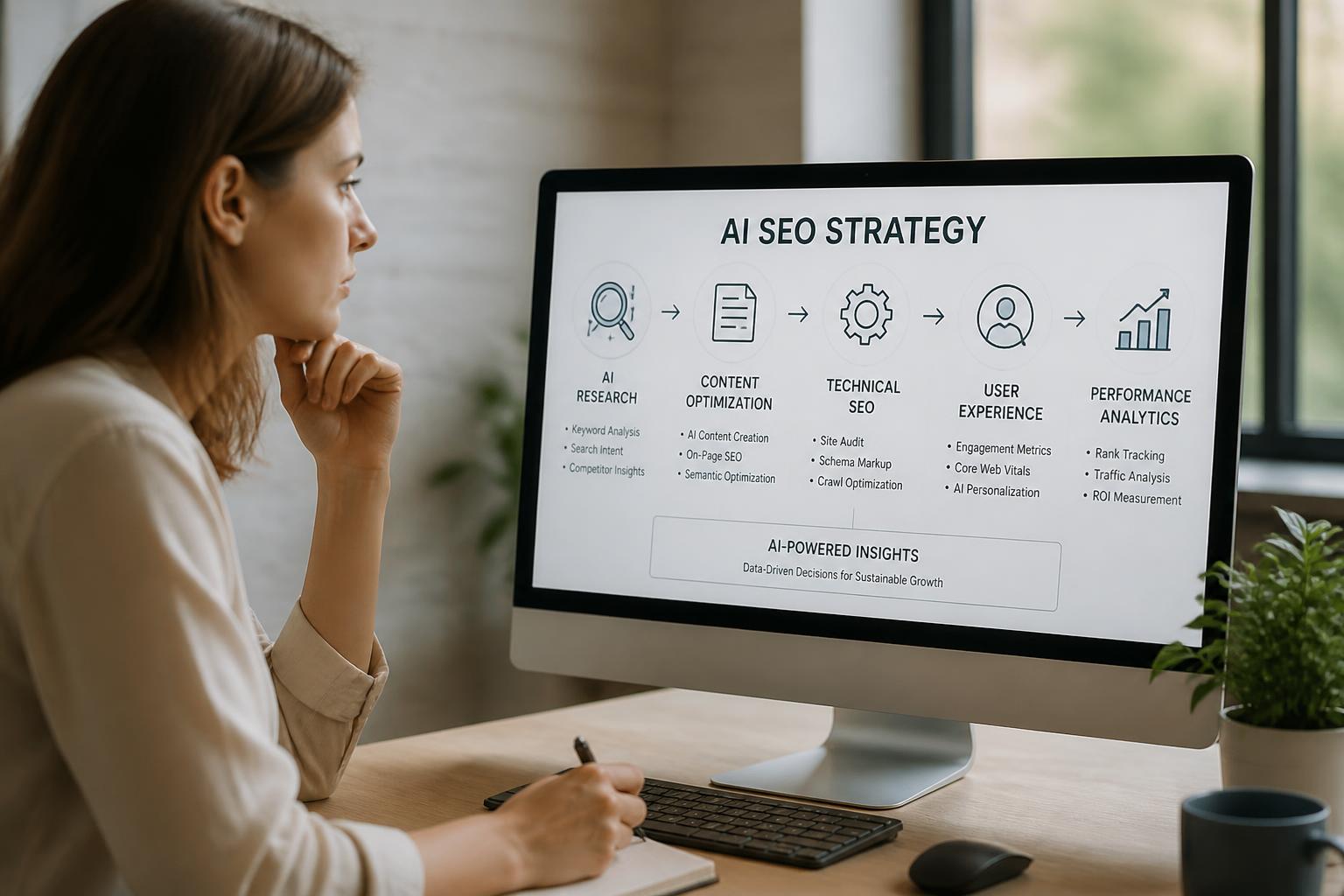
Traditional SEO tools showed you data. Modern ones generate content briefs from live SERP analysis, predict whether a page will rank before you publish it, run technical audits with specific fixes, and watch competitors in real time.
The gap between “here’s what happened” and “here’s what to do next” closed.
Why People Overpay
73% of businesses pay for features they don’t use. Common mistakes:
- Buying enterprise plans when you’re tracking 500 keywords, not 100,000
- Paying for tools that duplicate Google Search Console
- Locking into annual contracts before testing workflows
- Upgrading for reports that look good in meetings but don’t change decisions
Match what you actually do to what the tool can do. Ignore the marketing.
7 Features That Matter
1. Intelligent Keyword Research
Good platforms show semantic relationships between keywords, group searches by intent, calibrate ranking difficulty to your domain authority, compare your content coverage to competitors, and spot trends before they peak.
Look for tools that suggest long-tail variations you wouldn’t find manually.
2. AI Content Optimization
Modern systems analyze topical authority across your site, entity relationships Google expects in comprehensive content, structure patterns from top pages, readability for engagement, and SERP feature opportunities like featured snippets.
The best ones give you specific rewrites, not just scores.
3. Technical SEO Automation
AI prioritizes issues by ranking impact, generates code snippets for fixes, monitors site health with alerts, identifies crawl budget waste, and analyzes Core Web Vitals with roadmaps.
Find platforms that explain why each fix matters for your site specifically.
4. Competitor Intelligence
Smart analysis reveals strategy:
- What topics drive their traffic?
- Which backlinks could you realistically get?
- Where are they competing against themselves?
- Which changes moved their rankings?
- How are they winning rich results?
You want actionable gaps, not data dumps.
5. Rank Tracking with Context
Tracking needs context. Advanced systems show whether you’re losing traffic to AI Overviews, alert you when multiple pages compete for the same keyword, normalize for seasonality, monitor local pack changes, and analyze whether you’re consistently on page 1 or bouncing around.
Get tools that explain ranking changes instead of just reporting them.
6. Content Brief Generation
AI briefs include optimal length based on ranking patterns, recommended headings from top content, entity coverage for completeness, questions for featured snippets, and internal links to maximize authority flow.
The best ones let writers work without SEO expertise.
7. ROI Analytics
Connect activities to revenue. Attribution modeling shows which optimizations drove conversions, forecasting predicts traffic from ranking improvements, cost-per-acquisition compares SEO to paid channels, performance scoring identifies high-ROI pages, and budget optimization recommends where to spend.
Find tools that speak business results, not just SEO metrics.
Top Tools by Use Case
Solopreneurs and Small Businesses ($50-200/month)
Surfer SEO works best here. The Content Editor analyzes top pages and gives real-time suggestions as you write.
Pros: intuitive scoring, good SERP analyzer, built-in plagiarism checker, integrated keyword research.
Cons: limited technical auditing, rank tracking costs extra, smaller keyword database than enterprise options.
Good for content sites, blogs, affiliate marketers focused on on-page work.
Alternative: Frase specializes in question-based optimization, perfect for targeting featured snippets.
Growing Agencies ($200-500/month)
Semrush is the standard for agencies managing multiple clients. Combines keyword research, technical audits, and competitor analysis.
Pros: 25+ billion keyword database, white-label reporting, unlimited competitor tracking, integrated content toolkit.
Cons: steep learning curve, overwhelming for beginners, some AI features feel tacked on.
Good for agencies with diverse clients across industries.
Alternative: Ahrefs has the best backlink index and Site Explorer for competitive work. Content Explorer is unmatched for finding link opportunities.
Enterprise ($500-2000+/month)
BrightEdge pioneered enterprise AI SEO with DataMind. The platform predicts ranking impact before changes go live.
Pros: advanced intent analysis and automation, custom machine learning models, executive reporting, dedicated support.
Cons: expensive (typically $1,000+), significant onboarding, overkill for sites under 10,000 pages.
Good for large operations with complex architectures and dedicated teams.
Alternative: seoClarity offers similar capabilities with stronger technical automation and API access.
E-commerce
Bloomreach (formerly Exponea + Loomi AI) built specifically for product SEO. Automates product descriptions, recommends category content, generates schema for products, handles internal linking for discovery.
Good for stores with 500+ products needing scalable optimization.
Local Businesses
BrightLocal + ChatGPT handles citation building, review management, and Google Business Profile optimization. 2026 update includes automated review responses, local content briefs, NAP consistency monitoring, multi-location rank tracking.
Good for multi-location businesses and agencies managing local clients.
How to Choose
Stop comparing feature lists. Follow this instead:
1. Audit Your Workflow
Document what you actually do:
- Hours per week on keyword research
- Content pieces published monthly
- Backlink outreach volume
- Number of sites managed
- Common technical issues
Your tool should speed up your existing work, not force a new process.
2. Calculate True Cost
Factor in:
- Base subscription
- Add-on modules (rank tracking, extra projects)
- Team seats
- Training time
- Integration costs
Many “affordable” tools get expensive when you add what you need.
3. Test with Real Work
Use trials strategically:
Week 1: audit your most important page
Week 2: create a brief and optimize new content
Week 3: analyze a target keyword
Week 4: check if insights drove actual decisions
Don’t just explore—complete real tasks.
4. Check AI Quality
Test these:
- Does it suggest keywords you already rank for?
- Are recommendations generic or niche-specific?
- Can it explain why a competitor ranks higher?
- Do technical priorities match your assessment?
- Are predictions accurate later?
Bad AI creates busywork. Good AI surfaces what you’d miss.
5. Plan for Growth
Pick tools that scale:
- Easy tier upgrades
- No usage limits forcing a switch later
- Multiple team members supported
- Data export if you migrate
Switching SEO tools is painful. Choose one with a path forward.
Red Flags
Walk away when you see:
Proprietary “secret” metrics — If they won’t explain scoring methodology, be skeptical. Transparent tools show calculations.
No API or export — Data lock-in traps you. Ensure you can export keywords, rankings, audit data.
Aggressive upselling during trials — Pressuring upgrades before testing core features means the base plan is deliberately broken.
“AI-powered” everything — Some platforms slap “AI” on basic automation. Real AI provides insights you couldn’t generate manually.
No clear ROI path — If the vendor can’t say how their tool drives revenue (not just rankings), they’re selling features.
Save Money Without Sacrificing Quality
Stack Free Tools First
Before paying anything:
- Google Search Console for technical issues and queries
- Google Analytics 4 for traffic and conversions
- Google Keyword Planner for search volume
- Screaming Frog (free version) for crawling 500 URLs
- ChatGPT for content ideas and optimization
Many sites only need paid tools for competitive research.
Core Tool + Specialists
Instead of one expensive all-in-one:
- One comprehensive tool (Semrush or Ahrefs)
- Specialists for specific needs (Surfer for content, BrightLocal for local)
Often cheaper than enterprise platforms.
Negotiate Annual Plans
Most offer 20-40% off for annual commitments. If you’ve tested thoroughly, annual cuts costs.
Tips:
- Ask for custom plans without unused features
- Request extended trials (many do 30+ days)
- Mention competitor pricing (they often match)
- Buy during Black Friday (typical savings: 30-50%)
Share Accounts Carefully
Some allow project-based access:
- Agencies share client projects without extra seats
- Freelancers rotate active projects
- Partnerships split costs for shared research
Check terms first.
Use AI to Reduce Tool Dependency
ChatGPT, Claude, and Gemini can replicate many paid functions:
- Content optimization from SERP analysis
- Meta description generation
- Schema markup
- Content gap identification
- Keyword clustering
Pair free SERP data with AI analysis.
Future-Proofing
Choose tools preparing for:
AI Overviews (SGE) — Track when your content appears in AI summaries, optimize for AI citations, monitor SGE traffic impact. BrightEdge and Semrush lead here.
Voice and Visual Search — Analyze question-based performance, optimize images for visual search, capture featured snippets for voice.
Entity-Based SEO — Map entity relationships in content, identify gaps vs competitors, suggest entity-rich structures. Surfer SEO and Clearscope lead.
Predictive Analytics — Forecast traffic from ranking improvements, difficulty accounting for your authority, ROI before publishing. BrightEdge and seoClarity have the best forecasting.
Which Tool to Choose
No universal best. Depends on your situation:
Surfer SEO — content creator or small business, on-page focus, under $100/month budget
Semrush — agency with multiple clients, need competitive analysis and white-label reporting
Ahrefs — backlinks and link-building central to strategy, want most accurate link index
BrightEdge — enterprise with complex technical needs and budget for support
Frase — specialize in featured snippets and People Also Ask with question content
Start free — unsure? Begin with Google Search Console + free Screaming Frog + ChatGPT. Add paid tools when you hit specific gaps.
Next Steps
- Document your workflow — what takes the most time?
- Set a realistic budget — all costs, not just base subscription
- Start two free trials — test with real projects
- Track impact — did insights lead to optimizations?
- Commit or move on — don’t let trials expire without deciding
The best tool is one you’ll use consistently. Features don’t matter if the learning curve stops adoption.
For detailed comparisons and tutorials, check the complete AI SEO guide.
The goal isn’t finding the “perfect” tool. It’s picking one that speeds up your work without breaking your budget. Start small, prove ROI, scale as results justify it.
Your competitors are using AI. The question isn’t whether to adopt—it’s which one gives you the edge.