Is AI SEO Worth It? What Every Business Should Know in 2026
AI SEO is the standard now, not a trend. If you’re still optimizing for Google’s 2020 algorithm while your competitors feed AI-powered search engines, you’re not behind — you’re invisible.
60% of searches yield no clicks in 2026, according to Semrush’s AI SEO statistics. Google AI Overviews reach 2 billion monthly users. ChatGPT has 700 million weekly active users. The average AI search visitor is worth 4.4x more than a traditional organic search visitor. AI search isn’t coming. It’s already here.
But what does AI SEO actually mean? Is it just using ChatGPT to write blog posts faster, or is there something deeper that most businesses are missing?
This guide breaks down what AI SEO means in 2026, how it differs from traditional SEO, whether it delivers ROI, and whether it’s worth the investment for your business.
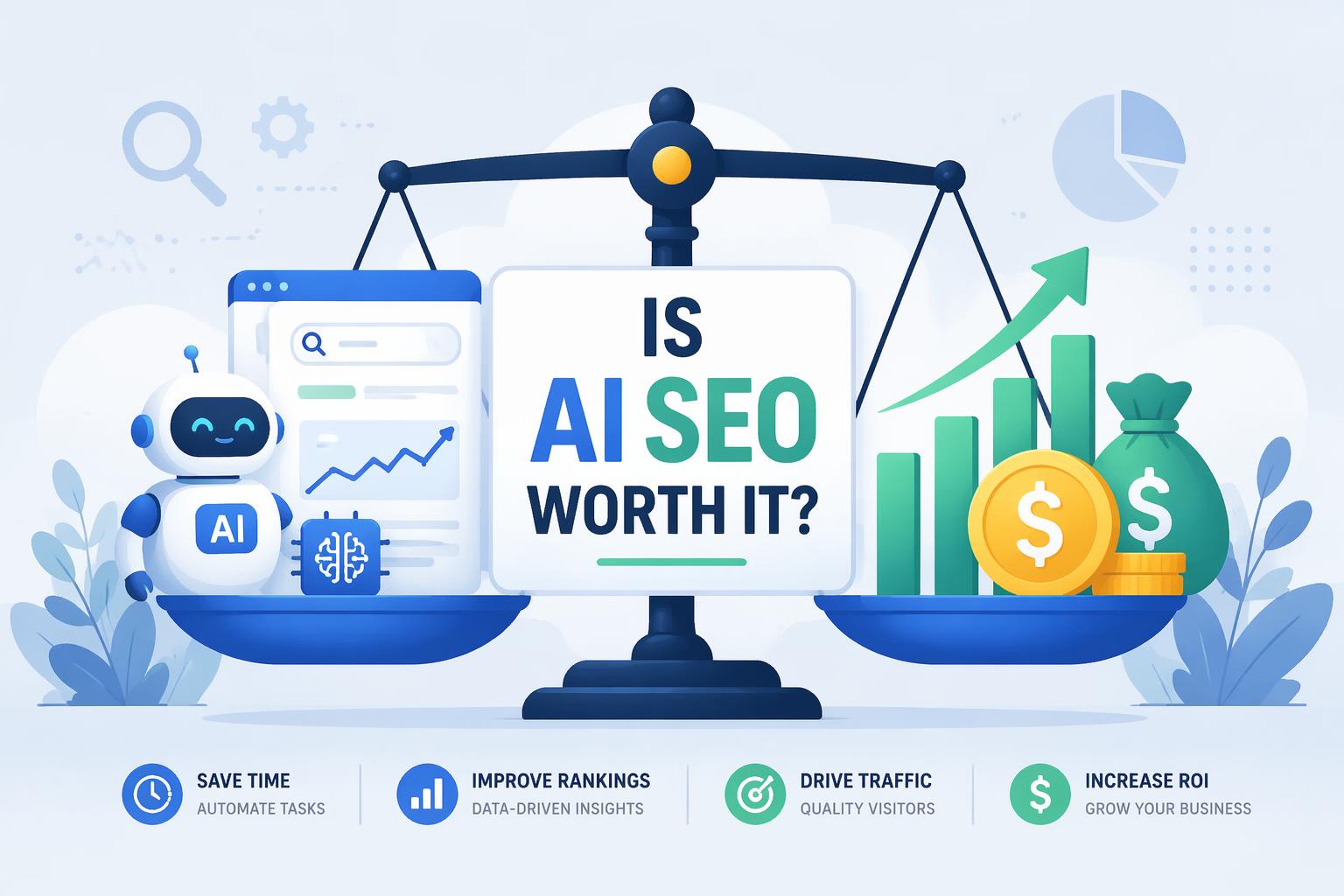
Table of Contents
- What Is AI SEO? (And What It’s Not)
- How AI SEO Works in 2026
- The Shift from SEO to AEO
- Real ROI: What the Data Shows
- When AI SEO Makes Sense (and When It Doesn’t)
- The Cost of Ignoring AI Search
- How to Get Started Without Wasting Money
- FAQ
What Is AI SEO? (And What It’s Not)
AI SEO uses artificial intelligence to enhance search engine optimization, but more importantly, it optimizes your content so AI-powered search engines can find, understand, and recommend your business.
That second part is what most people miss.
Traditional SEO focused on ranking #1 on Google. AI SEO focuses on being the answer ChatGPT, Perplexity, Google AI Overviews, and other AI assistants cite when someone asks a question.
According to Salesforce’s 2026 AI SEO guide, AI tools can process millions of data points in seconds and go beyond keyword matching to understand search intent. But the bigger shift: 50% of all the sources ChatGPT cites are business and service websites, per Semrush.
If your site isn’t structured for AI discovery, you’re not just losing rankings. You’re losing citations, recommendations, and high-intent traffic.
What AI SEO is not
Pumping out 50 blog posts with ChatGPT doesn’t make your SEO “AI-powered.” That’s content automation, and Google can spot thin AI content from a mile away.
AI can’t replace the human judgment needed to pick the right keywords, understand your audience, or craft a content angle that stands out. You still need technical SEO fundamentals — fast site speed, mobile optimization, proper schema markup. AI just makes the research, optimization, and scaling faster.
Think of AI SEO as a force multiplier. It doesn’t replace the fundamentals. It accelerates them.
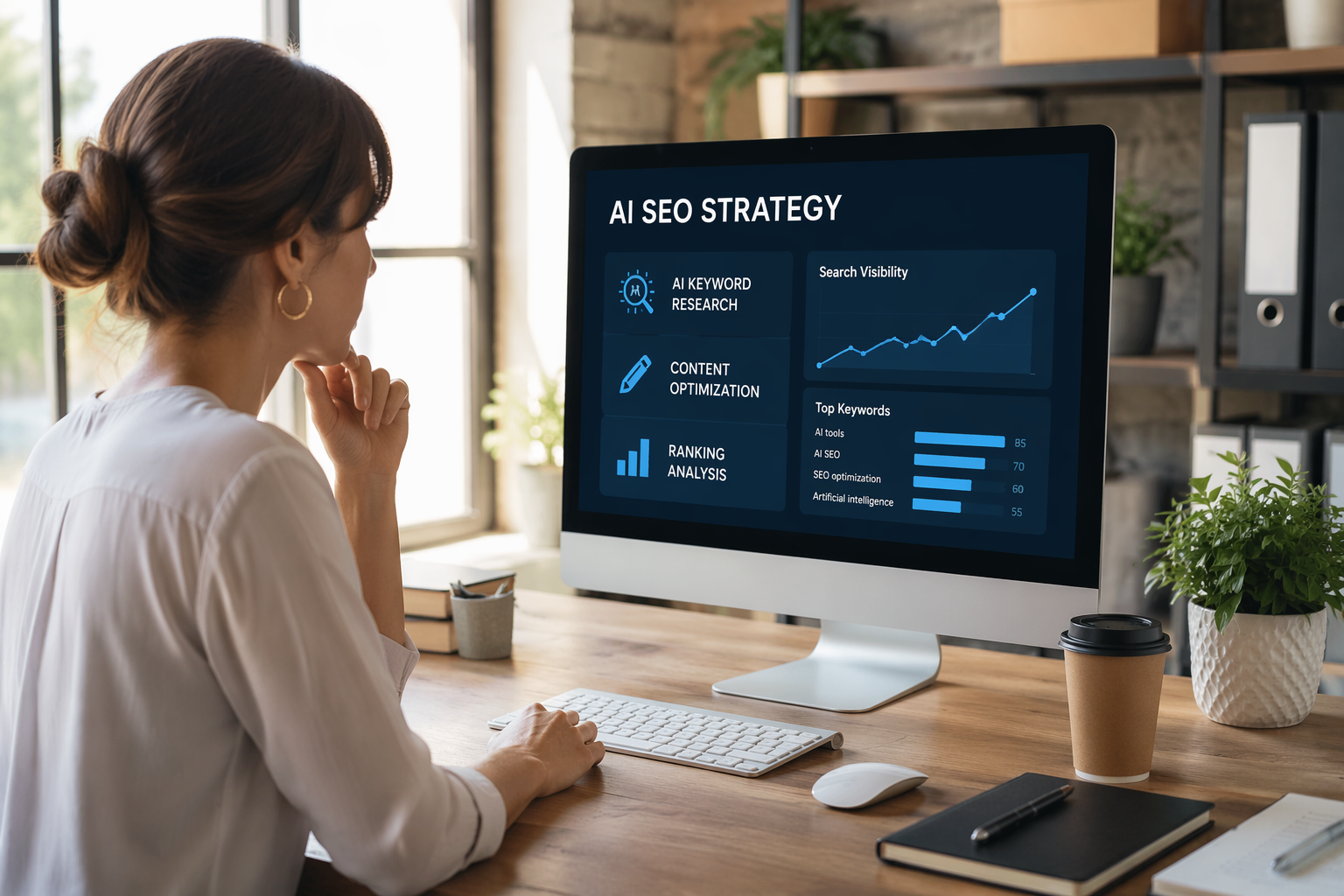
How AI SEO Works in 2026
AI SEO operates on three levels: research, execution, and optimization at scale.
Research and intent mapping
AI tools analyze search intent faster and deeper than any human can. Instead of manually reviewing the top 10 results for a keyword, AI can scan hundreds of ranking pages in seconds, identify common content gaps, map user intent patterns across related queries, and surface questions people are actually asking (not just keyword volume).
Wingman Planning’s 2026 AI SEO framework points out that AI allows optimization of hundreds or thousands of pages simultaneously — something that would take a human team months.
Content creation and optimization
This is where most businesses start, but it’s also where most fail. AI can draft content, but raw AI output rarely ranks. What works: using AI to create a detailed content brief (not the article itself), generating multiple headline variations and testing them, automating meta descriptions and title tags and schema markup, and scaling content refreshes across old blog posts.
AI should handle the repetitive work so humans can focus on strategic differentiation. Your competitors can also use AI. The ones who win are the ones who use it to scale insights, not just words.
Structured data and AI discoverability
Most businesses are still ignoring this: structured data is now required for AI recognition, according to Wingman Planning.
AI search engines don’t just scrape your content. They parse structured data (schema markup) to understand what your business does, your product or service pricing, customer reviews and ratings, and your expertise signals (author credentials, certifications, case studies).
If your site doesn’t have schema markup, AI assistants have a harder time citing you. And if you’re hard to cite, you’re invisible in the new search landscape.
Over 88% of searches that trigger AI Overviews are informational, per Semrush. Educational content with strong schema markup is your best bet for AI visibility.
The Shift from SEO to AEO
You’ll hear the term AEO (AI Experience Optimization) thrown around in 2026. It’s not jargon. It’s a real shift in how search works.
Traditional SEO optimized for rankings. AEO optimizes for recommendations.
According to this YouTube breakdown, AEO will surpass traditional SEO in importance because personalized AI recommendations will replace traditional search rankings.
What AEO prioritizes
First-party reviews are huge. AI assistants trust verified customer reviews more than anything else. Wingman Planning calls this the top trust signal for AI recommendations in 2026.
Pricing transparency matters. If your pricing isn’t on your site, AI can’t recommend you. This is now required for AI visibility, per the same source.
Demonstrated expertise — not keyword density. Real proof you know what you’re talking about: case studies, original data, author credentials, certifications. Demonstrated expertise will replace keyword targeting as the focus for businesses, according to the framework.
Unverified labels work like trust badges for AI. Sites that meet certain quality and transparency thresholds get labeled as “verified” or “trusted” by AI assistants. The ones that don’t get flagged as unverified.
If you’re still chasing keyword rankings while ignoring trust signals, you’re optimizing for a search engine that matters less every month.
Real ROI: What the Data Shows
Is AI SEO actually delivering ROI, or is it just hype?
What businesses are seeing
70% of businesses report higher ROI from using AI in SEO, according to Semrush’s 2026 report. AI search traffic is up 527% year over year (Semrush). Website traffic from AI search may surpass traffic from traditional search by 2028 (Salesforce).
Not all AI SEO investments pay off equally.
Businesses seeing the highest ROI use AI to scale research and optimization, not just content creation. They invest in structured data and schema markup early. They focus on trust signals (reviews, pricing, expertise) over keyword stuffing. They treat AI SEO as part of a full marketing ecosystem, not a siloed tactic.
The businesses wasting money think AI SEO means “publish 100 AI-written blog posts and wait for traffic.”
The traffic quality problem
35% of Gen Z people in the U.S. use AI chatbots for information (Semrush). That’s a big audience shift.
But remember: the average AI search visitor is worth 4.4x more than a traditional organic search visitor (Wingman Planning).
Why? Because AI search users are asking specific, high-intent questions. They’re not just browsing. They’re looking for answers, recommendations, and solutions. If your content delivers, they convert.
That’s the equation in 2026: fewer visitors, but higher quality and intent.
When AI SEO Makes Sense (and When It Doesn’t)
AI SEO isn’t a fit for every business.
AI SEO makes sense if
You have a content-heavy site (blogs, knowledge bases, resource libraries). AI can scale research, optimization, and internal linking across hundreds of pages.
Your audience uses AI search. If your target customers are Gen Z, tech workers, or early adopters, they’re already asking ChatGPT instead of Googling. You need to be there.
You compete on expertise, not just price. AI search rewards depth and trust. If your differentiation is “we know this space better than anyone,” AI SEO amplifies that.
You’re willing to invest in structured data. Schema markup isn’t optional anymore. If you’re not willing to implement it, AI SEO won’t move the needle.
You already have strong fundamentals. Fast site, mobile-optimized, decent backlink profile. AI SEO scales what’s already working. It doesn’t fix broken foundations.
AI SEO doesn’t make sense if
You have no content strategy. AI can’t create a strategy for you. If you don’t know what keywords to target or what your audience cares about, adding AI to the mix just creates noise faster.
Your site is purely transactional. If you’re running a simple e-commerce store with no blog or educational content, traditional SEO and paid ads might deliver faster ROI. Nearly 80% of queries triggering AI Overviews fall into the low-volume category (Semrush), meaning high-volume commercial terms still favor traditional search.
You’re looking for a quick win. AI SEO takes time. You’re optimizing for discovery by algorithms that are still evolving. Expect 6-12 months before you see meaningful traffic shifts.
You can’t afford to experiment. AI search is still the wild west. Some tactics work. Some don’t. If you need guaranteed ROI in 90 days, stick with paid search.
The Cost of Ignoring AI Search
What happens if you don’t invest in AI SEO?
Traditional SEO has dominated for 25 years, but that era is ending, per this analysis. Businesses that don’t adapt will face:
Declining organic traffic
60% of searches yield no clicks (Semrush). Users are getting answers directly from AI Overviews and chatbots. If your content isn’t being cited, you’re not getting the click.
Loss of high-intent visitors
AI search visitors are worth 4.4x more than traditional organic visitors. If you’re not showing up in AI recommendations, you’re missing the most valuable traffic.
Competitive disadvantage
Your competitors are already doing this. 70% of businesses report higher ROI from using AI in SEO (Semrush). The longer you wait, the harder it gets to catch up.
Irrelevance to younger audiences
35% of Gen Z uses AI chatbots for information (Semrush). If your brand isn’t showing up in ChatGPT or Perplexity, you’re invisible to the next generation of buyers.
The cost of ignoring AI SEO isn’t just lost traffic. It’s lost market position.
How to Get Started Without Wasting Money
If you’re convinced AI SEO is worth it, start smart without burning budget on tools and tactics that don’t work.
Audit your current AI visibility
Before you optimize, you need to know where you stand. Tools like Semrush’s AI Visibility Toolkit can show you whether your site appears in AI Overviews, which queries trigger AI citations of your content, and how your competitors are performing in AI search.
This baseline tells you where to focus.
Implement structured data
This is non-negotiable. Add schema markup for organization (your business name, logo, contact info), products and services (with pricing if possible), reviews and ratings, articles and blog posts (author, publish date, featured image), and FAQs.
Use Google’s Structured Data Markup Helper or a plugin like Yoast (for WordPress) to get started. This is the foundation of AI discoverability.
Add pricing and reviews
Two simple additions that massively boost AI visibility: publish your pricing (even if it’s a range). AI assistants prioritize transparent businesses. And collect and display first-party reviews — embed customer testimonials, case studies, or a review widget on service pages.
Both are required for AI visibility in 2026, per Wingman Planning.
Use AI to scale research, not just content
The biggest mistake is using AI to crank out generic blog posts. The better play: use AI to analyze competitor content gaps, generate content briefs (not full drafts), automate meta descriptions and title tag variations, and scale internal linking across old posts.
Focus AI on the repetitive tasks that slow down your team. Keep strategy and differentiation in human hands.
Track the right metrics
Traditional SEO metrics (keyword rankings, domain authority) matter less in 2026. Track AI citations (how often your site is cited in AI Overviews or ChatGPT), AI search traffic (set up a segment in Google Analytics for traffic from AI-powered search engines), and conversion rate by source (compare AI search visitors to traditional organic).
These metrics tell you if AI SEO is actually driving business results.
FAQ
What is AI SEO?
AI SEO uses artificial intelligence to enhance search engine optimization and optimizes content for AI-powered search engines like ChatGPT, Google AI Overviews, and Perplexity. It involves both using AI tools to scale SEO work and making sure your content is structured so AI assistants can discover, understand, and cite it.
Can AI replace human SEO specialists?
No. AI can automate research, content drafts, and repetitive optimization tasks, but it can’t replace strategic thinking, audience understanding, or editorial judgment. According to Wingman Planning’s 2026 framework, the best results come from using AI to scale execution while keeping humans in charge of strategy and differentiation.
How does AI enhance SEO strategies?
AI enhances SEO by processing millions of data points in seconds, identifying search intent patterns, scaling content optimization across hundreds of pages, and automating repetitive tasks like meta description generation and schema markup. According to Salesforce, AI tools go beyond keyword matching to help marketers understand search intent at a deeper level.
What is AEO and why does it matter?
AEO (AI Experience Optimization) optimizes content for AI-powered recommendations rather than traditional search rankings. It matters because personalized AI recommendations are replacing traditional search rankings as the primary way users discover content, according to this 2026 analysis. AEO prioritizes trust signals like reviews, pricing transparency, and demonstrated expertise over keyword density.
How much does AI SEO cost?
Costs vary widely depending on whether you’re using free AI tools (ChatGPT, Google AI), investing in specialized SEO AI platforms (Semrush, Surfer SEO), or hiring an agency. Many businesses start with free tools and existing staff, then scale investment as they see ROI. The bigger cost is often the time required to implement structured data, gather reviews, and audit AI visibility, not the tools themselves.
Is AI SEO worth it for small businesses?
It depends. Small businesses with content-heavy sites, expertise-driven offerings, or audiences that use AI search can see strong ROI. But if you’re a local service business with no blog and a simple website, traditional local SEO and Google Business Profile optimization might deliver faster results. Match the tactic to your business model and audience behavior.