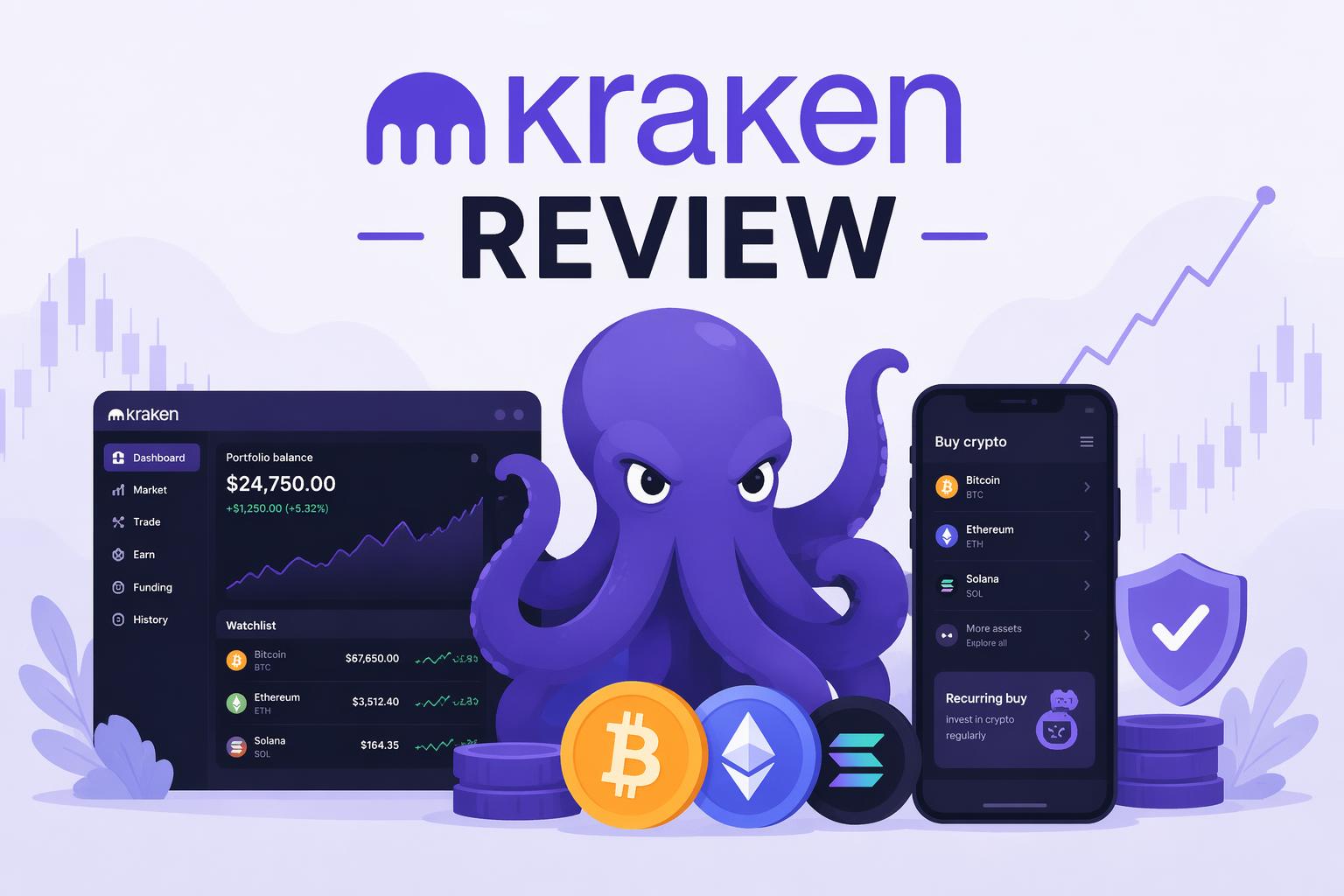
# Kraken Review 2026: Fees, Safety & Real Trading Value

If you’ve ever tried picking a crypto exchange, you already know the problem: too many platforms, unclear fees, and constant fear of hidden costs eating your profits.
That’s exactly where this Kraken review 2026 comes in.
Kraken is one of the oldest crypto exchanges still operating at scale. But longevity alone doesn’t mean it’s the best choice today. In 2026, the real question is simpler:
> Is Kraken still worth it, or are newer exchanges better for cost, speed, and usability?
Let’s break it down without hype.
---
Table of Contents
- Overview of Kraken in 2026
- Key Features and Trading Experience
- Fees Breakdown (Spot, Futures, Hidden Costs)
- Security and Regulation
- Pros and Cons
- Kraken vs Competitors
- Who Should Use Kraken
- Final Verdict + FAQ
---
Overview of Kraken in 2026
Kraken is a centralized crypto exchange that supports spot trading, futures, staking, and fiat on/off ramps.
What makes it stand out is consistency. While many exchanges rise fast and collapse or pivot aggressively, Kraken has stayed focused on:
- Security-first architecture
- Regulatory compliance in multiple jurisdictions
- Professional-grade trading tools
- Conservative asset listing strategy
But that stability comes with trade-offs: it’s not always the fastest to list new coins, and its interface still feels more “trader-focused” than beginner-friendly.
In 2026, Kraken sits in a specific category:
> A “serious exchange” for users who prioritize safety and structure over hype-driven token access.
---
Key Features and Trading Experience
Kraken is not trying to be a social trading app. It’s built for execution.
1. Spot Trading
The spot market covers major cryptocurrencies:
- BTC, ETH, SOL, XRP
- Stablecoins like USDT, USDC
- Select altcoins (more conservative listing policy)
Order types include:
- Market
- Limit
- Stop-loss
- Take-profit
- Advanced conditional orders
Execution is stable, with relatively low slippage on major pairs.
2. Kraken Pro Interface
The “Pro” interface is where most serious users operate.
It offers:
- Advanced charting tools
- Depth of market view
- API access for bots
- Faster execution layer
The learning curve is real, but once you adapt, it feels more precise than simplified mobile-first exchanges.
3. Staking (Reduced but Still Available)
Kraken still offers staking for select assets, but availability has tightened due to regulatory pressure.
- ETH staking remains popular
- Rewards vary based on network conditions
- Some regions have restrictions
4. Futures Trading
Futures exist but are more conservative compared to Binance-style leverage ecosystems.
- Lower leverage options
- Strong risk controls
- More compliance-focused restrictions
---
Fees Breakdown (What You Actually Pay)
Fees are where most users misjudge exchanges.
Kraken uses a maker-taker model:
Spot Trading Fees
- Maker: ~0.16% (can go lower with volume)
- Taker: ~0.26%
Compared to newer zero-fee marketing exchanges, Kraken looks expensive at first glance.
But there’s a catch:
- Lower hidden spread manipulation
- More stable execution pricing
- Less reliance on “fee-free but spread-heavy” models
Deposit Fees
- Crypto deposits: usually free
- Fiat deposits: depends on method (bank transfer is cheapest)
Withdrawal Fees
- Crypto withdrawals: network fee applies
- Fiat withdrawals: varies by region and method
Hidden Cost Reality
Kraken is relatively transparent compared to many competitors. The real “cost” is not hidden fees—it’s opportunity cost (less aggressive token listing, fewer speculative trading pairs).
---
Security and Regulation
This is where Kraken still holds strong positioning in 2026.
Security features include:
- Cold storage majority of funds
- 2FA mandatory for sensitive actions
- Global security monitoring systems
- Regular audits and compliance reviews
Unlike many competitors that expanded aggressively and later retrenched, Kraken built slowly and stayed conservative.
That approach matters when you consider exchange risk.
In crypto, the biggest hidden cost is not trading fees—it’s counterparty risk.
---
Pros and Cons
Pros
- Strong security reputation
- Long operational history
- Transparent fee structure
- Stable execution on major pairs
- Good fiat integration in supported regions
Cons
- Interface feels less beginner-friendly
- Fewer new token listings
- Staking availability reduced in some regions
- Fees higher than “zero-fee” competitors
---
Kraken vs Competitors
Kraken vs Binance
- Binance: more coins, more features, higher complexity
- Kraken: safer positioning, more conservative asset exposure
Kraken vs Coinbase
- Coinbase: simpler UX, higher fees in many cases
- Kraken: better for active traders, more flexible order system
Kraken vs newer exchanges
Newer platforms often:
- Push zero-fee marketing
- Rely on spreads
- Have less regulatory track record
Kraken trades hype for stability.
---
Who Should Use Kraken?
Kraken is best for:
- Long-term crypto investors
- Traders who prioritize security
- Users needing fiat on/off ramps
- People who want regulated exchange exposure
Kraken is NOT ideal for:
- Meme coin hunters
- High-frequency scalpers on micro fees
- Users wanting ultra-simple mobile UX
---
Final Verdict
Kraken in 2026 is not the flashiest exchange, and it doesn’t try to be.
It’s closer to a financial infrastructure platform than a trading playground.
If your goal is:
- Safety
- Reliability
- Regulatory clarity
- Stable execution
Then Kraken still earns its place.
If your goal is:
- Maximum token exposure
- Aggressive yield farming
- High-risk trading ecosystems
You’ll likely outgrow it quickly.
---
FAQ
Is Kraken safe in 2026?
Yes. It remains one of the more security-focused exchanges with long operational history and strong compliance posture.
Are Kraken fees high?
They are mid-range. Not the cheapest, but generally transparent and stable.
Is Kraken good for beginners?
It’s usable, but not the simplest. Beginners may prefer more guided interfaces.
Does Kraken support staking?
Yes, but availability depends on region and asset.
Is Kraken better than Binance?
Depends on your needs: Kraken prioritizes safety, Binance prioritizes ecosystem size.
---