Webull vs Robinhood: Which Trading Platform Actually Wins in 2026?
Commission free trading changed the game. But when both platforms charge $0, the differences that matter get harder to spot.
Robinhood has about 27 million funded accounts. Webull has around 5 million. Brand recognition doesn’t tell you which platform costs less in hidden fees, gives you better tools, or fits how you actually trade.
You’re either paying 8.74% margin interest when you could be paying 5.75%, or stuck with a phone only interface when you need real charting. By the end, you’ll know which platform fits your style, what the free model costs, and where each one trips you up.
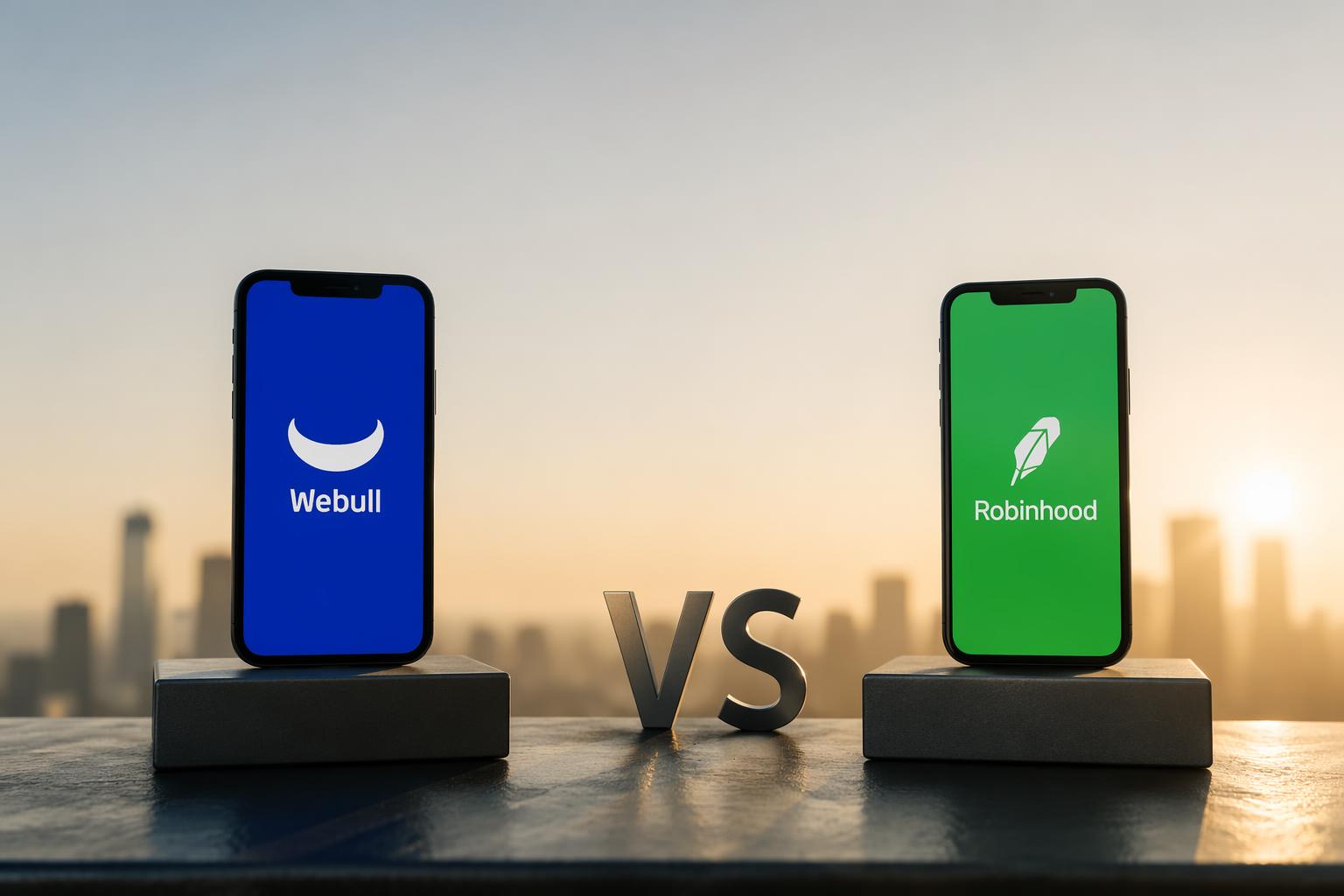
Table of Contents
- The Real Cost Breakdown: Where “Free” Trading Isn’t Actually Free
- Platform Features: Simplicity vs Power
- Who Should Pick Robinhood (and Who Shouldn’t)
- Who Should Pick Webull (and Who Shouldn’t)
- Account Types and Cash Management
- Trading Tools and Research Capabilities
- The Transparency Problem
- FAQ
Where free trading costs you anyway
Both platforms advertise $0 commissions and $0 minimums. Surface level, they look identical. The costs show up in three places most people miss.
Margin rates. Borrow money to trade and Webull charges 8.74% on balances under $25,000. Robinhood charges 5.75%. That’s a 3% spread. On a $10,000 margin balance held for a year, Robinhood saves you roughly $300 in interest. Use margin regularly and that gap compounds.
Options contracts. Equity options are free on both. Index options cost $0.50 per contract on Robinhood and $0.30 to $0.50 on Webull depending on type. Trade SPX or NDX options and that difference stacks up.
Uninvested cash. Webull pays 3.6% interest on cash if you’re a Premium user, 3.25% if your balance tops $25,000, and 0.5% otherwise. Robinhood pays 0.01% on free accounts and 3.35% on Gold accounts ($5/month). Keep cash sitting in your account and Robinhood’s free tier pays you almost nothing. Webull’s free tier pays 0.5%. Still low, but not insulting.
Both platforms sell your orders to market makers, a practice called payment for order flow. Legal and common, but it means your orders might not get the absolute best price. Research from June 2026 shows Robinhood is less transparent about how much revenue it generates per user from this. Webull is slightly more forthcoming.
The $0 commission is real for stock trades. Regulatory and exchange fees still apply, usually a few cents per trade depending on volume.
Trade on margin frequently? Robinhood’s lower rate wins. Keep large cash balances? Webull’s higher interest rates win, especially for Premium users. Do neither? The cost difference is negligible.

Simplicity vs power
Robinhood made investing feel like scrolling Instagram. Clean interface, fast onboarding, no intimidation factor. Mobile first, assumes you’re trading casually.
Webull looks like a trading terminal squeezed into a phone. Advanced charting, Level 2 market data, technical indicators, desktop platform. Steeper learning curve. Higher ceiling.
Charting. Webull offers customizable charts with 50+ technical indicators, multiple timeframes, drawing tools. Robinhood gives you line and candlestick views, a few indicators, limited customization.
Order types. Webull supports extended hours trading, conditional orders, complex trade setups. Robinhood offers the basics: market, limit, stop loss. Want to set a trailing stop or bracket order? Robinhood doesn’t have it.
Paper trading. Webull includes simulated trading so you can practice strategies without risking money. Robinhood doesn’t. New and want to test the waters? Webull gives you a sandbox. Robinhood throws you in.
Platform access. Webull runs on web, mobile, and desktop with API access for advanced users. Robinhood is mobile first. The web platform exists but it’s secondary. Trading from a laptop with multiple monitors? Webull is the only option.
Educational content. Robinhood integrates investing education into the app. Helpful if you’re learning what a call option is. Webull assumes you already know or you’ll figure it out. Robinhood holds your hand. Webull hands you the tools.
Data from June 2026 rates Webull as superior for active traders. Robinhood is more suitable for beginners.
Who should pick Robinhood
Pick Robinhood if you’re new to investing and want the simplest interface. Designed for people who’ve never opened a brokerage account. Fast onboarding, intuitive, no jargon.
Pick it if you want integrated education. Built in explainers walk you through stocks, ETFs, options. Still Googling “what’s a dividend”? This helps.
Pick it if you trade on margin and want lower rates. Robinhood’s 5.75% under $25,000 beats Webull’s 8.74%. Borrow to trade and that difference is real money.
Pick it if you trade from your phone. Robinhood’s design is built for that. Everything is swipe friendly, loads fast.
Skip Robinhood if you want advanced charting or technical indicators. Tools are basic. Need Fibonacci retracements, Bollinger Bands, multi timeframe analysis? You’ll be frustrated.
Skip it if you day trade frequently. Platform isn’t built for high frequency trading. Execution is fine for occasional trades but serious day traders need the speed and data Webull provides.
Skip it if you care about transparency. Research from June 2026 says Robinhood lacks transparency in how it handles order flow and revenue. Webull is slightly more forthcoming.
Skip it if you want to practice without risking money. No paper trading. You’re trading real money from day one.
Robinhood works for newer investors who want to start small, learn as they go, avoid overwhelming complexity. Right choice if you’re buying and holding index funds or dabbling in a few stocks. Wrong choice if you’re trying to scalp intraday moves or run multi leg options strategies.
Who should pick Webull
Pick Webull if you’re an active or technical trader. Platform was built for people who read charts, track volume, care about Level 2 quotes. Know what those things mean? Webull gives you the tools.
Pick it if you want a desktop trading platform. Full desktop application with multi monitor support. Trading from a laptop or serious workstation? Webull wins.
Pick it if you want paper trading. Simulated trading feature lets you test strategies without risking capital. Experimenting with options spreads or new techniques? Invaluable.
Pick it if you trade a broader range of assets. About 70 different crypto tokens, more international stocks, wider universe of tradable securities. Robinhood offers over 11,000 stocks and ETFs but Webull’s asset coverage is broader.
Pick it if you keep large cash balances. Pays 3.25% interest on balances over $25,000, 3.6% for Premium users. Park cash between trades? Webull’s rates are meaningfully better than Robinhood’s 0.01% on free accounts.
Skip Webull if you’re brand new to investing. Interface assumes you know what you’re doing. No hand holding. Learning curve is real. Don’t know the difference between market order and limit order? Webull will confuse you.
Skip it if you only trade from your phone casually. Mobile app is powerful but dense. Just buying a few shares of an ETF once a month? Robinhood’s simplicity fits better.
Skip it if you use margin heavily and have a small account. 8.74% margin rate under $25,000 is significantly higher than Robinhood’s 5.75%. Borrow frequently and that cost adds up.
Webull works for intermediate and advanced traders who need sophisticated tools and are comfortable navigating complexity. Right choice if you’re day trading, running technical analysis, treating trading as serious hobby or income source. Wrong choice if you’re just getting started.
Account types and cash management
Both support individual brokerage accounts and retirement accounts (IRAs). Benefits differ.
IRA matching. Webull offers 1% contribution match on IRA accounts with free accounts and 3.5% for paid. Robinhood offers 1% for free and 3% for Gold ($5/month). Contributing to a retirement account? Webull’s paid tier gives a slightly better match.
Cash management. Robinhood positions Gold membership ($5/month) as premium with better cash interest (3.35%) and margin rates. Webull Premium similarly offers higher cash interest (3.6%) but charges more for margin (8.74% vs Robinhood’s 5.75%).
Promotions. Both run signup bonuses. As of 2026, Webull offers a cash deposit bonus of 2-4% and free stock options depending on deposit size. Robinhood offers free stock on funding. Promotions change frequently. Worth checking before you open an account.
Neither charges annual fees, account maintenance, or inactivity fees. Both regulated by FINRA and SEC. Your account is protected up to $500,000 in securities and $250,000 in cash by SIPC insurance.
Trading tools and research
This is where the gap becomes obvious.
Webull’s tools:
- Level 2 market data showing real time bid/ask spreads and order book depth
- 50+ technical indicators including MACD, RSI, moving averages, Bollinger Bands
- Extended hours trading (4:00 AM to 8:00 PM ET)
- Customizable alerts for price, volume, technical conditions
- Stock screeners with dozens of filters
- Desktop platform with multi chart layouts
- API access for algorithmic traders
Robinhood’s tools:
- Basic charting with a handful of indicators
- Price alerts
- Simple stock screeners
- Extended hours trading (9:00 AM to 6:00 PM ET, more limited than Webull)
- Integrated news feed and earnings calendar
- Educational content explaining investment concepts
Need to analyze stocks deeply before you buy? Webull gives professional grade tools. Want to quickly check a stock’s price and news before trading? Robinhood’s streamlined approach is faster.
Research capabilities reflect this divide. Webull assumes you’re doing your own analysis. Robinhood tries to surface relevant information so you don’t have to dig.
The transparency problem
One recurring concern in 2026 research: Robinhood lacks transparency compared to Webull. Both engage in payment for order flow but Robinhood has been less forthcoming about exactly how much revenue it generates per user.
Payment for order flow isn’t inherently bad. It’s how commission free brokers make money. But it creates a conflict of interest. Broker profits when your order goes to a market maker who may not give you the absolute best execution price. SEC has scrutinized this practice. Still legal but transparency matters.
Webull publishes more detailed disclosures about order routing and revenue. Robinhood’s disclosures exist but they’re harder to parse. Care about understanding exactly how your broker makes money off your trades? Webull gives slightly better visibility.
Both regulated by FINRA and SEC so they operate under strict oversight. Your money is safe either way. But want to know how your free trades are subsidized? Webull is more upfront.
FAQ
Is Webull or Robinhood better for beginners?
Robinhood. Designed for people who’ve never traded. Interface is simpler, educational content is better, app doesn’t overwhelm you with data. Webull assumes you already know what you’re doing.
Does Robinhood or Webull have lower fees?
Depends on how you trade. Robinhood has lower margin rates (5.75% vs 8.74% under $25,000). Matters if you borrow. Webull has higher cash interest rates. Matters if you keep large balances. For basic stock trading both are effectively free.
Is Webull or Robinhood better for options trading?
Webull, especially if you trade index options frequently. Both charge $0 for equity options but Robinhood charges $0.50 per contract for index options while Webull charges $0.30-$0.50 depending on type. Webull’s platform gives better tools to analyze and execute options strategies.
Does Robinhood or Webull offer more cryptocurrencies?
Webull. Offers about 70 different crypto tokens as of 2026. Robinhood offers fewer though it supports most popular ones like Bitcoin, Ethereum, Dogecoin.
Which is better for active or day trading, Webull or Robinhood?
Webull. Level 2 quotes, advanced charting, faster execution, extended hours trading (4 AM – 8 PM ET), desktop platform. Robinhood’s mobile first design isn’t built for high frequency trading.
Does Webull or Robinhood offer paper trading?
Only Webull. Simulated trading feature lets you practice strategies without risking real money. Robinhood doesn’t offer this.
Can I trust Webull?
Yes. Regulated by FINRA and SEC. Accounts insured by SIPC up to $500,000 in securities and $250,000 in cash. Legitimate broker. Established in 2017, about 5 million funded accounts as of 2026.
Is Webull really free?
Yes and no. Stock trades are commission free but Webull makes money from payment for order flow, margin interest, premium subscriptions, other services. You won’t pay a commission but you’re indirectly paying through order flow revenue. Same model Robinhood uses.
Who charges more: Webull or Robinhood?
For margin trading, Webull charges more (8.74% vs 5.75% under $25,000). For options on indexes, Robinhood charges slightly more ($0.50 vs $0.30-$0.50). For stock trades, both are free. Depends on what you trade.
Which stock trading app is better for beginner investors?
Robinhood. Easier to navigate, better educational resources, doesn’t overwhelm new users with data. Once you outgrow it you can switch to Webull.
What are the minimum deposit requirements for Webull and Robinhood?
Both have $0 minimum deposits. You can open an account and start trading with any amount.
Can I trade cryptocurrencies on both platforms?
Yes. Webull offers about 70 crypto tokens. Robinhood offers fewer but includes major ones. If crypto variety matters, Webull wins.
—
Pick Robinhood if you’re new, trade casually, want simplicity. Pick Webull if you’re an active trader, need advanced tools, are comfortable with complexity. Both are legitimate, regulated brokers.