How to Save Money on AI SEO: A Practical Guide for 2026
Affiliate Disclosure: This article contains affiliate links. If you purchase through these links, we may earn a commission at no additional cost to you.
If you’re watching your SEO budget drain while trying to keep up with AI-driven search changes, you’re not alone. The landscape shifted dramatically in 2026—web traffic from generative AI referrals increased more than 10× in the United States from July 2024 to February 2025. The good news? You don’t need expensive enterprise tools to optimize for AI search. You just need the right approach.
By the end of this guide, you’ll have a clear roadmap to implement AI SEO strategies that cost little to nothing, focusing on what actually moves the needle: content depth, topical authority, and E-E-A-T signals that AI systems rely on.
What you’ll accomplish:
- Understand what AI search engines actually look for (and stop wasting money on outdated tactics)
- Implement proven optimization techniques without expensive tools
- Build content that ranks in both traditional Google and AI-powered search platforms
- Create a sustainable SEO workflow that won’t drain your budget
Time to complete: 2-3 hours for initial setup, then 30 minutes weekly for maintenance
Experience level: Beginner-friendly with some basic SEO knowledge helpful
—
What You Need Before Starting
Before diving into AI SEO optimization, gather these essentials:
- A website with existing content — AI SEO builds on what you already have
- Google Search Console access — Free tool for tracking your performance
- Basic keyword research — Know what topics your audience searches for (we’ll show you free methods)
- Content editing capability — Ability to update your website pages
- Estimated time: 2-3 hours for initial audit and planning, then ongoing weekly maintenance
—
Step 1: Audit Your Content Through an AI Lens
Traditional SEO focused heavily on keywords and backlinks. AI SEO in 2026 requires something different: depth and topical authority.
Start by reviewing your existing content against AI evaluation criteria:
- Open Google Search Console and identify your top 10 performing pages
- For each page, ask: “Does this comprehensively answer the user’s question, or does it just target a keyword?”
- Check if your content demonstrates Experience, Expertise, Authoritativeness, and Trustworthiness (E-E-A-T)—these are AI inclusion criteria in 2026
- Note pages that are thin (under 800 words) or surface-level
You should see: A clear list of content that needs deepening versus content that’s already comprehensive.
> Why this matters: AI systems analyze language, context, and intent—not just keyword density. Content that worked in 2023 may not satisfy AI algorithms in 2026.
—
Step 2: Identify Your Topic Clusters
AI-driven search optimization requires topical authority, not just individual keyword rankings.
Here’s how to map your content into clusters:
- List all your main topics (the broad subjects your site covers)
- Under each topic, list all related subtopics you’ve written about
- Identify gaps—subtopics you haven’t covered that your audience searches for
- Use Google’s “People also ask” feature (free) to find related questions
- Document this in a simple spreadsheet with columns: Main Topic | Subtopic | Existing Content | Gaps
You should see: A visual map of where you’re strong (comprehensive coverage) and where you’re weak (missing subtopics).
> Free tool alternative: Instead of paid keyword research tools, use Google Search Console’s “Queries” report to see what people already find you for—then expand on those topics.
—
Step 3: Optimize for Search Intent, Not Just Keywords
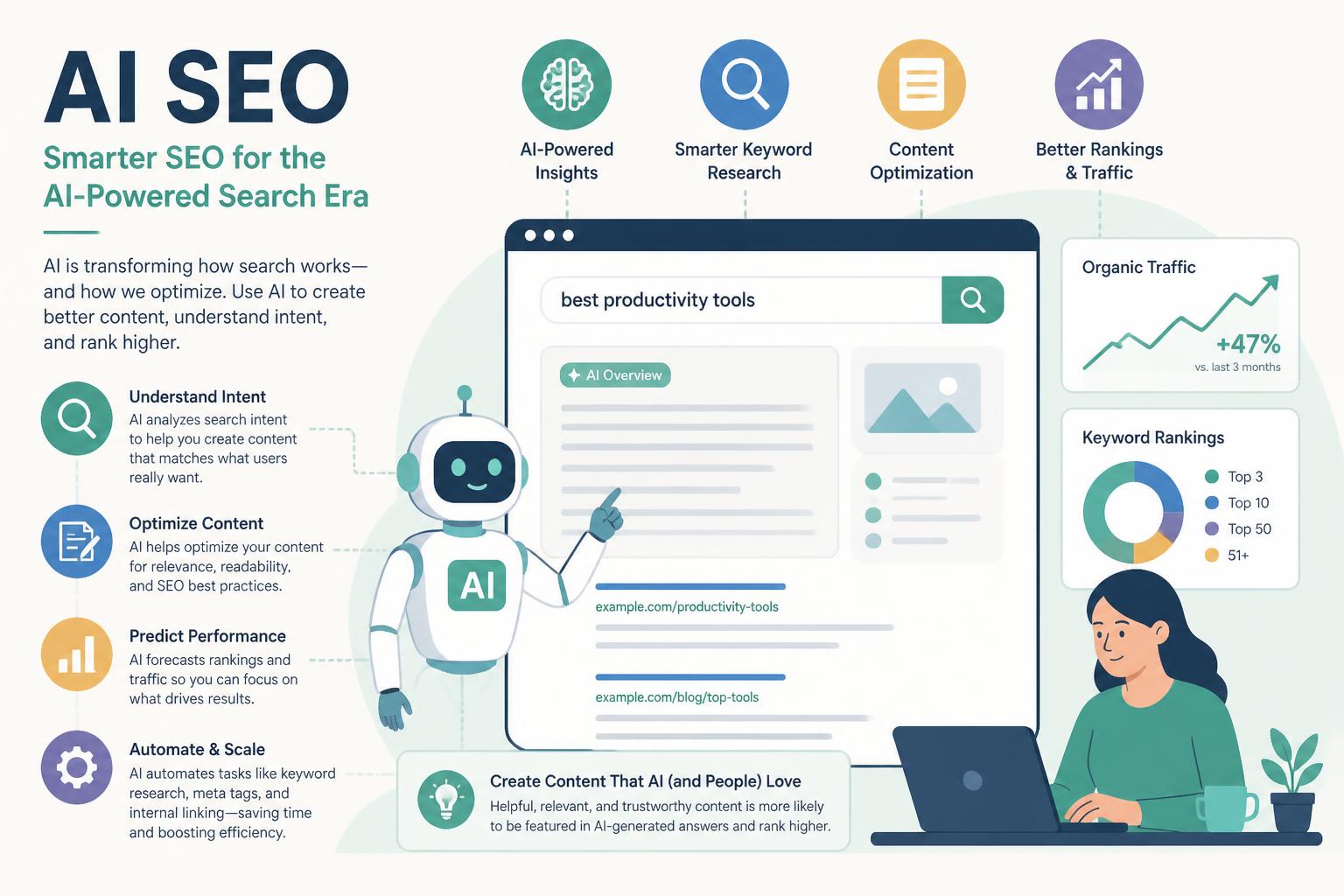
AI systems are transforming how information is found online. They prioritize content that matches user intent comprehensively.
For each piece of content you’re optimizing:
- Identify the search intent: Is the searcher looking to learn (informational), buy (transactional), navigate to a specific site, or compare options?
- Search your target keyword in Google and analyze the top 3 results
- Note what format they use (how-to guide, listicle, product comparison, etc.)
- Check what questions they answer that you don’t
- Restructure your content to match that intent more precisely
You should see: Content that directly answers what users are actually looking for, not what you assumed they wanted.
> Note: Google sends 190 times more traffic to websites than ChatGPT as of 2026, so optimizing for traditional search intent still drives the majority of traffic—but AI systems use similar intent analysis.
—
Step 4: Enhance E-E-A-T Signals Without Spending
Experience, Expertise, Authoritativeness, and Trustworthiness are critical AI inclusion criteria. Here’s how to strengthen these signals for free:
- Add author bios — Include credentials and relevant experience for each content author
- Link to authoritative sources — Cite reputable sources for claims (this builds trust with AI systems)
- Update author pages — Create or enhance “About the Author” pages with specific expertise indicators
- Add publication dates and update timestamps — Show content freshness
- Include original research or data — Even simple surveys or case studies boost expertise signals
You should see: Content that clearly demonstrates who wrote it, why they’re qualified, and when it was last verified.
> Why AI cares: AI algorithms can analyze data at unprecedented speeds and use E-E-A-T signals to determine which sources to cite or recommend.
—
Step 5: Implement Structured Data (Free SEO Boost)
Structured data helps AI systems understand your content context without expensive tools.
- Identify your content types (articles, how-to guides, FAQs, product reviews, etc.)
- Visit Google’s Schema Markup Generator (free tool)
- Generate JSON-LD structured data for your most important pages
- Add the generated code to your page’s
section or use a plugin if on WordPress - Test with Google’s Rich Results Test (free)
You should see: Your content appearing with enhanced features in search results (FAQ snippets, article metadata, etc.).
> Budget-friendly tip: Start with FAQ schema—it’s the easiest to implement and provides immediate visibility benefits.
—
Step 6: Deepen Content Strategically
AI systems require comprehensive content to recommend your site. Here’s how to deepen content without rewriting everything:
- Pick your top 5 performing pages from Step 1
- For each page, add a “Common Questions” section answering 5-8 related questions
- Expand thin sections with concrete examples, data points, or case studies
- Add comparison tables where relevant (AI systems parse these effectively)
- Include a “What to do next” section linking to related content on your site
You should see: Page word counts increasing to 1,500-2,500 words with genuinely useful additions, not fluff.
> Quality check: If you’re adding words just to hit a count, AI systems will detect that. Every addition should answer a real user question.
—
Step 7: Optimize for AI-Referred Visitor Engagement
AI-referred visitors engage at levels comparable to traditional traffic sources, browsing 12% more pages per visit and showing a 23% lower bounce rate. Capitalize on this:
- Add clear internal links in your content (at least 3-5 per article)
- Create a “Related Articles” section at the bottom of each page
- Ensure your site loads quickly (use Google PageSpeed Insights—free)
- Make your content scannable with descriptive headings
- Add a table of contents for articles over 1,500 words
You should see: Improved engagement metrics in Google Analytics as visitors explore more of your site.
—
Step 8: Build Topic Authority with Content Clusters
Traditional SEO tried to rank individual pages. AI SEO rewards comprehensive topic coverage:
- Choose one main topic from your Step 2 analysis
- Create a comprehensive “pillar page” (2,500-3,500 words) covering the topic broadly
- Write 5-8 supporting articles on specific subtopics (1,000-1,500 words each)
- Link all supporting articles to the pillar page
- Link from the pillar page to each supporting article with descriptive anchor text
You should see: A web of interlinked content that establishes you as an authority on that topic.
> Free approach: You don’t need to create all content at once. Build one cluster per month using this structure.
—
Step 9: Optimize for Citations, Not Just Rankings
Citations frequency is a new success metric in 2026, surpassing traditional rankings and clicks in importance for AI visibility.
Position your content to be cited by AI systems:
- Write with clear, quotable statements of fact
- Use data and statistics (cite your sources)
- Create original frameworks or methodologies AI can reference
- Structure content with clear headings that AI can pull from
- Answer questions directly and concisely before elaborating
You should see: Content structured like a reference guide, not just a blog post.
> Why this works: When ChatGPT or other AI systems cite information, they favor content with clear attribution, factual accuracy, and authoritative structure.
—
Step 10: Monitor AI Visibility (Free Tools)
You can’t improve what you don’t measure. Track your AI SEO progress:
- Set up Google Search Console alerts for significant ranking changes
- Use Google Analytics to track referral traffic sources
- Monitor “People also ask” boxes—if your content appears there, AI systems are finding it relevant
- Check featured snippets for your target keywords
- Search your brand name in ChatGPT and other AI tools periodically to see if you’re being cited
You should see: A baseline of your current AI visibility to measure improvement against.
> Free alternative to expensive AI tracking tools: Manually check your top 10 keywords in AI search platforms monthly. Takes 30 minutes but costs nothing.
—
Step 11: Create FAQ Content AI Systems Love
AI-powered tools can automate keyword research, but you can do effective FAQ research for free:
- Use Google’s “People also ask” feature for your main keywords
- Check forums like Reddit and Quora for real questions people ask
- Review comments on your existing content for questions readers have
- Compile a list of 20-30 frequently asked questions in your niche
- Write dedicated FAQ pages or add FAQ sections to existing content
You should see: Content that directly answers the questions AI systems are most likely to be asked.
—
Step 12: Establish Consistent Publishing Rhythm
AI visibility influences early-stage consideration in the customer journey. Maintain visibility with consistent content:
- Set a realistic publishing schedule (weekly, bi-weekly, or monthly)
- Focus on deepening existing content before creating new pieces
- Update your 5 best-performing articles quarterly with new data
- Repurpose one piece of content into multiple formats (turn a guide into FAQs, tips, etc.)
- Track what content types perform best and create more of those
You should see: Steady traffic growth over 3-6 months as AI systems recognize you as an active, authoritative source.
> Budget reality: Consistency beats volume. One well-researched, comprehensive article monthly outperforms four rushed, thin articles in AI SEO.
—
What You’ve Accomplished
You now have a complete AI SEO optimization system that costs little to nothing:
- Content audited through an AI-friendly lens
- Topic clusters mapped for authority building
- E-E-A-T signals strengthened without paid tools
- Structured data implemented for better AI understanding
- Citation-worthy content formatted for AI systems
- Monitoring system in place to track progress
The key difference between traditional SEO and AI SEO isn’t expensive tools—it’s the shift from keyword optimization to comprehensive topical authority. Google processes billions of searches every day, and AI systems are becoming gatekeepers for much of that traffic. By focusing on depth, expertise, and user intent, you position your content to succeed in both traditional and AI-driven search.
—
Troubleshooting Common Issues
“My content is comprehensive but still not ranking”
AI algorithms increase SEO efficiency by analyzing vast datasets—but they need time. Give optimization efforts 60-90 days to show results. Also verify your technical SEO basics (site speed, mobile-friendliness, indexing) aren’t blocking you.
“I don’t have time to write long-form content”
Start with what you have. Deepening 5 existing articles will outperform creating 5 new mediocre ones. Focus on your best performers first.
“How do I know if AI systems are citing me?”
Manually search key questions from your content in ChatGPT, Perplexity, or Claude. If they cite or mention your brand, you’re gaining AI visibility. This costs nothing but takes 15 minutes monthly.
“My niche is too specific for AI search”
Even niche topics benefit from AI optimization. AI systems are transforming how information is found online across all subjects. Focus on being the most comprehensive resource in your specific niche.
—
Next Steps
Now that you’ve optimized for AI search without breaking the bank:
- Implement in phases — Start with Steps 1-4 this week, then add the rest over the next month
- Track your baseline — Document your current traffic and rankings before optimization so you can measure improvement
- Focus on one topic cluster — Build complete authority in one area before spreading thin across multiple topics
- Join free SEO communities — Reddit’s r/SEO and free Discord communities provide ongoing learning without paid courses
Want to streamline your keyword research and content optimization? Consider exploring AI-powered SEO tools that can automate the analysis we’ve covered manually. While the strategies in this guide cost nothing to implement, tools like Surfer SEO can accelerate the process as your budget allows.
—
Frequently Asked Questions
Do I need expensive AI SEO tools to compete in 2026?
No. The strategies in this guide use free tools and manual analysis. AI SEO tools can speed up the process, but the fundamentals—depth, authority, and E-E-A-T—can be built without them.
How long does it take to see results from AI SEO optimization?
Expect 60-90 days for noticeable changes. AI-referred visitors showing 12% more page views and 23% lower bounce rates indicates your optimization is working, even before ranking improvements appear.
Can AI replace human SEO specialists?
No. AI facilitates personalized user experiences and automates data analysis, but strategic decisions about content depth, topical authority, and user intent still require human judgment.
What’s the difference between traditional SEO and AI SEO?
Traditional SEO focused too much on keywords and backlinks. AI SEO requires depth and topical authority—comprehensive coverage of topics rather than surface-level keyword targeting.
How often should I update my content for AI search?
Update your top-performing content quarterly with new data and insights. For other content, annual updates are sufficient unless your industry changes rapidly.
Is it worth optimizing for AI search if Google still sends most traffic?
Yes. Google sends 190 times more traffic than ChatGPT currently, but web traffic from generative AI referrals increased more than 10× from July 2024 to February 2025. Early optimization positions you for this growing channel while maintaining traditional search performance.