How to Get Started with AI Writing: A Step-by-Step Guide (2026)
This article contains affiliate links. If you purchase through these links, I may earn a commission at no extra cost to you.
You’re staring at a blank page again. The deadline’s approaching, and you’ve spent the last hour researching instead of writing. You’ve heard AI can help, but every tool claims to be the “best” — and you’re not sure where to start without wasting money on the wrong one.
By the end of this guide, you’ll know exactly how to choose and use AI writing tools in 2026, whether you’re writing blog posts, creative fiction, or marketing content. You’ll understand which tools actually deliver value (and which are just expensive wrappers), how to maintain your unique voice, and how to avoid the robotic tone that screams “AI-generated.”
This is a working system, not theory.
What You Need Before Starting
Requirements:
- A clear writing project (blog post, article, story, or marketing copy)
- An email address to create an account
- Budget: $0-$20/month (free tiers work for testing; paid plans unlock full capability)
- Your own outline or topic idea
- 15-30 minutes to set up and test
Estimated time to complete this tutorial: 45 minutes
—
Step 1: Identify Your Primary Writing Use Case
Before choosing a tool, know what you’re actually writing. AI tools excel at different tasks, and picking the wrong one means paying for features you’ll never use.
Ask yourself:
- Are you writing research-heavy content? (blog posts, reports, data-driven articles)
- Are you writing creative content? (fiction, personal essays, storytelling)
- Are you writing marketing content? (ads, landing pages, email campaigns)
- Do you need SEO optimization? (content that ranks in search engines)
Write down your answer. This determines which tool you’ll start with in Step 3.
A clear category should match 80% of your writing projects.
> Note: If you write across multiple categories, start with your most frequent use case. You can always add a second tool later.
—
Step 2: Understand the Real Cost vs. Value in 2026
Here’s what the pricing actually looks like in 2026, based on testing 12 tools:
General AI Tools (Best Value for Most Writers):
- ChatGPT: Free tier (10 messages per 5 hours), Plus ($20/month), Pro ($200/month)
- Claude: Free tier (limited), Pro ($20/month), Max ($100-200/month)
Specialized AI Writing Tools:
- Jasper AI: Creator ($49/month), Pro ($59/month), Business (custom pricing)
- Surfer AI: Varies by content volume
- Other niche tools: Generally $50-100+/month
According to testing by Zemith in February 2026, “For most writers, Claude Pro or ChatGPT Plus is cost-effective” compared to specialized tools.
Many specialized tools are wrappers around ChatGPT or Claude with added templates. You’re paying $30-80 extra per month for features you can replicate with good prompts.
Budget decision tree:
- $0/month: Start with free tiers of ChatGPT or Claude (sufficient for testing and light use)
- $20/month: ChatGPT Plus for research-heavy work OR Claude Pro for creative writing
- $50+/month: Only if you need specific features like team collaboration (Jasper) or SEO automation (Surfer AI)
Pick a clear budget tier that matches your writing volume and income from writing.
—
Step 3: Choose Your Primary AI Writing Tool
Based on your use case from Step 1 and budget from Step 2, select your starting tool:
If you answered “research-heavy content” in Step 1:
→ Start with ChatGPT Plus ($20/month)
- Works best for blog posts that need factual accuracy
- Has web search integration
- Excels at structured content and outlines
If you answered “creative content” in Step 1:
→ Start with Claude Pro ($20/month)
- Produces the most natural writing with better tone control
- Wins for creative writing and storytelling according to Zemith’s 2026 testing
- Supports up to 1 million tokens (longer manuscripts and books)
If you answered “marketing content” with team needs:
→ Consider Jasper AI ($59/month for Pro)
- Brand voice consistency across team members
- Pre-built templates for ads and campaigns
- Team collaboration features
If you’re testing or on a tight budget:
→ Start with free tiers of ChatGPT or Claude
- Test both for a week
- See which matches your writing style
- Upgrade when you hit message limits
If you’re still unsure, default to Claude Pro — it handles the widest range of writing tasks well.
> Note: You can create accounts for both ChatGPT and Claude for free and test them side-by-side before committing to a paid plan.
—
Step 4: Create Your Account and Set Up Your Workspace
Once you’ve chosen your tool, set up your account:
- Visit the official website (ChatGPT at chat.openai.com, Claude at claude.ai, or Jasper at jasper.ai)
- Click “Sign up” and enter your email address
- Verify your email through the confirmation link
- Choose your plan tier (start with free if available)
- Complete the basic profile setup
For paid plans, enter payment information. Most tools offer monthly billing (cancel anytime). No long-term contracts required for ChatGPT Plus or Claude Pro.
—
Step 5: Learn the “Messy Draft” Strategy
The biggest mistake new AI writing users make: treating AI like a vending machine. You type “write an article about X” and expect polished content.
That’s not how professional writers use AI in 2026.
Instead, use the Messy Draft Strategy described in Kamal Deen’s Medium article from December 2025:
The Process:
- Write your own messy first draft (200-500 words of raw thoughts)
- Give that draft to AI with instructions: “Expand this, maintain my voice, add structure”
- AI returns a structured version that sounds like you
- You edit and refine, adding personal stories and specific examples AI can’t create
Why this works:
- Your voice stays intact (you provided the original thinking)
- AI handles structure, expansion, and grammar
- You avoid the robotic tone that screams “AI-generated”
- You’re enhancing your work, not replacing your creativity
The content sounds like you wrote it — because you did. AI just helped you organize and expand it.

—
Step 6: Write Your First AI-Assisted Piece
Open your chosen AI tool and follow this process:
Your first prompt (in ChatGPT, Claude, or Jasper):
I’m writing about [your topic]. Here’s my messy first draft with my raw thoughts:
[Paste your 200-500 word draft here]
Please:
- Expand this to approximately [target word count]
- Maintain my tone and voice
- Add clear section headings
- Keep my original examples and stories intact
- Fill in transitions and structure
Do NOT add generic advice or change my core message.
What to include in your messy draft:
- Your main argument or point
- 2-3 specific examples from your experience
- Your authentic voice (don’t polish it)
- Any data or research you want included
The draft should read like a cleaner, more organized version of your original thinking — not generic AI content.
> Pro tip: If the output sounds too formal or robotic, add this to your prompt: “Write like you’re explaining this to a friend over coffee. Use contractions and natural language.”
—
Step 7: Edit Out the AI “Tells”
Even with good prompting, AI tools have signature patterns. According to Forbes’ May 2026 update on AI writing detection, these are the dead giveaways in 2026:
AI overuses certain words and phrases: “delve” and “delve into,” “navigate” (when talking about abstract concepts), “landscape” (as in “the digital landscape”), “realm” (as in “in the realm of”), and contrast-reframe sentences like “It’s not just X, it’s Y.”
Fix these patterns by searching your draft for these words and replacing them. Look for sentences that start with “It’s not just…” or “While X, it’s important to…” Remove overly formal transition phrases. Add contractions where they sound natural. Insert 1-2 personal anecdotes AI couldn’t have written.
Your content should pass the “Did a human write this?” test.
—
Step 8: Handle AI’s Limitations (Research and Accuracy)
AI tools in 2026 still have critical limitations you need to work around.
AI gets specific statistics wrong without sources. It hallucinates recent events or data (even with web search, accuracy varies). Technical details in specialized fields are often incorrect. Quotes from real people are usually fabricated.
Your fact-checking workflow:
- Highlight any statistic, date, or factual claim AI generated
- Open a separate browser tab and verify each claim
- Replace incorrect information with verified data
- Add source links for statistics and research
For research-heavy content, use ChatGPT’s web search feature, but verify the sources it cites. Or do your own research first and paste verified data into your prompt. Never publish AI-generated statistics without verification.
> Warning: Publishing false information destroys credibility faster than AI can help you build it.
—
Step 9: Develop Your Unique AI Workflow
After completing your first piece, create a repeatable system. Here’s a template based on the 13 AI tools workflow for authors shared in February 2026:
Your writing workflow template:
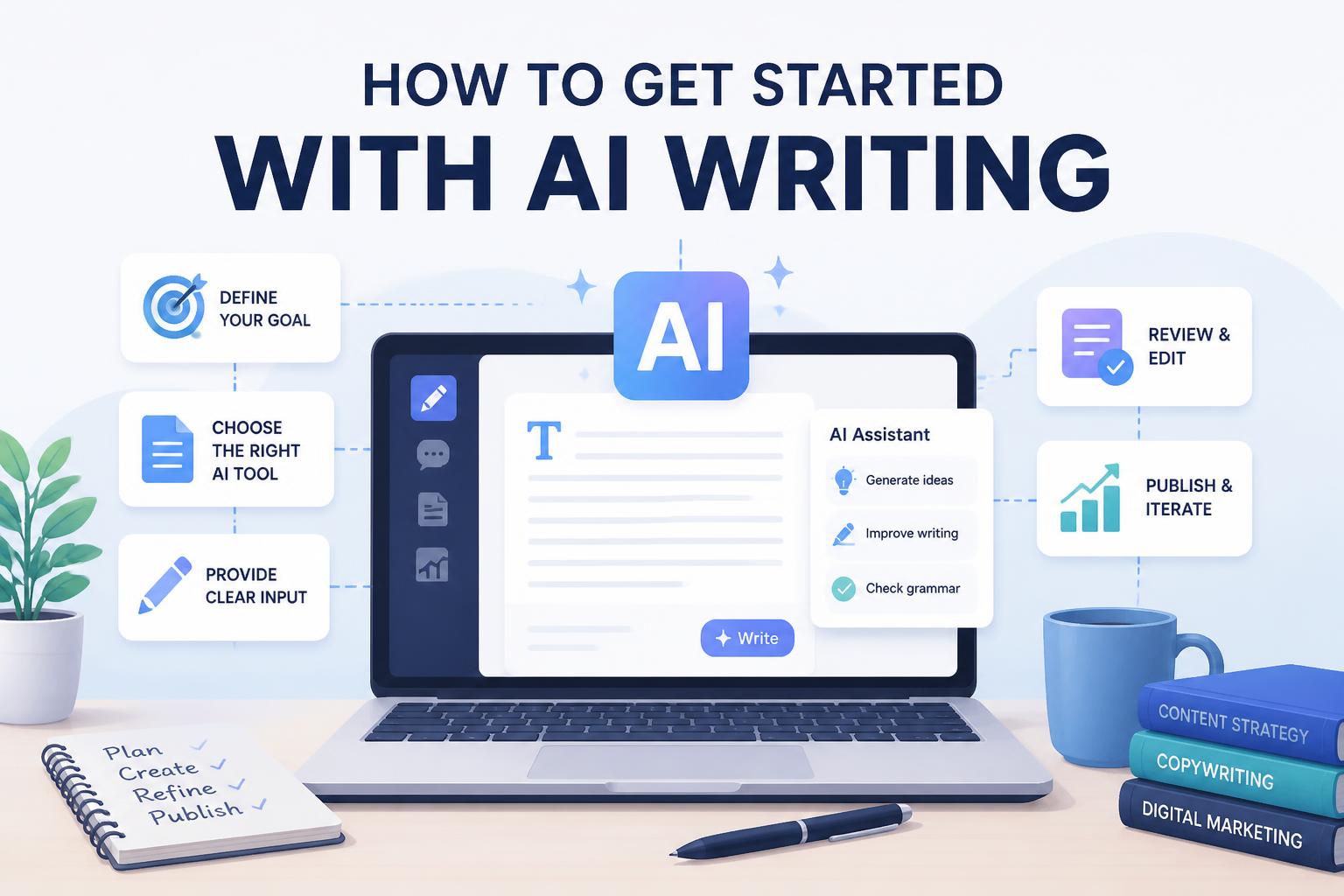
Ideation (5-10 minutes): Brainstorm topics in AI: “Give me 10 article ideas about [topic] that haven’t been covered extensively.” Pick one and create a rough outline.
Messy draft (15-30 minutes): Write your raw thoughts without AI (200-500 words). Include your unique perspective and examples.
AI expansion (5 minutes): Use the prompt from Step 6. Let AI structure and expand your draft.
Human editing (20-30 minutes): Remove AI tells from Step 7. Add personal stories AI can’t create. Fact-check research from Step 8.
Final polish (10 minutes): Read aloud to catch awkward phrasing. Run through grammar checker (Grammarly or built-in). Format for your platform.
Total time investment: 55-85 minutes for a complete article (vs. 3-4 hours writing from scratch).
—
Step 10: Avoid the Biggest Pitfall (Losing Your Voice)
The authors and writers successfully using AI in 2026 follow one rule: AI enhances your work, but doesn’t create it.
As noted in the Medium article on staying human with AI writing, “Using AI improperly results in content that lacks soul and originality. AI should be used as a tool for enhancement, not as a creator.”
How to protect your voice:
Never start with AI. Always begin with your own thinking. Use AI for structure, not substance. Let it organize, not originate. Add what AI can’t: personal stories, specific experiences, controversial opinions. Read your work aloud. If it doesn’t sound like you, rewrite it. Test with friends. Ask “Does this sound like me?” before publishing.
The question to ask yourself: “Could someone else have written this exact piece?” If yes, you’ve let AI do too much.
—
What You’ve Just Built
You now have a complete AI writing system that saves you 1-2 hours per article, maintains your authentic voice, produces content that doesn’t sound robotic, and costs $0-$20/month (for most writers).
You’ve learned to use AI as an assistant, not a replacement — which is exactly how professional writers are using these tools in 2026.
Next steps to level up your AI writing:
- Experiment with both ChatGPT and Claude — even if you picked one, test the other for a week to see which matches your style
- Build a prompt library — save your best prompts for different content types (blog posts, social media, emails)
- Track your time savings — measure how long pieces take with vs. without AI to see your ROI
- Join AI writing communities — learn advanced techniques from other writers
Pick your tool from Step 3 and create your free account today. Start with the free tier, follow the Messy Draft Strategy from Step 5, and publish your first AI-assisted piece this week.
—
Troubleshooting Common Issues
“The AI output sounds nothing like me”
You’re probably using the vending machine approach. Go back to Step 5 and use the Messy Draft Strategy instead — start with your own writing, not a cold prompt.
“ChatGPT/Claude keeps refusing to write or says it can’t help”
Your prompt might be too vague. Be more specific about what you want, and include your own draft as context. AI works better with concrete direction.
“I hit the free tier message limit too quickly”
This means you’re ready for a paid plan. Claude Pro or ChatGPT Plus at $20/month gives you significantly higher limits. If you’re publishing regularly, this pays for itself.
“My content still sounds robotic even after editing”
Check for the AI tells from Step 7, add more personal examples, and read your work aloud. If it doesn’t sound conversational, rewrite sections in your own voice.
“I’m not sure if I should fact-check everything AI writes”
Yes. Especially statistics, dates, quotes, and technical details. Use Step 8’s verification workflow.
—
Frequently Asked Questions
Do I need a paid plan to follow this tutorial?
No. You can complete every step using the free tiers of ChatGPT or Claude. Paid plans remove message limits and add features, but aren’t required to get started.
Which is better for blog writing, ChatGPT or Claude?
According to 2026 testing, ChatGPT Plus works best for research-heavy blog posts with web search integration, while Claude Pro wins for creative writing and natural tone. For general blog writing, try both free tiers and see which matches your style.
Can AI replace human writers?
No. Professional writers in 2026 use AI to handle structure, expansion, and editing — but the original thinking, voice, and unique perspective still comes from humans. Content that’s 100% AI-generated lacks the authenticity readers want.
What’s the best free AI writing tool?
Both ChatGPT and Claude offer capable free tiers. ChatGPT’s free version gives you 10 messages per 5 hours; Claude’s free tier has usage limits but no hard message cap. Test both and upgrade whichever you use most.
How do I avoid AI-sounding content?
Use the Messy Draft Strategy (Step 5), edit out AI tells (Step 7), add personal stories AI can’t write, and read your work aloud. If it doesn’t sound like you, it needs more human editing.
Are specialized AI writing tools like Jasper worth the cost?
For most writers, no. Testing in 2026 found that specialized tools often wrap ChatGPT or Claude with templates you can replicate with good prompts. Jasper makes sense if you need team collaboration or strict brand voice consistency — otherwise, stick with ChatGPT Plus or Claude Pro at $20/month.
—
Ready to start writing smarter? Create your free account with ChatGPT or Claude today and follow this tutorial step-by-step. You’ll publish your first AI-assisted piece this week.