M1 Finance vs Betterment: Which Robo-Advisor Wins in 2026?
Title tag: M1 Finance vs Betterment: Which Robo-Advisor Wins in 2026?
Meta description: M1 Finance vs Betterment breakdown: compare fees, control, tax optimization, and automation. Real data on which platform fits your investing style.
URL slug: /m1-finance-vs-betterment
Target keyword: m1 finance vs betterment
Secondary keywords: robo-advisor comparison, automated investing platforms, tax-loss harvesting, portfolio customization
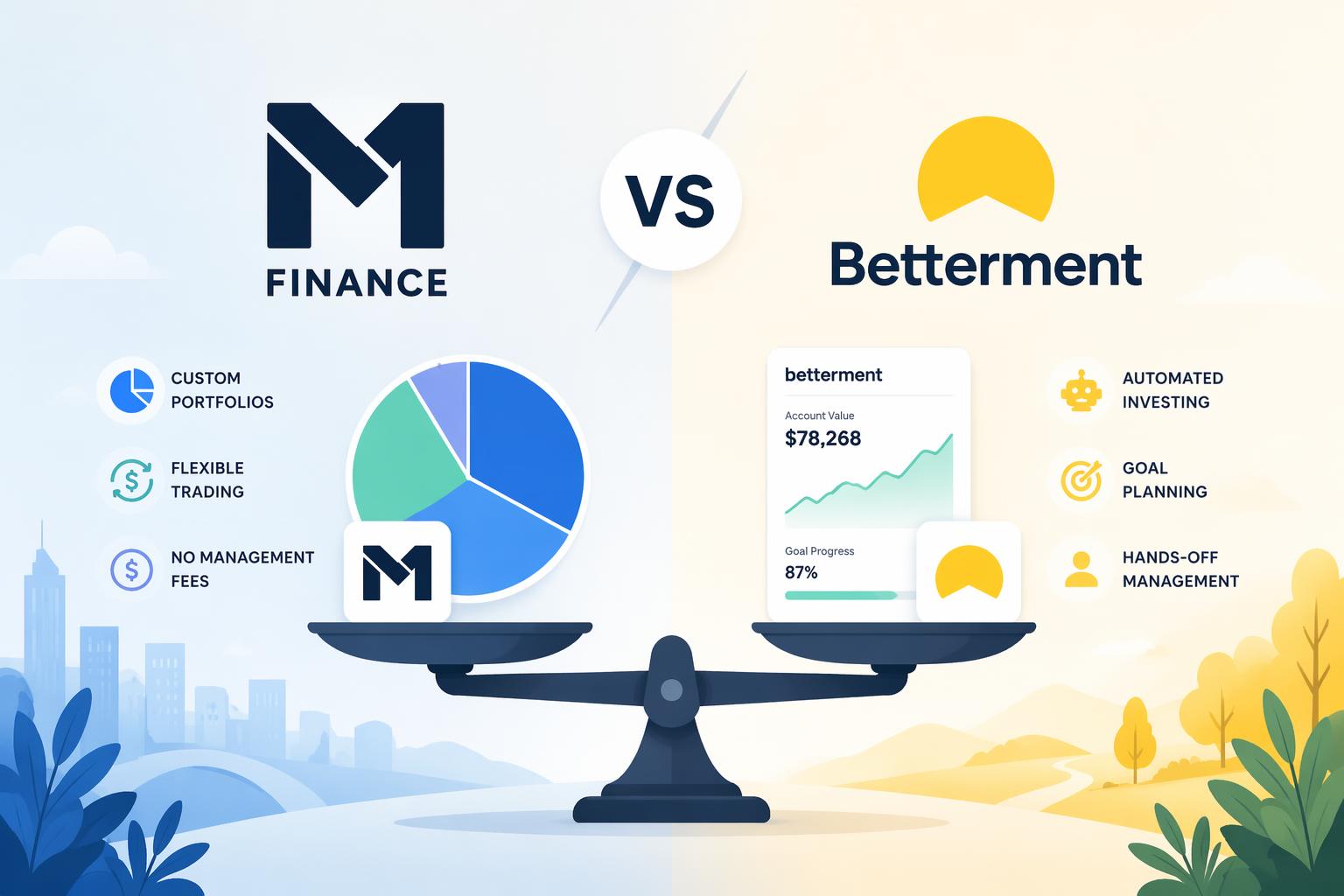
You’ve narrowed it down to M1 Finance and Betterment. Both automate investing without the wealth manager price tag. But one gives you full control over every holding, while the other decides everything for you. One charges zero management fees, the other takes 0.25% every year. One treats you like a portfolio architect, the other like someone who just wants it handled.
Which trade-off you’re willing to make depends on whether you want to tinker or delegate. Here’s how they compare on fees, tax optimization, and who wins in different scenarios.
Table of Contents
- The Core Difference: Control vs Full Automation
- Fee Breakdown: Where Your Money Goes
- Portfolio Customization: Build It vs Let Them Build It
- Tax Optimization: Who Does It Better
- Account Types and Minimums
- Rebalancing and Automation
- Customer Support and User Experience
- When M1 Finance Wins
- When Betterment Wins
- The Verdict: Which One Should You Pick?
- FAQ
The Core Difference: Control vs Full Automation
M1 Finance and Betterment solve the same problem — making investing accessible — but they take opposite approaches.
M1 Finance is self-directed. You build your portfolio from 80+ expert-designed “pies” or create your own from scratch using individual stocks and ETFs. You decide the allocation. M1 automates the execution: it buys fractional shares during daily trading windows, rebalances when you add money, and reinvests dividends according to your target weights. Automated execution of your strategy.
Betterment is fully managed. You answer a questionnaire about your goals, timeline, and risk tolerance. Betterment assigns you a portfolio of low-cost ETFs and handles everything: allocation, rebalancing, tax-loss harvesting, dividend reinvestment. You can tweak your risk level or switch goal types, but you don’t pick individual holdings. Delegated portfolio management.
M1 users spend time upfront deciding what to own. Betterment users spend five minutes on a quiz and move on. One gives you control. The other gives you speed.

Fee Breakdown: Where Your Money Goes
M1 Finance charges $0 management fees for basic accounts. You pay only the expense ratios baked into the ETFs you choose — typically 0.03% to 0.15% per year depending on your holdings. M1 Plus (margin borrowing, extended trading windows, custodial accounts) costs $36/year after a free trial.
Betterment charges 0.25% per year on your balance for the Digital plan (automated portfolios, tax-loss harvesting, goal tracking). The Premium plan costs 0.65% per year and includes unlimited access to certified financial planners, but requires a $100,000 minimum. ETF expense ratios run 0.07% to 0.15%, so your total cost is around 0.32% to 0.40% per year on Digital.
Example: $50,000 portfolio over 10 years
Assume 7% average annual return before fees.
- M1 Finance (0.10% ETF expenses, $0 management fee): You’d pay roughly $580 in total expenses over 10 years.
- Betterment Digital (0.10% ETF expenses + 0.25% management fee): You’d pay roughly $2,030 in total fees over 10 years.
That’s a $1,450 difference on a $50,000 starting balance. Scale it to $200,000 and the gap becomes $5,800 over a decade. M1’s zero-fee structure compounds in your favor if you’re comfortable building your own portfolio.
Betterment’s fee buys you tax-loss harvesting, automatic rebalancing, and goal-based planning tools. If those features save you more than 0.25% in drag or mistakes, the fee pays for itself.
Portfolio Customization: Build It vs Let Them Build It
M1 Finance lets you own any stock or ETF available on major exchanges. You create “pies” — target allocations represented as slices. A pie can hold up to 100 slices (individual securities or sub-pies). Want 70% diversified ETFs and 30% individual tech stocks? Build that. Want to replicate a three-fund Bogleheads portfolio? Build that. Want to copy Warren Buffett’s public holdings? You can build that too.
M1 also has 80+ expert pies spanning strategies like aggressive growth, dividend income, socially responsible investing, and hedge fund replication. You can use these as-is or modify them. If you add money, M1 buys whatever’s underweight relative to your target allocation. If you rebalance, it shifts new contributions without selling (avoiding taxable events when possible).
Betterment gives you 1 of 101 preset portfolios based on your risk score (0 to 100% stocks). Each portfolio is built from a globally diversified mix of ETFs covering U.S. stocks, international stocks, emerging markets, U.S. bonds, international bonds, and sometimes alternatives like REITs or commodities depending on your allocation.
You can adjust your stock-to-bond ratio manually, opt into socially responsible investing (SRI) portfolios, choose climate-focused portfolios, or switch to income-focused strategies (higher dividend yield). But you can’t add individual stocks, swap out specific ETFs, or create custom blends. Betterment decides the underlying holdings.
Which approach wins depends on your tolerance for choice. M1 suits people who want full discretion or have strong opinions about sectors, factors, or holdings. Betterment suits people who’d rather outsource those decisions to an algorithm.
Tax Optimization: Who Does It Better
Betterment runs daily tax-loss harvesting on taxable accounts. When a holding drops below your purchase price, Betterment sells it at a loss to offset capital gains elsewhere, then immediately buys a correlated ETF to maintain your allocation without violating wash-sale rules. In 2025, Betterment reported that tax-loss harvesting added an average of 0.77% per year in after-tax returns for clients in the 35% tax bracket. That alone can cover the 0.25% management fee and still net you a gain.
Betterment also practices asset location optimization across taxable and tax-advantaged accounts (if you link multiple accounts). It places tax-inefficient assets (bonds, REITs) in IRAs and tax-efficient assets (stocks) in taxable accounts to minimize your tax drag.
M1 Finance has no tax-loss harvesting on basic accounts. M1 Plus members get access to a feature called “tax minimization” that tries to avoid short-term capital gains when rebalancing, but it’s not true TLH. You’d need to track losses manually or use third-party software if you want to harvest losses yourself.
M1 does minimize taxable events during rebalancing by directing new deposits to underweight slices rather than selling overweight ones. And fractional shares mean you’re always fully invested without cash drag.
If you’re investing in a taxable account and you’re in a high tax bracket, Betterment’s TLH feature is worth the fee. If you’re investing primarily in IRAs or Roth accounts where taxes don’t matter, M1’s zero-fee structure wins.
Account Types and Minimums
Both platforms support standard account types: individual taxable, traditional IRA, Roth IRA, SEP IRA, and trust accounts.
M1 Finance:
- $100 minimum for taxable accounts
- $500 minimum for retirement accounts
- Supports custodial accounts (UGMA/UTMA) with M1 Plus
- Supports joint accounts and entity accounts (LLC, trust)
- Has a 2% APY checking account and a cash management feature with M1 Plus
Betterment:
- $10 minimum to start (one of the lowest in the industry)
- $100,000 minimum for Premium (human advisor access)
- Supports joint accounts, trusts, and 529 plans (not offered by M1)
- Has a Cash Reserve account with competitive APY (currently 4.75% as of early 2026, though rates fluctuate)
- Added crypto investing in 2024 (small-cap allocation option within portfolios)
Betterment’s $10 minimum makes it more accessible for beginners testing the waters. M1’s checking account and margin lending (borrow against your portfolio at low rates with M1 Plus) appeal to people using it as a full banking replacement.
Rebalancing and Automation
M1 Finance rebalances dynamically by directing new money to underweight slices. If you deposit $1,000 and your target allocation says you need more bonds, M1 buys bonds during the next trading window. Manual rebalancing (selling overweight and buying underweight) is available but most users avoid it to minimize taxes.
M1 trades once per day during a morning window (9:30 AM ET for basic users, plus an afternoon window for M1 Plus members). You don’t choose exact execution prices. If you need intraday trading, M1 isn’t the platform.
Betterment rebalances whenever your allocation drifts more than 3% from target or when you add money. It rebalances using new deposits first (like M1), but will sell and buy across your portfolio if drift is significant. Rebalancing triggers are tuned to minimize unnecessary taxable events.
Betterment also has auto-deposit, automatic dividend reinvestment, and goal-based automation (like auto-increasing contributions as your income grows, or shifting to bonds as your goal date approaches).
Both platforms reinvest dividends. Both support recurring deposits. The difference is that Betterment’s automation extends into goal planning (retirement, home purchase, emergency fund) while M1’s automation is execution-focused.
Customer Support and User Experience
M1 Finance:
- Email and chat support (no phone support for basic accounts; M1 Plus gets priority access)
- Clean, minimalist interface focused on portfolio visualization (“the pie”)
- Steeper learning curve if you’re new to investing (you need to understand asset allocation)
- Mobile app is functional but not as polished as Betterment’s
Betterment:
- Email, phone, and chat support for all users (Premium members get dedicated CFP access)
- Guided onboarding with educational prompts and explainer videos
- Dashboard shows progress toward specific goals with projected outcomes
- Mobile app is highly rated (4.8/5 on iOS) and includes features like round-ups (invest spare change) and Smart Deposit (auto-adjust contributions based on income)
Betterment’s UX is designed for people who want a “set it and forget it” experience. M1’s UX assumes you know what you want to build and gives you the tools to execute it. If you need hand-holding, Betterment is smoother. If you want granular control, M1’s interface makes more sense once you learn it.
When M1 Finance Wins
Choose M1 Finance if:
- You want zero management fees. Every basis point compounds over decades. If you’re comfortable managing your own allocation, M1’s fee structure is unbeatable among robo-advisors.
- You want to own individual stocks. Betterment doesn’t let you hold Apple or Tesla. M1 does. You can mix broad ETFs with single-stock convictions.
- You’re investing primarily in IRAs. Tax-loss harvesting doesn’t matter in retirement accounts, so you’re paying Betterment’s fee for features you can’t use.
- You want margin borrowing or integrated banking. M1 Plus has portfolio line of credit at competitive rates (currently around 7% as of early 2026) and a checking account that pays 2% on cash balances.
- You like tinkering. If you enjoy researching funds, comparing expense ratios, and adjusting your pie when market conditions change, M1 gives you room to operate.
When Betterment Wins
Choose Betterment if:
- You’re investing in a taxable account and you’re in a high tax bracket. Tax-loss harvesting alone can justify the 0.25% fee. In 2025, Betterment’s TLH added an average of 0.77% per year for clients in the 35% bracket.
- You want someone else to make allocation decisions. You don’t want to spend time researching ETFs or deciding on stock-to-bond ratios. Betterment’s questionnaire handles it.
- You value goal-based planning. Betterment’s dashboard projects whether you’re on track for retirement, a home down payment, or another goal. It auto-adjusts risk as your timeline shortens.
- You want human advice without hiring a traditional advisor. Premium members ($100k minimum) get unlimited CFP access for 0.65% per year — far less than the 1% typical advisors charge.
- You’re a true beginner. Betterment’s onboarding teaches you as you go. M1 assumes baseline investing knowledge.
The Verdict: Which One Should You Pick?
Pick M1 Finance if you’re cost-conscious, want control over your holdings, and you’re comfortable building your own portfolio. It’s the better choice for IRA investors, DIY stock pickers, and anyone who sees the 0.25% robo-advisor fee as unnecessary friction.
Pick Betterment if you’re investing in taxable accounts, you value automation over customization, and you’d rather delegate portfolio decisions to an algorithm. The fee is worth it if tax-loss harvesting, goal tracking, and hands-off management save you time and mistakes.
Can’t decide? Start with Betterment if you’re new to investing and want the training wheels. Switch to M1 later once you’ve learned enough to manage your own allocation. Both platforms make transferring assets straightforward (though be mindful of taxable events if you’re moving a taxable account).
Staying in a high-fee actively managed fund or doing nothing because you’re paralyzed by options is worse than either platform.
FAQ
Is M1 Finance free?
Yes. M1 charges $0 management fees for basic accounts. You pay only the expense ratios of the ETFs and stocks you hold (typically 0.03% to 0.15% per year). M1 Plus costs $36/year and adds features like margin borrowing, custodial accounts, and extended trading windows, but the core investing platform is free.
Does Betterment’s 0.25% fee include trading costs?
Yes. Betterment’s 0.25% annual fee covers portfolio management, rebalancing, tax-loss harvesting, and all trades. You also pay ETF expense ratios (around 0.07% to 0.15%), but there are no commission fees or transaction costs on top of the management fee.
Can I transfer my existing portfolio to M1 or Betterment?
Both platforms support account transfers (ACATS). M1 will accept “in-kind” transfers if your holdings match securities available on their platform (stocks and ETFs), but they may liquidate and reinvest if you’re transferring mutual funds. Betterment will liquidate your existing holdings and reinvest according to your assigned portfolio, which may trigger capital gains in taxable accounts. Check with each platform before initiating a transfer.
Which platform is better for retirement accounts?
M1 Finance is often better for IRAs and Roth IRAs because tax-loss harvesting (Betterment’s main value-add) doesn’t apply in tax-advantaged accounts. You’d be paying Betterment’s 0.25% fee without getting the tax benefit. M1’s zero-fee structure compounds more wealth over time in retirement accounts.
Can I use both platforms at once?
Yes. Some investors use Betterment for taxable accounts (to capture tax-loss harvesting) and M1 for IRAs (to avoid paying fees where TLH doesn’t apply). There’s no rule against splitting your portfolio across platforms, though it adds complexity when tracking overall asset allocation.
Does M1 Finance offer tax-loss harvesting?
No. M1 does not offer automated tax-loss harvesting. M1 Plus includes a “tax minimization” feature that tries to avoid short-term capital gains during rebalancing, but it’s not true TLH. If tax-loss harvesting matters to you, Betterment is the better choice.
How does Betterment decide my portfolio?
Betterment assigns you a portfolio based on your answers to a risk assessment questionnaire (age, goal timeline, risk tolerance, income, net worth). Your portfolio consists of globally diversified ETFs weighted according to your risk score (higher score = more stocks, lower score = more bonds). You can manually adjust your allocation or switch to SRI/climate-focused portfolios.
Can I invest in crypto on M1 or Betterment?
Betterment added crypto exposure in 2024 as an optional small allocation within portfolios (currently up to 5% in Bitcoin and Ethereum via ETFs). M1 Finance does not currently support cryptocurrency investing. If crypto exposure is a priority, Betterment has it; if you want direct crypto ownership, you’d need a separate platform like Coinbase or Kraken.
—
Structured Data
{
  "@context": "https://schema.org",
  "@type": "Article",
  "headline": "M1 Finance vs Betterment: Which Robo-Advisor Wins in 2026?",
  "description": "M1 Finance vs Betterment breakdown: compare fees, control, tax optimization, and automation. Real data on which platform fits your investing style.",
  "image": "images/featured.png",
  "author": {
    "@type": "Organization",
    "name": "NotFair"
  },
  "publisher": {
    "@type": "Organization",
    "name": "NotFair",
    "logo": {
      "@type": "ImageObject",
      "url": "https://notfair.co/logo.png"
    }
  },
  "datePublished": "2026-01-15",
  "dateModified": "2026-01-15"
}
json
{
“@context”: “https://schema.org”,
“@type”: “FAQPage”,
“mainEntity”: [
{
“@type”: “Question”,
“name”: “Is M1 Finance really free?”,
“acceptedAnswer”: {
“@type”: “Answer”,
“text”: “Yes. M1 charges $0 management fees for basic accounts. You pay only the expense ratios of the ETFs and stocks you hold (typically 0.03% to 0.15% per year). M1 Plus costs $36/year and adds features like margin borrowing, custodial accounts, and extended trading windows, but the core investing platform remains free.”
}
},
{
“@type”: “Question”,
“name”: “Does Betterment’s 0.25% fee include trading costs?”,
“acceptedAnswer”: {
“@type”: “Answer”,
“text”: “Yes. Betterment’s 0.25% annual fee covers portfolio management, rebalancing, tax-loss harvesting, and all trades. You also pay ETF expense ratios (around 0.07% to 0.15%), but there are no commission fees or transaction costs on top of the management fee.”
}
},
{
“@type”: “Question”,
“name”: “Can I transfer my existing portfolio to M1 or Betterment?”,
“acceptedAnswer”: {
“@type”: “Answer”,
“text”: “Both platforms support account transfers (ACATS). M1 will accept in-kind transfers if your holdings match securities available on their platform (stocks and ETFs), but they may liquidate and reinvest if you’re transferring mutual funds. Betterment will liquidate your existing holdings and reinvest according to your assigned portfolio, which may trigger capital gains in taxable accounts.”
}
},
{
“@type”: “Question”,
“name”: “Which platform is better for retirement accounts?”,
“acceptedAnswer”: {
“@type”: “Answer”,
“text”: “M1 Finance is often better for IRAs and Roth IRAs because tax-loss harvesting (Betterment’s main value-add) doesn’t apply in tax-advantaged accounts. You’d be paying Betterment’s 0.25% fee without getting the tax benefit. M1’s zero-fee structure compounds more wealth over time in retirement accounts.”
}
},
{
“@type”: “Question”,
“name”: “Does M1 Finance offer tax-loss harvesting?”,
“acceptedAnswer”: {
“@type”: “Answer”,
“text”: “No. M1 does not offer automated tax-loss harvesting. M1 Plus includes a tax minimization feature that tries to avoid short-term capital gains during rebalancing, but it’s not true TLH. If tax-loss harvesting matters to you, Betterment is the better choice.”
}
}
]
}
Internal Linking Plan
Link TO this page from:
- Robo-advisor comparison hub (anchor: “M1 Finance vs Betterment detailed comparison”)
- M1 Finance review (anchor: “compare M1 to Betterment”)
- Betterment review (anchor: “see how Betterment stacks up against M1 Finance”)
- Best robo-advisors 2026 roundup (anchor: “M1 vs Betterment breakdown”)
- Tax-loss harvesting explainer (anchor: “platforms that offer TLH”)
This page links to:
- M1 Finance full review
- Betterment full review
- Tax-loss harvesting guide
- Robo-advisor fee comparison
- IRA vs taxable account strategy guide
Publishing Checklist
- [ ] Title tag and meta description set
- [ ] URL slug configured: /m1-finance-vs-betterment
- [ ] Structured data added (Article + FAQPage with image populated)
- [ ] Featured image (images/featured.png) uploaded and set as Open Graph image
- [ ] Inline image (images/image_2.png) uploaded with alt text and lazy-loaded
- [ ] Table of contents renders with working anchor links
- [ ] Internal links placed (both directions)
- [ ] Canonical URL set to self
- [ ] Mobile rendering verified
- [ ] Word count confirmed: 2,500+ words