How to Use Brokerage Accounts: A Complete Step-by-Step Guide (2026)
Affiliate Disclosure: This article contains affiliate links. If you sign up through our links, we may earn a commission at no extra cost to you. We only recommend services we genuinely believe will help you invest successfully.
You’ve decided it’s time to start investing. You know you need a brokerage account, but staring at the endless options—Fidelity, Charles Schwab, Interactive Brokers, Robinhood—feels overwhelming. Which one won’t nickel-and-dime you with hidden fees? Which platform actually makes sense for someone who isn’t a day trader?
Here’s the truth: picking and using a brokerage account isn’t as complicated as the financial industry makes it seem. The right account depends on what you want to do with your money, and once you understand the basics, you can be up and running in under an hour.
By the end of this guide, you’ll know exactly how to open a brokerage account, fund it, place your first trade, and avoid the common mistakes that cost new investors hundreds (sometimes thousands) in unnecessary fees and poor timing.
What you need before starting:
- Government-issued ID (driver’s license or passport)
- Social Security Number or Tax ID
- Bank account information for funding transfers
- Basic investment goal in mind (retirement, wealth building, short-term savings)
- Estimated time: 45-60 minutes for setup, plus research time for choosing investments
Let’s walk through the entire process, step by step.
—
Step 1: Understand What Type of Brokerage Account You Need
Before you open any account, you need to know which type matches your investing goal. There are three main types, and choosing the wrong one can cost you in taxes or limit your access to money when you need it.
Taxable brokerage account — This is a standard investment account with no tax advantages and no restrictions. You can deposit and withdraw money anytime. Capital gains are taxed when you sell investments at a profit. Use this if you’re investing for goals that aren’t retirement (buying a house, building wealth, creating passive income).
Traditional IRA — Tax-deferred retirement account. Contributions may be tax-deductible now, but you’ll pay taxes when you withdraw in retirement. You can’t touch the money before age 59½ without penalties. Annual contribution limit: $7,000 in 2026 ($8,000 if you’re 50+).
Roth IRA — Retirement account where you pay taxes now but withdraw tax-free in retirement. Contributions can be withdrawn anytime penalty-free (but not earnings). Same contribution limits as Traditional IRA. Best for younger investors who expect to be in a higher tax bracket later.
You should see: A clear understanding of which account type aligns with your timeline and tax situation. If you’re investing for anything other than retirement, start with a taxable brokerage account. If it’s for retirement and you’re early in your career, Roth IRA is usually the winner.
> Note: You can open multiple account types at the same brokerage. Many investors run both a taxable account and a Roth IRA simultaneously.
—
Step 2: Choose Your Brokerage Platform
Not all brokerages are created equal. The right platform depends on whether you want to be hands-on or hands-off, and whether you’re trading frequently or investing long-term.
Here’s what matters most:
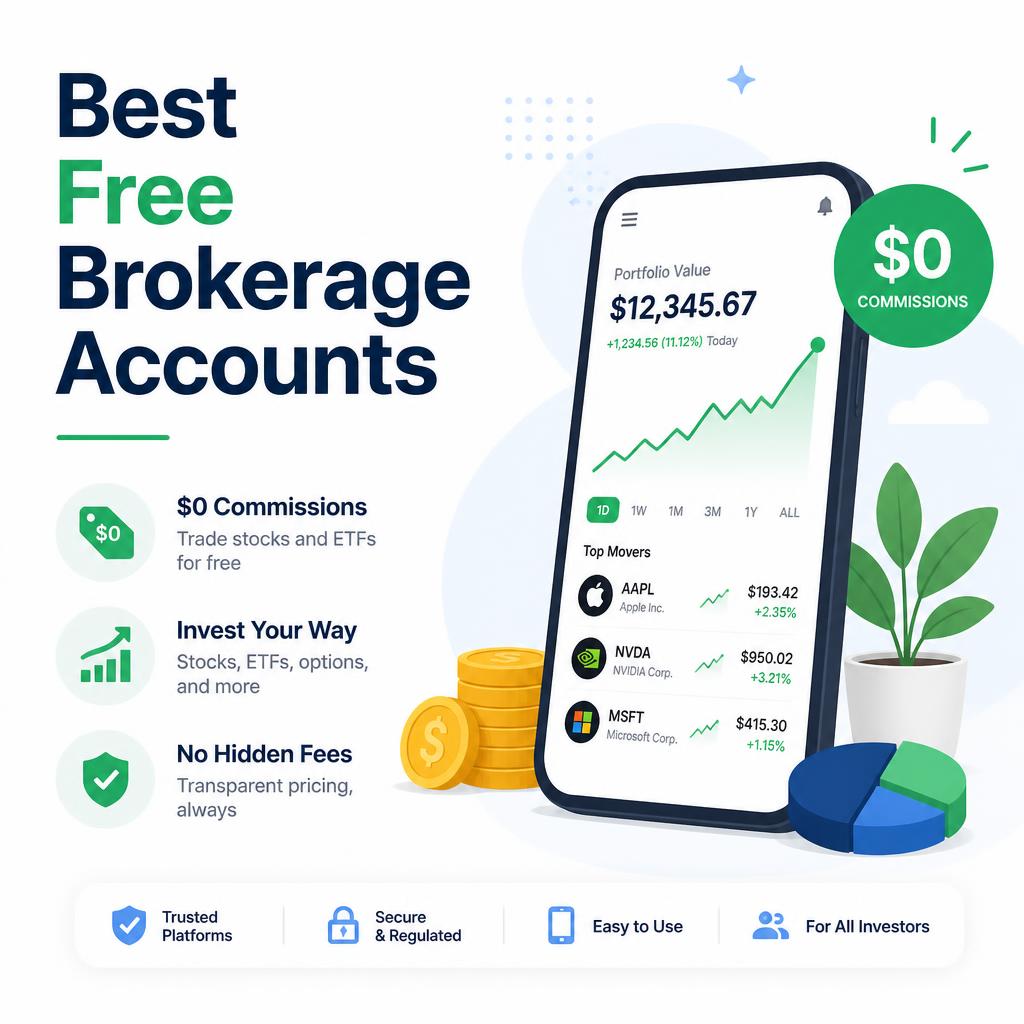
Commission structure — Most major brokerages (Fidelity, Schwab, Vanguard, E*TRADE) now offer $0 commission on stocks and ETFs. Avoid any platform still charging per-trade fees unless you’re getting specialized services in return.
Account minimum — Some brokerages require $0 to open an account (Fidelity, Schwab, Robinhood). Others require $500-$3,000 minimums (some robo-advisors). If you’re starting with under $1,000, choose a no-minimum platform.
Investment options — All major brokerages offer stocks, ETFs, and mutual funds. If you want options trading, futures, or international stocks, verify your platform supports them. If you want fractional shares (buying less than one full share of expensive stocks like Amazon), choose Fidelity, Schwab, or Robinhood.
Interface and tools — Robinhood and Webull have the simplest mobile-first interfaces. Fidelity and Schwab offer more research tools and educational resources. Interactive Brokers is powerful but has a steeper learning curve.
For most people, the best all-around choice is Fidelity or Charles Schwab: $0 commissions, no account minimums, excellent research tools, fractional shares, and strong customer service. Both have been around for decades and hold trillions in client assets.
If you want to get started with a trusted platform that won’t nickel-and-dime you, Fidelity is consistently rated as one of the top brokerages for both beginners and experienced investors. Their mobile app is intuitive, and their research tools rival what professionals use.
—
Step 3: Open Your Brokerage Account
Once you’ve chosen your platform, account opening takes 10-15 minutes. Most brokerages let you do this entirely online.
- Go to the brokerage’s website or download their mobile app
- Click “Open an Account” and select your account type (taxable brokerage, Traditional IRA, or Roth IRA)
- Enter your personal information: full legal name, date of birth, Social Security Number, residential address, and employment information
- Answer questions about your financial situation: annual income, net worth, investment experience, and risk tolerance (be honest—this helps the brokerage meet regulatory requirements and offer appropriate investment options)
- Choose your account features: margin trading (borrowing money to invest—usually not recommended for beginners), options trading level (start with “none” or “covered calls only”)
- Review and sign the account agreement electronically
- Verify your identity by uploading a photo of your driver’s license or passport (some platforms verify instantly through your bank)
You should see: A confirmation screen with your new account number and instructions for funding your account. Some brokerages approve accounts instantly; others take 1-2 business days to review your application.
> Note: If you’re opening a retirement account (IRA), you’ll also need to designate a beneficiary—the person who inherits the account if something happens to you.
—
Step 4: Link Your Bank Account and Fund Your Brokerage
Your brokerage account is open, but it has $0 in it. You need to transfer money from your bank before you can invest.
- Navigate to the “Transfer” or “Deposit” section of your brokerage dashboard
- Select “Add Bank Account” and enter your bank’s routing number and your account number (find these on a check or your bank’s app)
- Choose whether to link a checking or savings account
- Complete the micro-deposit verification process: your brokerage will send two small deposits (usually under $1 each) to your bank account within 1-3 business days. Log back in and confirm the amounts to verify ownership.
- Once verified, initiate your first transfer. Enter the amount you want to deposit (most brokerages let you start with as little as $1).
- Select the transfer speed: standard ACH takes 3-5 business days and is free; instant transfers (if available) may cost $0.50-$3.00
You should see: A pending deposit in your brokerage account. Once it clears, the cash will show as available to invest. Don’t try to buy stocks before the deposit clears—you’ll get a “Good Faith Violation” warning.
> Note: If you’re funding a Roth IRA, make sure your deposit doesn’t exceed the annual contribution limit ($7,000 in 2026, or $8,000 if you’re 50+). Your brokerage will warn you, but it’s your responsibility to track contributions across all IRAs.
—
Step 5: Research Your First Investment
This is where most beginners freeze. With thousands of stocks, ETFs, and mutual funds available, what should you actually buy?
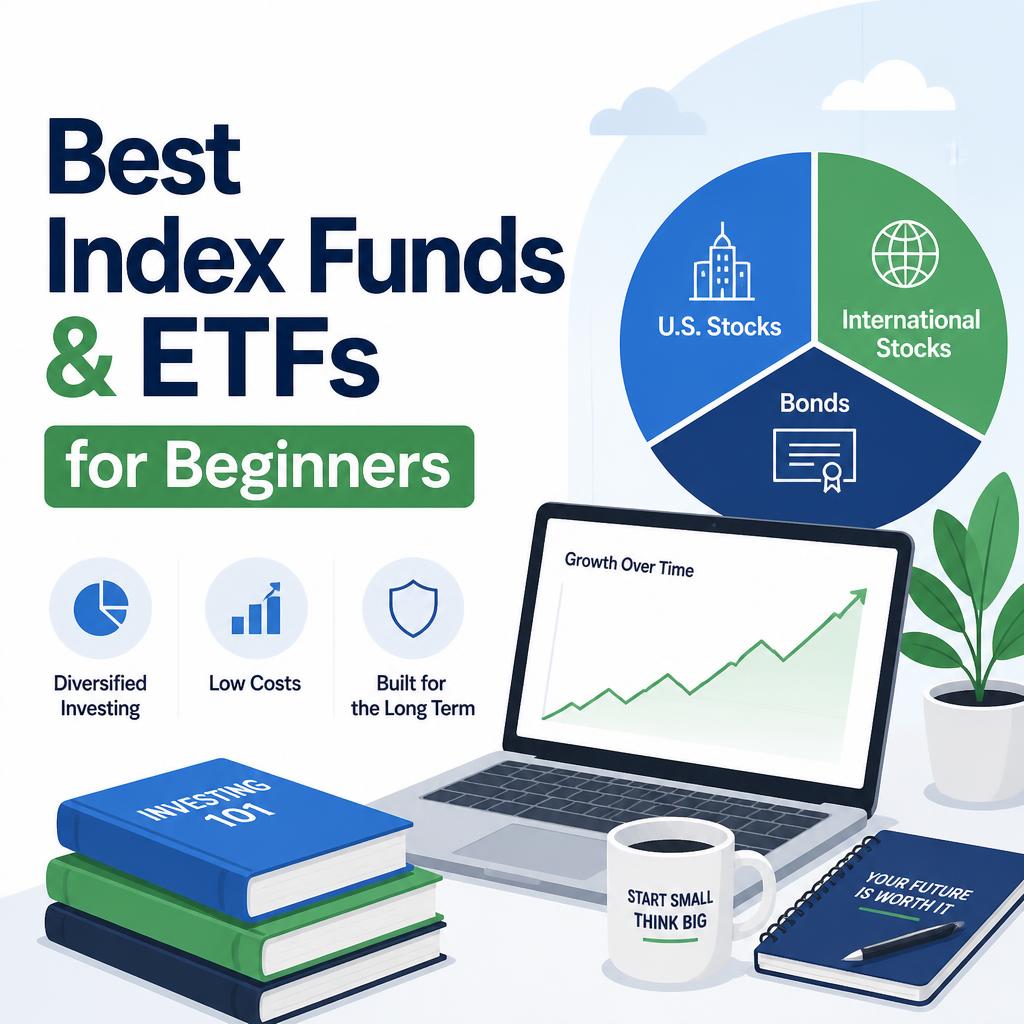
If you’re investing for long-term wealth building (5+ years), the safest and most effective starting point is a broad-market index fund. These funds own hundreds or thousands of companies, spreading your risk.
Top beginner-friendly index funds to research:
- VOO or SPY (S&P 500 ETFs) — Own the 500 largest US companies. Historical average return: ~10% per year over decades.
- VTI (Total US Stock Market ETF) — Own virtually every publicly traded US company, from giants like Apple to small-cap companies.
- VXUS (Total International Stock Market ETF) — Own companies outside the US for global diversification.
- VT (Total World Stock Market ETF) — Own the entire global stock market in one fund.
To research a fund or stock within your brokerage:
- Use the search bar in your brokerage app to look up the ticker symbol (e.g., VOO)
- Review the fund’s expense ratio (annual fee expressed as a percentage—VOO charges 0.03%, meaning $3 per year for every $10,000 invested)
- Check the holdings (what companies the fund owns) and performance history
- Read the fund prospectus (available on the fund’s detail page) to understand what you’re buying
You should see: Clear information about what the fund invests in, its fees, and its historical returns. If the expense ratio is above 0.20% for an index fund, keep looking—you’re paying too much.
—

Step 6: Place Your First Buy Order
You’ve chosen your investment. Now it’s time to execute the trade.
- Navigate to the “Trade” or “Buy” section of your brokerage platform
- Enter the ticker symbol of the investment you researched (e.g., VOO)
- Select your order type:
– Market order — Buy immediately at the current price (best for liquid ETFs and stocks during market hours)
– Limit order — Only buy if the price drops to your specified level (use this if you want to wait for a better price)
- Choose how much to buy:
– Shares — Enter the number of shares (if VOO costs $400/share and you have $1,000, you can buy 2 shares)
– Dollar amount — If your brokerage supports fractional shares, you can invest any dollar amount (e.g., $500 buys 1.25 shares of a $400 stock)
- Select the order duration: “Day” (order expires at market close if not filled) or “Good ’til Canceled” (stays open for up to 60 days)
- Review your order summary carefully: quantity, estimated cost, and any fees
- Click “Submit” or “Place Order”
You should see: An order confirmation screen with a confirmation number. If you placed a market order during market hours (9:30am-4pm ET, Monday-Friday), your order should fill within seconds. If placed outside market hours, it will execute when the market opens.
> Note: The stock market is closed on weekends and federal holidays. Orders placed during closed hours won’t execute until the market reopens.
—
Step 7: Monitor Your Investment (Without Obsessing)
Your trade has executed. You’re officially an investor. Now comes the hardest part: not checking your account every five minutes.
Healthy monitoring habits:
- Set up account alerts in your brokerage app for important events (dividend payments, corporate actions, account balance changes over $X)
- Check your portfolio once per week, not once per hour
- Review your overall performance once per quarter (every 3 months)
- Rebalance your portfolio once per year if you have multiple investments
What to ignore:
- Daily price swings—the market fluctuates constantly; focus on long-term trends
- Financial news headlines designed to trigger panic or greed
- Your coworker’s hot stock tip that “can’t miss”
You should see: Your investment’s value fluctuating daily. This is normal. Over time, the trend should be upward if you’ve invested in diversified index funds, but expect drops of 10-20% during market corrections and 30-50% during recessions.
> Note: If seeing red numbers causes you to panic-sell, you’re checking too often. Set a reminder to review your portfolio monthly instead of daily.
—
Step 8: Set Up Automatic Contributions (Optional but Powerful)
The most reliable way to build wealth through brokerage accounts isn’t timing the market—it’s consistently adding money regardless of market conditions (a strategy called dollar-cost averaging).
- Navigate to your brokerage’s “Automatic Investment” or “Recurring Transfer” section
- Link your bank account if you haven’t already (covered in Step 4)
- Set your recurring deposit amount and frequency:
– Weekly (matches paycheck cycles for many people)
– Bi-weekly (every other week)
– Monthly (simplest to track)
- Choose whether to automatically invest the deposited cash or leave it as cash until you manually buy (automatic investment removes the temptation to time the market)
- If setting up automatic investment, select the fund or stock to purchase with each deposit (e.g., buy $200 of VOO every two weeks)
- Review and activate the recurring plan
You should see: A confirmation of your recurring investment plan. Your brokerage will pull the specified amount from your bank on the scheduled dates and invest it according to your instructions.
Why this matters: Investing $200 twice per month for 30 years at a 10% average annual return grows to over $800,000. The same amount invested randomly or inconsistently grows far less because you’ll inevitably buy more when the market is high and avoid buying when it’s low (the opposite of what works).
—
Step 9: Understand Tax Implications
Unlike a savings account, brokerage accounts have tax consequences. Knowing the rules helps you keep more of your returns.
In a taxable brokerage account:
- Capital gains — You owe taxes when you sell an investment for a profit. Hold for over a year before selling to qualify for long-term capital gains rates (0%, 15%, or 20% depending on income, versus 10%-37% for short-term gains).
- Dividends — If your stocks or funds pay dividends, you owe taxes on them in the year received (even if you reinvest them).
- Tax-loss harvesting — If you sell investments at a loss, you can use those losses to offset gains and reduce your tax bill.
Your brokerage will send you a 1099 tax form each February showing all taxable events from the previous year. Give this to your accountant or enter it into tax software.
In a retirement account (IRA):
- Traditional IRA — No taxes while invested. You’ll pay income tax on withdrawals in retirement.
- Roth IRA — No taxes ever if you follow the rules (contribute after-tax money, wait until 59½ to withdraw earnings).
You should see: Tax documents available in your brokerage account’s “Tax Center” each year. Download and save these immediately when available.
> Note: Frequent trading in a taxable account creates a tax paperwork nightmare and usually triggers higher short-term capital gains taxes. Buy-and-hold investing is more tax-efficient.
—
Step 10: Avoid the Biggest Beginner Mistakes
You now know how to use a brokerage account. But knowing what NOT to do is just as important.
Mistake 1: Trading too frequently
Every time you sell, you trigger a taxable event and risk buying back at a higher price. Successful investors buy quality investments and hold them for years, not weeks.
Mistake 2: Panic-selling during downturns
The market will drop 10-20% multiple times during your investing life and crash 30-50% during recessions. Selling locks in losses. Holding through downturns (or buying more) is how wealth is built.
Mistake 3: Chasing hot stocks
The stock that doubled last month is more likely to crash than repeat. Slow, boring index funds outperform 90% of active stock pickers over 20+ years.
Mistake 4: Ignoring fees
A fund charging 1% per year costs you $200,000+ over a 30-year career compared to a fund charging 0.03%. Always check expense ratios.
Mistake 5: Not diversifying
Putting all your money in one stock or sector is gambling, not investing. Spread risk across hundreds or thousands of companies through index funds.
Mistake 6: Trying to time the market
Studies show that missing just the 10 best days in the stock market over 20 years cuts your returns in half. Stay invested continuously rather than jumping in and out.
You should see: A simple, diversified portfolio that you contribute to regularly and rarely touch. If your strategy requires constant monitoring and tinkering, you’re doing it wrong.
—
Troubleshooting Common Issues
“My deposit is taking longer than expected”
Standard ACH transfers take 3-5 business days. Check that you entered your bank information correctly and that your bank account has sufficient funds. If it’s been over a week, contact your brokerage’s support.
“I tried to buy a stock but got an error”
Most likely causes: (1) Your deposit hasn’t cleared yet—cash must be settled before you can invest. (2) You’re trying to buy during non-market hours—the market is only open 9:30am-4pm ET, Monday-Friday. (3) You entered an invalid ticker symbol—double-check spelling.
“Why did my order not fill at the price I saw?”
Stock prices fluctuate every second. The price you see is the last traded price, which may have changed by the time your order reached the exchange. Use limit orders if you want to control the maximum price you’ll pay.
“I got a ‘Good Faith Violation’ warning”
This happens when you buy stocks with unsettled cash and then sell those stocks before the cash settles. Wait 3-5 days for deposits to fully clear before trading with that money. Three violations in 12 months can get your account restricted to settled cash only.
“Do I need a paid plan or premium account to invest?”
No. The basic free account at Fidelity, Schwab, Vanguard, or E*TRADE gives you everything you need: $0 commissions, full access to stocks and ETFs, research tools, and retirement accounts. Premium tiers usually add features like margin trading and advanced analytics—not necessary for most investors.
—
Next Steps: Building Your Investment Strategy
You’ve successfully opened and funded a brokerage account, placed your first trade, and learned the fundamentals. Here’s what to focus on next:
Month 1-3: Build your emergency fund outside your brokerage (3-6 months of expenses in a high-yield savings account). Never invest money you might need in the next 1-2 years.
Month 3-6: Increase your automatic contributions. Every $100/month invested from age 25-65 at 10% returns becomes $630,000. Time is your most powerful tool.
Year 1: Max out your IRA contributions ($7,000/year in 2026). The tax advantages are too valuable to ignore.
Year 2+: Diversify into international stocks (VXUS), bonds for stability (BND), and possibly real estate (VNQ) as your portfolio grows beyond $25,000.
The hardest part of investing isn’t picking stocks or timing the market—it’s staying consistent when the market drops, ignoring the noise, and letting compound growth do its work over decades.
If you’re ready to start building wealth through a brokerage account, Fidelity offers one of the most complete platforms for both beginners and experienced investors: $0 commissions, fractional shares, excellent research tools, and 24/7 customer support. Open your account in under 15 minutes and start investing today.
—
FAQ
Do I need a lot of money to open a brokerage account?
No. Most major brokerages (Fidelity, Charles Schwab, E*TRADE, Robinhood) have $0 account minimums. You can start investing with as little as $1 if your brokerage supports fractional shares. The key is starting early and contributing consistently, not starting with a large lump sum.
How is a brokerage account different from a bank account?
A bank account holds cash and is FDIC-insured up to $250,000 (you can’t lose money). A brokerage account holds investments like stocks and ETFs, which fluctuate in value—you can gain or lose money. Brokerages offer SIPC insurance up to $500,000 if the brokerage fails, but this doesn’t protect against investment losses.
Can I lose all my money in a brokerage account?
If you invest in individual stocks, yes—companies can go bankrupt and stock values can drop to $0. However, if you invest in diversified index funds like VOO (which owns 500 large companies), the chance of losing everything is virtually zero. Even during the worst market crashes, diversified portfolios eventually recover and reach new highs.
How much should I invest as a beginner?
A good rule: invest 15-20% of your gross income if possible. If that’s not realistic, start with whatever you can afford consistently—even $50/month builds the habit and grows over time. Prioritize paying off high-interest debt (credit cards) before investing aggressively.
What’s the difference between a brokerage account and a 401(k)?
A 401(k) is an employer-sponsored retirement account with higher contribution limits ($23,000/year in 2026) and often includes employer matching (free money). A brokerage account has no contribution limits but no employer match and fewer tax benefits. Ideal strategy: max out your 401(k) match first, then fund an IRA, then invest additional money in a taxable brokerage account.
How do I avoid the pattern day trader rule with a small account?
The PDT rule requires $25,000 minimum account balance if you make 4+ day trades (buying and selling the same stock within one day) in a 5-business-day period. To avoid it: (1) Make fewer than 4 day trades per week, or (2) Hold positions overnight instead of day trading, or (3) Build your account to $25,000+ before day trading. Most beginners shouldn’t day trade at all—it’s statistically unprofitable for 90%+ of people.