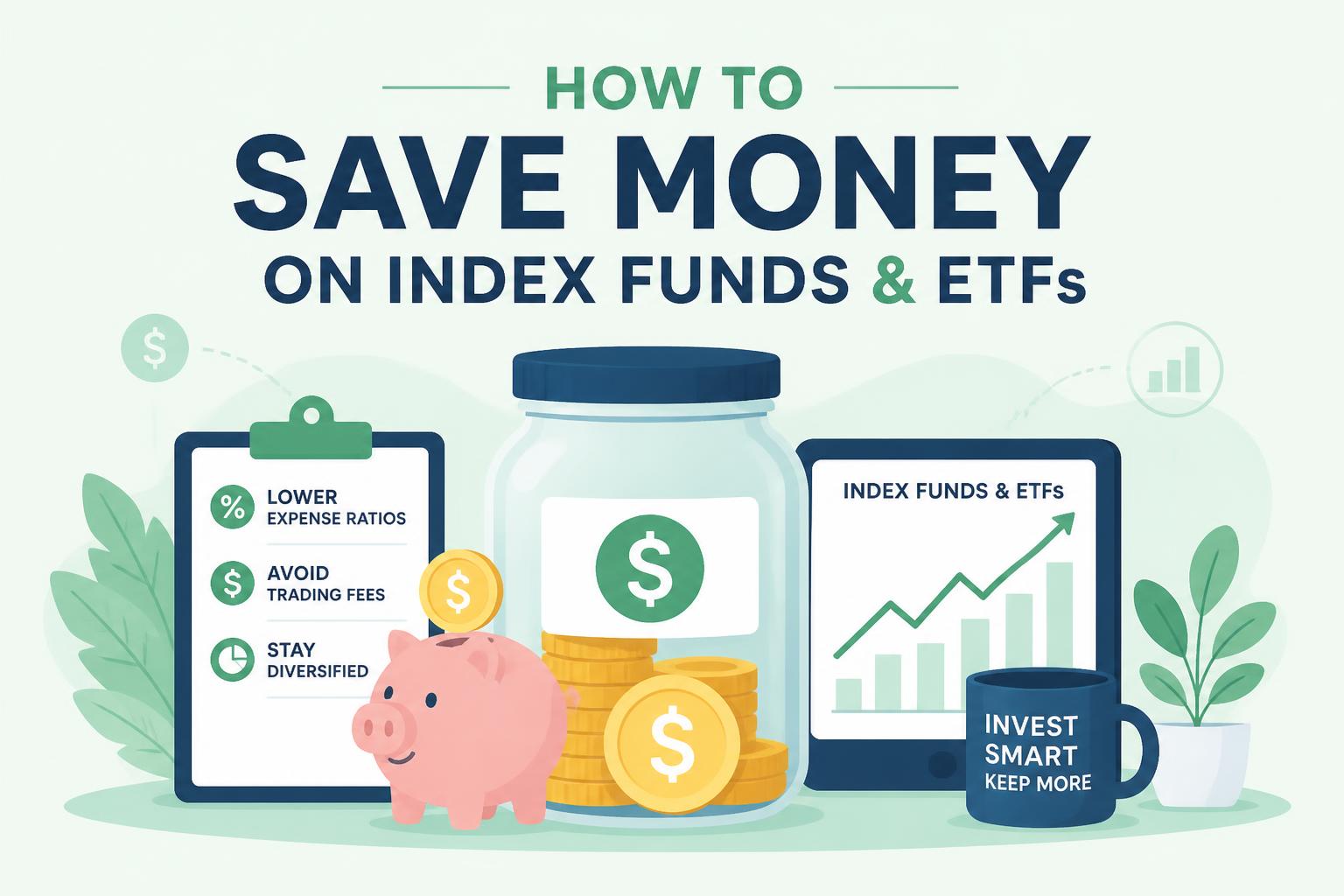
How to Save Money on Index Funds & ETFs: A 2026 Guide to Smart Investing
This article contains affiliate links. If you sign up through one of these links, I may earn a commission at no additional cost to you. Read full disclosure.
If you’re watching your investment costs eat into your returns, you’re not alone. With expense ratios ranging from zero to well over 1%, the difference between a smart fund choice and an expensive one can cost you tens of thousands over a lifetime of investing.
Here’s the good news: in 2026, saving money on index funds and ETFs is easier than ever. Some funds now charge as little as 2 basis points—that’s just $2 per year on a $10,000 investment. The challenge isn’t finding low-cost options; it’s knowing which ones deliver the best value without sacrificing performance.
By the end of this guide, you’ll know exactly how to identify the lowest-cost index funds and ETFs, avoid hidden fees, and build a portfolio that keeps more money working for you instead of flowing to fund managers.
What you need before starting:
- A brokerage account (many now offer commission-free trading)
- Basic understanding of your investment goals and timeline
- Estimated time: 15 minutes to review and apply these strategies
—
Understanding the Real Cost of Index Funds & ETFs
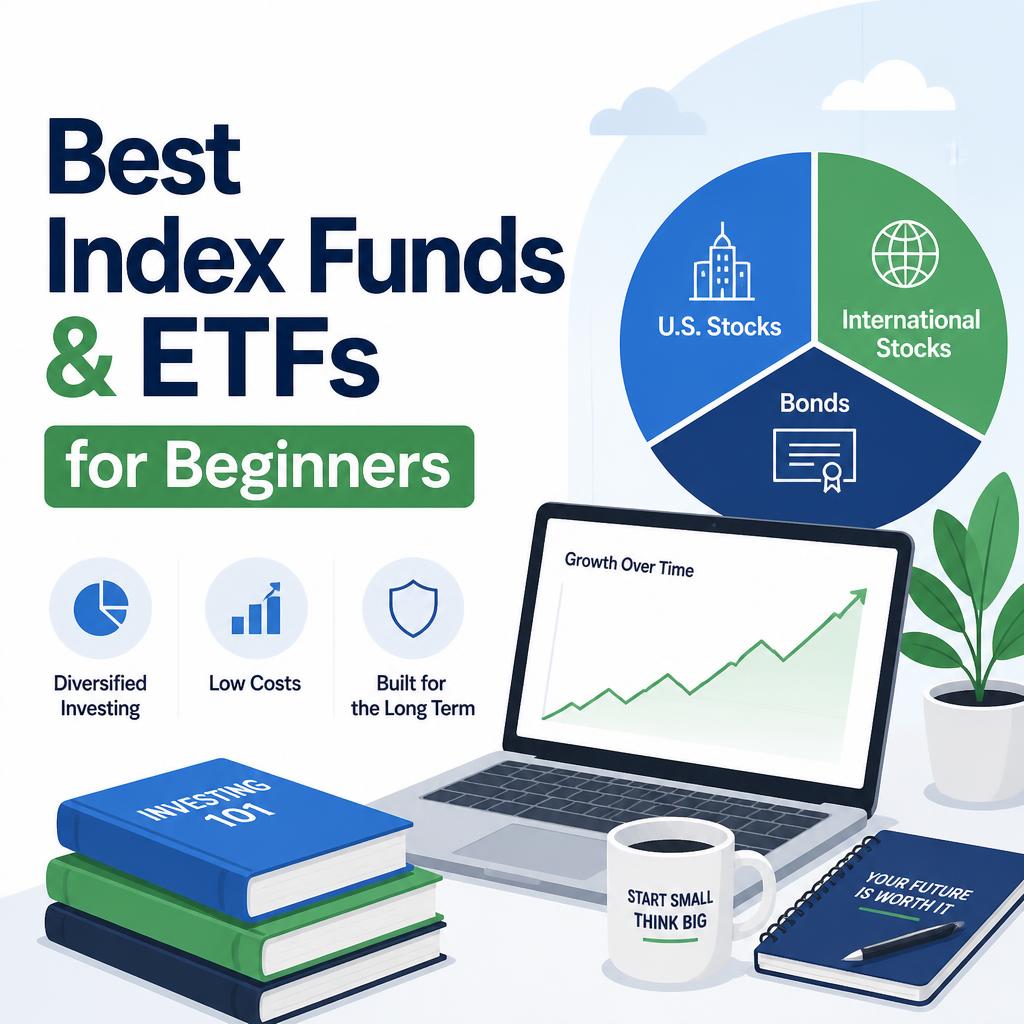
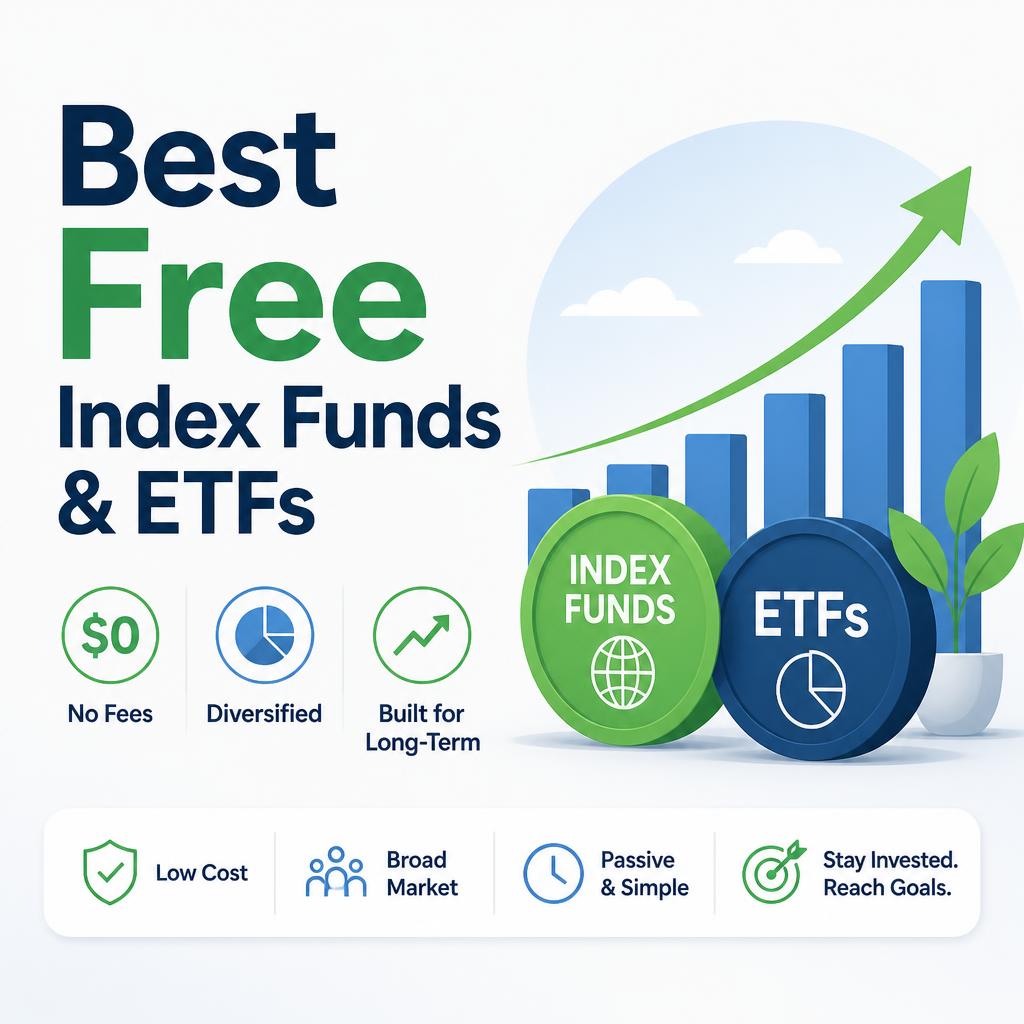
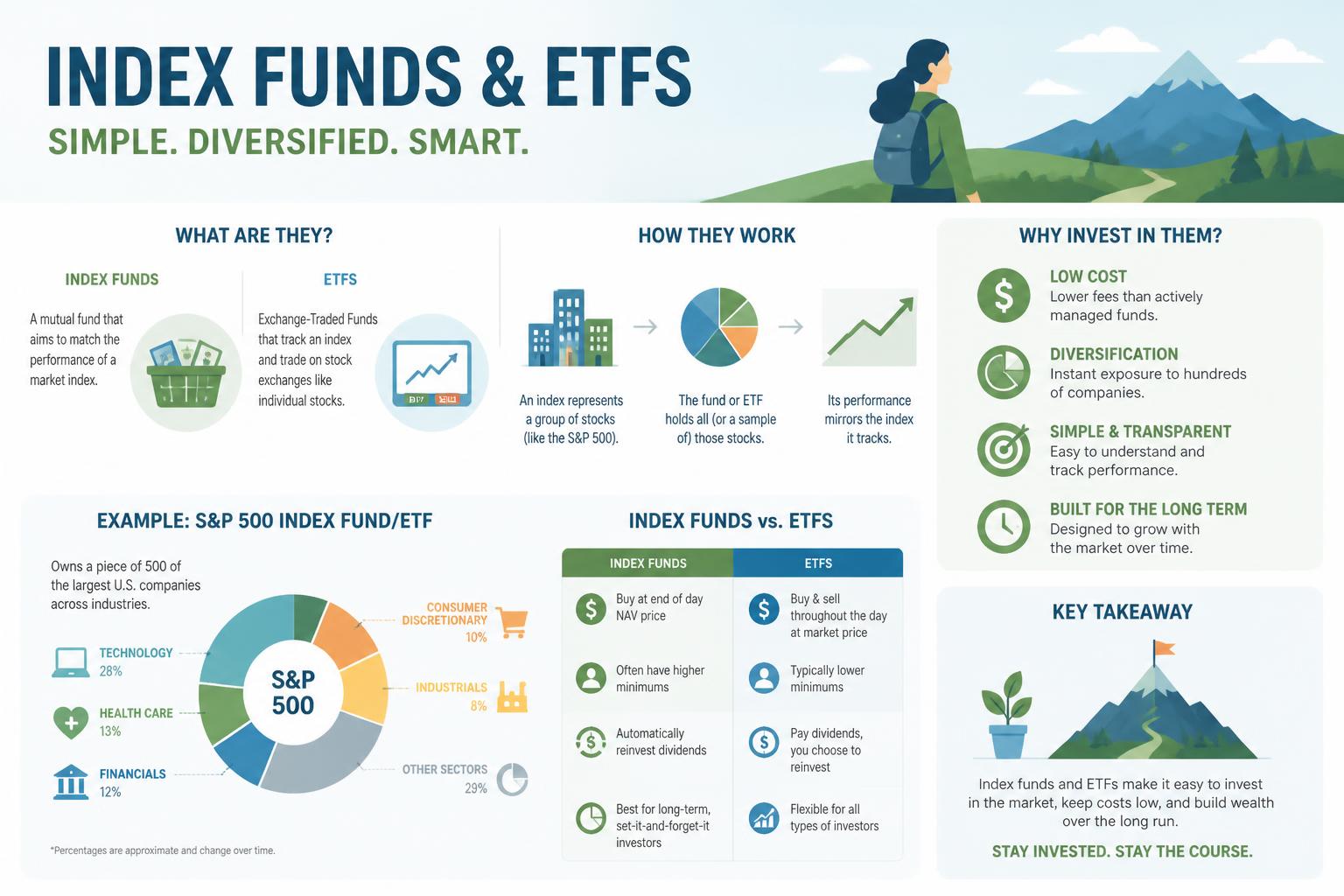
Before diving into cost-cutting strategies, let’s clarify what you’re actually paying for. Index funds and ETFs track market indices rather than relying on active management, which is why they can charge dramatically lower fees.
The expense ratio is your primary cost—it’s the annual fee expressed as a percentage of your investment. A fund with a 0.50% expense ratio costs $50 per year on a $10,000 investment. That might sound small, but over 30 years with compound growth, that difference adds up to thousands.
In 2026, the landscape has shifted dramatically. According to recent data, less than 5% of active large-blend funds survived and outperformed their passive peers over the past 15 years. This makes the case for low-cost index investing stronger than ever.
—
Step 1: Target Ultra-Low Expense Ratios
The single most effective way to save money is choosing funds with rock-bottom expense ratios. In 2026, several providers have pushed costs to near-zero levels.
Start by filtering for funds with expense ratios below 0.10% (10 basis points). This immediately eliminates the majority of overpriced options.
Top ultra-low-cost options for 2026:
- State Street SPDR Portfolio S&P 500 ETF charges just 2 basis points—one of the lowest in the market
- Fidelity offers no-expense-ratio index funds (0.00%)
- E*TRADE also provides no-expense-ratio options
The State Street SPDR Portfolio S&P 500 ETF, which tracks the S&P 500 index, has demonstrated the best performance over the past 10 years while maintaining its minimal 2 basis point fee.
You should see: When comparing funds side-by-side, the expense ratio is clearly listed in the fund’s prospectus or on your broker’s fund comparison tool.
> Note: Zero expense ratio funds are legitimate—providers like Fidelity absorb the costs to attract customers to their platform, where they profit from other services.
—
Step 2: Choose ETFs Over Traditional Index Funds
ETFs typically offer structural advantages that translate to cost savings compared to traditional mutual fund versions of the same index.
Look for the ETF version of your target index rather than the mutual fund. ETFs typically have lower investment minimums and greater tax efficiency due to their unique structure.
According to 2026 research, ETFs have lower investment minimums compared to traditional index funds. Many traditional index funds require $1,000 to $3,000 minimum investments, while ETFs can be purchased for the price of a single share—often under $100.
Additional ETF advantages in 2026:
- Commission-free trading at most major brokers
- Intraday trading flexibility
- More tax-efficient structure for taxable accounts
- Fractional shares now widely available through major brokers
You should see: The same index tracked by both an ETF and a mutual fund, with the ETF version showing a lower expense ratio and no minimum investment beyond the share price.
—
Step 3: Verify the Fund’s Asset Size and Track Record
Bigger isn’t always better, but in the ETF world, substantial assets under management (AUM) often correlate with lower costs and tighter bid-ask spreads.
Filter for funds with at least $10 billion in assets under management and a Morningstar rating of at least 4 stars. These thresholds indicate established funds with proven track records and sufficient scale to maintain low costs.
Large AUM funds benefit from economies of scale—they can spread their fixed costs across more investor dollars, which helps keep expense ratios low. Additionally, higher trading volume means tighter bid-ask spreads, reducing your transaction costs.
You should see: The fund’s AUM and Morningstar rating clearly displayed on your broker’s platform or on sites like Morningstar.com.
> Note: While AUM and ratings are important, they shouldn’t be your only criteria. A newer fund with a stellar track record and ultra-low fees may still be an excellent choice.
—
Step 4: Understand What You’re Actually Getting
Not all S&P 500 funds are created equal, even if they track the same index. Some include additional features or restrictions that affect cost and performance.
Read the fund’s fact sheet or prospectus to verify:
- Exact index tracked
- Any ESG (environmental, social, governance) screening
- Geographic or sector limitations
- Rebalancing frequency
For example, some 2026 semiconductor-focused indices like the “MSCI ACWI IMI Semiconductors & Semiconductor Equipment ESG Screened Select Capped” have delivered remarkable returns (+120.51% in 2026) but come with sector concentration risk and may have higher expense ratios due to specialized screening.
You should see: A clear description of the index methodology and any screens or caps applied to the portfolio.
—
Step 5: Consider Bond Funds Differently
While stock index funds are straightforward, bond funds require a different evaluation approach in 2026.
For bond exposure, don’t automatically default to the lowest-cost passive option. According to current market analysis, active stock ETFs may struggle to beat their passive peers, but the same isn’t true for bonds.
The Fidelity Investment Grade Bond ETF charges 36 basis points—higher than ultra-cheap stock ETFs—but offers active management by Fidelity’s experienced core/core-plus team. Since its March 2021 inception, it has achieved top quartile performance with flexibility to invest across various bond types.
When to choose active bond funds:
- Interest rate environments are volatile (like 2026, with inflation concerns)
- You want professional management of credit risk
- You value flexibility to adjust duration and credit quality
You should see: The fund’s active management strategy clearly explained, along with the team’s track record managing similar strategies.
> Note: The extra 30-40 basis points for skilled active bond management can be worthwhile, especially compared to the 100+ basis point fees charged by many traditional actively managed funds.
—
Step 6: Use Target-Date ETFs for Automatic Rebalancing
If you want to minimize ongoing management costs and time, target-date ETFs offer automatic rebalancing at ultra-low costs.
Consider a target-date ETF if you’re investing for retirement and want a hands-off approach. These funds automatically adjust your stock-to-bond ratio as you age.
The iShares LifePath Target Date 2070 ETF charges under 13 basis points and starts with 99% stock allocation, gradually shifting to 60% bonds and 40% stocks by 2070. It provides diversified global exposure including international investments—all managed automatically.
This eliminates the need to manually rebalance, which saves you:
- Trading commissions (even if your broker offers commission-free trades, bid-ask spreads cost money)
- Time researching optimal allocation
- The risk of emotional decision-making during market volatility
You should see: The target-date fund’s glide path clearly illustrated, showing how allocation changes over time.
—
Step 7: Avoid These Common Fee Traps
Even when hunting for low-cost funds, several hidden costs can erode your savings.
Watch out for:
- 12b-1 fees: Some funds charge marketing fees passed to investors. These appear in the expense ratio but aren’t always highlighted.
- Transaction fees: While most brokers now offer commission-free ETF trading, some still charge fees for certain funds. Verify your broker’s specific fee structure.
- Bid-ask spreads: The difference between buying and selling prices. Low-volume ETFs can have wide spreads that effectively increase your cost.
- Taxable events: Frequent trading or holding tax-inefficient funds in taxable accounts creates tax drag that’s worse than a high expense ratio.
You should see: Your broker’s fee schedule clearly stating which ETFs trade commission-free and any transaction fees that apply.
> Note: If your target fund charges a transaction fee at your current broker, it may be worth switching to a broker that offers it commission-free rather than paying $5-10 per trade.
—
Step 8: Implement Your Low-Cost Strategy
Now that you know what to look for, here’s how to actually build your portfolio.
- Open an account with a broker offering commission-free ETF trading (Fidelity, Schwab, E*TRADE, or Vanguard)
- Start with a core holding: Choose an ultra-low-cost broad market ETF like the State Street SPDR Portfolio S&P 500 ETF (2 basis points)
- Add bond exposure: Select either a passive bond ETF for minimal costs or an active fund like Fidelity Investment Grade Bond if you value professional management
- Consider international diversification: Add a low-cost international index fund if it fits your strategy
- Set up automatic investments: Most brokers now support automatic fractional share purchases
For a simple, complete portfolio, you could use just two funds:
- 80% State Street SPDR Portfolio S&P 500 ETF (for US stock exposure)
- 20% Fidelity Investment Grade Bond ETF (for bond diversification)
Total portfolio cost: approximately 10 basis points weighted average, or $10 per year on $10,000 invested.
You should see: Your complete portfolio with clear allocation percentages and a weighted average expense ratio under 0.15%.
—
The Math: How Much You Actually Save
Let’s put real numbers to these strategies.
Scenario 1: Traditional approach
- $10,000 initial investment
- $500 monthly contributions
- 8% annual return (pre-fees)
- 0.75% expense ratio (typical for many actively managed funds)
- 30-year time horizon
- Ending balance: $642,000
Scenario 2: Low-cost index approach
- Same investment pattern
- 0.05% expense ratio (weighted average of ultra-low-cost ETFs)
- Ending balance: $721,000
Savings: $79,000 over 30 years—that’s the power of minimizing costs.
—
When to Rebalance (And When Not To)
Rebalancing controls risk but doesn’t necessarily improve returns. However, how you rebalance affects your costs.
According to 2026 investment research, younger investors may not need to rebalance frequently, while older investors should do so regularly.
Cost-effective rebalancing strategies:
- Use new contributions: Instead of selling and buying (triggering potential taxes and spreads), direct new contributions to underweighted assets
- Rebalance in tax-advantaged accounts first: IRAs and 401(k)s avoid tax consequences
- Set meaningful thresholds: Only rebalance when allocation drifts 5+ percentage points from target
- Consider annual rebalancing: More frequent rebalancing increases trading costs without meaningful benefit
You should see: Your portfolio’s drift from target allocation clearly displayed by your broker’s tools, making it easy to identify when rebalancing is needed.
—
Troubleshooting Common Issues
“The ultra-low-cost fund isn’t available at my broker”
Check if your broker charges a transaction fee for that specific ETF. If so, calculate whether paying $5-10 per trade is worth it compared to a slightly higher expense ratio fund that’s commission-free. For large investments or infrequent trading, paying the transaction fee often makes sense.
“Should I sell my current funds to switch to lower-cost options?”
In tax-advantaged accounts (IRA, 401(k)): Generally yes, as there are no tax consequences.
In taxable accounts: Calculate the tax cost of selling (capital gains tax) versus the ongoing expense ratio savings. If you’re sitting on large unrealized gains, the tax hit might outweigh years of expense ratio savings.
“The expense ratio is low but the fund’s returns lag the index”
This is called “tracking error.” Check the fund’s methodology—some ESG-screened or capped versions of indices intentionally deviate from the parent index. Verify you’re comparing apples to apples: the fund’s return versus its specific benchmark, not a different index.
“I want to invest in specialized sectors like semiconductors”
Sector-specific indices like the Nasdaq Global Semiconductor (+115.76% in 2026) can deliver impressive returns but come with concentration risk. If you choose sector funds, keep them to a small portion of your portfolio (10-15%) and maintain a low-cost broad market core.
—
Next Steps: Putting Your Knowledge to Work
You now have a complete framework for minimizing index fund and ETF costs in 2026. Here’s what to do next:
- Audit your current holdings: List each fund’s expense ratio and calculate your portfolio’s weighted average cost
- Identify expensive outliers: Flag any funds charging more than 0.25% that could be replaced with lower-cost alternatives
- Create a transition plan: For taxable accounts with embedded gains, consider a multi-year transition strategy to manage tax impact
- Set up automatic investments: Take advantage of commission-free fractional share purchases to dollar-cost average into your chosen low-cost funds
The key insight for 2026: with expense ratios approaching zero and commission-free trading now standard, the barriers to building an ultra-low-cost portfolio have never been lower. The difference between a cost-conscious investor and an average one can easily exceed $50,000 over a career—money that stays in your pocket instead of going to fund companies.
—
FAQ
Do I need to pay for investment advice to build a low-cost portfolio?
No. The strategy outlined above—core holdings in ultra-low-cost broad market ETFs—is straightforward enough for most investors to implement independently. However, if you have complex tax situations, significant assets, or need help with estate planning, a fee-only financial advisor can provide value beyond fund selection.
Are no-expense-ratio index funds really free?
Yes, funds from Fidelity and E*TRADE with 0.00% expense ratios are genuinely free to hold. These firms use them as loss leaders to attract customers, profiting from other services. There are no hidden catches, though you’ll still pay standard bid-ask spreads when trading.
How do I know if my portfolio’s expense ratio is competitive?
For a diversified stock/bond portfolio in 2026, aim for a weighted average expense ratio under 0.15%. If you’re above 0.25%, you likely have room for improvement. Above 0.50% means you should strongly consider switching to lower-cost alternatives.
Should I use Vanguard or switch to funds with even lower expense ratios?
Vanguard pioneered low-cost investing and remains excellent, with funds like the Vanguard S&P 500 ETF charging just 0.03%. However, some competitors like State Street now offer even lower costs (2 basis points). The difference between 0.03% and 0.02% is minimal—don’t switch if it means triggering capital gains taxes or dealing with a less user-friendly platform.
Can I use these strategies in my 401(k)?
Partially. Your 401(k) fund menu is predetermined by your employer. Look for the lowest-cost index fund options available in your plan. If your 401(k) lacks good options, contribute enough to get the full employer match, then prioritize IRA contributions where you have complete fund selection freedom.
How often should I check my portfolio?
For long-term index investors, quarterly reviews are sufficient. Check that:
- Automatic investments are processing correctly
- Your allocation hasn’t drifted significantly
- No fund has announced expense ratio increases (rare but possible)
More frequent checking often leads to counterproductive emotional decisions during market volatility.
—
Ready to start building your low-cost portfolio? Open a commission-free brokerage account with Fidelity, Schwab, or ETRADE to access the ultra-low-cost funds mentioned in this guide.*