How to Compare Retirement Accounts (IRA vs 401k): Step-by-Step Guide (2026)
Affiliate Disclosure: This article contains affiliate links. If you sign up for a service through our links, we may earn a commission at no additional cost to you. We only recommend products we believe will help you make better financial decisions.
You know you should be saving for retirement. You’ve heard about 401(k)s and IRAs. But which one should you prioritize? How much can you actually contribute? And what if you have access to both?
This guide will show you exactly how to compare these two retirement vehicles, understand the 2026 contribution limits, and decide which strategy maximizes your long-term wealth. Whether you’re just starting your career or optimizing an existing retirement strategy, you’ll walk away with a clear plan based on your specific situation.
What you need before starting:
- Access to your employer’s benefits portal (if you have a workplace retirement plan)
- Your most recent tax return or W-2 to determine your income level
- A retirement calculator or spreadsheet tool — Personal Capital’s free retirement planner works well for tracking both account types in one place
- Estimated time: 25-30 minutes
Step 1: Understand What Each Account Type Actually Is
A 401(k) is an employer-sponsored retirement plan. Your contributions come directly from your paycheck before taxes are taken out (for traditional 401(k)s) or after taxes (for Roth 401(k)s). Many employers match a percentage of your contributions — free money, basically.
An IRA (Individual Retirement Account) is a retirement account you open yourself, independent of your employer. You have two main types: Traditional IRAs (tax-deductible contributions, taxed withdrawals) and Roth IRAs (after-tax contributions, tax-free withdrawals).
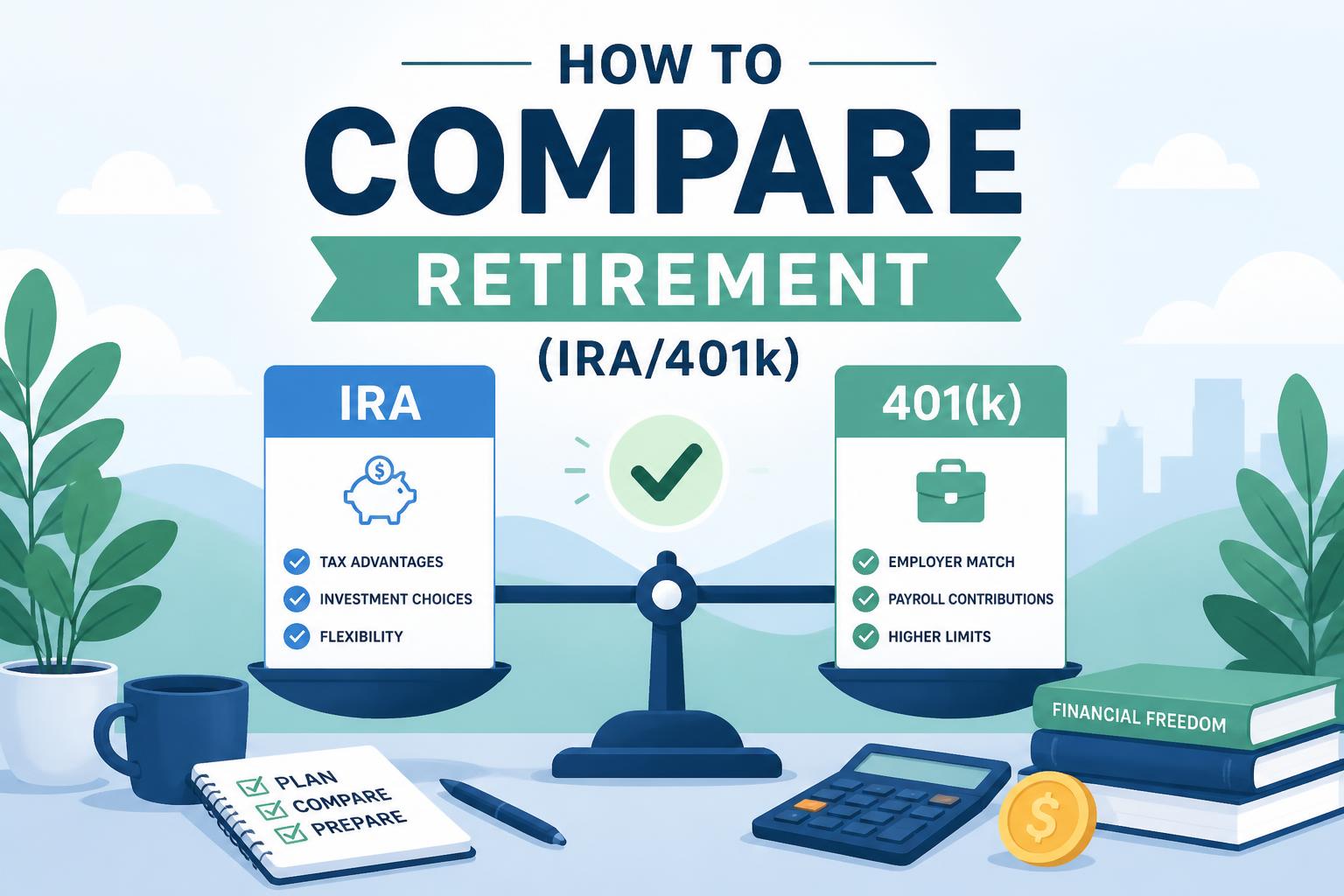
The big difference: 401(k)s are tied to your employer and have higher contribution limits. IRAs give you more investment flexibility and control, but with lower contribution caps.
Step 2: Check the 2026 Contribution Limits
The IRS sets annual contribution limits for both account types. For 2026:
401(k) limits:
- Standard contribution: $24,500
- Catch-up (age 50+): additional $8,000
- Super catch-up (ages 60-63): additional $11,250
- Combined employee + employer: up to $72,000
IRA limits:
- Standard contribution: $7,500 (under age 50)
- With catch-up (age 50+): $8,600
Write these numbers down. The difference is massive — $24,500 vs $7,500 — which is why 401(k)s are usually the first priority if you have access to one.
If you’re between 60 and 63, the new super catch-up provision under SECURE 2.0 lets you contribute up to $11,250 in catch-up contributions to your 401(k) — significantly more than the standard $8,000 for those 50 and over.
Step 3: Determine Your Income and Tax Situation
Your income level affects whether you can contribute to certain retirement accounts and whether you can deduct traditional IRA contributions.
Pull up your most recent tax return and find your Modified Adjusted Gross Income (MAGI). Here’s why it matters:
Traditional IRA deductibility (2026):
If you’re covered by a workplace retirement plan, your ability to deduct traditional IRA contributions phases out at these income levels:
- Single filers: $81,000-$91,000
- Married filing jointly: $129,000-$149,000
- Married filing separately: $0-$10,000
If you’re NOT covered by a workplace plan, your traditional IRA contributions are fully deductible regardless of income.
Roth IRA eligibility (2026):
Your ability to contribute to a Roth IRA phases out at:
- Single filers: $153,000-$168,000
- Married filing jointly: $242,000-$252,000
Step 4: Identify Your Employer’s 401(k) Match (If You Have One)
Log into your employer’s benefits portal. Navigate to the retirement plan section and look for the employer match policy.
Common match structures:
- 50% match on the first 6% of salary you contribute
- 100% match on the first 3% of salary
- Dollar-for-dollar match up to a certain percentage
Calculate the free money you’re leaving on the table if you don’t contribute enough to get the full match. If you earn $80,000 and your employer matches 50% of the first 6% you contribute, that’s $2,400 per year in free money — a guaranteed 50% return.
Critical rule: Always contribute at least enough to your 401(k) to get the full employer match before putting money in an IRA. This is the highest-return investment decision you can make.
Step 5: Compare Tax Benefits Based on Your Current vs Future Tax Rate
Now you need to decide between traditional (tax-deferred) and Roth (tax-free growth) contributions. This comes down to one question: Will your tax rate be higher now or in retirement?
Open a spreadsheet or use Personal Capital’s retirement tax calculator to model both scenarios:
Choose traditional (401k or IRA) if:
- You’re in a high tax bracket now (24% federal or higher)
- You expect to be in a lower bracket in retirement
- You want to reduce your current taxable income
Choose Roth (401k or IRA) if:
- You’re early in your career with a lower current tax rate
- You expect your income (and tax rate) to increase substantially
- You want tax-free withdrawals in retirement
- You’re in the 60-63 age range and required to make catch-up contributions as Roth if your earnings exceed $150,000
Calculate the tax savings from a traditional contribution: multiply your contribution by your marginal tax rate. For someone in the 24% bracket contributing $24,500 to a traditional 401(k), that’s $5,880 in immediate tax savings.
Step 6: Evaluate Investment Options in Each Account
The investment choices available in your 401(k) versus an IRA can significantly impact your long-term returns.
401(k) investment options:
Log into your 401(k) account and review the available investment menu. Most plans offer 10-30 mutual fund options across different asset classes. Look for:
- The expense ratios of available funds (lower is better — aim for under 0.50%)
- Whether low-cost index funds are available
- The quality of the target-date fund options
IRA investment options:
With an IRA at a brokerage like Fidelity or Vanguard, you have access to:
- Thousands of mutual funds and ETFs
- Individual stocks and bonds
- More specialized investment vehicles
Compare the expense ratios. If your 401(k) only offers high-cost funds (1%+ expense ratios) and you’ve already captured the employer match, contributing to an IRA with low-cost index funds might generate better long-term returns.
Step 7: Map Out Your Contribution Strategy Priority Order
Based on everything you’ve evaluated, create your contribution priority list. For most people in 2026, the order is:
Priority 1: Contribute to 401(k) up to the employer match
Capture the free money first. This is a guaranteed return you can’t get anywhere else.
Priority 2: Max out Roth IRA (if eligible based on income)
Better investment options than most 401(k)s, tax-free growth and withdrawals. Contribution limit: $7,500 ($8,600 if 50+).
Priority 3: Return to 401(k) and contribute up to the max
After capturing the match and maxing the Roth IRA, fill the remaining 401(k) space. 2026 limit: $24,500 (or $32,500 with catch-up if 50+, or $35,750 if ages 60-63).
Priority 4: If you’ve maxed both, consider a backdoor Roth IRA or taxable brokerage account
Write out your specific monthly contribution amounts needed to execute this strategy. Divide your annual goals by 12 (or by the number of paychecks if contributing per paycheck).
Step 8: Account for Catch-Up Contributions If You’re 50 or Older
If you’re 50 or older in 2026, you have access to catch-up contributions — extra contribution room designed to help late savers accelerate their retirement funding.
2026 catch-up limits:
- 401(k): $8,000 (total contribution: $32,500)
- IRA: $1,100 (total contribution: $8,600)
- Super catch-up (ages 60-63): $11,250 (total 401(k) contribution: $35,750)
Update your payroll deductions to take advantage of this extra contribution space. If you’re in the 60-63 age bracket, the super catch-up provision gives you an additional three years to significantly boost retirement savings.
Check with your HR department or 401(k) provider to make sure catch-up contributions are enabled in your account. Some plans require you to opt in.
Starting in 2026, if you earn more than $150,000, your 401(k) catch-up contributions must be made as Roth contributions (after-tax). This is a new requirement under SECURE 2.0.
Step 9: Check Whether You Can Contribute to Both Accounts
Many people assume they have to choose between a 401(k) and an IRA. You don’t — you can contribute to both in the same year, subject to the limits covered earlier.
The rules:
- You can contribute the full $24,500 to a 401(k) AND the full $7,500 to an IRA
- The IRS treats these as separate contribution buckets
- Your income may limit Roth IRA eligibility or traditional IRA deductibility, but not your ability to contribute to a 401(k)
If you have access to multiple 401(k) plans (for example, if you changed jobs mid-year or have a side business with a solo 401(k)), your total contributions across all 401(k) plans cannot exceed $24,500 for 2026. The employer match doesn’t count toward this limit, but your personal contributions do.
Step 10: Set Up Automatic Contributions
Don’t rely on manual transfers or remembering to contribute. Automate your retirement savings so it happens before you have a chance to spend the money.
For 401(k) contributions:
- Log into your employer’s payroll or HR system
- Navigate to retirement plan elections
- Set your contribution percentage to achieve your target annual amount
- Save and confirm the change takes effect on your next paycheck
For IRA contributions:
- Log into your IRA provider’s website (Fidelity, Vanguard, etc.)
- Set up automatic monthly transfers from your checking account
- Choose your target monthly contribution (annual goal ÷ 12)
- Select the date each month the transfer should occur (ideally right after you get paid)
Step 11: Review and Adjust Your Strategy Annually
Contribution limits, income phase-outs, and tax rules change every year. Set a calendar reminder for January of each year to review:
- New contribution limits announced by the IRS
- Changes to your income that might affect Roth IRA eligibility or traditional IRA deductibility
- Whether your 401(k) plan has added better investment options
- Whether you’ve crossed into catch-up contribution eligibility (age 50, or ages 60-63 for super catch-up)
Use a tool like Personal Capital to track your total retirement savings across all accounts in one dashboard. This gives you a clear view of whether you’re on track for your retirement goals.
Your Retirement Account Comparison is Complete
You now have a framework for comparing 401(k) and IRA options, understanding the 2026 contribution limits, and building a prioritized contribution strategy that maximizes tax advantages and employer matches.
The key insight: You don’t have to choose one or the other. Most people should use both — starting with the 401(k) up to the employer match, then maximizing a Roth IRA, then returning to fill the remaining 401(k) space.
If you want to track all your retirement accounts in one place and get personalized recommendations on whether you’re on track for your goals, Personal Capital’s free retirement planner connects to all your accounts and shows you exactly where you stand.

Advanced Retirement Strategies
Once you’ve mastered the basics of 401(k) and IRA contributions, consider these advanced moves:
Backdoor Roth IRA: If your income exceeds the Roth IRA limits, you can contribute to a traditional IRA (which has no income limits) and immediately convert it to a Roth.
Mega Backdoor Roth: If your 401(k) plan allows after-tax contributions beyond the $24,500 limit, you can contribute up to the combined limit of $72,000 and convert the after-tax portion to Roth.
Roth Conversion Strategy: In years when your income is lower (sabbatical, job transition, early retirement), convert traditional IRA or 401(k) funds to Roth while in a lower tax bracket.
Solo 401(k) for Side Income: If you have self-employment income, you can open a solo 401(k) and make both employee ($24,500) and employer contributions (up to $72,000 total).
Troubleshooting Common Issues
I contributed too much to my 401(k) — what do I do?
Contact your plan administrator immediately. Excess contributions must be withdrawn (along with any earnings) by April 15 of the following year to avoid double taxation. Your employer can process an excess deferral distribution.
I’m not sure if I’m covered by a workplace retirement plan for IRA deduction purposes.
Check Box 13 on your W-2. If the “Retirement plan” box is checked, you’re considered covered, which may limit your traditional IRA deduction based on your income.
Can I contribute to my IRA even though I maxed out my 401(k)?
Yes — the $24,500 401(k) limit and the $7,500 IRA limit are completely separate. You can contribute the full amount to both.
What if I don’t have earned income — can I still contribute to an IRA?
You must have earned income to contribute to an IRA. However, if you’re married and your spouse has earned income, you can contribute to a spousal IRA even if you have no income yourself.
Frequently Asked Questions
Do I need a paid plan to compare 401(k) and IRA options?
No — the comparison process itself is free. You can review your 401(k) options through your employer’s benefits portal and open an IRA with no minimum balance at most major brokerages. Tools like Personal Capital offer free retirement planning features alongside optional paid advisory services.
Can I contribute to multiple 401(k) plans in the same year?
If you changed jobs or have a side business with a solo 401(k), your total employee contributions across all 401(k) plans cannot exceed $24,500 for 2026. Employer match contributions don’t count toward this limit.
Is it better to contribute to a traditional or Roth 401(k)?
It depends on whether you expect your tax rate to be higher now or in retirement. If you’re in a high tax bracket now and expect to be in a lower bracket in retirement, traditional contributions offer immediate tax savings. If you’re early in your career or expect higher future tax rates, Roth contributions provide tax-free growth.
What happens if I contribute too much to my IRA?
Excess IRA contributions are subject to a 6% penalty tax for each year the excess remains in the account. You can withdraw the excess contribution (and any earnings on it) by the tax filing deadline to avoid the penalty, or apply the excess to a future year’s contribution.
Can I use both a 401(k) and an IRA if I’m self-employed?
If you have a side business, you can open a solo 401(k) and contribute both as an employee (up to $24,500) and as an employer (up to 25% of compensation, with a combined limit of $72,000). You can also separately contribute to an IRA, subject to the $7,500 limit.
How much should I be saving for retirement?
A common guideline is to save 15-20% of your gross income for retirement, including employer match. Use a retirement calculator to model whether your current savings rate will generate enough income to maintain your lifestyle in retirement.
—
Ready to optimize your retirement strategy? Personal Capital offers free tools to track your 401(k), IRA, and other accounts in one dashboard, plus retirement planning calculators that show whether you’re on track for your goals.