Brokerage Accounts Explained: What 73% of New Investors Get Wrong in 2026
You decided to start investing. You heard about brokerage accounts. Then you sat down to actually open one and got hit with a wall of jargon—taxable vs retirement, full service vs discount, margin vs cash—and zero clarity on which one you actually need.
Most guides won’t tell you this: the “best” brokerage account isn’t the one with the flashiest app or the most features. It’s the one that matches how you actually invest, doesn’t nickel and dime you on fees, and gets out of your way when you need to execute a trade.
What follows is exactly what a brokerage account is, the types that exist in 2026, what they cost, and how to pick one without wasting hours comparing platforms that all look identical on the surface.
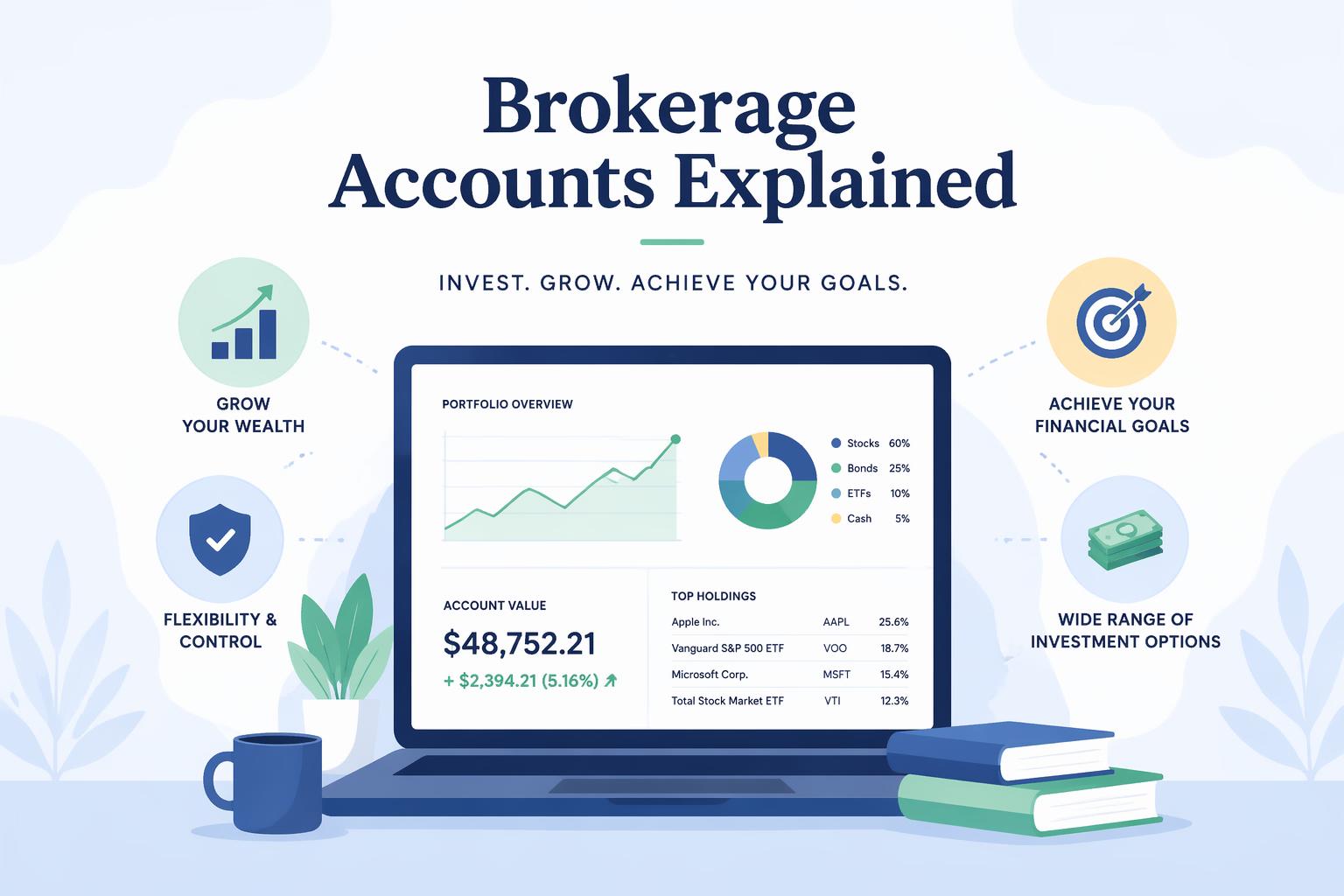
Table of Contents
- What Is a Brokerage Account?
- How Brokerage Accounts Work
- Types of Brokerage Accounts
- Full-Service vs. Discount Brokerages
- What You Can Buy in a Brokerage Account
- Brokerage Account Fees in 2026
- How to Choose the Right Brokerage Account
- Opening Your First Brokerage Account
- Brokerage Account Safety and Protection
- Common Mistakes to Avoid
- FAQ
What Is a Brokerage Account?
A brokerage account lets you buy and sell investments—stocks, bonds, ETFs, mutual funds, options, sometimes crypto. Think of it as the bridge between your bank account and the stock market.
Unlike a savings account that just holds cash and earns interest, a brokerage account gives you direct access to investment products. You deposit money, place trades, and your investments live there until you sell or withdraw.
Two major categories:
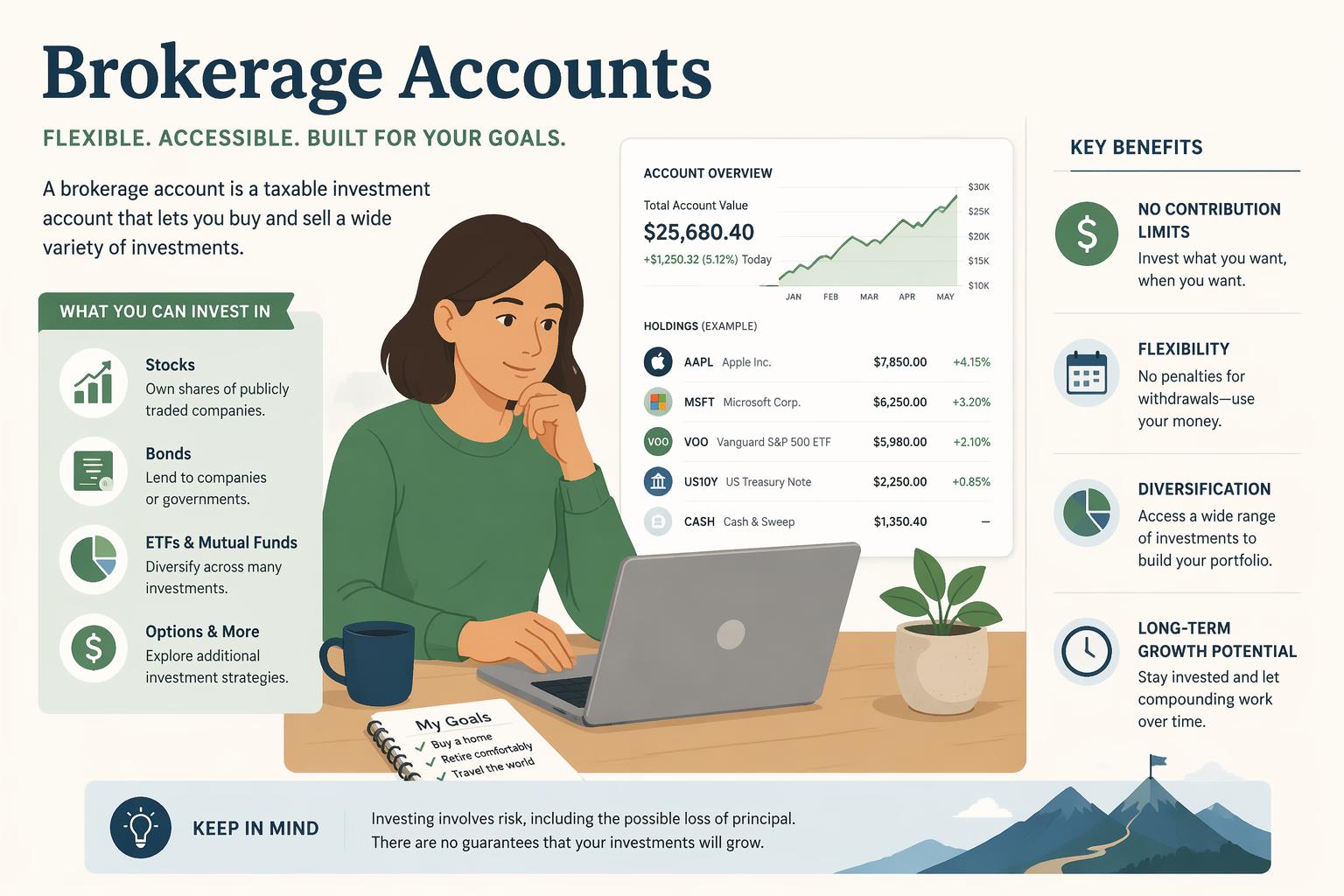
Taxable brokerage accounts — Standard accounts with no contribution limits, no withdrawal penalties, no special tax treatment. You pay capital gains tax when you sell for a profit.
Retirement accounts (IRAs) — Tax-advantaged accounts with annual contribution limits and penalties for early withdrawal before age 59½. Traditional IRAs and Roth IRAs both fall into this bucket.
Most people start with a standard taxable account because it’s flexible. You can deposit and withdraw anytime without penalties, which makes it ideal for goals outside retirement.
How Brokerage Accounts Work
The basic flow:
You open an account with a brokerage firm. You deposit money from your bank via ACH transfer, wire, or check. You place trades through the platform—web, mobile app, or phone. The brokerage executes your trade on a stock exchange and holds your investments in your account. You monitor and manage your portfolio, buying and selling as your strategy dictates. You withdraw cash anytime by selling investments and transferring money back to your bank.
The brokerage is the middleman. They don’t create the stocks or set the prices—they just connect you to the market and handle the paperwork. In exchange, they may charge fees (though many don’t in 2026) or make money through interest on your cash balance and payment for order flow.
Types of Brokerage Accounts
Standard Taxable Brokerage Accounts
This is the default account type. No contribution limits, no withdrawal penalties, no age restrictions. You can deposit $100 or $100,000, trade daily or hold for decades, pull your money out anytime.
Best for: Investing outside retirement, saving for goals in 5–10 years (house, car, college), active traders who need flexibility.
Tax treatment: You pay capital gains tax when you sell for a profit. Short term gains (held less than a year) get taxed as ordinary income. Long term gains (held more than a year) get preferential rates.
Individual Retirement Accounts (IRAs)
IRAs are retirement focused with tax benefits. The tradeoff: you face penalties if you withdraw before age 59½ (with some exceptions), and there are annual contribution limits.
Traditional IRA: Contributions may be tax deductible (depending on your income and whether you have a workplace retirement plan). Investments grow tax deferred. Withdrawals in retirement are taxed as ordinary income.
Roth IRA: Contributions are made with after tax dollars (no upfront deduction). Investments grow tax free. Qualified withdrawals in retirement are tax free.
Annual contribution limit (2026): Check current IRS limits—typically around $6,500–$7,000 for those under 50, with catch up contributions for those 50+.
Best for long term retirement savings when you won’t need the money for decades.
Joint Brokerage Accounts
Owned by two people (usually spouses or partners). Both have full access to deposit, trade, and withdraw. When one owner dies, the account typically passes to the surviving owner outside probate.
Best for couples managing shared investments or family wealth.
Custodial Accounts (UTMA/UGMA)
Accounts opened by an adult for a minor. The adult controls the account until the child reaches the age of majority (18 or 21, depending on state). At that point, the account transfers to the child’s control.
Best for saving and investing for a child’s future (college, first car, etc.).
Margin Accounts
Lets you borrow money from the brokerage to buy more investments than you have cash for. This amplifies both gains and losses. Interest gets charged on the borrowed amount.
Best for experienced traders who understand leverage risk.
Not recommended for beginners. Margin calls (forced selling when your account value drops) can wipe out your portfolio fast.
Cash Accounts
The opposite of a margin account. You can only trade with the cash you’ve deposited—no borrowing. This is the default for most beginners and safer overall.
Full Service vs Discount Brokerages
Full Service Brokerages
These firms offer personalized investment advice, portfolio management, and financial planning. You get a dedicated advisor who helps you pick investments and manage your strategy.
Pros: Professional guidance, customized portfolio management, hand holding for complex financial situations.
Cons: Higher fees (often 1%–2% of assets annually, plus commissions), less control over individual trades, may push proprietary products.
Best for high net worth individuals who want a hands off experience and can justify the cost.
Discount Brokerages
Self directed platforms where you make your own investment decisions. No personal advisor, but you get research tools, educational content, and low (or zero) fees.
Pros: Low or no commissions, full control over your portfolio, access to a wide range of investments.
Cons: No personal advice (you’re on your own), steeper learning curve for beginners.
Best for DIY investors who want to save on fees and learn as they go.
In 2026, the line between full service and discount has blurred. Many discount brokers now offer optional advisor access (like SoFi’s $10/month financial planning), and full service firms have launched lower cost digital platforms.
Robo-Advisors
A hybrid model: algorithms build and manage your portfolio based on your risk tolerance and goals. Lower fees than full service (typically 0.25%–0.50% annually), but no human advisor unless you pay extra.
Best for hands off investors who want automated management without paying full service fees.
What You Can Buy in a Brokerage Account
Most brokerage accounts give you:
Stocks — Individual company shares (Apple, Tesla, Microsoft, etc.)
ETFs (Exchange Traded Funds) — Baskets of stocks or bonds that trade like a single stock
Mutual Funds — Professionally managed funds (some brokerages charge transaction fees for these)
Bonds — Government and corporate debt securities
Options — Contracts that give you the right to buy or sell a stock at a set price
Cryptocurrencies — Some brokers (Robinhood, Webull, Public) offer crypto trading
Not every brokerage offers every asset type. If you want to trade options or crypto, confirm the platform supports it before opening an account.
Brokerage Account Fees in 2026
The fee war is over—most major brokerages charge $0 commissions on U.S. stock and ETF trades. The current landscape based on 2026 data:
Brokerage Account Minimum Stock/ETF Commissions Options NerdWallet Rating Fidelity $0 $0 $0.65/contract 5.0 Charles Schwab $0 $0 $0.65/contract 4.9 Interactive Brokers $0 $0 $0.65/contract 5.0 Robinhood $0 $0 $0 4.5 E*TRADE $0 $0 $0.65/contract 4.5 Webull $0 $0 $0 5.0 SoFi Active Investing $0 $0 $0 4.6 Public $0 $0 Rebates offered 4.4
Mutual fund transaction fees — Some brokers charge $20–$75 per trade for funds outside their no transaction fee list.
Options contracts — Typically $0.50–$0.65 per contract (Public is unique—it pays you to trade options via rebates).
Margin interest — If you borrow money to trade, expect 5%–12% annual interest depending on the broker and amount borrowed.
Account transfer fees — Moving your account to another brokerage can cost $50–$75.
Inactivity fees — Rare in 2026, but some brokers charge if you don’t trade for a year.
Advisory fees — Robo-advisors and full service options charge 0.25%–2% of assets annually.
Even with $0 commissions, you’re likely paying through payment for order flow—brokers sell your order to market makers who profit from the bid-ask spread. This is legal and typically costs you fractions of a cent per share, but it’s how “free” trading stays free.
How to Choose the Right Brokerage Account
The cheapest broker isn’t always the best broker. How to narrow it down:
1. Match the account type to your goal
Saving for retirement? Open an IRA (Roth if you expect to be in a higher tax bracket in retirement; Traditional if you want the upfront deduction).
Investing for a house in 5 years? Standard taxable account.
Day trading or active management? Discount brokerage with advanced tools (Interactive Brokers, E*TRADE).
Hands off, long term growth? Robo-advisor or target date fund at Fidelity or Schwab.
2. Check the investment options
Not all brokers offer the same assets. If you want to trade:
Options → Confirm per contract fees and approval process.
Cryptocurrencies → Robinhood, Webull, and Public offer crypto; Fidelity and Schwab don’t.
International stocks → Interactive Brokers has the widest reach.
Fractional shares → SoFi, Fidelity, and Schwab let you buy partial shares of expensive stocks.
3. Evaluate the platform and tools
If you’re a beginner, look for educational content (E*TRADE has webinars and daily market discussions; Fidelity has strong research tools), paper trading (Webull lets you practice with $1 million in play money before risking real cash), and an intuitive interface (Robinhood and SoFi are known for beginner friendly design).
If you’re experienced, prioritize advanced charting and analytics (Interactive Brokers and E*TRADE), customizable dashboards (Webull), and access to over the counter securities (Interactive Brokers).
4. Consider customer support
If you need help, you want it fast. Charles Schwab has 24/7 support and educational resources. Robinhood’s customer service has been historically weak (email only for years, though it’s improved).
5. Look for advisor access (if you want it)
SoFi Active Investing offers unlimited access to a financial planner for $10/month—good value if you want occasional guidance without paying a full service fee.
6. Check account minimums
All the major brokers listed above have $0 account minimums in 2026. You can open an account and start with as little as $1 (if the broker supports fractional shares).
7. Read the fine print on promotions
Some brokers offer cash bonuses or free stock for opening an account and depositing a certain amount. SoFi Invest, for example, offers a free stock up to $1,000. These are real perks, but don’t let a $10 signup bonus override a platform that doesn’t fit your needs.
Opening Your First Brokerage Account
The process is fast—usually under 15 minutes. What you’ll need:
Personal information — Name, address, date of birth, Social Security number.
Employment information — Employer name, occupation, income range.
Bank account details — Routing and account number for funding.
Investment experience — Some brokers ask about your trading history (this affects options approval).
The steps:
Choose your brokerage based on the criteria above. Select the account type (taxable, IRA, joint, etc.). Fill out the online application (5–10 minutes). Fund your account via ACH transfer (typically takes 1–3 business days). Start trading once your funds settle.
How quickly can you start? Most brokers let you trade immediately with instant deposit credit (up to $1,000–$5,000), even while your ACH transfer is still processing.
Brokerage Account Safety and Protection
Your money is safe—mostly.
SIPC Insurance
The Securities Investor Protection Corporation (SIPC) insures brokerage accounts up to $500,000 per customer per firm (with a $250,000 limit for cash). This covers you if the brokerage goes bankrupt, but it does not protect against investment losses (if your stocks drop, you lose money—that’s not insured).
Additional Coverage
Many brokers carry excess SIPC insurance beyond the $500,000 cap. Fidelity and Schwab, for example, have additional coverage in the millions. Check your broker’s policy.
FDIC Insurance for Cash
Cash sitting in your brokerage account (not invested) is not FDIC insured unless the broker sweeps it into an FDIC insured bank account. Some brokers do this automatically; others don’t. If you’re holding large amounts of uninvested cash, confirm how it’s protected.
What to do
Use strong passwords and two factor authentication (2FA). Don’t share your login credentials. Monitor your account regularly for unauthorized activity. Withdraw large cash balances to your bank account if you’re not investing it soon.
Common Mistakes to Avoid
1. Picking a broker based on the app design alone
A slick interface is nice, but if the platform charges hidden fees, has poor customer service, or lacks the investments you want, you’ll regret it.
2. Ignoring tax implications
Selling investments in a taxable account triggers capital gains tax. If you’re in a high tax bracket, consider holding investments longer than a year to qualify for lower long term capital gains rates, or use an IRA to defer taxes.
3. Trading on margin before you understand it
Margin amplifies losses just as much as gains. If the market moves against you, you can lose more than you invested—and owe the brokerage money. Stick to a cash account until you fully understand leverage.
4. Chasing promotions without reading the terms
That “free stock” offer might require you to keep your account open for 6 months or deposit $10,000. If you pull your money out early, you forfeit the bonus.
5. Opening too many accounts at once
Some investors open accounts at multiple brokerages to “diversify.” This creates unnecessary complexity—tracking performance, tax reporting, and rebalancing becomes a mess. Start with one, get comfortable, then expand if you have a specific reason.
6. Not taking advantage of retirement accounts
If you’re investing for retirement, an IRA is almost always smarter than a taxable account because of the tax benefits. Don’t skip it just because the contribution limits feel restrictive.
FAQ
How much money do I need to open a brokerage account?
Most major brokers in 2026—Fidelity, Schwab, Robinhood, E*TRADE, Webull, SoFi, Public, Interactive Brokers—have $0 account minimums. You can open an account and start investing with as little as $1 if the broker supports fractional shares.
Is my money insured at brokerage firms?
Yes, up to $500,000 per customer per firm through SIPC insurance. This protects you if the brokerage goes bankrupt, but it does not protect against investment losses (if your stocks drop, you lose that money).
How quickly can I start trading with an online broker?
Most brokers offer instant deposit credit of $1,000–$5,000, meaning you can start trading immediately while your ACH transfer (which takes 1–3 business days) is still processing.
Can I have multiple brokerage accounts?
Yes. Many investors have accounts at multiple brokers—one for retirement (IRA), one for taxable investing, one for active trading. Just be aware that tracking performance and tax reporting becomes more complex.
What’s the difference between a brokerage account and a bank account?
A bank account holds cash and earns interest (usually minimal). A brokerage account lets you buy investments (stocks, bonds, ETFs) that can grow (or shrink) in value. Brokerage accounts don’t have FDIC insurance on invested assets, but they do have SIPC protection.
Do I need a brokerage account to invest in stocks?
Yes. You can’t buy stocks directly from a company or exchange (with rare exceptions like direct stock purchase plans). You need a brokerage account to reach the market.
What happens if the brokerage goes out of business?
Your investments (stocks, ETFs, bonds) are held in your name, not the brokerage’s. If the firm fails, your assets transfer to another brokerage. SIPC insurance covers up to $500,000 in case of fraud or missing assets.
Are brokerage accounts taxable?
Taxable brokerage accounts: Yes—you pay capital gains tax when you sell for a profit.
IRAs: Tax deferred (Traditional) or tax free (Roth) growth, but with withdrawal rules and penalties.
Should I use a robo-advisor or pick my own investments?
Robo-advisor if you want hands off management and are willing to pay 0.25%–0.50% annually.
Self directed if you want full control and are willing to learn how to build and manage a portfolio.
—
Final Takeaway
A brokerage account is the gateway to investing—but the right one depends on your goals, your experience level, and how involved you want to be. If you’re just starting out, look for a broker with $0 fees, strong educational content, and a simple interface (Fidelity, Schwab, SoFi, or Robinhood). If you want to practice without risk first, Webull’s paper trading feature is solid.
Don’t overthink it. The best brokerage is the one you’ll use. Open an account, deposit what you’re comfortable investing, and start small. You can always transfer to a different broker later if your needs change—just expect a $50–$75 transfer fee.
The biggest mistake isn’t picking the wrong broker. It’s waiting too long to start.