Index Funds vs ETFs: Which One Actually Fits Your Portfolio? (2026 Guide)
You’ve heard index funds and ETFs are the smart, boring way to invest. But here’s what nobody tells you upfront: they’re not the same thing, and picking the wrong vehicle for your situation costs you money—sometimes in fees, sometimes in taxes, sometimes in flexibility you didn’t know you needed.
This isn’t about which one is “better.” It’s about which one works for how you actually invest. By the end of this guide, you’ll know exactly which structure fits your account type, trading habits, and tax bracket—and you’ll stop second-guessing yourself every time someone on Reddit swears by the opposite choice.
Table of Contents
- What Index Funds and ETFs Actually Are (The Part Everyone Skips)
- The Real Differences That Matter in 2026
- When ETFs Win: Three Scenarios Where Structure Beats Cost
- When Index Mutual Funds Win: The Underrated Advantages
- The 2026 Fee Landscape: What You’re Actually Paying
- Tax Efficiency: The Hidden Cost Most Investors Ignore
- Three Top ETFs for 2026 (According to Morningstar)
- Common Mistakes That Cost You Returns
- FAQ
What Index Funds and ETFs Actually Are (The Part Everyone Skips)
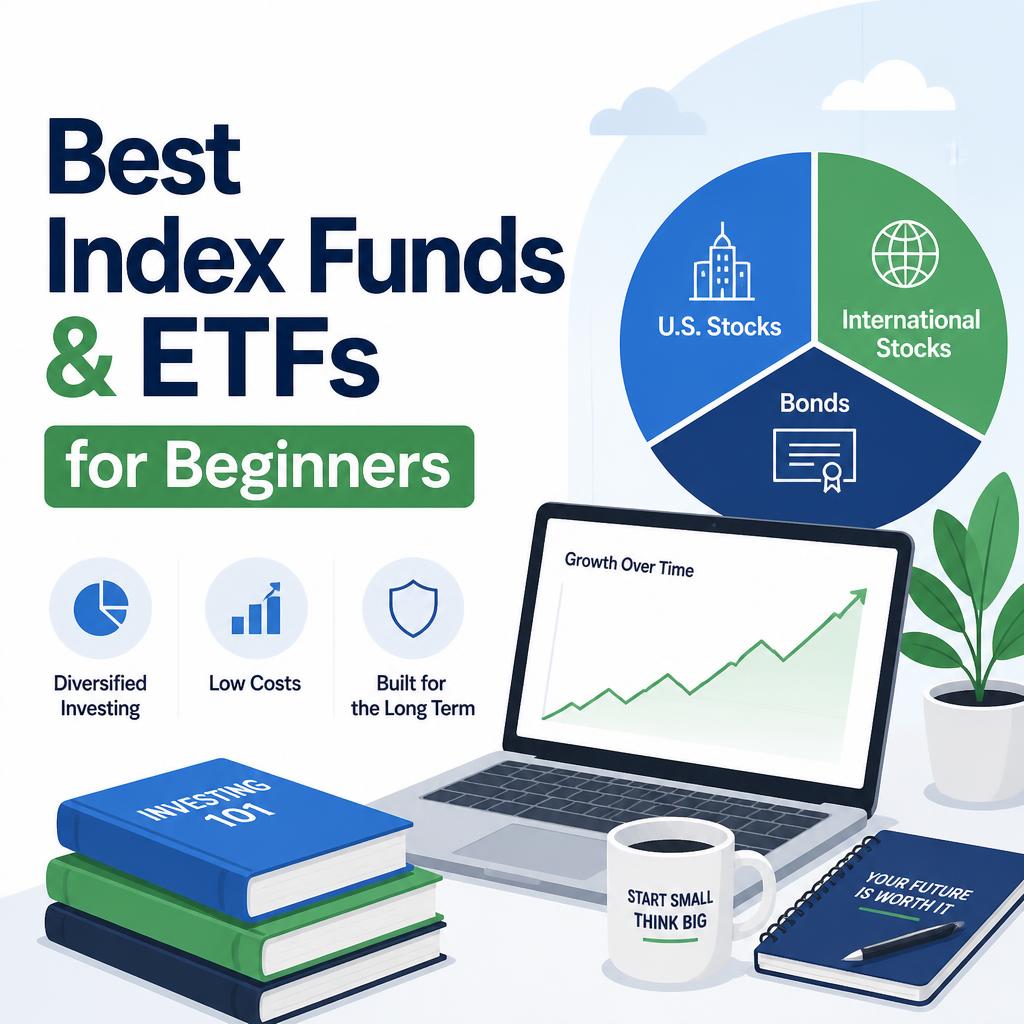
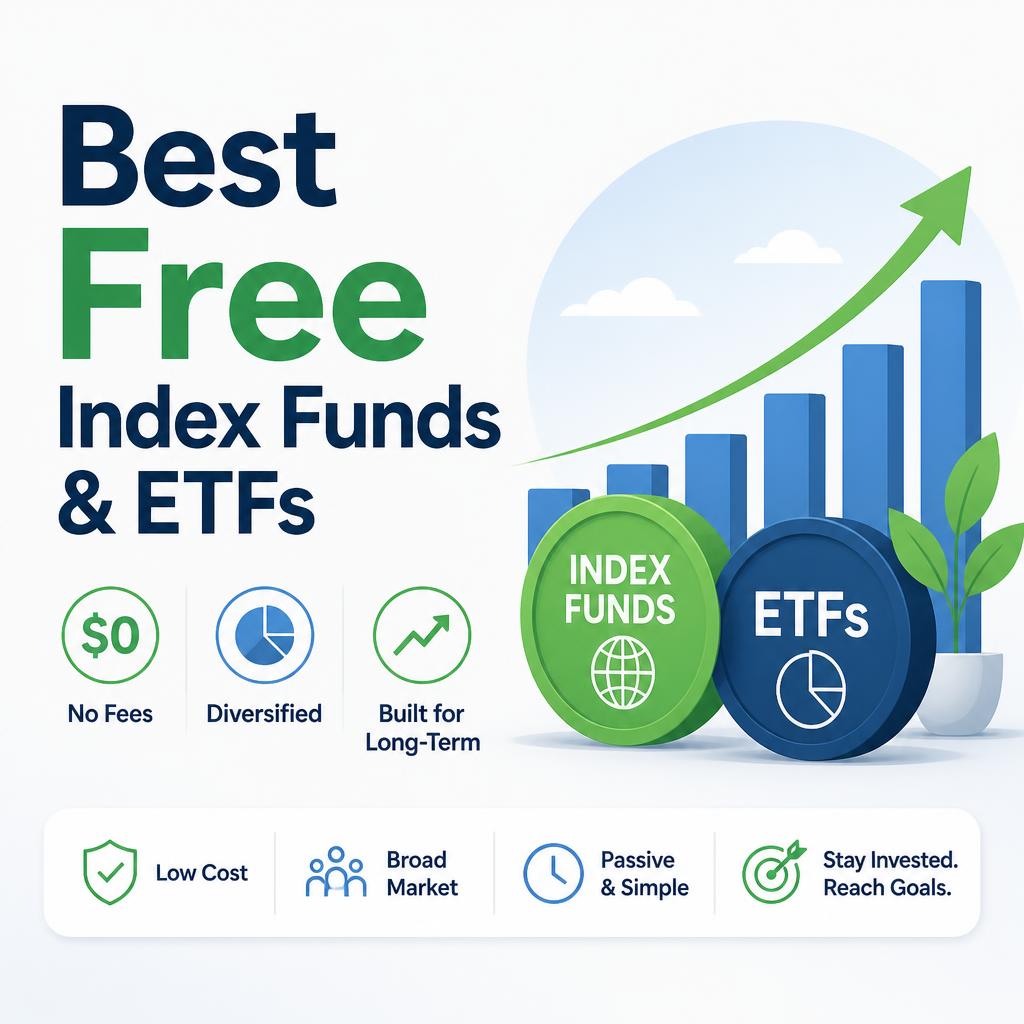
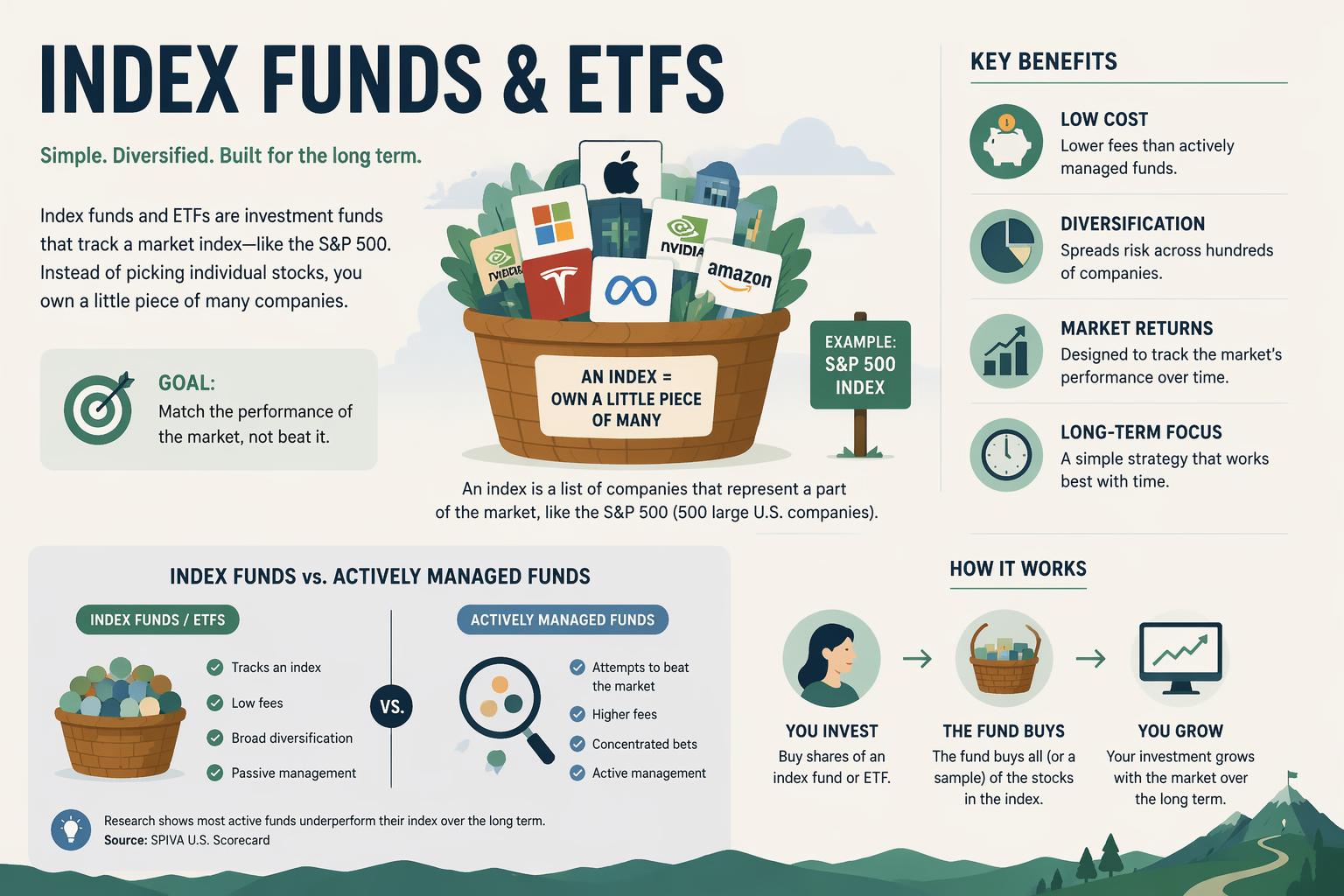
Both index funds and ETFs are passive investment vehicles that track a market index—the S&P 500, total US stock market, global equities, bonds, whatever. They don’t try to beat the market. They are the market.
The confusion starts because “index fund” can mean two things:
- Index mutual funds — Traditional funds you buy directly from a company like Vanguard or Fidelity. You place an order, it executes once per day at 4 p.m. ET at the net asset value (NAV). You can invest exact dollar amounts ($1,247.53 if you want). They’re the original passive vehicle.
- Index ETFs — Exchange-traded funds that track the same indexes but trade like stocks throughout the day. You buy shares at market prices that fluctuate minute-by-minute. You need whole shares (no fractional investing at most brokers).
Here’s the key: over 40% of all ETFs are passively managed, meaning they’re index funds in ETF form. When someone says “index fund vs ETF,” they usually mean index mutual fund vs index ETF—both tracking the same benchmark, just packaged differently.
The packaging matters more than you think.
The Real Differences That Matter in 2026
Let’s skip the textbook stuff and focus on the gaps that actually affect your account balance.
Trading Flexibility
ETFs trade all day. You can buy at 10:37 a.m., sell at 2:14 p.m., set limit orders, use stop-losses. If the market drops 3% by noon and you want in now, you get the noon price.
Index mutual funds price once per day at 4 p.m. ET. Your order goes in whenever, but you get the closing NAV. No intraday moves, no timing games. According to Fidelity’s 2026 analysis, this structure benefits long-term investors who’d otherwise be tempted to trade emotionally.
If you’re investing monthly paychecks and holding for decades, daily pricing is a feature, not a bug. If you’re rebalancing quarterly or tax-loss harvesting in December, intraday access helps.
Minimum Investment
Index mutual funds often have minimums—$1,000, $3,000, sometimes $0 at Fidelity or Schwab. But once you’re in, you can add $47.23 if that’s what’s left in your paycheck. Exact dollar investing.
ETFs require whole shares. If the ETF costs $287/share and you have $300 to invest, you buy one share and leave $13 sitting in cash. Some brokers (Fidelity, Schwab, Robinhood) now offer fractional ETF shares, but it’s not universal.
For dollar-cost averaging with irregular amounts—like investing “whatever’s left after bills”—index mutual funds automate better.
Tax Efficiency (This Is the Expensive One)
Here’s where ETFs pull ahead in taxable accounts.
ETFs generally don’t owe taxes when investors cash out. The “in-kind redemption” structure lets ETFs shed low-cost-basis shares without triggering capital gains. According to Fidelity, this makes them “potentially more tax-efficient than mutual funds.”
Index mutual funds can generate capital gains distributions even if you didn’t sell. When other investors redeem shares, the fund might have to sell holdings to raise cash—and if those holdings have appreciated, everyone left in the fund gets a tax bill.
In a 401(k) or IRA? Doesn’t matter—tax-deferred accounts shelter both. In a taxable brokerage account? ETFs’ structural advantage saves you money every year you hold.
Cost: Expense Ratios in 2026
Both are cheap. The question is how cheap.
Index equity ETFs averaged 0.14% expense ratios in 2025 (asset-weighted). Index mutual funds averaged 0.05% per year in 2025, according to Monarch’s June 2026 comparison.
But averages hide the extremes. The cheapest ETF tracking the S&P 500—State Street’s SPDR Portfolio S&P 500 ETF (SPYM)—charges 2 basis points (0.02%). Vanguard and Fidelity offer mutual fund share classes at similar levels.
The gap between cheapest and most expensive index funds matters less than people think over a 30-year horizon, but if you’re comparing two funds tracking the same index, take the cheaper one.
When ETFs Win: Three Scenarios Where Structure Beats Cost
1. You’re in a High Tax Bracket and Investing in a Taxable Account
If you’re in the 32% or 35% federal bracket and holding stocks outside retirement accounts, ETFs’ tax efficiency compounds. You avoid surprise capital gains distributions, and you control when to realize gains (or losses for tax-loss harvesting).
One caveat: bond ETFs are less tax-efficient than equity ETFs because bonds generate ordinary income, not qualified dividends. The structural advantage shrinks.
2. You Want Intraday Control for Rebalancing or Tactical Moves
Let’s say you’re rebalancing annually and the market’s down 2% on your rebalance day. With an ETF, you can place a limit order to buy at a specific price. With a mutual fund, you get whatever the NAV is at 4 p.m.—no negotiation.
If you’re tax-loss harvesting in late December and want to lock in losses before year-end, ETFs let you trade right up to market close on the 31st.
3. You’re Buying Niche or International Exposure
Some index strategies—sector ETFs, single-country funds, thematic plays—only exist as ETFs. If you want South Korea exposure, you’re buying an ETF. JustETF’s 2026 rankings show the FTSE Korea 30/18 Capped ETF returned +108.52% in 2026 (yes, that’s an outlier year). You can’t get that in a mutual fund wrapper.
When Index Mutual Funds Win: The Underrated Advantages
1. You’re Automating Contributions (Especially Irregular Amounts)
Mutual funds let you set up automatic investments of exact dollar amounts—$500 every payday, $83 every week, whatever. No fractional-share workarounds, no cash drag.
If your paycheck varies or you’re investing “whatever’s left,” mutual funds handle it without forcing you to manually calculate shares.
2. You’re Investing in a Retirement Account and Want Simplicity
In a 401(k), IRA, or Roth IRA, tax efficiency doesn’t matter. The tax-deferred wrapper handles it. At that point, mutual funds’ exact-dollar investing and once-daily pricing remove decision fatigue.
According to Monarch, “Which fund type is best for dollar-cost averaging?” Answer: mutual funds, because you’re buying time in the market, not timing the market.
3. You Want to Avoid the Temptation to Trade
ETFs’ intraday liquidity is a feature for disciplined investors. For everyone else, it’s a loaded gun.
If you know you’ll check prices at lunch and panic-sell during a 10 a.m. dip, mutual funds’ once-daily pricing removes the option. You can’t trade what doesn’t have a live ticker.
Morningstar’s research found that less than 5% of active large-blend funds survived and outperformed passive peers over 15 years. The takeaway isn’t “active bad”—it’s “sticking to a long-term plan beats chasing trends.” Mutual funds enforce that by design.
The 2026 Fee Landscape: What You’re Actually Paying
Let’s get concrete with real 2026 costs.
Rock-Bottom ETFs
- State Street SPDR Portfolio S&P 500 ETF (SPYM): 0.02% (2 basis points). On a $10,000 investment, that’s $2/year. Morningstar calls it one of the top US ETFs for 2026.
- Amundi Prime All Country World: 0.07%. Global diversification for $7/year per $10k.
- SPDR MSCI All Country World Index (Accumulating): 0.12%. Trades on the London Stock Exchange, cheapest accumulating global fund in pounds according to this 2026 analysis.
Low-Cost Mutual Funds
Fidelity and Vanguard offer index mutual funds at 0.015%–0.05% for core equity indexes. Fidelity ZERO funds charge 0.00%—literally free, subsidized by the company to win your business (and cross-sell other products).
The Active Management Tax
Compare that to actively managed funds: average expense ratio for equity mutual funds was 0.40% in 2026. That’s 8x–20x more expensive than index options, and only about 1 out of 4 active funds outperformed the market over the past 10 years.
Worse: 92% of domestic active funds underperformed their benchmarks over the past 20 years. You’re not just paying more—you’re paying more to lose.
Tax Efficiency: The Hidden Cost Most Investors Ignore
Here’s a scenario most investors don’t see coming.
You buy an index mutual fund in a taxable account in 2024. You hold it, don’t sell, just sit there. December 2026 rolls around, and you get a 1099 showing $487 in capital gains distributions. You owe taxes on gains you never realized because other investors redeemed shares and forced the fund to sell appreciated holdings.
ETFs avoid this through in-kind redemptions. When an investor cashes out, the ETF transfers shares to an authorized participant instead of selling them. No sale = no capital gains = no tax bill for you.
According to Fidelity’s June 2026 update, “ETFs generally don’t owe taxes when investors cash out, making them potentially more tax-efficient than mutual funds.”
Exception: Bond ETFs. Bonds generate ordinary income (interest), not capital gains. The in-kind redemption advantage doesn’t help with income taxes, only capital gains. If you’re buying bond exposure, the mutual fund vs ETF decision hinges more on cost and convenience than tax efficiency.
Three Top ETFs for 2026 (According to Morningstar)
Morningstar’s January 2026 picks highlight three funds for different goals:
1. State Street SPDR Portfolio S&P 500 ETF (SPYM)
- Expense ratio: 0.02%
- What it does: Tracks the S&P 500. Pure US large-cap exposure.
- Why it matters: Best long-term performance over the past 10 years among S&P 500 ETFs, and the lowest fee. If you want US stocks and nothing else, this is the floor.
2. Fidelity Investment Grade Bond ETF (FIGB)
- Expense ratio: 0.36%
- What it does: Actively managed bond fund with flexibility to invest across investment-grade bond types.
- Why it’s here: Bonds are harder to index than stocks. Active bond managers have an edge because corporate bond markets are less liquid and less efficient. Fidelity’s team can shift between corporate, government, and mortgage-backed bonds as opportunities shift.
Not the cheapest bond ETF, but one of the few cases where paying 36 basis points for active management makes sense.
3. iShares LifePath Target Date 2070 ETF (ITDJ)
- Expense ratio: 0.13% overall cost
- What it does: Starts 99% stocks, 1% bonds. Gradually shifts to 60% bonds / 40% stocks by 2070.
- Who it’s for: Investors in their 20s or 30s who want a single-fund portfolio that auto-rebalances as they age.
Target-date ETFs are new—most target-date funds are mutual funds. If you want the “set it and forget it” glide path and ETF tax efficiency, this is one of the few options.
Common Mistakes That Cost You Returns
Chasing Last Year’s Winners
The FTSE Korea 30/18 Capped ETF returned +108.52% in 2026. The MSCI Korea 20/35 returned +106.02%. Semiconductors returned +105.29%.
Don’t buy them now because of those numbers. By the time an ETF appears on a “best performers” list, the move is over. In 2027, those funds could return -20%. Nobody knows.
Morningstar’s Active/Passive Barometer shows that 79% of actively managed large-cap U.S. equity funds underperformed the S&P 500 in 2025. The pros can’t time it. You can’t either.
Over-Concentrating Without Realizing It
Let’s say you own:
- A total US stock ETF
- An S&P 500 ETF
- A large-cap growth ETF
Congrats, you own Apple, Microsoft, and Nvidia three times over. This isn’t diversification—it’s redundancy.
“People usually freeze or own overlapping funds due to choices in global funds,” according to this 2026 explainer. Check your holdings. If the same 10 companies dominate three different funds, you’re not spreading risk.
Ignoring Liquidity and Size
Small, niche ETFs with under $50 million in assets risk liquidation. If your ETF shuts down, you’re forced to sell (triggering taxes in a taxable account) and find a replacement.
Larger, established ETFs are less likely to be liquidated. Stick with funds that have at least $100 million in assets and average daily trading volume above 100,000 shares.
Paying Too Much for Active Management You Don’t Need
If you’re buying a large-cap US equity fund, there’s no reason to pay 0.50% or more. The S&P 500 has averaged around 10% annualized returns since 1928. An index fund captures that for 0.02%–0.05%.
The 0.45% you save by going passive compounds. Over 30 years, that difference turns $10,000 into $174,494 (at 10% gross, 9.55% net after 0.45% fees) vs $190,669 (at 10% gross, 9.98% net after 0.02% fees). That’s $16,175 you kept instead of handing to a fund manager.
FAQ
Can I lose money in an index fund or ETF?
Yes. Both track markets, and markets go down. The S&P 500 dropped 18% in 2022. If you own an S&P 500 index fund or ETF, you dropped 18% too. The “safety” of indexing isn’t that you never lose—it’s that you match the market instead of underperforming it (which 92% of active funds do over 20 years).
Should I use ETFs or mutual funds in my Roth IRA?
Doesn’t matter. Roth IRAs are tax-free, so ETFs’ tax efficiency advantage disappears. Pick whichever has lower fees and better automation for your contribution style. If you’re auto-investing $500/month, mutual funds are easier. If you’re manually investing lump sums, ETFs work fine.
Are there index funds with 0% expense ratios?
Yes. Fidelity offers four ZERO index mutual funds (US stocks, international stocks, total market, extended market) with 0.00% expense ratios. They’re loss leaders to get you in the door, but they’re real funds tracking real indexes with no annual cost.
What’s the difference between an expense ratio and a load?
Expense ratio is the annual fee (0.05%, 0.50%, etc.) deducted from the fund’s returns. A load is a sales commission—front-end (charged when you buy) or back-end (charged when you sell). Index funds and ETFs almost never have loads. If someone’s selling you a fund with a 5% front-end load, walk away.
Do I need to worry about currency risk with international ETFs?
For equities, not much. “Currency risk largely washes out for equities over long periods,” according to this 2026 analysis. Stock returns dominate currency fluctuations over 10+ years. For bond ETFs, currency risk matters more because bond returns are lower, so currency swings take a bigger bite.
Should I avoid new ETFs without a long track record?
Generally, yes—not because they’ll underperform, but because they might shut down. A 2-year-old ETF with $30 million in assets is a liquidation risk. Stick with funds that have been around 5+ years and have at least $100 million in assets.
Which is better for dollar-cost averaging: ETF or mutual fund?
Mutual funds, because you can automate exact-dollar purchases ($250 every paycheck) without worrying about fractional shares or cash drag. ETFs require whole shares unless your broker supports fractional trading, which not all do.
—
The Bottom Line
Index funds and ETFs aren’t competitors—they’re two wrappers for the same strategy. The question isn’t which one is better in the abstract. It’s which one fits your account type, tax situation, and investing behavior.
Use ETFs if:
- You’re investing in a taxable account and want tax efficiency
- You’re rebalancing or tax-loss harvesting and want intraday control
- You’re buying niche exposure (sector, country, thematic funds)
Use index mutual funds if:
- You’re automating contributions in irregular dollar amounts
- You’re investing in a retirement account where taxes don’t matter
- You want to remove the temptation to trade intraday
Both are better than active management 92% of the time over 20 years. Both are cheaper than they’ve ever been. Both give you market returns without the hassle of picking stocks.
Pick the structure that removes friction from your actual investing process, then forget about it and let compounding do the work.