Free AI SEO Tools That Actually Work

Picking an AI SEO tool shouldn’t feel like sorting through a pile of overpriced promises. The market is crowded, the claims are wild, and most tools either cost too much or don’t deliver. If you’re trying to improve your search rankings without blowing your budget, you’re in the right place.
You don’t need a massive budget to use AI for SEO. Several solid free tools can help you optimize content, research keywords, analyze competitors, and fix technical issues. No cost, real value.
This guide covers the best free AI SEO tools available, how to use them, and which ones are worth your time based on what you’re trying to do.
Why AI SEO Is Different
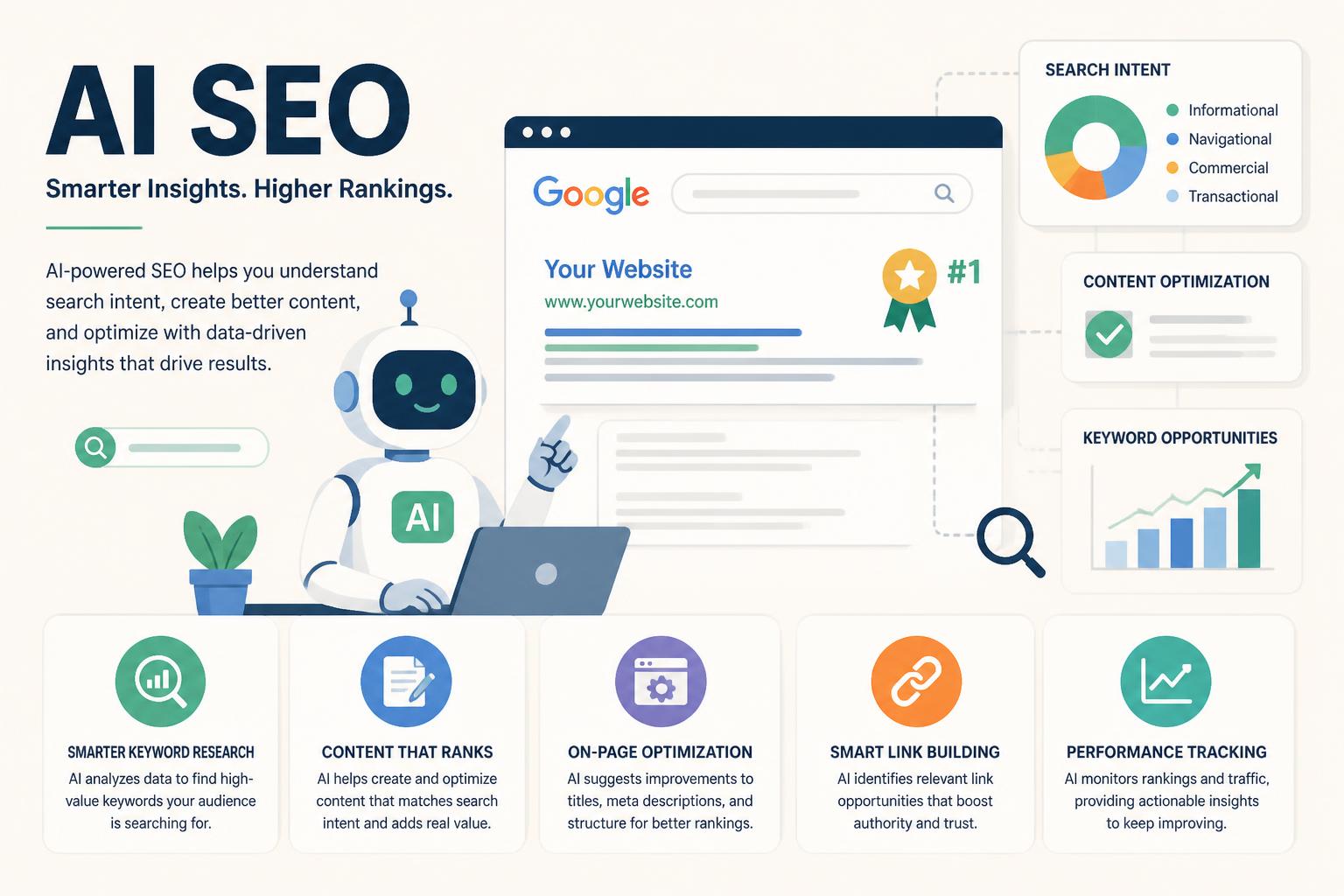
AI-powered SEO tools analyze massive datasets to predict what will work, suggest optimized content, spot technical problems, and adapt to algorithm changes faster than manual methods. Traditional SEO — manual keyword research, content optimization by feel, periodic audits — still works, but it’s slow and relies on guesswork more than data.
The practical difference: faster, smarter optimization that gives small teams capabilities that used to require dedicated SEO departments.
Why Free Tools Are Actually Good Now
Free doesn’t mean weak anymore. Several factors make high-quality free tools possible:
- Freemium models work: Companies give away core features to build user bases, then sell advanced features to power users.
- Cloud and AI costs have dropped: Infrastructure is cheaper, so sophisticated tools can run at no cost to users.
- Competition forces better offers: The crowded SEO market pushes providers to give more away.
The trick is knowing which free tools deliver real value instead of just setting you up for an upsell.
The Best Free AI SEO Tools by Category
Keyword Research
Google Keyword Planner
Google’s tool uses machine learning to suggest related keywords and estimate search volumes. It’s free with a Google Ads account (you don’t need to run ads), and the data comes directly from Google, so it’s as accurate as you’ll get.
Best for: Finding primary keywords and understanding search intent
Catch: Requires Google Ads account; gives search volume ranges, not exact numbers
AnswerThePublic
Visual keyword tool that aggregates autocomplete data to show you what questions people ask about your topics. Free version allows limited daily searches but gives excellent insights into content gaps.
Best for: Question-based keywords and content angles
Catch: 3 free searches per day; visualizations have watermarks
KeywordTool.io
Generates long-tail keyword suggestions using Google Autocomplete with AI-powered relevance scoring. No search volumes in the free version, but the keyword suggestions alone are useful for content ideas.
Best for: Long-tail discovery and topic generation
Catch: No search volume or competition data in free tier
Content Optimization
Yoast SEO (Free WordPress Plugin)
Free version includes AI-powered content analysis that evaluates readability, keyword usage, and structure. Real-time suggestions as you write.
Best for: WordPress users optimizing content
Catch: WordPress-only; advanced features require premium
Grammarly (Free Version)
Writing assistant that analyzes clarity, engagement, and delivery. Better-written content keeps users on the page longer, which helps rankings.
Best for: Improving content quality and readability
Catch: Limited advanced suggestions; no SEO-specific scoring
Site Audit and Technical SEO
Google Search Console
Free webmaster tool that uses AI to identify site issues, suggest improvements, and highlight indexing problems. Core Web Vitals report prioritizes technical fixes based on user experience impact.
Best for: Technical issues Google cares about
Catch: Only shows data for your own sites; learning curve for beginners
Screaming Frog SEO Spider (Free Version)
Desktop app that crawls websites like a search bot, finding broken links, duplicate content, and missing meta tags. Free version crawls up to 500 URLs.
Best for: Technical audits of smaller sites
Catch: 500 URL limit; desktop-only
Lighthouse (Chrome DevTools)
Open-source tool that audits web pages for performance, accessibility, and SEO. Provides specific metrics and recommendations.
Best for: Quick performance and SEO checks
Catch: Must run on each page individually; results can be technical
Content Generation
ChatGPT (Free Version)
Can help with keyword research, content outlining, meta descriptions, and draft generation. Don’t publish AI content verbatim, but it’s good for overcoming writer’s block and generating ideas.
Best for: Content ideation, outlining, first drafts
Catch: Requires fact-checking; can be generic without good prompts
Copy.ai (Free Plan)
Marketing copy templates for SEO titles, meta descriptions, blog intros. Free plan includes 2,000 words per month.
Best for: Meta tags and content snippets
Catch: 2,000 word monthly limit; quality varies
Jasper AI (Free Trial)
Paid tool with a free trial that includes SEO mode for generating content optimized for specific keywords. Trial is limited but can be useful for specific projects.
Best for: Testing premium AI writing
Catch: Trial period only; requires credit card
Competitor Analysis
Ubersuggest (Free Version)
Combines keyword research with competitor analysis, showing which keywords competitors rank for. Free version offers limited daily searches but provides useful insights.
Best for: Competitor keyword strategies
Catch: 3 searches per day; limited historical data
SimilarWeb (Free Version)
Uses AI to estimate traffic, referral sources, and audience demographics for any website. Helps you understand where competitors get traffic.
Best for: Competitive intelligence and traffic analysis
Catch: Traffic estimates, not exact numbers; limited comparisons
Backlink Analysis
Moz Link Explorer (Free Version)
Uses AI to evaluate link quality and spam scores. Free version allows limited queries but shows domain authority and top content.
Best for: Basic backlink analysis
Catch: 10 queries per month; limited link data
Ahrefs Webmaster Tools (Free)
Genuinely free backlink analysis, site audits, and keyword rankings for sites you verify ownership of. Light version of their premium product.
Best for: Free backlink and site audit data
Catch: Only for sites you own and verify
Building a Free AI SEO Stack
The real power comes from combining tools. Here’s a practical workflow:
Research and Planning
- Google Keyword Planner and KeywordTool.io for target keywords
- AnswerThePublic for content angles and user questions
- Ubersuggest and SimilarWeb for competitor analysis
Content Creation
- ChatGPT for outlines and overcoming writer’s block
- Grammarly for quality checks
- Yoast SEO or Copy.ai for meta tags
Technical Optimization
- Screaming Frog for site-wide issues
- Google Search Console for indexing problems
- Lighthouse for page performance
Monitoring
- Google Search Console for rankings
- Ahrefs Webmaster Tools for backlinks
- Traffic analysis to refine strategy
This gives you enterprise-level capabilities without spending money.
Common Mistakes
Over-reliance on AI content: Search engines are getting better at detecting purely AI-written content. Use AI for ideas and first drafts, but add your own expertise, insights, and fact-checking.
Ignoring tool limitations: Free tools have usage caps and feature restrictions. Understand what each tool can and can’t do.
Tools over strategy: No tool replaces strategic thinking. Understand your audience, goals, and competitive landscape first, then use tools to execute.
Not verifying AI suggestions: AI tools sometimes provide outdated or incorrect information. Verify recommendations against current best practices and Google’s guidance.
Using too many tools: Tool overload wastes time. Start with 3-4 core tools and master them before expanding.
When to Consider Paid Tools
Free tools work well for most people, but consider paid options if you:
- Manage multiple large websites with thousands of pages
- Operate in highly competitive niches where small advantages matter
- Need automation and batch processing to save hours weekly
- Require detailed competitor research, rank tracking, or AI content at scale
- Have multiple team members needing simultaneous access
If you’re making significant revenue from organic traffic or managing client sites professionally, premium tools often pay for themselves through time savings and better results. Many successful websites still run primarily on free tools with selective premium subscriptions.
What’s Coming
The AI SEO landscape is changing fast:
- Predictive SEO: AI that predicts algorithm updates and content trends before they happen
- Automated technical optimization: AI that fixes technical issues, rewrites meta tags, and optimizes speed without human help
- Semantic understanding: Better AI comprehension of user intent beyond simple keyword matching
- Voice and visual search: Tools designed specifically for voice assistants and image search
- CMS integration: Deeper AI integration in WordPress, Shopify, and other platforms
Many of these capabilities will filter down to free tools as technology matures and costs drop.
Which Tools to Start With
If you’re overwhelmed, here’s where to start:
For bloggers and content creators:
- Google Search Console
- Yoast SEO or Rank Math
- ChatGPT
- AnswerThePublic
For small business websites:
- Google Search Console
- Screaming Frog
- Ubersuggest
- Ahrefs Webmaster Tools
For agencies and freelancers:
- All of the above
- Multiple browser profiles to maximize free tier limits
- Strategic use of free trials
Start with 3-4 tools max, use them consistently for 30 days, then consider adding more.
Your Action Plan
Week-by-week implementation:
Week 1: Set up Google Search Console and verify your site. Install Yoast SEO or your preferred on-page tool. Run your first Screaming Frog audit.
Week 2: Keyword research with Google Keyword Planner and AnswerThePublic. Create a content calendar based on what you find.
Week 3: Create and optimize content using ChatGPT for ideas and your optimization tool for real-time feedback. Quality over quantity.
Week 4: Set up Ahrefs Webmaster Tools and analyze your backlink profile. Fix technical issues from your audits.
By the end of one month, you’ll have a functional free AI SEO system.
Final Thoughts
The free tools available today provide capabilities that were enterprise-only a few years ago. Success comes from picking the right tools for your situation, using them consistently, and combining AI efficiency with human judgment.
Start simple, master the basics, expand thoughtfully. The free AI SEO tools in this guide give you what you need to compete in search results without the burden of expensive subscriptions. Your commitment to learning and applying these tools matters more than your budget.
Take advantage of these free resources, experiment with different combinations, and find what works for you.