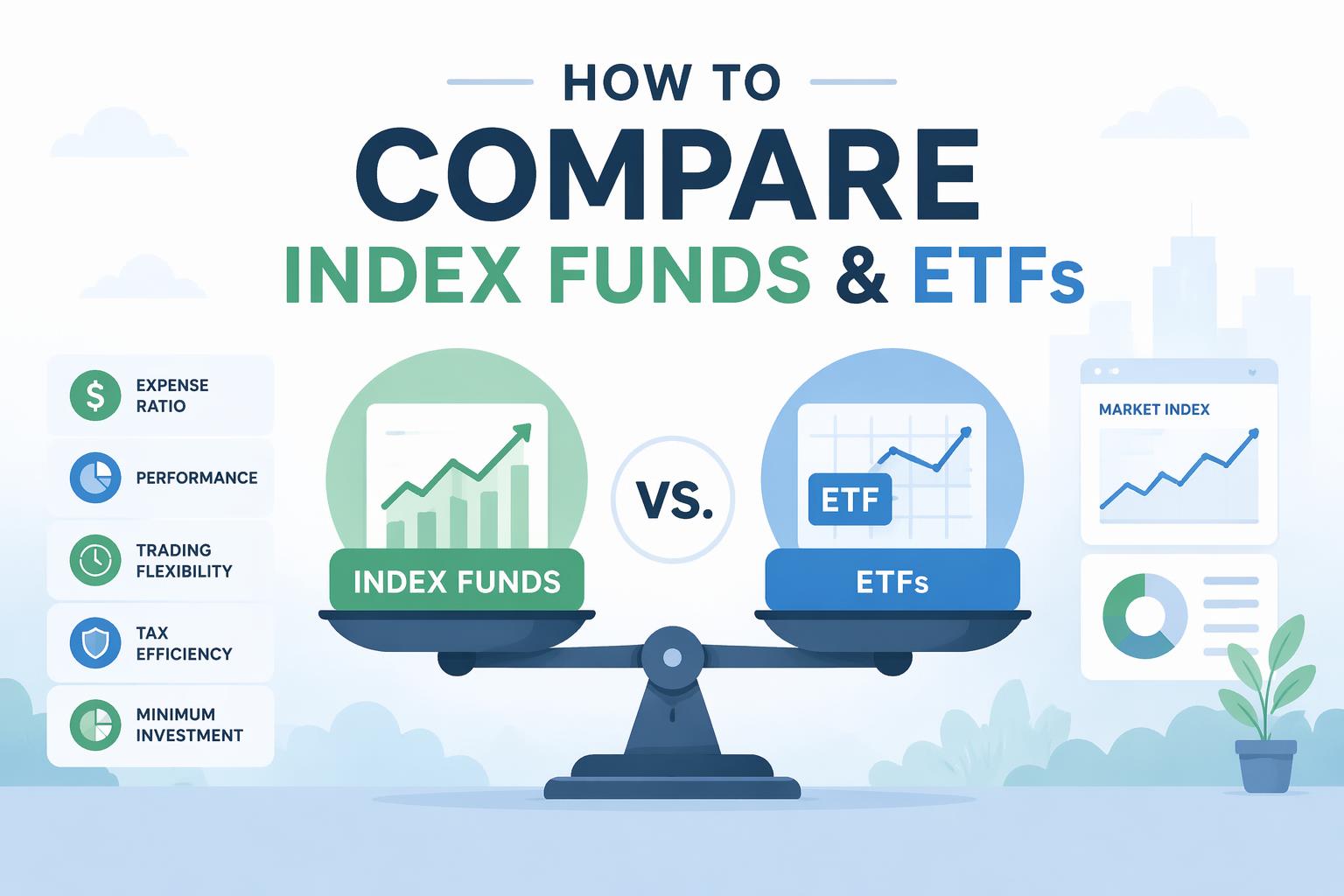
How to Compare Index Funds & ETFs: Step-by-Step Guide (2026)
Affiliate Disclosure: This article contains affiliate links. If you click through and make a purchase, I may earn a commission at no additional cost to you. I only recommend products I’ve researched and believe will help you.
You’re staring at hundreds of index funds and ETFs, all claiming to be the “best choice” for your portfolio. The numbers blur together—expense ratios, tracking errors, asset allocation percentages. You know passive investing is the smart move, but which fund actually deserves your money?
Here’s the truth: less than 5% of active large-blend funds survived and outperformed their passive peers over the past 15 years. The right index fund or ETF can save you thousands in fees while delivering solid returns. The wrong one costs you money every single day it sits in your portfolio.
By the end of this guide, you’ll know exactly how to evaluate any index fund or ETF using a clear, repeatable process. You’ll understand which metrics actually matter (and which ones are just marketing noise), and you’ll be able to make confident investment decisions in under 30 minutes.
What you need before starting:
- A brokerage account (or be ready to open one—most are free)
- The names or tickers of 2-3 funds you’re considering
- Access to fund comparison tools (I’ll show you the free ones)
- Estimated time: 20-30 minutes
—
Step 1: Identify What You Actually Want to Own
Before comparing funds, get crystal clear on your investment goal. Are you buying broad US stock market exposure? International stocks? Bonds? A target-date retirement fund?
Write down your answer in one sentence: “I want exposure to _______.”
Examples:
- “I want exposure to the 500 largest US companies”
- “I want exposure to investment-grade corporate bonds”
- “I want a diversified portfolio that automatically adjusts as I approach retirement in 2070”
You should see: A clear, specific investment objective. If your answer is vague (“I want to make money”), go back and define what asset class or market segment you’re targeting.
> Note: Don’t compare funds across different categories. Comparing a bond fund to a stock fund makes no sense—they serve completely different purposes.
—
Step 2: Pull Up the Fund’s Basic Information
Go to the fund provider’s website (Vanguard, iShares, Fidelity, State Street, etc.) or use a free research tool like Morningstar.com. Enter the fund’s ticker symbol.
Look for these five pieces of core data:
- Expense ratio (annual fee as a percentage)
- Assets under management (AUM) (total money in the fund)
- Inception date (how long it’s been around)
- Index tracked (what benchmark it follows)
- Minimum investment (if it’s a mutual fund) or current share price (if it’s an ETF)
You should see: A summary page with all five data points clearly listed. If a fund makes this information hard to find, that’s a red flag—move on.
—
Step 3: Check the Expense Ratio First
The expense ratio is the percentage of your investment that the fund takes as an annual fee. This is deducted automatically from your returns, so a fund charging 0.50% takes $50 per year for every $10,000 you invest.
Rule of thumb for 2026:
- Great: Under 0.10% (10 basis points)
- Acceptable: 0.10% – 0.25%
- Question it: 0.25% – 0.50%
- Walk away: Over 0.50% (unless it’s an actively managed bond fund with proven skill)
Real examples from 2026:
- State Street SPDR Portfolio S&P 500 ETF: 0.02% (2 basis points)
- Vanguard S&P 500 ETF: 0.03%
- Fidelity Investment Grade Bond ETF: 0.36% (actively managed)
If you’re comparing two similar funds, the one with the lower expense ratio usually wins. A 0.20% difference might sound tiny, but over 30 years, it can cost you tens of thousands of dollars.
> Note: Some brokers like Fidelity offer no-expense-ratio index funds (0.00%). These are real and legitimate—not tricks.
—
Step 4: Verify the Assets Under Management
AUM tells you how much total money is invested in the fund. Bigger isn’t always better, but very small funds (under $100 million) carry risks:
- They might be closed or merged into other funds
- They may have wider bid-ask spreads (costing you more to trade)
- They lack track records
What to look for:
- Ideal: At least $10 billion in AUM
- Acceptable: $500 million to $10 billion
- Risky: Under $100 million
All the top-performing funds in 2026 have AUM well above $10 billion. This threshold ensures liquidity and stability.
You should see: The AUM number prominently displayed on the fund’s summary page. If it’s not there, check the fund’s prospectus or fact sheet.
—
Step 5: Understand What Index It Tracks
Index funds and ETFs track a benchmark index. You need to know:
- What’s in the index?
- How many holdings does it have?
- Is it market-cap weighted or equal-weighted?
Common indexes in 2026:
- S&P 500: 500 largest US companies, market-cap weighted
- MSCI ACWI IMI: Global stocks including emerging markets and small-caps
- Nasdaq Global Semiconductor: Tech-focused, semiconductor industry
- Bloomberg US Aggregate Bond Index: Investment-grade US bonds
Two funds tracking the same index should perform nearly identically (minus the expense ratio difference). If one claims to track the S&P 500 but performs wildly differently, something’s wrong.
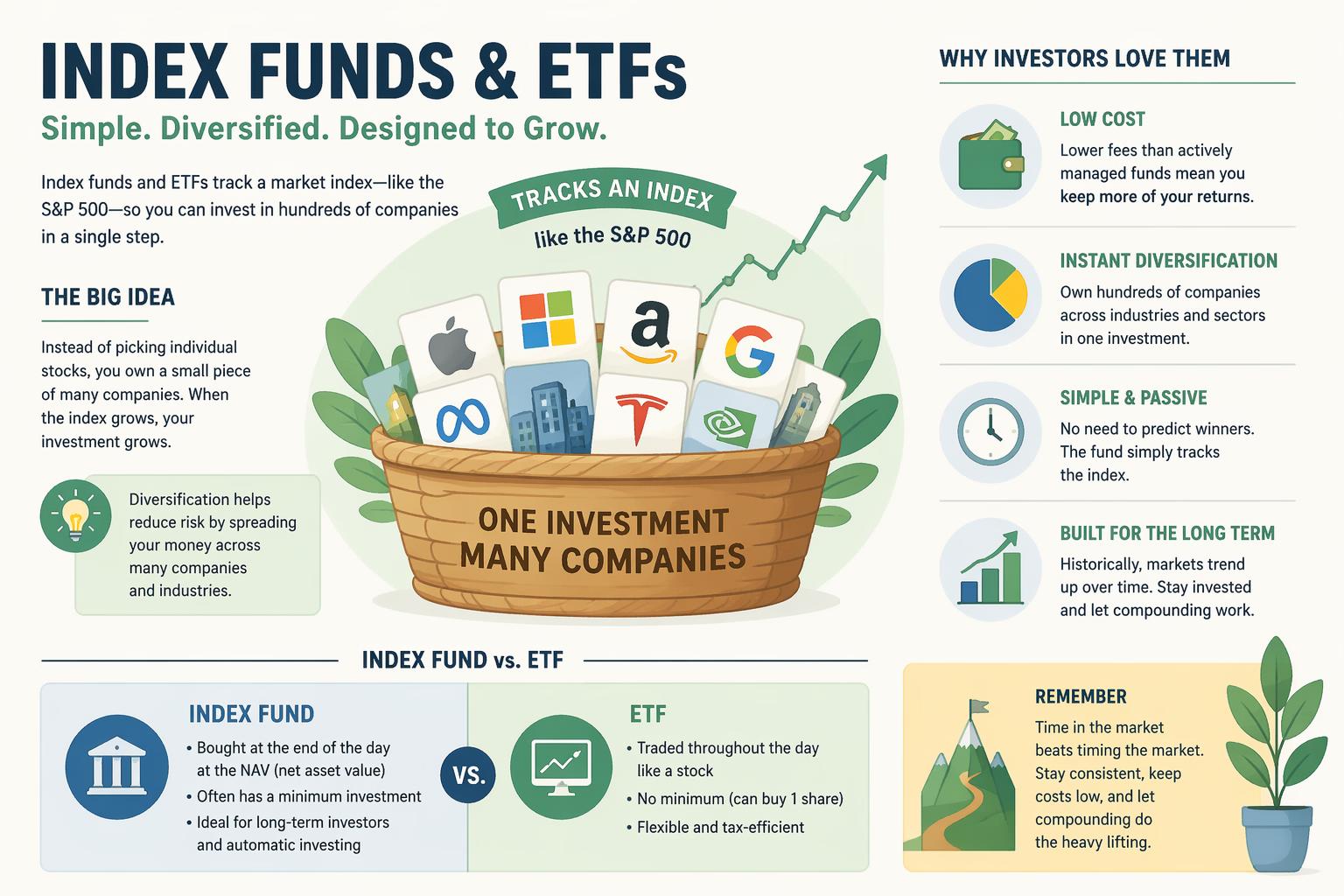
You should see: The exact name of the index tracked, usually on the fund’s overview page or in the prospectus. Write it down—you’ll use it in the next step.
—
Step 6: Compare Tracking Error
Tracking error measures how closely the fund follows its benchmark index. You want this number to be as close to zero as possible.
How to find it:
- Go to Morningstar.com and search the fund’s ticker
- Click the “Performance” tab
- Look for “Tracking Difference” or compare the fund’s annual return to its index’s return
What’s acceptable in 2026:
- ETFs: 0.00% – 0.10% tracking difference annually
- Index mutual funds: 0.00% – 0.15%
- Red flag: More than 0.20% difference (the fund isn’t doing its job)
The State Street SPDR Portfolio S&P 500 ETF, charging just 2 basis points, has one of the tightest tracking records in 2026. That’s what you’re looking for.
You should see: Annual returns that match the index within a few basis points. If the fund claims to track the S&P 500 but returned 9% when the S&P 500 returned 11%, walk away.
—
Step 7: Review the Holdings Overlap
If you’re comparing two funds that track similar (but not identical) indexes, check their top 10 holdings. You might think you’re diversifying by buying both, but if they hold the same companies, you’re just paying two expense ratios for the same exposure.
How to check:
- Go to the fund’s website
- Click “Holdings” or “Portfolio”
- Look at the top 10-20 holdings and their percentages
Example scenario:
- Fund A: Vanguard S&P 500 ETF—top holdings are Apple, Microsoft, Amazon
- Fund B: Vanguard Total Stock Market ETF—top holdings are Apple, Microsoft, Amazon
These funds have 70%+ overlap. Buying both doesn’t add much diversification.
You should see: Clear percentage breakdowns of the top holdings. If the fund doesn’t disclose this publicly, that’s a transparency red flag.
—
Step 8: Check the Morningstar Rating (If Available)
Morningstar rates funds from 1 to 5 stars based on risk-adjusted performance. It’s not perfect, but it’s a useful quick-check filter.
What the stars mean:
- 5 stars: Top 10% of funds in its category
- 4 stars: Next 22.5%
- 3 stars: Middle 35%
- 2 stars or below: Bottom performers
For index funds specifically, aim for at least 4 stars. In 2026, the best-performing ETFs consistently hold 4- or 5-star ratings.
You should see: The star rating on Morningstar’s summary page for the fund. If a fund has no rating, it’s either too new (under 3 years old) or too small to be rated.
> Note: A 3-star index fund isn’t automatically bad—check why it lost stars. Sometimes it’s due to a temporary underperformance that doesn’t reflect fund quality.
—
Step 9: Compare Tax Efficiency (For Taxable Accounts)
If you’re investing in a taxable brokerage account (not a retirement account), tax efficiency matters. ETFs are generally more tax-efficient than mutual funds because of how they’re structured.
What to look for:
- Capital gains distributions: Check the fund’s history. ETFs rarely distribute capital gains; mutual funds often do.
- Dividend yield: Higher dividends = more taxable income each year.
- Turnover ratio: Lower is better (means fewer taxable events).
Rule of thumb:
- ETFs > Index mutual funds for taxable accounts
- In retirement accounts (IRA, 401k), tax efficiency doesn’t matter—go with whichever fund has the lower expense ratio
You should see: A turnover ratio under 10% for a true index fund. Anything over 30% suggests the fund is trading too much, which creates taxable events.
—
Step 10: Evaluate Minimum Investment Requirements
Index mutual funds often require a minimum initial investment ($1,000 – $3,000 is common). ETFs let you buy a single share, which in 2026 might be as low as $50 or as high as $600 depending on the fund.
The ETF advantage in 2026: Most brokers now offer fractional shares, meaning you can invest $10 in an ETF that costs $600 per share. This removes the barrier entirely.
What to check:
- Mutual fund: Look for “minimum initial investment” on the fund page
- ETF: Check the current share price and whether your broker supports fractional shares
If you’re starting with under $3,000, ETFs are usually your best option.
You should see: The minimum investment clearly stated, or confirmation that your broker allows fractional ETF purchases.
—
Step 11: Consider Special Cases—Target-Date and Bond Funds
If you’re comparing target-date funds or bond funds, the process changes slightly:
For target-date funds (like iShares LifePath Target Date 2070 ETF):
- Check the glide path: How does the stock/bond allocation shift over time?
- In 2026, this fund starts at 99% stocks and gradually shifts to 60% bonds by 2070
- Confirm the target date matches your expected retirement year (±5 years is fine)
- Expense ratio: Should be under 0.15% (the iShares version charges under 13 basis points)
For bond funds (like Fidelity Investment Grade Bond ETF):
- Active management is acceptable here (unlike stock funds)
- Fidelity’s bond fund charges 36 basis points but has a skilled team with a top-quartile track record since inception in March 2021
- Check the credit quality: Investment-grade only, or does it include junk bonds?
You should see: For target-date funds, a clear glide path chart. For bond funds, a breakdown of credit quality and duration.
—
Step 12: Make Your Final Decision Using a Simple Scorecard
Now that you’ve gathered all the data, score each fund on these six criteria (1-5 scale, 5 = best):
Criteria Fund A Fund B Fund C Expense ratio (lower = better) AUM size (bigger = better) Tracking error (lower = better) Morningstar rating Tax efficiency (if taxable account) Minimum investment (easier = better) Total Score
You should see: A clear winner. If all three funds score within 2 points of each other, they’re functionally equivalent—just pick the cheapest one.
—
What You’ve Just Accomplished
You now have a repeatable system to evaluate any index fund or ETF in 2026. You’ve learned to filter out marketing hype and focus on the metrics that actually predict long-term performance: expense ratios, tracking error, AUM, and tax efficiency.
The funds that consistently rank highest using this process in 2026 include:
- State Street SPDR Portfolio S&P 500 ETF (ultra-low 0.02% fee)
- Vanguard S&P 500 ETF (0.03% expense ratio, $681 per share)
- Fidelity Investment Grade Bond ETF (actively managed, 0.36%, strong track record)
- iShares LifePath Target Date 2070 ETF (under 0.13% fee, auto-rebalancing)
These funds meet every criterion in the scorecard above. If you’re ready to start investing, open an account with a broker that offers commission-free ETF trading and fractional shares.
—
Troubleshooting Common Issues
“The fund I picked has a 3-star rating but a super low expense ratio—should I still buy it?” Yes, if the tracking error is tight and the index it follows matches your goal. Star ratings fluctuate; expense ratios compound forever.
“Step 6 doesn’t work—I can’t find tracking error data on Morningstar.” Try the fund provider’s website directly, or manually compare the fund’s annual return to its benchmark index return (subtract one from the other).
“Two funds track the same index but have different returns over 1 year. Why?” This is normal if one launched mid-year or if one has a higher expense ratio. Check 3-year and 5-year returns for a clearer picture.
“The fund I want has a $3,000 minimum and I only have $500.” Buy the ETF version of the same fund instead. Most fund families offer both mutual fund and ETF versions tracking identical indexes.
—
Next Steps: What to Do After You Choose a Fund
Once you’ve selected your index fund or ETF:
- Set up automatic investments — Dollar-cost averaging beats trying to time the market
- Rebalance annually — If you’re under 40, once a year is enough; if you’re closer to retirement, do it quarterly
- Ignore short-term performance — Index investing is a 10+ year game
- Explore complementary funds — If you picked a US stock fund, consider adding international exposure or bonds
If you’re investing in a taxable account, track your cost basis carefully for tax reporting. Most brokers do this automatically now.
—
Frequently Asked Questions
Do I need a paid plan to access low-cost index funds? No. Brokers like Fidelity and E*TRADE offer no-expense-ratio index funds for free. Vanguard and iShares ETFs are available commission-free at most brokers in 2026.
How long does it take to compare funds using this method? 20-30 minutes for your first comparison. Once you know the process, you can evaluate a new fund in under 10 minutes.
Can I do this without paying for Morningstar Premium? Yes. The free version of Morningstar shows expense ratios, AUM, ratings, and basic performance data. Fund provider websites (Vanguard, iShares, etc.) have even more detail for free.
What should I do if the expense ratio is the only difference between two funds? Pick the cheaper one. If Fund A charges 0.03% and Fund B charges 0.05%, and everything else is identical, Fund A will outperform Fund B by 0.02% annually forever.
Is there a “best” index fund that works for everyone? No. The best fund depends on your goal (US stocks? bonds? international?), your account type (taxable vs. retirement), and your timeline. Use the scorecard in Step 12 to find your best fit.
Should I avoid new funds that don’t have a long track record? Not necessarily. If a new ETF tracks a well-established index (like the S&P 500) and charges a competitive expense ratio, the index’s track record is what matters, not the fund’s age. Just make sure AUM is growing and liquidity is adequate.
—
Final thought: The best index fund is the one you’ll actually hold for 10+ years. Choose based on the scorecard, not on which fund had the highest return last quarter. Consistency beats performance-chasing every time.